TAMAS (Darkness)
Govind Nihalani
India. 1987. 298 min
Cast : Om Puri, Deepa Sahi, Amrish Puri, Surekha Sikri
Introduction
When Tamas was first broadcast on Doordarshan across six episodes in the first days of 1988, having been completed in 1987, it did something that Indian cinema had rarely dared to attempt with such unflinching candour: it looked directly into the abyss of the 1947 Partition and refused to blink. Govind Nihalani's adaptation of Bhisham Sahni's Sahitya Akademi Award-winning novel arrived not in the darkness of a cinema hall but in the living rooms of a nation, and it was precisely this intimacy of address that made its account of communal butchery so incendiary. The title itself, meaning "darkness" in Sanskrit, gestures towards the Hindu conception of tamas as the guna of ignorance, inertia and dissolution, the lowest of the three qualities that constitute material existence. The film is an anatomy of that darkness, an attempt to understand how ordinary human beings, neighbours and friends, are led into the machinery of massacre.
Tamas merits sustained attention not merely as a distinguished work of adaptation or as a landmark of the parallel cinema movement, but as one of the most morally serious engagements with mass violence in the whole of Indian film history. It is significant precisely because it declines the consolations of heroism and villainy, refusing to locate the catastrophe of Partition in the malevolence of a few and instead tracing it to the slow accretion of rumour, fear and political manipulation. That the film provoked riots, court injunctions and death threats against its director testifies to the accuracy with which it identified the mechanisms of communal hatred, mechanisms that had lost none of their potency four decades after the events it depicts. To watch Tamas is to be confronted with the uncomfortable proposition that the darkness it names is not a historical aberration safely consigned to the past, but a permanent possibility latent within the social order.
Cast
- Om Puri - Nathu
- Deepa Sahi - Karmo
- Amrish Puri - Sardar Teja Singh
- Uttara Baokar - Jasbir
- A.K. Hangal - Bakshi Ji
- Manohar Singh - Hayat Baksh
- Bhisham Sahni - Harnam Singh
- Deena Pathak - Banto
- K.K. Raina - Mirdad
- Iftekhar - Ehsan Ali
- Surekha Sikri - Rajo
- Pankaj Kapoor - Thekedar
- Saeed Jaffrey - Karim Khan
- Surendra Pal - Shahnawaz
- Barry John - Richard
- Karen Smith - Liza
- Virendra Saxena - Jarnail
- Pinchoo Kapoor - Dilawar
- Akash Khurana - Dr. Kapoor
- Harish Patel - Karada
Crew
- Direction - Govind Nihalani
- Story - Bisham Sahni
- Screenplay - Govind Nihalani
- Music - Vanaraj Bhatia
- Cinematography - V.K. Murthy
- Editing - Sutanu Gupta

Background and Production
The genesis of Tamas lies in a moment of recognition that was also, for its maker, a moment of self-recognition. While working as second-unit director and cinematographer on Richard Attenborough's Gandhi in the early 1980s, Nihalani chanced upon Bhisham Sahni's novel in a Delhi bookshop, drawn first by the resonance of its title. Himself a refugee who had crossed into India as a child following Partition, Nihalani had long carried the ambition to make a film about the event, yet had found the subject too vast and too painful to approach. He had read Yashpal's monumental Jhootha Sach and found it "intimidating" in its scale; it was Sahni's more contained and humane novel, published in 1974 and honoured with the Sahitya Akademi Award the following year, that finally gave him the courage to proceed. Sahni, who was himself a witness to the Rawalpindi riots of 1947 and had seen Nihalani's debut feature Aakrosh, gave his consent readily, confident that the younger man possessed the temperament the material demanded.
The collaboration between novelist and film-maker extended well beyond the granting of rights. Nihalani invited Sahni to assist with the screenplay, and the writer contributed several additional scenes; more strikingly, Sahni also appeared before the camera, taking the pivotal role of the aged Sikh Harnam Singh opposite Dina Pathak's Banto, and lending his own voice to the film's narration. Nihalani assembled a company drawn largely from the ranks of parallel cinema and the theatre, and he did so with a specific principle in mind: many of his chosen actors, among them Amrish Puri, A. K. Hangal, Om Puri and Pankaj Kapur, had been young at the time of Partition and thus carried some living memory of its atmosphere. Financing proved difficult, for producers were wary of the controversy the subject invited, until Lalit Bijlani of Blaze Films agreed to back the project despite Nihalani's explicit warnings about the risks. The director had hoped to shoot in the Punjab of Pakistan where the story is set, but the security situation made this impossible, and the film was ultimately realised in and around Mumbai, its landscapes of dread conjured through the disciplined artifice of location and set.
Story
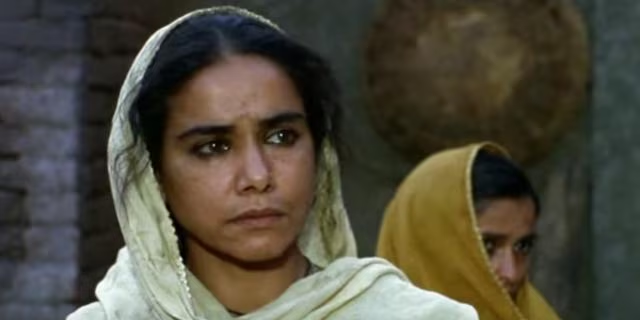
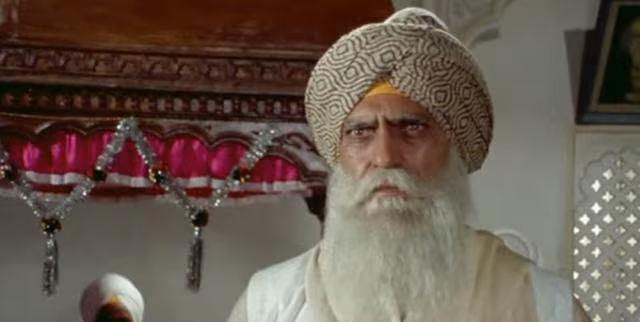
The narrative of Tamas is set in motion by an act at once trivial and catastrophic. Nathu, a Chamar tanner, is paid five rupees by a local contractor, the thekedar, to slaughter a pig, ostensibly for a veterinary surgeon. By the following morning the pig's carcass has been flung upon the steps of a mosque, and the town, already taut with sectarian suspicion, ignites. From this single engineered provocation the film radiates outward to follow a constellation of figures caught in the ensuing conflagration: Nathu and his pregnant wife Karmo fleeing on foot; the elderly Harnam Singh and Banto seeking refuge and finding the door of an old Muslim friend closed against them by his son; the Sikh community gathered in a gurudwara, negotiating and then perishing; and, presiding over the whole from a position of colonial detachment, the Deputy Commissioner Richard, who declines to impose the curfew that might have averted the slaughter. The structure is deliberately choral, a mosaic of interlocking fates rather than a single dramatic arc, and this dispersal of the narrative across many lives is itself an argument about the nature of the catastrophe as something suffered collectively and without redemptive shape.
Beneath its surface chronicle of riot and flight, Tamas is an inquiry into the manufacture of communal violence and the moral vacancy at its centre. The film is scrupulous in withholding the satisfaction of a clear villain: the pig is thrown by a hired hand, the fury is stoked by political operatives on both sides, and the colonial administration cynically permits the disorder it could have prevented. Nihalani insists that atrocity is not the work of monsters but the aggregate of ordinary cowardice, opportunism and fear, orchestrated by those who stand to gain. The theme of complicity is embodied above all in Nathu, whose naive conviction that he personally caused the holocaust dramatises the terrible disproportion between individual conscience and historical calamity. Against this darkness the film sets fugitive images of a shared humanity that the violence has not wholly extinguished, the friendships and instincts of protection that survive across the communal divide, even as they are overwhelmed. Perhaps the film's most harrowing sequence, the collective suicide of the Sikh women who leap into a well rather than face dishonour, distils its central preoccupation with the way ideologies of purity and honour convert human beings into instruments of their own destruction.
The closing image crystallises the film's refusal of consolation and its insistence upon continuity. In a refugee camp, Karmo identifies Nathu's corpse among the rows of the dead and immediately goes into labour; from within the hospital tent the cries of the newborn mingle with the slogans of "Allahu Akbar" and "Har Har Mahadev" carried on the wind from a fresh disturbance in the distance. Birth and death, hope and renewed hatred, are held in a single unbearable frame. The child arrives into a world already poisoned by the very forces that killed its father, and the film declines to promise that the cycle will be broken. This is Tamas at its most unsparing and its most honest: it will not offer the balm of a reconciliation it does not believe in, and it leaves the spectator suspended between the fragile fact of new life and the ominous evidence that the darkness has not lifted.

Direction and Craftsmanship
Nihalani, a cinematographer by training who had graduated from the film institute in Bangalore and apprenticed under V. K. Murthy before serving as director of photography on many of Shyam Benegal's key films, brought to Tamas an image-maker's precise sense of how meaning is carried by light and composition. He shares the film's cinematography credit with Murthy himself, and the visual scheme is governed by a controlled sombreness entirely appropriate to a work whose title is darkness: the palette is muted and earthen, the interiors are heavy with shadow, and the frequent recourse to low, oppressive light gives the images a quality of gathering dread. Nihalani resists the sensationalism that the material might have invited; the violence is rendered with a documentary restraint that makes it more, not less, disturbing, and the camera tends to observe rather than to incite, holding its subjects at a distance that permits reflection. The vast running time, close to five hours in its full serial form and some four hours as a feature, is deployed not for spectacle but for the patient accumulation of atmosphere and consequence.
The film's authority rests equally upon its performances and its sound. Om Puri's Nathu is a study in inarticulate conscience, his weathered face and stooped frame conveying a man crushed beneath a guilt vastly larger than his own small transgression; Nihalani had him lose weight and grow a beard to inhabit the role. Amrish Puri lends the Sikh leader Teja Singh a grave authority, A. K. Hangal brings a wounded decency to the Congress worker Bakshi, and Surekha Sikri, in a supporting performance that won her a National Film Award, registers the human cost of the upheaval with quiet exactness. The casting of Bhisham Sahni himself as Harnam Singh gives the film a peculiar poignancy, the novelist ageing into the role of a man who has lost everything he knew. Vanraj Bhatia's score, also honoured with a National Film Award, eschews the emotional underlining of conventional film music, favouring a spare and often elegiac idiom that allows the silences and ambient sounds of massacre, the distant slogans and the crackle of burning, to do their terrible work. The editing by Sutanu Gupta sustains the choral structure across its many strands without losing the thread of individual anguish, weaving the disparate fates into a single fabric of catastrophe.
The Cinema of Govind Nihalani
Tamas occupies a central place within a body of work distinguished by its unwavering engagement with the pathologies of the Indian polity. Nihalani emerged as a director from a long apprenticeship in cinematography, having shot advertising films and then eight features for Shyam Benegal, among them Nishant, Manthan, Bhumika and Junoon, before making his own directorial debut with Aakrosh in 1980. That first film, scripted by the playwright Vijay Tendulkar and awarded the Golden Peacock at the International Film Festival of India, announced the themes that would preoccupy him throughout his career: caste oppression, institutional violence and the silencing of the powerless. Ardh Satya, his 1983 study of police brutality and masculine disintegration, consolidated his reputation and remains among the defining achievements of the parallel cinema movement. Across these works Nihalani established himself, alongside Benegal, as one of the principal architects of a socially committed alternative to mainstream Hindi cinema, a film-maker for whom the camera was an instrument of political and moral inquiry rather than of escape.
Within this oeuvre Tamas represents both a continuation and an expansion. The concern with the machinery of power and the vulnerability of ordinary people that runs through Aakrosh and Ardh Satya is here transposed onto the largest possible canvas, the founding trauma of the modern subcontinent, and the intimate scale of Nihalani's earlier chamber dramas gives way to a sprawling historical fresco. Yet the sensibility remains recognisably his: the same refusal of easy moral arithmetic, the same attention to the institutional and structural sources of violence, the same insistence that the spectator confront rather than merely consume the suffering on screen. If his subsequent films, among them Party, Droh Kaal and the animated fable Kamla, would range widely across genre and form, Tamas endures as the fullest realisation of his artistic project, the point at which his documentary rigour, his political seriousness and his cinematographer's eye converged upon a subject worthy of them all. It stands as evidence of a paradox that has troubled his admirers, that a film-maker of such consequence should, as some critics have lamented, be comparatively neglected in the popular memory of Indian cinema.

Reception and Legacy
Few Indian productions have generated a public reaction as fierce as that which met Tamas. Broadcast on Doordarshan as a serial in early 1988, it drew an enormous audience and immediate acclaim from the outset, yet its unsparing depiction of communal violence also unleashed a storm of protest. The Hyderabad office of the national broadcaster was attacked, Nihalani himself received threats and was placed under police protection for some eight weeks, and on 21 January 1988 the Bombay High Court granted a stay to halt further transmission after a petition alleged that the serial would "poison the minds of the people." Two days later the court vacated the injunction, delivering a judgement that has since become a landmark defence of the film: it found that Tamas treated the fundamentalists of both communities with equal severity and that its message, "directed as it is against the sickness of communalism," was "loud and clear." The controversy, far from discrediting the work, in effect confirmed the acuity of its diagnosis, for the very passions it depicted were reproduced in the reaction to it.
Set against this turbulence stood the formal recognition the film swiftly earned. At the 35th National Film Awards it received three honours, including the Nargis Dutt Award for Best Feature Film on National Integration, together with awards for Surekha Sikri's supporting performance and Vanraj Bhatia's music, a striking affirmation from the state of a work that state television had struggled to protect. In the decades since, Tamas has come to be regarded as one of the essential cinematic treatments of Partition and as a touchstone for later film-makers who have sought to reckon with communal violence, its choral structure and its refusal of partisanship establishing a template of moral seriousness. Its re-telecast in 2013 by History TV18 during the Independence Day season, and its continued presence in scholarly discussion of Indian cinema and Partition memory, attest to a durability that few television productions of its era have achieved. It remains a work to which critics and historians return whenever the question of representing collective trauma on screen is raised.
Commentary
What gives Tamas its enduring authority is the courage of its refusals. It refuses to console, refuses to apportion blame in a manner that would let any community or institution comfortably off the hook, and refuses the redemptive shape that narrative so readily imposes upon suffering. In an artistic and political culture perennially tempted to sentimentalise the nation's founding wound or to weaponise it for present ends, Nihalani's film holds fast to a more difficult truth: that the violence of Partition was neither inevitable nor the work of aliens, but was manufactured out of ordinary materials, rumour and fear and calculated provocation, by people who could as easily have chosen otherwise. This is at once the film's bleakest proposition and its most humane, for if the darkness was made by human hands then it might, in principle, have been unmade by them too. That the film locates its faint hope not in any resolution but in the mere continuation of life, the child born amid the corpses, is characteristic of its unwillingness to promise more than the evidence allows.
The passage of nearly four decades has not diminished the film's relevance; if anything it has sharpened it. The mechanisms Tamas anatomises, the engineered rumour, the political exploitation of religious feeling, the administrative failure or refusal to intervene, have proved depressingly recurrent in the subcontinent's subsequent history, and the film's warning has lost none of its urgency. Its true subject was never the past alone but the permanent susceptibility of any society to the seductions of communal hatred, and it is this that makes Tamas less a period piece than a standing indictment. To return to it is to be reminded that the darkness of its title is not a condition that history has cured but a possibility that vigilance must perpetually hold at bay. In the final reckoning Tamas endures because it dared to understand rather than merely to lament, and in that understanding it offers the only consolation a serious work of art can honestly provide, which is the clarity to recognise the darkness for what it is.