
Guru Dutt
Guru Dutt (born Vasanth Kumar Shivashankar Padukone; 9 July 1925 – 10 October 1964) was an Indian film director, producer, actor, choreographer, and writer, widely regarded as one of the supreme auteurs of Indian cinema. Working primarily in Hindi, he created a body of work in the 1950s and early 1960s that placed him alongside the foremost filmmakers of his era – among them Raj Kapoor, Mehboob Khan, and Bimal Roy – as an artist who achieved an unusual and demanding synthesis of artistic ambition and commercial viability. Over a career of barely fifteen years, Dutt directed eight feature films, produced several more, and acted in a number of productions both within and outside his own studio, assembling a cohort of collaborators whose collective vision transformed the visual and emotional grammar of Hindi cinema.
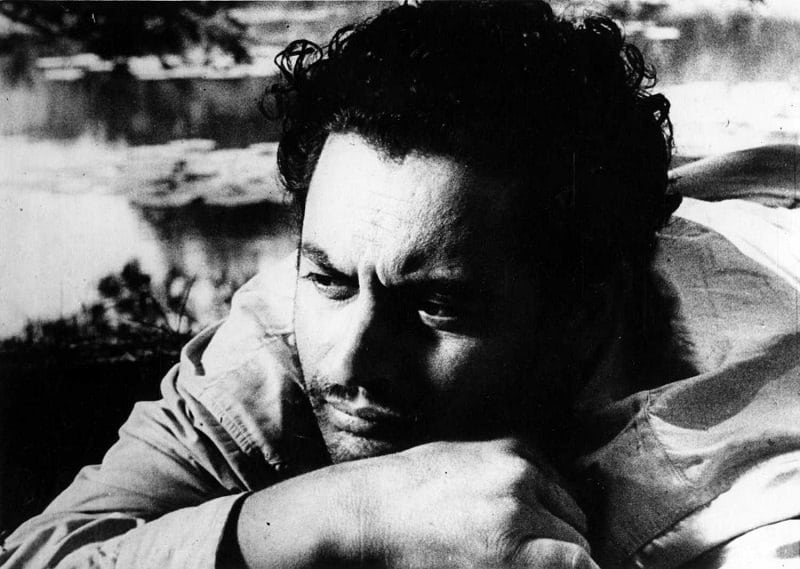
Dutt is celebrated above all for two masterworks: Pyaasa (1957) and Kaagaz Ke Phool (1959). Both films, melancholy meditations on the suffering of the creative individual in a commercialised and indifferent society, have entered the canon of world cinema. Pyaasa appeared on Time magazine’s All-Time 100 Movies list in 2005, and both films featured in Sight & Sound magazine’s 2002 survey of the greatest films, polled across more than two hundred and fifty international critics and directors. Kaagaz Ke Phool holds the additional distinction of being the first Indian film produced in CinemaScope. The films’ extraordinary cinematography – executed by Dutt’s principal collaborator, V. K. Murthy – deployed light, shadow, and the moving camera with an expressive precision that invited comparison, by later commentators, with the work of Orson Welles.
As an actor, Dutt brought a quality of introspective vulnerability to his performances that accorded perfectly with the alienated, melancholic protagonists he favoured as a director. His studio, Guru Dutt Films, produced work of consistent distinction and launched the careers of several figures who went on to become important practitioners in their own right, including the director Abrar Alvi and the comedian Johnny Walker. Dutt’s personal life was marked by increasing unhappiness – a troubled marriage, professional anxieties, and episodes of severe depression – and he died on 10 October 1964, aged thirty-nine, in circumstances that remained, and remain, a matter of dispute. He left behind him a legacy that has grown steadily in international esteem since his death, and which places him among the indispensable artists of mid-twentieth-century Indian culture.
In 2010, Dutt was named among CNN’s twenty-five greatest Asian actors of all time. A commemorative postage stamp was issued in his honour by India Post on 11 October 2004. His autograph is preserved on the Walk of the Stars at Bandra Bandstand, Bombay. The 56th International Film Festival of India, held in November 2025, paid centenary tribute to Dutt by screening his classic films. His niece, the filmmaker Kalpana Lajmi, and his second cousin, Shyam Benegal, would themselves become distinguished directors, suggesting that the Padukone family represented one of the most artistically fertile lineages in Indian cinema history.
Life and Early Work
Vasanth Kumar Shivashankar Padukone was born on 9 July 1925 in Bangalore, in the Kingdom of Mysore (now the state of Karnataka), into a Konkani Chitrapur Saraswat Brahmin family. His father, Shivashanker Rao Padukone, served as a headmaster and later worked in banking; his mother, Vasanthi, was a teacher and writer whose literary sensibility would leave a discernible imprint on her son. Following a childhood accident, the family believed that the name Vasanth was inauspicious, and it was changed to Gurudatta Padukone – subsequently simplified, in the manner of the Bombay film world, to Guru Dutt. The family relocated during his early years to Bhowanipore in Kolkata, where the young Dutt grew up speaking fluent Bengali and absorbing the rich cultural atmosphere of that city’s Bengali intellectual and artistic milieu. He had three younger brothers – Atma Ram, who would become a film director; Devi, who would work as a producer; and Vijay – and a younger sister, Lalita Lajmi, who would become a celebrated Indian painter.
In 1942, at the age of seventeen, Dutt enrolled at Uday Shankar’s School of Dancing and Choreography in Almora. Uday Shankar, the elder brother of Ravi Shankar and a pioneering figure in the modernisation of Indian classical dance, ran an institution that offered rigorous training in the performing arts and that attracted students from across the country. Dutt’s years at Almora instilled in him a profound and lasting understanding of movement, rhythm, and the relationship between the body and space – an understanding that would inform his later work as a choreographer and filmmaker. He left the school in 1944 following a personal entanglement with one of the company’s leading performers, a circumstance that would prove to be the first of several episodes in which his impulsive personal conduct complicated his professional situation.
Following his departure from Almora, Dutt took employment as a telephone switchboard operator at a Lever Brothers factory in Calcutta, a position he found uncongenial and soon abandoned. He returned to Bombay and to his family, and in 1944 his uncle secured him a three-year contract as a choreographer with the Prabhat Film Company in Pune. Prabhat had once been among the most artistically distinguished production houses in India but was then in a period of decline, having lost its founding creative talent, V. Shantaram. Nevertheless, it was at Prabhat that Dutt formed two friendships of signal importance: with the actor Rehman, who would later appear in several of his most celebrated productions, and with Dev Anand, with whom Dutt struck an agreement that would determine the shape of both their careers. The two young men resolved that if Dev Anand were to produce a film, he would engage Dutt as director, and that if Dutt were to direct, he would cast Anand in the leading role. This compact of mutual loyalty was honoured in full.
When his Prabhat contract expired in 1947, Dutt found himself unemployed for an extended period. During these months, he developed a facility for writing in English and contributed short stories to The Illustrated Weekly of India, a prominent English-language magazine. This period of literary activity, though brief, reveals the range of his intellectual interests and his capacity for self-expression in forms other than the visual. He subsequently found work as an assistant director with Amiya Chakravarty on Girls' School (1949) and with Gyan Mukherjee at Bombay Talkies on Sangram (1950). These apprenticeships equipped him with a working knowledge of studio production methods, and they came at the very moment when Dev Anand was establishing his own production company, Navketan Films, and preparing to honour his agreement with his old friend from Prabhat.
Filmmaking
Guru Dutt made his directorial debut with Baazi (1951), produced by Navketan Films and starring Dev Anand. The film was a self-conscious tribute to the Hollywood film noir of the 1940s, deploying shadow lighting, a morally ambiguous hero, and the transgressive figure of the dangerous woman. Its success at the box office was immediate, and it announced a filmmaker of confident technical command and sophisticated generic awareness. The partnership continued with Jaal (1952), again produced by Navketan and again starring Anand, which similarly performed well commercially. These early films, though working within the conventions of the popular thriller, were already notable for the choreographic fluency of the camera work and the attention to the textural expressiveness of light.
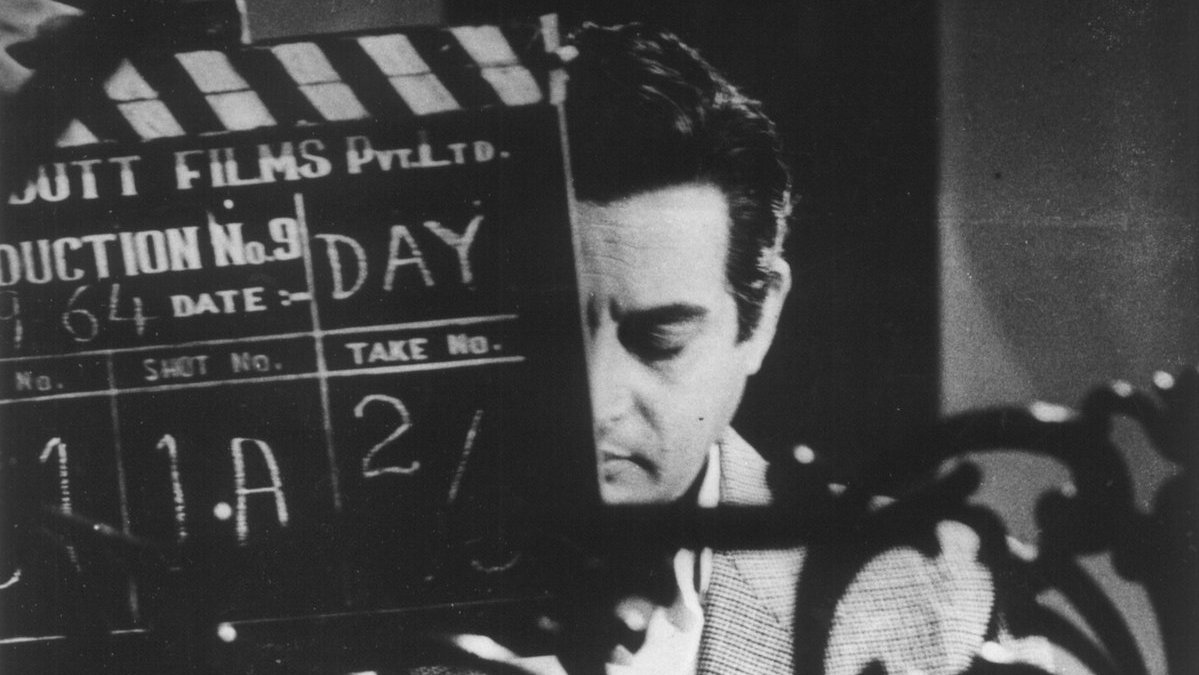
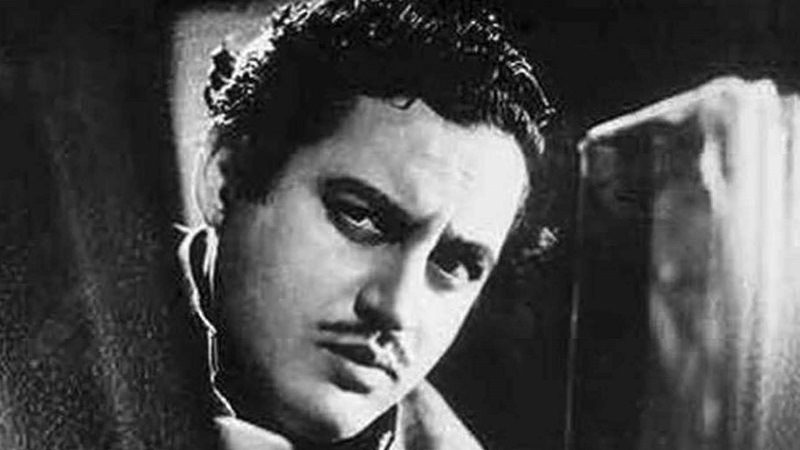
For his next project, Dutt assumed direction, production, and the leading role simultaneously. Baaz (1953) was less successful at the box office than its predecessors, but it brought together the nucleus of what became known as the Guru Dutt team: V. K. Murthy as cinematographer, Abrar Alvi as screenwriter and eventual director, Johnny Walker as comic actor, and, later, Waheeda Rehman as leading actress. This creative collective, sustained by shared aesthetic commitments and by an unusual degree of mutual trust, would prove to be among the most artistically productive ensembles in the history of Indian popular cinema. The subsequent films Aar Paar (1954) and Mr. & Mrs. ’55 (1955) – the former a vigorous working-class comedy-thriller, the latter a sparkling satirical comedy of manners – were both substantial box-office successes. In these pictures, Dutt demonstrated that his artistic ambitions need not preclude commercial accessibility, and that the conventions of popular Hindi cinema – song, dance, romantic plot, comic relief – could be infused with a degree of formal sophistication and thematic intelligence that did not alienate the general audience.
Dutt produced C.I.D. (1956), directed by Raj Khosla, and appeared in it as an actor alongside Dev Anand. The film was a commercial hit. That same year he also directed Sailaab (1956). But the decisive turn in his career came with Pyaasa (1957), the film that established him beyond any question as a major artist. The story of Vijay, an idealistic poet whose work goes unrecognised during his lifetime only to be celebrated after his supposed death, Pyaasa fused the conventions of the melodrama and the social critique with a lyricism of image and song unparalleled in Hindi cinema. The film’s extraordinary visual design – Murthy’s use of shafts of light, deep shadow, and low-angle compositions – created an atmosphere of sustained poetic intensity. The songs, written by Sahir Ludhianvi and set to music by S. D. Burman, and sung partly by Geeta Dutt, achieved an integration of lyric and image that remains a model of the form. Dutt himself played Vijay with a quality of wounded sincerity that gave the film its emotional centre.
In 1959, Dutt released Kaagaz Ke Phool, the first Indian film to be shot in CinemaScope, the wide-screen format that had transformed Hollywood production in the early 1950s. The film, in which Dutt played a celebrated director who falls in love with an aspiring actress (played by Waheeda Rehman), was his most personal and formally ambitious work. Its narrative, tracing the arc of creative success, romantic disillusionment, and professional decline, carried unmistakable autobiographical resonance. Murthy’s cinematography exploited the CinemaScope frame with extraordinary sophistication, particularly in the justly famous sequences in which light streams through the high windows of a film studio, illuminating the ageing director in a cone of radiance that functions simultaneously as revelation and entombment. Despite the film’s exceptional artistic quality, it was a catastrophic failure at the box office – the only production of Dutt’s studio to sustain such a result – and the experience left him deeply shaken. He publicly attributed the failure to his own reputation and thereafter declined to credit himself as director on subsequent productions from his studio.
The films that followed Kaagaz Ke Phool were produced by Dutt’s studio but directed by others. Chaudhvin Ka Chand (1960), directed by M. Sadiq and starring Dutt and Waheeda Rehman in a story of unrequited love set against the backdrop of Muslim aristocratic culture in Lucknow, was an enormous commercial success that more than recovered the losses from Kaagaz Ke Phool. Sahib Bibi Aur Ghulam (1962), directed by Abrar Alvi and based on a celebrated Bengali novel by Bimal Mitra, starred Dutt alongside Meena Kumari, Waheeda Rehman, and Rehman. A richly atmospheric study of the decline of the Bengali zamindar class, the film won the National Film Award for Best Feature Film in Hindi and the Filmfare Award for Best Film. Abrar Alvi won the Filmfare Best Director Award for the picture. Dutt’s last completed film as an actor was Sanjh Aur Savera (1964), directed by Hrishikesh Mukherjee and again co-starring Meena Kumari. He died on 10 October 1964, leaving several projects incomplete, including Picnic, co-starring Sadhana, and his participation in K. Asif’s epic Love and God, in which he was replaced, after the film was revived years later, by Sanjeev Kumar.
The Cinema of Guru Dutt
The cinema of Guru Dutt is distinguished by an exceptional density of meaning achieved through the convergence of visual style, musical expression, and thematic preoccupation. Where many directors of the Hindi popular cinema of his era treated the film frame as a neutral container for narrative incident and emotional display, Dutt – in close collaboration with Murthy – understood it as an expressive field in which every element of lighting, composition, and camera movement contributed to the total meaning of the work. The influence of Hollywood film noir, visible in his earliest pictures, was transmuted over the course of his career into something distinctively his own: a lyrical cinema of interiority in which the objective world is consistently refracted through the consciousness of the suffering protagonist.
Critics have noted Dutt’s affinities with Orson Welles in his willingness to subordinate conventional narrative transparency to the demands of visual and auditory expressiveness. Like Welles, Dutt was interested in the expressive potential of low-angle compositions, the dramatic manipulation of light sources within the frame, and the use of deep focus to create spatial relationships of psychological significance. Unlike Welles, however, whose aesthetic was fundamentally theatrical in its origins, Dutt’s was rooted in the traditions of Indian classical performance – in the choreographic precision that he had acquired under Uday Shankar and that shaped his understanding of the relationship between body, rhythm, and space. This dual inheritance – from Hollywood modernism and from the Indian performing arts – gave his films their distinctive character: simultaneously cosmopolitan in their formal ambition and deeply embedded in a specifically Indian cultural sensibility.
Key Themes
The Alienation of the Artist. The most persistent concern of Dutt’s mature cinema is the predicament of the creative individual in a society that refuses to recognise genuine talent. In Pyaasa, the poet Vijay is ignored, dismissed, and eventually presumed dead before his work achieves posthumous celebrity – a celebrity he regards with contempt, having witnessed the hypocrisy of those who celebrate him. In Kaagaz Ke Phool, the director Suresh Sinha witnesses the destruction of his career by the same studio apparatus that had once celebrated him. This recurrent figure of the unrecognised or destroyed artist carries obvious autobiographical resonance, and Dutt’s films treat it with a degree of intensity that suggests personal identification rather than merely intellectual sympathy.
The Critique of Bourgeois Society. Dutt’s films are consistently suspicious of the values of the urban commercial bourgeoisie. The songs of Pyaasa, written by Sahir Ludhianvi and informed by a progressive, socialist sensibility, constitute an explicit critique of a society that commodifies human relationships and prostitutes artistic values in the service of profit. The prostitute Gulabo – played with extraordinary subtlety by Waheeda Rehman – is presented in Pyaasa as morally superior to the respectable middle-class characters who surround her, a characteristic inversion of social hierarchies that marks Dutt’s work as politically engaged, if not polemical.
Melancholy and the Aesthetics of Pathos. There is in Dutt’s work a sustained engagement with melancholy as an aesthetic category and emotional condition. His films are structured around loss – of love, of recognition, of youth, of hope – and they find in this loss a source of formal beauty. The slow dissolves, the rhapsodic tracking shots, the pools of light in surrounding darkness: all of these formal choices articulate a sensibility for which sadness is not merely an emotion to be represented but a mode of visual apprehension.
Music and Song as Structural Element. Like many Hindi filmmakers of his period, Dutt recognised the centrality of song to the aesthetic experience of the popular film. But he went further than most of his contemporaries in integrating song into the formal and thematic structure of his narratives. In Pyaasa and Kaagaz Ke Phool, the songs are not ornamental additions to the story but essential expressions of the protagonist’s inner life, and the camera work during the song sequences is as carefully considered as in any other passage of the film. His collaboration with composers S. D. Burman and O. P. Nayyar, and with lyricists Sahir Ludhianvi and Shailendra, produced some of the most enduring songs in the Hindi film repertoire.
Women, Desire, and Social Transgression. The women in Dutt’s films are among the most complex and sympathetically drawn female characters in mid-century Hindi cinema. Waheeda Rehman, who appeared in Pyaasa, Kaagaz Ke Phool, and Sahib Bibi Aur Ghulam, brought to each role an intelligence and moral seriousness that elevated the films well beyond the conventions of the romantic melodrama. Meena Kumari’s performance in Sahib Bibi Aur Ghulam – as the declining aristocrat Chhoti Bahu, whose alcoholism and longing for love constitute a devastating portrait of feminine subjugation within a patriarchal order – is among the greatest performances in the history of Indian cinema.
Selected Filmography
Baazi (1951)
Dutt’s directorial debut, produced by Navketan Films and starring Dev Anand. A film noir-influenced thriller featuring a morally ambiguous hero and expressionistic shadow lighting. A major commercial success that announced Dutt as a director of assured technical command and sophisticated generic awareness.
Aar Paar (1954)
A vigorous comedy-thriller set in the world of Bombay taxi drivers, starring Dutt as a cheerful, resourceful working-class hero. The film demonstrated Dutt’s capacity for light-toned popular entertainment and his gift for integrating comic and dramatic registers. Its O. P. Nayyar score became enormously popular.
Mr. & Mrs. ’55 (1955)
A satirical comedy of manners in which Dutt played a struggling cartoonist who enters into a marriage of convenience with a wealthy heiress, only for genuine feeling to complicate the arrangement. A witty critique of class pretension and the hypocrisy of social convention, the film was one of the most commercially successful productions of its era.
Pyaasa (1957)
Widely regarded as Dutt’s greatest achievement, Pyaasa follows the poet Vijay through rejection, anonymity, and a form of social death, before his work is celebrated by the world that had ignored him. The film’s visual design, by V. K. Murthy, and its songs, by Sahir Ludhianvi and S. D. Burman, constitute an integrated work of sustained lyrical intensity. Named to Time magazine’s All-Time 100 Movies list (2005) and featured in Sight & Sound’s 2002 international critics’ poll.
Kaagaz Ke Phool (1959)
The first Indian film shot in CinemaScope, Kaagaz Ke Phool traces the career of a celebrated film director whose life unravels through romantic disillusionment and professional failure. Murthy’s cinematography exploits the wide screen with breathtaking invention, notably in the celebrated studio sequences. Despite its initial commercial failure, the film is now recognised as a masterpiece and a cult classic. Featured in Sight & Sound’s 2002 international critics’ poll.
Sahib Bibi Aur Ghulam (1962)
Produced by Guru Dutt Films and directed by Abrar Alvi, this adaptation of Bimal Mitra’s Bengali novel depicts the decline of a Calcutta zamindar household in the late nineteenth century. Dutt played the observing narrator, Bhoothnath, while Meena Kumari’s performance as Chhoti Bahu won international recognition. Winner of the National Film Award for Best Feature Film in Hindi and the Filmfare Award for Best Film.
Legacy
The legacy of Guru Dutt is, by the measure of critical and scholarly attention, among the most substantial of any director to have worked in the Indian popular cinema. In the decades since his death, his reputation has grown steadily and has spread well beyond the borders of India, sustained by retrospective screenings at major international film festivals, by the availability of his films on international platforms, and by a body of critical literature that has established him as a canonical figure in the study of world cinema. Nasreen Munni Kabir’s scholarly biography Guru Dutt: A Life in Cinema (Oxford University Press, 1996), together with her edited volume Yours Guru Dutt (Roli Books, 2006) and Sathya Saran’s Ten Years with Guru Dutt: Abrar Alvi’s Journey (Penguin, 2008), have provided the scholarly foundations for sustained engagement with his work. The Channel 4 documentary In Search of Guru Dutt, included as a supplementary feature on the DVD edition of Kaagaz Ke Phool, introduced his cinema to a significant international audience. In 2021, Yasser Usman published a new biographical study, Guru Dutt: An Unfinished Story, with Simon & Schuster.
Within India, Dutt’s influence on subsequent filmmakers has been pervasive, if not always explicitly acknowledged. His methods of integrating song into narrative structure, his deployment of light as an expressive instrument, and his willingness to use the conventions of the popular film as vehicles for serious social and psychological enquiry have informed the practice of filmmakers across generations and across languages. His cousin Shyam Benegal, who became one of the principal architects of the Parallel Cinema movement in the 1970s, acknowledged the formative significance of Dutt’s example. The National Film Archive of India published a monograph on Dutt, written by Firoze Rangoonwalla, as early as 1973, testifying to the promptness with which the Indian critical establishment recognised the importance of his contribution.
Dutt’s personal awards were, by the measure of his achievement, modest. The studio system within which he worked accorded him the respect due to a commercially successful producer, rather than the recognition owed to an artist of his stature. The National Film Award for Best Feature Film in Hindi, won by Sahib Bibi Aur Ghulam in 1963, and the Filmfare Awards won by the same film for Best Film and Best Director, represent the principal formal acknowledgements of his work during his lifetime. He was nominated but did not win the Filmfare Award for Best Actor for Sahib Bibi Aur Ghulam. The Bengal Film Journalists’ Association awarded him its Best Actor (Hindi) prize for the same film in 1963. These awards, significant as they are, inadequately represent the full measure of his achievement, and it is only in the decades since his death that recognition has come to approximate the scale of his contribution.
Dutt died on 10 October 1964, having separated from his wife, the playback singer Geeta Dutt, and living alone in a rented apartment at Pedder Road, Bombay. He was found dead in his bed, the victim of what appears to have been a lethal combination of sleeping pills and alcohol. The question of whether his death was accidental or voluntary has never been definitively resolved; his son Arun maintained that it was accidental. Geeta Dutt survived him by eight years, dying in 1972 at the age of forty-one from the effects of excessive drinking. Their three children – Tarun, Arun, and Nina – were raised in the homes of Dutt’s brother Atma Ram and Geeta’s brother Mukul Roy. Dutt’s mother, Vasanthi Padukone, published a memoir of her son in Kannada in 1976, titled Nanna Maga Gurudatta: Jeevana-Charitre (My Son Gurudatta: Life-Story).
The brevity of Guru Dutt’s creative life – he was thirty-nine at his death and had been directing films for barely thirteen years – makes the achievement all the more remarkable. In that span he produced two works, Pyaasa and Kaagaz Ke Phool, that stand comparison with the finest achievements of world cinema in the 1950s, and a further body of work of consistent craft and seriousness. The incompleteness of the oeuvre – the projects abandoned, the films planned but never made – invites speculation about the directions his art might have taken, while the films that were completed offer testimony to a sensibility of rare distinction: at once intellectually rigorous and emotionally open, formally innovative and culturally rooted, critical of the world it inhabited and wholly alive to its beauty.