
G Aravindan
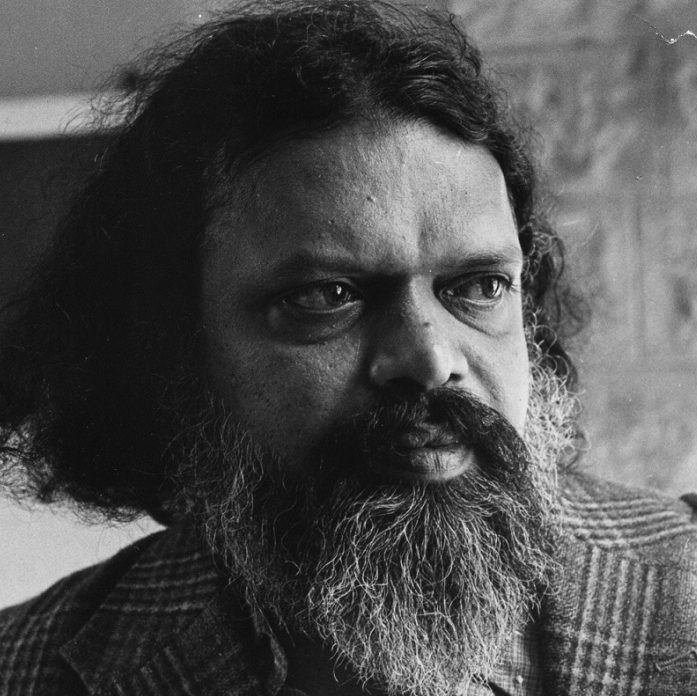
G. Aravindan (23 January 1935 – 15 March 1991) is one of the most singular figures in the history of Indian art cinema—a filmmaker whose work refuses easy categorisation and whose creative sensibility was shaped as much by cartooning, music, and theatre as by cinema itself. A self-taught filmmaker with no formal film education, he brought to Malayalam cinema a contemplative, philosophical vision rooted in folk tradition, spiritual inquiry, and an acute awareness of human fragility.
Working across a relatively compact filmography of eleven feature films and several documentaries between 1974 and 1991, Aravindan consistently reinvented his cinematic language, refusing to settle into a recognisable style or formula. Each film represented a distinct formal experiment: from the documentary realism of Thampu to the mythological humanism of Kanchana Sita, from the magical realism of Esthappan to the impressionistic visual poetry of Pokkuveyil. His was a cinema that asked questions rather than offered resolutions.
Celebrated across major international film festivals and critically examined in retrospectives worldwide, Aravindan's films—marked by long meditative takes, the integration of music into visual composition, and a profound attentiveness to landscape—occupy a place of rare distinction in world cinema. In Kerala itself, he remains a transformative presence in film culture: a bridge between the literary and visual arts, and between tradition and modernism.
A recipient of the Padma Shri (1990), seven National Film Awards, and eighteen Kerala State Film Awards, Aravindan died prematurely at the age of fifty-six, leaving behind a body of work that continues to be rediscovered, screened, and written about with undiminished admiration.
Life and Early Work
Govindan Aravindan was born on 23 January 1935 in Kottayam, in what was then the Kingdom of Travancore. He was the son of M. N. Govindan Nair, a humorist, lawyer, and one of the founding members of the Sahitya Pravarthaka Co-operative Society—a writers' cooperative established in Kottayam in 1945—and P. G. Thankamma. The household was steeped in literary culture: writers and artists were frequent visitors, and the young Aravindan grew up in proximity to some of the most significant Malayalam literary voices of the mid-twentieth century. His neighbour and mother's relative, the writer Karoor Neelakanta Pillai, was among those who shaped his early imaginative world.
He attended Karapuzha NSS English High School and CMS College in Kottayam before graduating in botany from the University College, Trivandrum in 1955. His university years proved formative in ways that went beyond his formal discipline: his fellow students included painter A. Ramachandran and writers O. N. V. Kurup, Sugathakumari, and Thirunalloor Karunakaran—all of whom would go on to become significant figures in Kerala's cultural life and would remain lifelong companions.
In 1956, Aravindan began his professional life as a field officer at the Rubber Board, a Government of India organisation, a position he would hold for nearly two decades. It was during these years that his true artistic vocation revealed itself—not through cinema, but through the newspaper cartoon. In 1961, at the invitation of editor N. V. Krishna Warrier of the Mathrubhumi weekly, Aravindan launched his now-legendary six-column cartoon series Cheriya Manushyarum Valiya Lokavum (Small People and a Big World). Running continuously until December 1973, the series followed two central figures—Ramu and Guruji—through a wry, socially observant landscape of political satire and everyday absurdity. It made Aravindan one of the most widely read cartoonists in Kerala, while also sharpening his instinct for social observation and visual storytelling.
Simultaneously, Aravindan was drawn into theatre. He was associated with the theatre club Navarangam in the early 1960s alongside playwright C. N. Sreekantan Nair, and later collaborated extensively with the eminent theatre figure Kavalam Narayana Panicker and his group Sopanam, directing plays such as Kali and Avanavan Kadamba. The Kavalam association would prove especially durable, shaping Aravindan's understanding of folk tradition, musical forms, and the mythological imagination—influences that would permeate his cinema throughout his career.
By the late 1960s, living in Kozhikode and part of a vibrant artistic circle that included illustrator Namboothiri, playwright Thikkodiyan, writer Pattathuvila Karunakaran, and M. T. Vasudevan Nair, Aravindan began to find his way toward filmmaking. It was from within this community of friendships—rather than from any institutional film training—that his first feature emerged.
Filmmaking
Aravindan's debut feature, Uttarayanam (1974), was a collective enterprise born directly from the Kozhikode artistic circle: written by Thikkodiyan, produced by Pattathuvila Karunakaran, and carrying the unmistakable imprint of Aravindan's cartoon series in its episodic social satire. The film follows an unemployed young man navigating a landscape of post-independence disillusionment, exposing the hypocrisy of former freedom fighters who have since grown corrupt. It was received with considerable critical enthusiasm, winning five Kerala State Film Awards including Best Film, Best Director, and Best Screenplay.
His second film, Kanchana Sita (1977), signalled an entirely different artistic ambition. An adaptation of C. N. Sreekantan Nair's play—itself a reworking of the Uttara Kanda of Valmiki's Ramayana—Aravindan took the radical step of casting Rama Chenchu tribal people from Andhra Pradesh in the roles of the epic's protagonists. Recentring the narrative through the perspective of Sita and weaving in Samkhya-Yoga philosophical threads, the film was a feminist and humanist intervention into one of India's most sacralised narratives. It was the first independently produced film in Malayalam cinema, and it attracted significant controversy for the casting of tribals in divine roles—a choice Aravindan defended on aesthetic and cultural grounds.
Thampu (1978) marked yet another departure. Shot in black and white in an almost documentary mode, the film follows the daily life of a travelling circus troupe, capturing the suffering and transience of the performers with quiet, observational precision. The film won Aravindan the National Award for Best Direction, as well as Kerala State Film Awards for Best Film and Best Director.

The year 1979 yielded two films of contrasting character. Kummatty drew on Malabar folklore—the figure of a wandering shapeshifter who can transform children into animals—to create a work of enchanted imagination that was widely celebrated as a masterpiece of children's cinema. Esthappan, released in the same year, was more formally ambitious: structured as a collective account of a legendary, enigmatic figure—part saint, part trickster, part Christ figure—whose deeds are recalled by a community of coastal fisherfolk. The film wove together local myth, Christian folk legend, music by Isaac Thomas Kottukapally and Kavalam Narayana Panicker, and the striking cinematography of Shaji N. Karun, achieving one of the most fully realised examples of magical realism in Indian cinema.
Pokkuveyil (1981) was perhaps his most formally audacious project: a film reportedly composed not from a script but from musical notation, its visuals structured to accompany a Subhapantuvarali raag performed by Hariprasad Chaurasia on flute and Rajeev Taranath on sarod. The film traces the psychological disintegration of a young artist with an impressionistic freedom that places it closer to visual music than conventional narrative cinema.
Chidambaram (1985) was received as one of his masterworks—a rich, poetic film set against the backdrop of a temple town, exploring guilt, desire, and the pursuit of moral redemption through the metaphorical language of colour. Oridathu (1986) returned to a more realist mode, depicting the lives of people on a rural riverbank with warmth and humanistic engagement.
His final completed feature, Vasthuhara (1991), based on a short story by C. V. Sreeraman, was a deeply compassionate meditation on the lives of Bengali refugees and the experience of displacement. Featuring Mohanlal and Neena Gupta, it was released posthumously and won the National Award for Best Film in Malayalam. Aravindan died of a sudden heart attack on 15 March 1991, before the film could be released.
Beyond his features, Aravindan was an accomplished composer, directing music for films including Piravi (1988) by Shaji N. Karun and Ore Thooval Pakshikal (1988). He also served on the board of the National Film Development Corporation, where he supported the funding of emerging filmmakers, though he never drew a loan for himself.
The Cinema of G Aravindan
In a cinema culture that has frequently prized either theatrical excess or sociological realism, Aravindan occupies a category of his own. His films resist the twin temptations of spectacle and thesis. They do not argue positions; they inhabit states of feeling, perception, and wonder. What distinguishes him most decisively from his peers—including the more celebrated Adoor Gopalakrishnan, with whom he is inevitably paired in discussions of Kerala's parallel cinema movement—is his unwillingness to repeat himself. Each film is a new formal proposition.
This formal restlessness was not eccentricity for its own sake; it arose from a genuinely integrative sensibility. Aravindan moved between cartooning, painting, music, and theatre throughout his creative life, and these disciplines left visible traces in his cinema. His feel for visual rhythm owes something to cartoon sequencing; his understanding of sound as a compositional element rivals that of any filmmaker working in India during the period; his attentiveness to folk tradition and mythological symbolism reflects years of collaboration with theatre practitioners of the calibre of Kavalam Narayana Panicker. The result is a cinema that is unmistakably rooted in Kerala's cultural landscape while remaining open to universal, even metaphysical, concerns.
At the centre of Aravindan's cinema is a sustained engagement with the relationship between the visible and the ineffable. His films frequently return to figures who operate at the boundary of the ordinary and the transcendent—Esthappan, the mysterious wanderer in whose deeds a community discovers meaning; Kummatty, the shape-shifting sorcerer of children's imagination; the solitary protagonist of Pokkuveyil, whose inner dissolution the film renders in purely sensory terms. These are not characters in the conventional dramatic sense; they are focal points through which Aravindan meditates on the nature of faith, memory, and collective experience.
His handling of landscape is equally distinctive. Whether it is the tribal forests of Andhra Pradesh in Kanchana Sita, the rain-drenched circus grounds of Thampu, the coastal villages of Esthappan, or the temple precincts of Chidambaram, Aravindan treats environment not as backdrop but as atmosphere, consciousness, and meaning. Space, in his films, is an active participant in the drama rather than a neutral container for it.
Aravindan's use of music is equally integral. Unlike many filmmakers who treat the score as emotional punctuation, Aravindan often began from musical form and constructed his visual sequences in relation to it. Pokkuveyil makes this procedure explicit. The effect is a mode of filmmaking in which image and sound are genuinely co-equal—not illustration and accompaniment, but partners in the creation of meaning.
Critics have sometimes noted that this formal ambition could work against narrative coherence, and that not every experiment succeeded equally. Yet even Aravindan's least resolved films contain passages of arresting beauty and insight. The film critic Iqbal Masud observed that all of Aravindan's films share a transcendental edge—a sense of meaning that exceeds schematic explanation. This quality—hard to theorise but immediately felt by attentive viewers—is perhaps the most durable aspect of his achievement.
What Aravindan ultimately demonstrates is that art cinema need not choose between the local and the universal, between formal rigour and emotional warmth, between tradition and experiment. His films are Kerala films—culturally specific, folk-inflected, rooted in the rhythms of a particular landscape and history—and simultaneously open to the largest questions about existence. This balance, maintained across seventeen years and eleven features, constitutes his deepest contribution to Indian cinema.
Key Themes
Myth, Legend, and the Sacred Aravindan was persistently drawn to figures and narratives that inhabit the boundary between the historical and the mythological. Kanchana Sita, Esthappan, and Kummatty all engage with the way communities construct meaning from extraordinary human presences—figures who become, in the popular imagination, larger than themselves.
The Spiritual in the Everyday Rather than treating spirituality as a separate register of experience, Aravindan embeds it within the ordinary rhythms of life. His films suggest that the sacred is not distant but immanent—available to those attentive enough to perceive it.
Landscape as Language Environment in Aravindan's films is never neutral. Forest, coastline, river, and temple town each carry cultural and emotional weight, functioning as extensions of the film's inner life.
Music as Structural Principle Aravindan's training in Hindustani classical music (in the Kirana style Khayal) shaped not just his soundtracks but his sense of cinematic rhythm and composition. Music, for him, was an organising principle rather than an ornament.
Displacement and Collective Memory Several of his films—including Vasthuhara and, in a different register, Uttarayanam—reflect on the experience of loss, dislocation, and the persistence of the past within the present.
Formal Reinvention Unlike filmmakers who develop a signature style and refine it across a career, Aravindan treated each film as an opportunity to begin again—to ask what cinema could be rather than to consolidate what it has been.
Selected Fimography
Uttarayanam (1974) Aravindan's debut feature, rooted in the social satire of his cartoon series Cheriya Manushyarum Valiya Lokavum, follows an unemployed young man confronting post-independence disillusionment. A searing examination of idealism betrayed by opportunism, it launched his directorial career with five Kerala State Film Awards.
Kanchana Sita (1977) A formally radical reworking of the Uttara Kanda of the Ramayana, told from the perspective of Sita and cast with Rama Chenchu tribal people in the roles of the epic's protagonists. Weaving Samkhya-Yoga philosophy into a feminist reading of classical myth, the film remains a landmark in Malayalam independent cinema.
Thampu (1978) Shot in black and white with a documentary economy, Thampu observes the daily life of a travelling circus troupe with compassion and restraint. One of Aravindan's most socially grounded films, it won him the National Award for Best Direction.
Kummatty (1979) Drawing on Malabar folk tradition, the film portrays a wandering shape-shifting figure who enchants the children of a village. A film of luminous imagination and warm humanism, it is widely regarded as the finest work of children's cinema in Malayalam.
Esthappan (1979) Among Aravindan's most celebrated works, Esthappan constructs a portrait of a legendary wanderer through the collective memory of a coastal fishing community. Blending Christian folk legend, local myth, and musical texture—with cinematography by Shaji N. Karun—the film achieves a rare and sustained magical realism.
Pokkuveyil (1981) Perhaps his most formally experimental film, Pokkuveyil was composed to a pre-recorded Subhapantuvarali raag by Hariprasad Chaurasia and Rajeev Taranath. Its meditative, impressionistic imagery traces a young artist's psychological dissolution in terms that are closer to music than narrative.
Chidambaram (1985) Set in and around a south Indian temple town, Chidambaram explores guilt, desire, and the possibility of redemption through richly metaphorical colour design and landscape. Among his most formally accomplished works, it won the National Award for Best Film.
Oridathu (1986) A warm, humanistic portrait of the lives of people gathered on a rural riverbank, Oridathu represents Aravindan at his most accessible without sacrificing his characteristic attentiveness. It won both National and Kerala State Awards for Best Direction.
Vasthuhara (1991) Aravindan's final film, released posthumously, follows the lives of Bengali refugees navigating displacement, loss, and resilience. Based on a story by C. V. Sreeraman and featuring Mohanlal and Neena Gupta, it won the National Award for Best Film in Malayalam—a moving valediction to a singular career.
Legacy
G. Aravindan died on 15 March 1991, at the age of fifty-six, from a sudden heart attack, before he could witness the release of his final film. He left behind eleven feature films, a body of documentary work, an extraordinary cartoon archive, and a set of theatre collaborations that collectively constitute one of the richest artistic careers in twentieth-century Kerala.
His legacy within Malayalam cinema is profound and ongoing. He helped establish, alongside Adoor Gopalakrishnan and John Abraham, the possibility of a rigorous, non-commercial art cinema in a regional language—demonstrating that such films could engage with formal and philosophical questions of genuine complexity without sacrificing their cultural rootedness. His example influenced a generation of filmmakers, including his frequent cinematographer Shaji N. Karun, who went on to an acclaimed directorial career of his own.
Internationally, Aravindan's films have been screened at festivals across Europe and Asia, and retrospectives of his work have been held at major cultural institutions. His reputation continues to grow among scholars of world cinema, who increasingly situate his practice alongside other contemplative masters of the form.
Within India, his contribution has been recognised through the Padma Shri (1990), seven National Film Awards across multiple categories, and eighteen Kerala State Film Awards—a scale of recognition that reflects both the consistency of his achievement and the range of disciplines in which he excelled. The Kerala government established the G. Aravindan Award in his memory, honoring contributions to Malayalam cinema.
What endures most powerfully, however, is the films themselves. In their refusal of formula, their openness to the mysterious, their sustained attention to landscape and music and the interior lives of marginal figures, Aravindan's films continue to offer a model of what cinema can aspire to—not as spectacle or argument, but as a form of sustained, generous, wondering attention to the world.