
P. Padmarajan
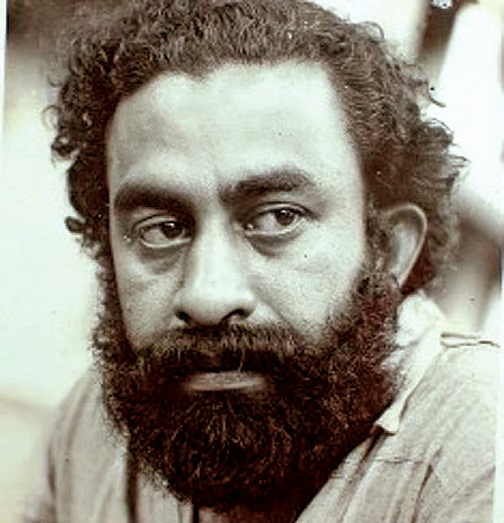
Padmarajan (1945–1991), generally referred to in the Malayalam literary and cinematic worlds simply as Padmarajan and credited on screen as P. Padmarajan, was an Indian author, screenwriter, and film director whose brief but luminous career fundamentally reshaped the contours of Malayalam cinema. Working almost exclusively in Malayalam, he came to filmmaking already established as one of the most original novelists and short-story writers of his generation, and he carried into the cinema an extraordinary sensitivity to language, character, and the half-lit interior lives of ordinary people. In a working span of barely sixteen years as a screenwriter and a mere twelve as a director, he produced a body of work distinguished by its psychological complexity, its lyrical romanticism, and its unflinching attention to the marginal, the transgressive, and the emotionally wounded.
Padmarajan is most commonly grouped, alongside the directors Bharathan and K. G. George, as one of the architects of what came to be called the "middle cinema" of Malayalam film during the late 1970s and 1980s—a current that occupied the fertile ground between the avowedly commercial mainstream and the austere art cinema of Adoor Gopalakrishnan and G. Aravindan. This middle path sought films that were at once popular and serious, accessible to a broad audience yet thematically ambitious and formally refined. Within that movement Padmarajan was perhaps its most beloved figure, a storyteller whose films could fill theatres while quietly subverting the moral certainties and narrative conventions of popular melodrama.
His literary achievements were recognised early: his first novel, Nakshathrangale Kaaval, won the Kerala Sahitya Akademi Award in 1972, and he remained a prolific and admired writer of fiction throughout his life. In cinema, his directorial debut, Peruvazhiyambalam (1979), won the National Film Award for Best Feature Film in Malayalam, and he was honoured repeatedly with Kerala State Film Awards and Kerala Film Critics Association awards for screenwriting and direction. Films such as Namukku Parkkan Munthiri Thoppukal (1986), Thoovanathumbikal (1987), Moonnam Pakkam (1988), and Innale (1990) are today regarded as classics of Indian cinema, studied for their craftsmanship and cherished by successive generations of viewers.
When Padmarajan died suddenly in January 1991, at the age of forty-five and at the height of his creative powers, the loss was felt as a defining rupture in Malayalam cultural life. In the decades since, his reputation has only grown. His films are revived, restored, and endlessly rewatched; his novels and stories remain in print; and an award instituted in his memory continues to honour new film talent. Few figures in the history of Indian regional cinema have exerted so durable an influence on both popular taste and critical esteem.
Life and Early Work
Padmarajan was born on 23 May 1945 in Muthukulam, a village near Haripad in the Alappuzha district of what was then the princely state of Travancore, in present-day Kerala. He was the sixth son of Thundathil Anantha Padmanabha Pillai and Njavarakkal Devaki Amma, and he grew up in the rural, backwater landscape of central Travancore—a region of paddy fields, canals, and small temple towns whose textures would later recur throughout his fiction and films. The rhythms of village life, the close observation of community and kinship, and an instinctive feel for the speech and superstition of ordinary Keralites all took root in him during these formative years.
He pursued his higher education at M. G. College and at University College, Thiruvananthapuram, graduating with a Bachelor of Science degree in chemistry in 1963. His scientific training notwithstanding, his intellectual energies were drawn decisively toward literature and language. He subsequently studied Sanskrit under the scholar Cheppad Achyutha Warrier at Muthukulam, deepening a grounding in classical learning that would inform the literary cadence and allusive richness of his later prose. This combination of a rationalist, empirical education and a classical literary sensibility is often cited as a source of the distinctive tension in his work between clear-eyed realism and lyrical, almost mythic, romanticism.
In 1965 Padmarajan joined All India Radio at Thrissur (Trichur), beginning his professional life as a programme announcer. He later settled at Poojappura in Thiruvananthapuram in 1968, and he remained in the service of All India Radio until 1986, by which time he was already an established filmmaker. The radio years were significant: the medium honed his ear for dialogue, his sense of timing, and his understanding of how narrative could be carried by voice and sound—qualities that would distinguish his cinema, with its careful attention to spoken Malayalam and its evocative use of music and ambient sound.
It was as a writer of fiction, however, that Padmarajan first achieved public recognition. His debut novel, Nakshathrangale Kaaval—a title rendered variously as "With Only the Stars as Witness" or "The Stars Alone Guard Me"—was published in the early 1970s and won the Kerala Sahitya Akademi Award in 1972. Over the following years he produced a substantial and admired corpus of novels and short stories. His fiction was notable for its frankness about desire and transgression, its sympathy for outsiders and the socially peripheral, and its willingness to dwell on the darker currents of the human psyche. Recurring preoccupations included deceit and betrayal, crime and violence, passion and jealousy, anarchism and individualism, and the inner lives of characters who existed at the margins of respectable society. This literary sensibility—humane yet unsentimental, romantic yet alert to cruelty—would carry over almost entirely intact into his films.
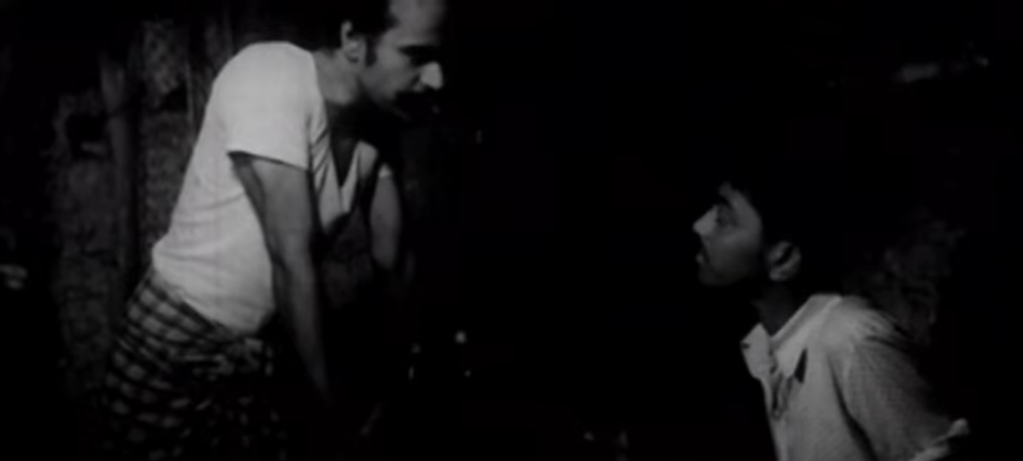
Peruvazhiyambalam (1979)
Filmmaking
Padmarajan entered the Malayalam film industry as a screenwriter in 1975, when he wrote the script for Prayaanam, the directorial debut of the cinematographer-turned-director Bharathan. The collaboration proved foundational, both for Padmarajan and for Malayalam cinema as a whole. Padmarajan and Bharathan, soon joined in spirit by K. G. George, came to define a new approach to filmmaking in the late 1970s—one that rejected the formulaic excesses of the commercial cinema without retreating into the rarefied difficulty of the art film. Padmarajan went on to write a number of screenplays for Bharathan in this period, among them the much-discussed Rathinirvedam (1978), a frank coming-of-age story that combined commercial appeal with a serious treatment of adolescent desire.
His own directorial debut came in 1979 with Peruvazhiyambalam, which he both wrote and directed. The film, whose title evokes the wayside resting place or "halfway house" of a public road, told the story of a boy who kills a local bully and becomes, paradoxically, a figure of awe and authority. It announced Padmarajan as a major directorial talent: Peruvazhiyambalam won the National Film Award for Best Feature Film in Malayalam, along with the Kerala State Film Awards for Second Best Film and for Best Screenplay. From the outset, then, Padmarajan was recognised as a filmmaker who could unite critical distinction with narrative power, and who brought to the screen the same moral curiosity about violence, transgression, and social hierarchy that animated his fiction.
Through the early 1980s Padmarajan consolidated his position with a series of films that explored a remarkable range of subjects and tones. Oridaththoru Phayalvaan (1981), a tale set around a travelling wrestler, demonstrated his gift for rooting drama in the specific textures of small-town and rural life. Koodevide (1983) turned to the world of a boarding school and the troubled relationships among its inhabitants, while other films of the period engaged with crime, obsession, and the disquieting undercurrents of ostensibly ordinary communities. Throughout, Padmarajan worked closely with a recurring circle of collaborators—cinematographers, composers, and actors—building an ensemble sensibility that lent his films coherence and depth.
The middle and later years of the 1980s saw Padmarajan reach the summit of his powers. In 1986 alone he released several of his most enduring works. Namukku Parkkan Munthiri Thoppukal (1986), a romance of rare tenderness, became one of the best-loved films in the history of Malayalam cinema; its cinematographer, Venu, won the National Film Award for Best Cinematography, while its lead actress, Shari, won the Kerala State Film Award for Best Actress, and Padmarajan himself received the Kerala Film Critics Association Award for Best Screenplay. The same year saw Desadanakkili Karayarilla, a sensitive and unconventional story of two schoolgirls who run away together, as well as Arappatta Kettiya Graamathil and Kariyilakkattu Pole, films that further demonstrated his thematic daring and his willingness to portray desire, rebellion, and despair without moralising.
In 1987 Padmarajan made Thoovanathumbikal, adapted partly from his own novel Udakappola and now widely regarded as his masterpiece. A bittersweet love story poised between a respectable romance and an affair with a sex worker, set against the recurring motif of rain, the film achieved a delicate fusion of realism and lyricism that has made it a touchstone of Malayalam cinema; it again brought Padmarajan recognition for his screenplay. He followed it with Aparan (1988), a tense psychological drama built on the doppelgänger motif of a man haunted by a double, and Moonnam Pakkam (1988), an elegiac study of a grandfather and grandson by the sea that is among the most emotionally affecting of all his works.
Padmarajan’s final films sustained this extraordinary level of accomplishment. Season (1989), set amid the tourist economy of Kovalam, explored crime and exploitation in a coastal milieu. Innale (1990), a haunting story of an amnesiac woman reconstructing an identity that may not be wholly her own, won him the Kerala Film Critics Association Award for Best Screenplay. His last completed film, Njan Gandharvan (1991), drew on myth and fantasy in its tale of a celestial being who descends to the human world, marking a striking late turn toward the supernatural. Within days of its release, Padmarajan was dead. He suffered a sudden cardiac arrest on 24 January 1991 while staying at a hotel in Kozhikode (Calicut), where he had travelled in connection with the film. He was forty-five years old.

Parkkan Munthiri Thoppukal (1986). Source NFAI.
The Cinema of Padmarajan
The cinema of Padmarajan is defined above all by a profound humanism—an abiding fascination with the interior lives of his characters and a refusal to reduce them to the simple moral categories of popular melodrama. Trained first as a writer, he approached film as a narrative art in which character and emotion took precedence over spectacle, and his finest works achieve their power through accumulation of detail, nuance of performance, and the patient observation of how people love, deceive, long, and grieve. His was a cinema of feeling rather than statement, suggestion rather than declaration; meaning emerges from gesture, silence, and atmosphere as much as from plot.
Formally, Padmarajan occupied a deliberate middle ground. He retained the storytelling pleasures and emotional accessibility of the popular film—a clear narrative line, memorable songs, and strong characterisation—while infusing them with the thematic seriousness and psychological realism associated with the art cinema. He had a painterly eye, developed in close partnership with his cinematographers, and an exceptional ear for sound and music, doubtless sharpened by his years in radio. Landscape and weather function in his films almost as characters in their own right: the rain in Thoovanathumbikal, the sea in Moonnam Pakkam, the village pathways and waterways of his Travancore films are charged with mood and meaning. His use of music, particularly his celebrated collaborations with composers of the period, is integral rather than ornamental, binding image and emotion into a single lyrical fabric.
Equally characteristic is Padmarajan’s sympathy for the marginal and the transgressive. His protagonists are frequently outsiders—drifters, criminals, runaways, sex workers, the lovelorn and the disillusioned—and he regarded them with a tenderness and moral seriousness rare in the commercial cinema of his time. He was unafraid of desire, of moral ambiguity, or of unhappy endings, and he repeatedly declined to punish his characters according to conventional codes of virtue and vice. In this he extended directly the concerns of his fiction, carrying into the popular cinema a writer’s curiosity about the full, contradictory range of human conduct.
Key Themes
Romantic love and its impossibility. Across his films, love is rendered with extraordinary delicacy yet rarely permitted an untroubled fulfilment. From the bittersweet romance of Thoovanathumbikal to the tender union of Namukku Parkkan Munthiri Thoppukal, Padmarajan treats longing, separation, and the fragility of intimacy as the central drama of human life.
The outsider and the margins of society. Padmarajan was drawn to characters who live at the edges of respectability—criminals, drifters, runaways, and the socially excluded—portraying them without condescension and often with a fierce sympathy that overturns the audience’s easy moral judgements.
Transgression, crime, and moral ambiguity. Inheriting the preoccupations of his fiction, his films dwell on deceit, violence, jealousy, and desire, refusing tidy resolutions and allowing his characters the full complexity of their flaws, as in Peruvazhiyambalam and Season.
Identity, doubling, and the unstable self. Films such as Aparan, with its motif of the haunting double, and Innale, with its amnesiac heroine, probe the precariousness of personal identity and the unsettling possibility that the self may be lost, divided, or reconstructed.
Memory, mortality, and loss. A pervasive sense of transience runs through his work, nowhere more movingly than in Moonnam Pakkam, where the bond between generations is shadowed by death and the inexorable passage of time.
Nature, landscape, and the elements. Rain, sea, and the rural landscape of Kerala recur as expressive forces in his cinema, externalising the emotional states of his characters and lending his films their distinctive lyrical atmosphere.
Selected Filmography
Peruvazhiyambalam (1979). Padmarajan’s directorial debut, the story of a boy who kills a village tyrant and is transformed into an object of fearful reverence. A study of violence, power, and social hierarchy, it won the National Film Award for Best Feature Film in Malayalam and announced a major new voice in Indian cinema.
Oridaththoru Phayalvaan (1981). A drama centred on a travelling wrestler, notable for its rich evocation of small-town life and its sympathetic portrait of an outsider figure. The film exemplifies Padmarajan’s gift for grounding human drama in vividly observed regional milieu.
Koodevide (1983). Set in the closed world of a boarding school, the film examines troubled relationships, authority, and vulnerability, demonstrating Padmarajan’s skill at drawing nuanced performances and excavating tension beneath ostensibly ordinary institutions.
Namukku Parkkan Munthiri Thoppukal (1986). One of the most beloved romances in Malayalam cinema, a tender story of devoted love. Its cinematographer Venu won the National Film Award for Best Cinematography and its lead actress Shari the Kerala State Film Award for Best Actress, while Padmarajan was honoured for his screenplay.
Desadanakkili Karayarilla (1986). An unconventional and quietly daring story of two schoolgirls who run away together, distinguished by its sensitivity toward adolescent friendship, rebellion, and emotional need, and by its refusal of conventional moral framing.
Thoovanathumbikal (1987). Adapted in part from his own novel Udakappola and widely regarded as his masterpiece, a bittersweet romance set against the recurring motif of rain, poised between a respectable love and an affair with a sex worker. Its fusion of realism and lyricism has made it a touchstone of Malayalam cinema.
Aparan (1988). A taut psychological thriller built on the doppelgänger motif, in which a young man is tormented by the existence of an identical double who commits crimes in his name. The film explores identity, paranoia, and the instability of the self.
Moonnam Pakkam (1988). An elegiac and profoundly moving study of the bond between a grandfather and his grandson by the sea, shadowed throughout by intimations of mortality. It is among the most emotionally resonant of all Padmarajan’s films.
Season (1989). A drama of crime and exploitation set amid the tourist economy of the Kovalam coast, marked by Padmarajan’s characteristic attention to milieu and his unflinching treatment of moral compromise and violence.
Innale (1990). A haunting story of an amnesiac woman who must reconstruct an identity that may not truly be her own, a meditation on memory, selfhood, and the fragility of the past. The screenplay won the Kerala Film Critics Association Award.
Njan Gandharvan (1991). His final completed film, a turn toward myth and fantasy in its tale of a celestial gandharva who descends to the mortal world. Released only days before his death, it stands as a poignant coda to his career.
Legacy
Padmarajan’s death in January 1991, at the age of forty-five and at the very height of his creative powers, was received as one of the great losses of modern Malayalam culture. Yet in the decades that followed, his reputation has not merely endured but steadily expanded. His films have become permanent fixtures of the Malayalam cinematic imagination, revived in theatres and on television, restored for new audiences, and continually rediscovered by younger viewers for whom Thoovanathumbikal, Namukku Parkkan Munthiri Thoppukal, and Moonnam Pakkam remain points of emotional and artistic reference. Few directors anywhere in Indian cinema have achieved so rare a combination of enduring popular affection and sustained critical regard.
His influence on subsequent generations of filmmakers has been profound and pervasive. The "middle cinema" sensibility that he, Bharathan, and K. G. George pioneered—films that were serious without being austere, popular without being formulaic—established a template that shaped Malayalam cinema for decades and that informs much of the celebrated work of the contemporary Malayalam new wave. Directors and writers across the industry have acknowledged his example: his attentiveness to character, his lyrical use of landscape and music, his moral courage in depicting transgressive and marginal lives, and his refusal of easy sentiment have all become part of the inheritance of Malayalam film.
Padmarajan’s standing as a writer has likewise been preserved. His novels and short stories remain widely read and continue to be reissued, securing his place in the modern Malayalam literary canon alongside his stature as a filmmaker—an unusual dual achievement that few in any Indian language have matched. The recognition he received in his lifetime, from the National Film Award for Peruvazhiyambalam to his repeated Kerala State and Kerala Film Critics Association honours for screenwriting and direction, has been amplified by posthumous tributes, retrospectives, and scholarly attention. An award instituted in his memory, the Padmarajan Award, continues to honour notable achievement in film, ensuring that his name remains attached to the recognition of new talent.
Assessed in the long view, Padmarajan occupies a singular place in the history of Indian cinema. He demonstrated that a regional, popular cinema could be at once commercially vital and artistically serious, that the conventions of melodrama could be bent toward genuine psychological truth, and that the lives of the obscure and the transgressive deserved to be told with tenderness and respect. Working in a single language and within a single, intense decade of filmmaking, he created a body of work whose emotional depth and formal grace continue to set a standard. More than three decades after his death, Padmarajan endures not as a figure of nostalgia but as a living presence in Malayalam cinema—the writer-director who, perhaps more than any other, taught it how to feel.