
K. Balachander
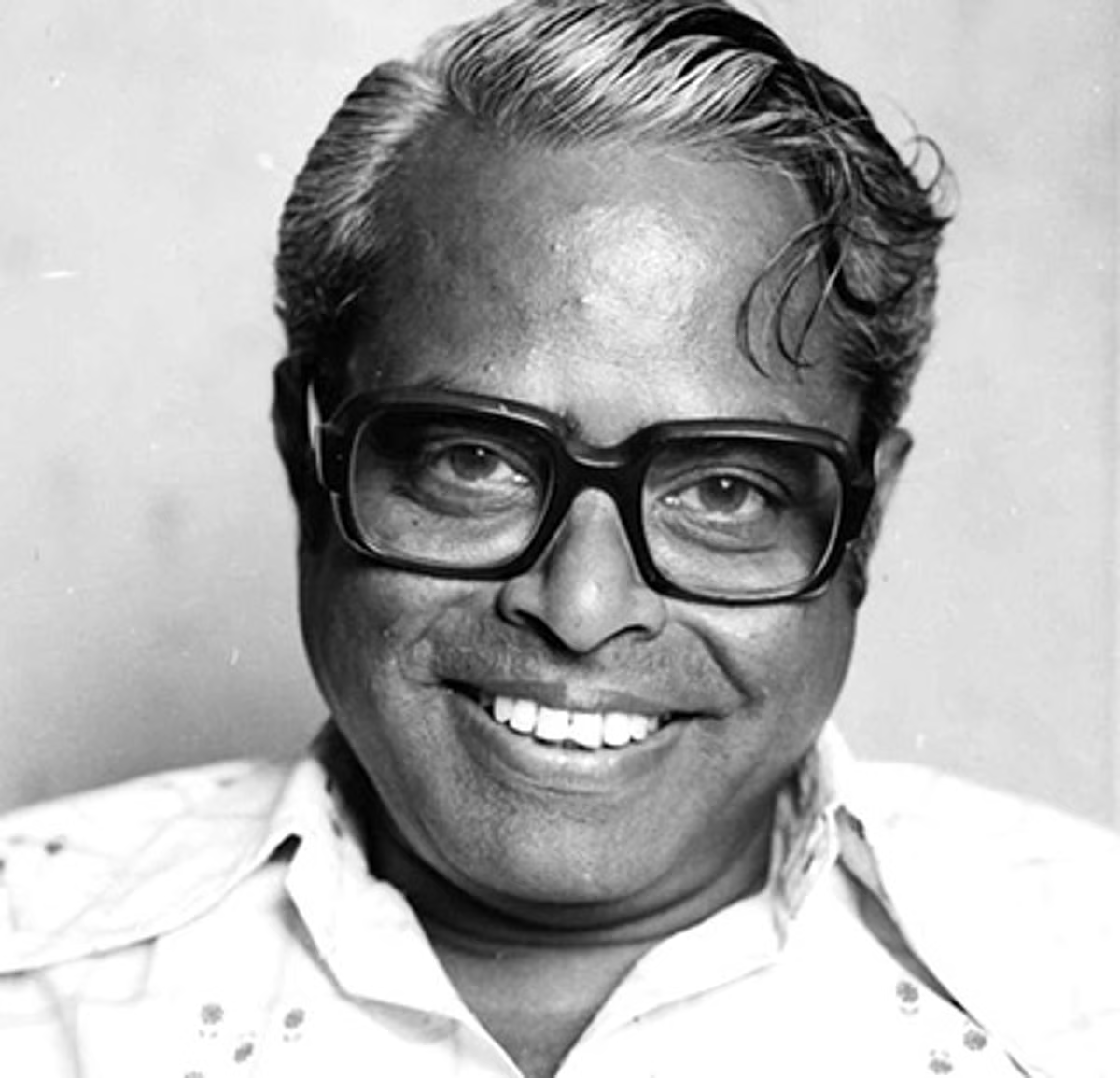
Kailasam Balachander (1930–2014), K. Balachander, was an Indian film director, screenwriter, producer, playwright, and actor who stands among the most influential figures in the history of Tamil cinema. Working principally in Tamil but also extensively in Telugu and occasionally in Hindi and Kannada, he fashioned, over a career spanning five decades and nearly one hundred feature films, a body of work distinguished by its insistence on serious social subject matter, psychologically complex characters, and an unfashionable willingness to place women at the moral and dramatic centre of his narratives. Reverentially known across the South Indian film world as Iyakkunar Sigaram (“the pinnacle of directors”), Balachander brought to popular cinema the sensibility of the modern stage, transforming melodrama into a vehicle for the examination of caste, class, gender, and the moral compromises of middle-class life.
Balachander emerged from the amateur theatre movement of Madras in the 1950s, and his films never fully relinquished the theatrical concentration on dialogue, performance, and confined dramatic space. Yet he was no mere filmer of plays. He developed a distinctive cinematic idiom in which long, charged conversations, unexpected narrative structures, and morally ambiguous resolutions challenged the conventions of the hero-centred commercial film. At a time when Tamil cinema was dominated by larger-than-life male stars and the political iconography of the Dravidian movement, Balachander redirected attention towards ordinary, often marginalised people, and especially towards women portrayed as headstrong, intelligent, and self-determining.
His critical and popular standing was matched by formal recognition. Across his career Balachander received nine National Film Awards, fourteen Tamil Nadu State Film Awards, five Nandi Awards, and thirteen Filmfare Awards South. In 1987 the Government of India conferred upon him the Padma Shri, the country’s fourth-highest civilian honour, and in 2010 he received the Dadasaheb Phalke Award, India’s highest distinction in cinema, in acknowledgement of a lifetime’s contribution to the medium.
Beyond his own films, Balachander exerted an extraordinary influence as a discoverer and shaper of talent. Through his production house, Kavithalaya Productions, and his films he introduced or launched the careers of figures who would define Indian popular cinema for generations, among them the actors Kamal Haasan and Rajinikanth, the actresses Sridevi, Jayasudha, Jaya Prada, and Saritha, and the composer A. R. Rahman. To speak of the “KB school” is to acknowledge a lineage that runs through the whole of modern Tamil and Telugu cinema.
Life and Early Work
K. Balachander was born on 9 July 1930 in Nannilam, in the Tanjore district of the Madras Presidency (now part of Tiruvarur district, Tamil Nadu). Raised in a Tamil family in the deltaic heartland of the Kaveri, he later recalled that his fascination with cinema began in early childhood; by his own account he had been “seeing cinema” from the age of eight, and his imagination was first captured by the films of M. K. Thyagaraja Bhagavathar, then the reigning superstar of the Tamil screen. By the age of twelve he had been drawn to theatre and drama, an attraction that would prove the decisive formative influence of his life.
Balachander pursued his higher education at Annamalai University, where he graduated in Zoology in 1949 while remaining deeply involved in stage productions. After completing his degree he worked briefly as a school teacher in Muthupet, in his native Tiruvarur district. In 1950 he moved to Madras and joined the office of the Accountant General as an apprentice clerk, eventually rising to the position of superintendent. It was during these years of clerical employment that his parallel life in the theatre flourished.
In Madras he joined the amateur drama company “United Amateur Artistes” and soon formed his own troupe. He came to prominence as a playwright with Major Chandrakanth, which he wrote first in English and then, recognising the limited audience for English-language theatre in the city, rewrote in Tamil, where it became a sensation. His troupe drew together performers who would become mainstays of Tamil cinema, including Major Sundarrajan, Nagesh, Srikanth, and Sowcar Janaki. Among the other plays he wrote, produced, and directed were Server Sundaram, Neerkumizhi, Mezhuguvarthi, Naanal, and Navagraham, works that were well received by critics and that established him as one of the leading dramatists of his generation. The discipline of the stage — its reliance on the spoken word, on tightly constructed situations, and on ensemble performance — would remain visible throughout his cinema.
Balachander acknowledged a lasting debt to the Tamil poet Subramania Bharati, whom he had admired since childhood and whose reformist and humanist concerns he traced through many of his own films. In 1956, while still employed at the Accountant General’s office, he married Rajam; the couple had three children, including Bala Kailasam, who would himself become a noted television producer.
Filmmaking
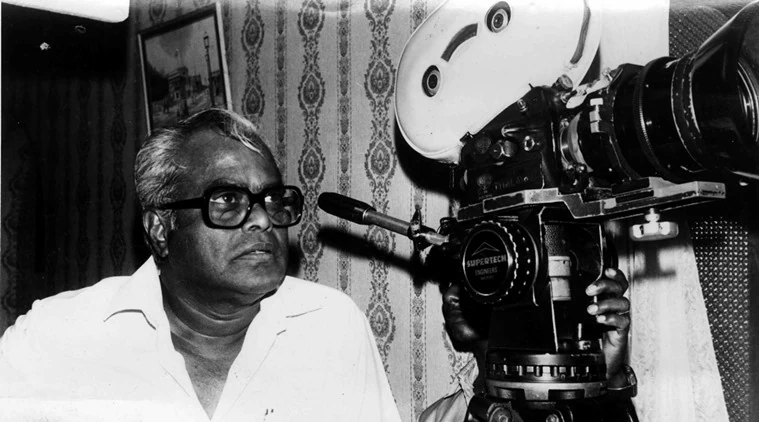
Balachander’s entry into cinema came through writing. In 1964 the actor M. G. Ramachandran invited him to compose the dialogue for the film Dheiva Thaai (1964). Though initially reluctant, given his commitment to the theatre, he was persuaded by friends to take up the work. In the same period his plays began to be adapted for the screen: Server Sundaram, filmed by the directorial duo Krishnan–Panju with Nagesh in the lead, won wide acclaim, while Major Chandrakanth was adapted into Hindi as Oonche Log (1965), which received a National Film Award.
He made his own directorial debut with Neerkumizhi (1965), based on his own play and performed largely by members of his theatrical troupe. A succession of stage-derived films followed, including Naanal, Major Chandrakanth (1966), which gave the future Tamil Nadu Chief Minister Jayalalithaa a leading role, and Ethir Neechal (1968). In 1967 he directed Bama Vijayam, an ensemble family comedy whose success in Tamil prompted Balachander’s own Telugu remake and a subsequent Hindi version, Teen Bahuraniyan. With Iru Kodugal (1969) and a string of films in the early 1970s he turned increasingly towards a realist treatment of family and social questions.
The decade of the 1970s saw Balachander produce some of his most daring and consequential work. Arangetram (1973) confronted poverty and prostitution through the story of the eldest daughter of a conservative Brahmin household who turns to sex work to support her siblings; the film’s frankness was well ahead of its time in Tamil cinema, and it gave Kamal Haasan his first significant adult role — the beginning of a collaboration that would extend across some thirty-five films. Aval Oru Thodar Kathai (1974), inspired in part by Ritwik Ghatak’s Bengali classic Meghe Dhaka Tara, examined the emotional life of a working woman who is the sole earner for her family, and became a landmark of the female-centred film.
In 1975 Balachander made Apoorva Raagangal, an original story of intergenerational romance entangling two families, which marked the screen debut of Rajinikanth in a key supporting role; the film won the National Film Award for Best Feature Film in Tamil. In the years that followed he was extraordinarily prolific, frequently directing several films a year and casting Kamal Haasan as his leading man. Moondru Mudichu (1976) introduced the child actress Sridevi as an adult heroine, while Manmadha Leelai (1976), a study of a womaniser, achieved cult status as a trendsetter. Avargal (1977) traced the life of a divorced woman moving through her relationships, and Varumayin Niram Sigappu (1980) charted the indignities of unemployment in a harsh and indifferent city.
Balachander was simultaneously a major force in Telugu cinema, where, alongside K. Vishwanath and Bapu, he was regarded as a trailblazer of the late 1970s and 1980s. Maro Charitra (1978), a cross-cultural love story, became one of the most admired Telugu films of its era, and he later achieved a further peak in the language with Rudraveena (1988), starring Chiranjeevi, a film about art and social conscience widely counted among the finest in Telugu cinema. He remade Maro Charitra in Hindi as Ek Duuje Ke Liye (1981), which launched Kamal Haasan, the actress Rati Agnihotri, and the playback singer S. P. Balasubrahmanyam in Hindi cinema and won Balachander the Filmfare Award for Best Screenplay. His earlier Hindi venture, Aaina (1977), had been a remake of Arangetram.
The early 1980s produced some of his most politically and socially charged films. Thaneer Thaneer (1981), adapted from a play by Komal Swaminathan, dramatised a drought-stricken village’s struggle for water against a backdrop of bureaucratic indifference and political opportunism, and won the National Film Award for Best Screenplay as well as recognition as the best regional film. 47 Natkal (1981) followed a newly married woman enduring an abusive expatriate husband in suburban Paris. Achamillai Achamillai (1984), an unsparing indictment of political corruption, won the National Film Award for Best Feature Film in Tamil. Sindhu Bhairavi (1985), produced under his own banner, dramatised the collision and romance between an eminent but complacent Carnatic vocalist and the educated woman who challenges him; it remains among his most beloved works and brought further national recognition to its performers and music.
From the late 1980s through the 1990s Balachander increasingly turned to television, creating numerous serials — among them Rail Sneham, Ramani vs Ramani, Kasalavu Nesam, and Anni — which, like his films, often placed strong women at their centre. He observed that the medium allowed him to “reach out to the public” in a new way. It was as a producer in this period that he made one of his most far-reaching contributions to Indian cinema: his Kavithalaya production Roja (1992), directed by Mani Ratnam, introduced the composer A. R. Rahman and became a cultural landmark. His later directorial work included Parthale Paravasam (2001) and Poi (2006), and he continued to mentor and produce, returning briefly to the stage in 2009. His final screen appearance was a role in Uttama Villain (2015), a Kamal Haasan film released after his death.
The Cinema of K. Balachander
Balachander’s cinema is defined by the tension between the popular form he worked within and the serious moral and social purposes to which he bent it. He accepted the conventions of mainstream Tamil and Telugu cinema — stars, songs, melodrama, emotional intensity — yet repeatedly subverted them from within, refusing easy resolutions and confronting audiences with characters whose choices were ambiguous, compromised, or quietly transgressive. His training in the theatre gave his films their characteristic density of dialogue and their reliance on performance and confrontation rather than spectacle, while his instinct as a storyteller — he was known to construct his scripts backwards, beginning from the climax — lent his narratives an architectural precision.
More than any of his contemporaries in popular Tamil cinema, Balachander shifted the centre of gravity away from the heroic male protagonist. His most enduring films are studies of women navigating economic precarity, social judgement, and the constraints of patriarchal family life, and his refusal to sentimentalise or punish these women marked a decisive departure from convention. At the same time his films engaged directly with the structures of caste, class, and political power, treating cinema as a space in which the moral health of a changing society could be examined.
Key Themes
Women as moral and dramatic centre: Across Arangetram, Aval Oru Thodar Kathai, Avargal, and Sindhu Bhairavi, Balachander placed intelligent, self-determining women at the heart of his narratives, portraying their struggles with dignity rather than as objects of pity or romance.
Social realism and the middle class: He repeatedly dramatised the anxieties of ordinary, middle- and lower-middle-class life — unemployment, poverty, the burdens of family obligation — most directly in films such as Varumayin Niram Sigappu and Thaneer Thaneer.
Unconventional and transgressive relationships: Intergenerational love, divorce, adultery, and other socially fraught bonds recur throughout his work, from Apoorva Raagangal to Manmadha Leelai, treated with a frankness rare in the cinema of his time.
Political and bureaucratic critique: In Thaneer Thaneer and Achamillai Achamillai he turned an unflinching gaze on corruption, opportunism, and the failures of public institutions.
Art, conscience, and the individual: Films such as Sindhu Bhairavi and Rudraveena explore the responsibilities of the artist and the relationship between aesthetic excellence and social commitment.
Selected Filmography
Neerkumizhi (1965). Balachander’s directorial debut, adapted from his own stage play and performed largely by his theatrical troupe, establishing the dialogue-driven, ensemble manner that would mark his cinema.
Arangetram (1973). A bold study of poverty and prostitution centred on a young Brahmin woman who sacrifices herself for her family; ahead of its time in subject matter and the film that launched Kamal Haasan as an adult actor.
Aval Oru Thodar Kathai (1974). A landmark female-centred drama, partly inspired by Ritwik Ghatak’s Meghe Dhaka Tara, depicting a working woman who is the sole support of her family.
Apoorva Raagangal (1975). An original tale of intergenerational romance across two families that marked the screen debut of Rajinikanth and won the National Film Award for Best Feature Film in Tamil.
Maro Charitra (1978). A Telugu cross-cultural love story regarded as one of the finest films of its era; later remade by Balachander in Hindi as Ek Duuje Ke Liye.
Ek Duuje Ke Liye (1981). His celebrated Hindi remake of Maro Charitra, a major box-office success that launched Kamal Haasan in Hindi cinema and won Balachander the Filmfare Award for Best Screenplay.
Thaneer Thaneer (1981). Adapted from Komal Swaminathan’s play, a searing account of a drought-stricken village and bureaucratic indifference that won the National Film Award for Best Screenplay.
Achamillai Achamillai (1984). An unsparing examination of political corruption that won the National Film Award for Best Feature Film in Tamil.
Sindhu Bhairavi (1985). A richly drawn drama of music, intellect, and romance between a Carnatic vocalist and his critic, among the most beloved of his films.
Rudraveena (1988). A Telugu film starring Chiranjeevi on art and social conscience, widely counted among the greatest works of Telugu cinema.
Roja (1992). Produced under Balachander’s Kavithalaya banner and directed by Mani Ratnam, the film that introduced the composer A. R. Rahman and became a national cultural landmark.
Legacy
Balachander’s legacy rests on a dual achievement: he expanded the thematic and moral range of popular South Indian cinema, and he nurtured the talent that would carry that cinema into the future. By insisting that commercial films could address prostitution, unemployment, political corruption, and the inner lives of women, he demonstrated that seriousness and popularity need not be opposed, and he opened a path between the parallel cinema of the festival circuit and the mainstream of the Tamil and Telugu industries.
His role as a mentor was without parallel in the South Indian film world. The two towering stars of modern Tamil cinema, Kamal Haasan and Rajinikanth, were both shaped decisively by him, and the actresses Sridevi, Jayasudha, Jaya Prada, Saritha, and Saritha’s contemporaries owed their careers in large part to his discernment. As a producer he gave A. R. Rahman his first film and helped launch Mani Ratnam’s Roja. So extensive was his influence that the phrase “the KB school” came to denote an entire tradition of performers, writers, and technicians who passed through his orbit.
The honours he received reflect this stature. He was named a Kalaimamani by the Government of Tamil Nadu, won nine National Film Awards along with numerous state, Nandi, and Filmfare honours, received the Padma Shri in 1987, and in 2010 was awarded the Dadasaheb Phalke Award, the highest recognition in Indian cinema. When he died in Chennai on 23 December 2014 at the age of eighty-four, he was cremated with state honours, and tributes across the country acknowledged the passing of a figure who had, in the words of one obituary, taken Tamil cinema “beyond hero-centric creations.”
In the longer view, Balachander occupies a singular place in the history of Indian cinema: a popular entertainer who never surrendered his moral seriousness, a man of the theatre who reshaped the screen, and a teacher whose pupils became the defining artists of their age. His films endure not only as documents of a changing Tamil society but as demonstrations of how mainstream cinema, in the hands of a rigorous and humane intelligence, can become an instrument of conscience.