
Girish Kasarvalli

Girish Kasaravalli (born 3 December 1950) is one of India's most distinguished auteurs, widely recognised as the foremost architect of the New Wave movement in Kannada cinema. Over a career spanning nearly five decades, he has consistently refused the blandishments of commercial filmmaking, producing instead a body of work of uncommon rigour, moral seriousness, and formal beauty.
Educated at the Film and Television Institute of India (FTII), Pune, where he graduated with a gold medal in 1975, Kasaravalli came of age in the same intellectual milieu that produced several of the founders of Indian Parallel Cinema. His debt to neo-realism and to world masters such as Yasujir? Ozu, Satyajit Ray, Michelangelo Antonioni, and Federico Fellini is evident across his filmography, yet his cinema remains deeply rooted in the cultural, social, and literary landscape of Karnataka.
His debut feature, Ghatashraddha (1977), based on a novella by the Jnanpith Award-winning writer U.R. Ananthamurthy, won the National Award for Best Film and announced the arrival of a filmmaker of formidable seriousness. In the decades that followed, four of his feature films went on to win the Golden Lotus — a record that places him among the most decorated filmmakers in Indian cinema history. Films such as Tabarana Kathe, Thaayi Saheba, and Dweepa were celebrated at major international festivals while remaining intimately anchored in the idiom of Karnataka.
A recipient of the Padma Shri (2011) and multiple National Film Awards, Kasaravalli has also served as a teacher, a juror, and a documentarian. His feature-length documentary on Adoor Gopalakrishnan, Images/Reflections (2015), attests to his deep engagement with cinema as a culture and not merely as a practice.
Life and Early Work
Girish Kasaravalli was born on 3 December 1950 in Kesalur, a village in the Tirthahalli taluk of Shimoga district, Karnataka, to Ganesh Rao and Lakshmi Devi. He completed his primary schooling in Kesalur and his middle-level education at Kanmarradi Middle School before moving to Manipal to study pharmacy — a practical concession to circumstance that would not last long. His family was steeped in cultural tradition: his father was a devoted patron of Yakshagana, the folk dance-drama native to the coastal regions of Karnataka, and his uncle, K.V. Subbanna — later recipient of the Ramon Magsaysay Award — was the founder of a celebrated drama company. Both influences fostered in the young Kasaravalli an acute sensitivity to narrative form, performance, and community storytelling.
His earliest encounters with cinema were through the touring talkies that occasionally visited Kesalur, screening popular Kannada films to village audiences. These visits left a lasting impression, and even during his years in pharmacy at Manipal, Kasaravalli remained active in theatrical circles. He eventually found it impossible to reconcile his professional obligations with his creative instincts, and abandoned his pharmaceutical career to enrol at the Film and Television Institute of India in Pune, where he specialised in film direction and graduated in 1975.
At the FTII, Kasaravalli encountered the great tradition of world cinema that would define his aesthetic sensibility. The works of Ozu, Ray, Antonioni, Fellini, and Kurosawa deepened his conviction in neo-realism as both a method and an ethical stance. His diploma film, Avashesh, which explored the quiet lives of a neglected child and an elderly woman within a household indifferent to both, won the National Award for Best Experimental Short Film and was screened as part of the Indian Panorama at Filmotsav '78. Even before his feature debut, then, Kasaravalli had demonstrated a distinctive ability to locate meaning in stillness, in marginality, and in the unspoken. In his final year at the FTII, he was chosen as assistant director to the eminent B.V. Karanth on Chomana Dudi (1975), a formative experience that consolidated his understanding of Kannada literary culture and its cinematic possibilities.
Filmmaking
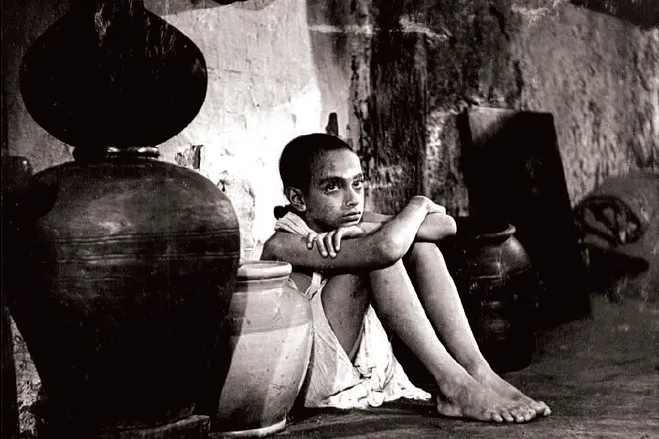
Kasaravalli's debut feature, Ghatashraddha (1977), was a landmark not only in his own career but in the broader history of Kannada and Indian art cinema. Adapted from U.R. Ananthamurthy's novella and shot in black and white, the film is set in an orthodox Brahmin community in 1920s Karnataka and narrates the fate of a young widow — Yamuna — through the observing eyes of a young schoolboy. Her transgression of caste and social codes, and the brutal ritual of excommunication that follows, are rendered with unflinching realism and a profound humanism. The film won the National Award for Best Film and was the only Indian film selected by the National Archives of Paris to represent Indian cinema at the centenary of cinema celebrations.
His subsequent feature, Akramana (1979), was a psychological drama examining characters caught between the demands of family and tradition. Mooru Darigalu (1981), a more formally experimental work built on a complex literary structure, encountered production difficulties that compromised its realisation, though it remains significant as evidence of Kasaravalli's ambition to push the boundaries of narrative form. His next major film, Tabarana Kathe (1986), based on a story by Poornachandra Tejasvi, emerged as one of his most beloved works. The story of a retired government employee struggling to claim his pension while his ailing wife declines beside him is both a coruscating critique of bureaucratic indifference and an intensely moving portrait of loyalty and love. The film won the National Award for Best Film, with Charu Haasan winning the National Award for Best Actor.
After a period of teaching at a film institute and working in television — including the direction of the mega-serial Grihabhanga, based on S.L. Bhyrappa's novel — Kasaravalli returned to feature filmmaking with Mane (1989/1990), an urban drama adapted from T.G. Raghava, and Kraurya (1996), a quietly devastating film about a widowed grandmother whose grief is compounded by the emotional aridness of the world around her. Both films demonstrated his continued interest in the interior life of marginalised individuals.
Thaayi Saheba (1997) marked another major achievement. Working with the popular actress Jayamala, who both produced and starred in the film, Kasaravalli crafted an ambitious historical drama mapping the personal struggles of a woman against the backdrop of pre- and post-independence India. The film's narrative architecture — interweaving private experience with political transformation — earned it Kasaravalli's third National Award for Best Film and the admiration of his peers, including Adoor Gopalakrishnan, who has cited it as a film of exceptional maturity.
Dweepa (2002), based on Norbert D'Souza's novel, addressed the human cost of dam construction and displacement with a lyrical intensity unusual even for Kasaravalli. The film's relationship with rain — used extensively as a metaphor for both life and loss — and its visual grandeur marked a partial departure in style while remaining consistent in ethical orientation. It won the National Award for Best Film and starred the late actress Soundarya in a career-defining performance. Subsequent films including Hasina (2004), Naayi Neralu (2006), Gulabi Talkies (2008), Kanasemba Kudureyaneri (2009), Koormavatara (2011), and Illiralare Allige Hogalare (2020) have continued to accumulate awards and festival recognition, confirming the durability and evolution of his vision.
The Cinema of Girish Kasarvalli
At a time when Kannada cinema, like most regional industries in India, was largely organised around the conventions of commercial entertainment — star-driven spectacle, melodrama, and genre formula — Kasaravalli asserted a radically different possibility. From Ghatashraddha onwards, he established that Kannada cinema could engage with the most demanding questions of individual experience, social justice, and cultural identity without conceding an inch to populism. In this sense, his project parallels those of Adoor Gopalakrishnan in Malayalam cinema, Mrinal Sen in Bengali cinema, and Shyam Benegal in Hindi cinema, while remaining entirely its own.
What distinguishes Kasaravalli above all is his sustained fidelity to literature as a source and to realism as a method. He has drawn his subjects from some of the finest writers in Kannada and Indian letters — U.R. Ananthamurthy, Poornachandra Tejasvi, S.L. Bhyrappa, Jayanth Kaikini — but he has always exercised the novelist's right to interrogate the text rather than merely transcribe it. His adaptations are genuine interpretations, shaped by his own moral and aesthetic preoccupations, so that the films exist in productive dialogue with their sources rather than in subordination to them.
His cinema consistently foregrounds those whom history and society have rendered invisible or expendable: the ostracised widow, the pensioner stranded in bureaucratic indifference, the woman resisting patriarchal coercion, the family displaced by the imperatives of development. Yet his approach is never polemical. Kasaravalli trusts his characters and his audience too much to simplify. His films resist the temptation of resolution, allowing moral complexity to breathe. The forces of caste, patriarchy, class, and institutional power are rendered not as abstractions but as lived textures — in the grain of a performance, in the weight of a silence, in the quality of light falling across a familiar room.
Formally, his cinema is characterised by a restrained precision that is the antithesis of exhibitionism. His compositions are purposeful, his editing patient, and his use of sound — including, in the case of Dweepa, an unusually generous deployment of music — always in the service of emotional and thematic meaning rather than effect. Women occupy a central place in his cinema, not as passive objects of narrative attention but as the moral and dramatic centres of their stories. The female leads in his films — from Yamuna in Ghatashraddha to Hasina in Hasina to the protagonists of Thaayi Saheba and Dweepa — are defined by their will, their endurance, and the particularity of their inner lives.
Equally distinctive is his understanding that cinema is made not in isolation but in relation to a culture. Kasaravalli has consistently engaged with Kannada literary tradition, with folk performance, with questions of language and region, while never allowing these engagements to become parochial. His films address Karnataka, but they speak beyond it — to universal experiences of loss, injustice, desire, and dignity. His retrospective at the International Film Festival Rotterdam in 2003, and the screening of Naayi Neralu in the Maestros' category at Rotterdam in 2007, are among many indications of the international resonance of a cinema that is also deeply local.
Key Themes
Caste, Gender, and Social Hierarchy Kasaravalli's films repeatedly examine the mechanisms by which social hierarchies — caste, class, gender — shape and constrain individual lives, from the ritual excommunication of Ghatashraddha to the marital coercion of Hasina.
Literature and the Moral Imagination His sustained engagement with Kannada and Indian literary tradition is not merely a matter of source material but reflects a conviction that the moral imagination of great fiction — its capacity to inhabit other lives with precision and empathy — is the proper model for cinematic storytelling.
The Marginalised Individual At the centre of his films is almost always a figure whom society has deemed peripheral or disposable: the widow, the pensioner, the displaced family, the ageing grandmother. Kasaravalli insists on the full humanity of those the world overlooks.
Realism as Ethical Practice His neo-realist aesthetic is not merely a stylistic preference but an ethical commitment — to what is actually true about the lives he depicts, and to the respect owed to his subjects by a filmmaker unwilling to simplify or sentimentalise them.
Women as Moral Centres Female characters in his films are almost invariably the most complex, the most resilient, and the most fully realised. His cinema offers some of the most sustained and serious portrayals of women in Indian art cinema.
Development, Displacement, and Ecology Films such as Dweepa engage with the human and environmental consequences of large-scale development projects, situating personal stories within larger political and ecological contexts.
Selected Fimography
Ghatashraddha (1977)
A landmark debut, adapted from U.R. Ananthamurthy's novella, set in an orthodox Brahmin community in 1920s Karnataka. Narrated through the perspective of a young boy, the film follows the tragic fate of a young widow who transgresses caste and social law. Shot in black and white with austere beauty, it won the National Award for Best Film and was the only Indian entry selected by the National Archives of Paris to mark cinema's centenary.
Akramana (1979)
A psychological drama exploring the interior struggles of three protagonists caught between personal desire and the constraints of family and tradition. The film's formal ambition and its unsentimental examination of social conformity extended the aesthetic commitments of Kasaravalli's debut.
Mooru Darigalu (1981)
A formally experimental work built around a complex, multi-layered literary structure. Though production difficulties compromised its original design, the film remains a significant index of Kasaravalli's determination to explore non-linear narrative possibilities.
Tabarana Kathe (1986)
Based on a short story by Poornachandra Tejasvi, the film follows a retired government employee and his ailing wife as they navigate the indifferent labyrinths of bureaucracy. A film of restraint, warmth, and devastating precision, it won the National Award for Best Film, with Charu Haasan earning the National Award for Best Actor.
Thaayi Saheba (1997)
A magisterial historical drama tracing a woman's life across the political transitions of pre- and post-independence India. Combining the personal and the political with unusual formal command, the film won Kasaravalli his third National Award for Best Film and was acclaimed by filmmakers and critics alike as one of the finest works of its generation.
Dweepa (2001)
Based on Norbert D'Souza's novel, the film addresses the displacement caused by dam construction with lyrical intensity and visual grandeur. Rain, metaphorically freighted throughout, becomes the film's most eloquent language. Winner of the National Award for Best Film, it starred Soundarya in a performance of extraordinary depth.
Hasina (2004)
A quietly devastating portrait of a woman confronting her husband's abandonment and the weight of a society indifferent to her survival. The film's central performance by Thara won the National Award for Best Actress, while Kasaravalli's direction maintains its characteristic poetic restraint throughout.
Naayi Neralu (2006)
An adaptation of S.L. Bhyrappa's novel on reincarnation, the film pushes Kasaravalli into more metaphysical territory while retaining his commitment to emotional and social truth. Screened in the Maestros' category at International Film Festival Rotterdam 2007 and at the Mumbai International Film Festival.
Gulabi Talkies (2008)
A tender yet socially acute story centred on a woman's life in a coastal Karnataka community, the film won the National Award for Best Film in Kannada and continued Kasaravalli's exploration of feminine experience and cultural belonging.
Koormavatara (2011)
A formally inventive drama about a retired government employee who, bearing a resemblance to Mahatma Gandhi, is cast in a television serial — prompting a meditation on identity, historical memory, and the power of image-making. The film won the National Award for Best Film in Kannada.
Illiralare Allige Hogalare (2020)
Adapted from Jayanth Kaikini's short story, the film examines a family's experience of urban displacement and the pain of belonging to a place that no longer belongs to them. The film received recognition at the Rome Film Festival and the Kassel Documentary Film and Video Festival, reaffirming the international reach of Kasaravalli's late work.
Legacy
Girish Kasaravalli's contribution to Indian cinema is, by any measure, exceptional. With thirteen National Film Awards to his credit — including four National Awards for Best Film — he is among the most honoured filmmakers in the country's history. His recognition with the Padma Shri in 2011 affirmed a career of sustained achievement and influence. A retrospective of his films held at the International Film Festival Rotterdam in 2003 consolidated his standing within world art cinema.
Yet the dimensions of his legacy extend beyond individual accolades. Kasaravalli effectively established that Kannada cinema could sustain an auteurist tradition of the highest order — that a regional language could be the vehicle for universal cinematic experience without surrendering its local specificity. He demonstrated this not once but across five decades and fifteen feature films, maintaining a consistency of purpose and quality that is, in the context of Indian art cinema, without parallel.
As a teacher and mentor — having served on the faculty of a film institute and as principal of the Bangalore Film Institute — he has shaped the sensibilities of successive generations of filmmakers. His daughter Ananya Kasaravalli has herself emerged as a filmmaker, extending the family's engagement with serious cinema. His feature documentary Images/Reflections (2015) on Adoor Gopalakrishnan attests to a filmmaker who understands that the preservation and articulation of cinema culture is as important as the creation of individual films.
In an era in which the pressures of the marketplace have grown more intense and the space for contemplative, socially engaged cinema has progressively narrowed, Kasaravalli's work stands as an argument — patient, elegant, and unyielding — for the moral and artistic possibilities of cinema when it refuses to be anything less than serious. His films endure not merely as historical documents of a particular phase of Indian cinema but as living works, as capable of disturbing and illuminating a contemporary audience as they were at the moment of their creation.