
V Shantaram
V. Shantaram (Shantaram Rajaram Vankudre, 18 November 1901 - 30 October 1990) was one of the founding architects of Indian cinema: a filmmaker, producer, actor, screenwriter, and editor whose career spanned nearly seven decades of the medium's history on the subcontinent. Working primarily in Hindi and Marathi, Shantaram directed more than fifty films and produced over ninety, becoming a towering presence in both the commercial and socially conscious strands of Indian filmmaking. He is most celebrated for works such as Duniya Na Mane (1937), Do Aankhen Barah Haath (1957), Jhanak Jhanak Payal Baaje (1955), and Navrang (1959) - films that brought him national and international recognition, including the President's Gold Medal for Best Film at the National Film Awards, a Silver Bear at the Berlin International Film Festival, and the Samuel Goldwyn International Film Award at the Golden Globes. His foundational role in building India's studio system, first through the Prabhat Film Company (1929) and later through Rajkamal Kalamandir (1942), earned him the Dadasaheb Phalke Award in 1985 and the Padma Vibhushan posthumously in 1992.
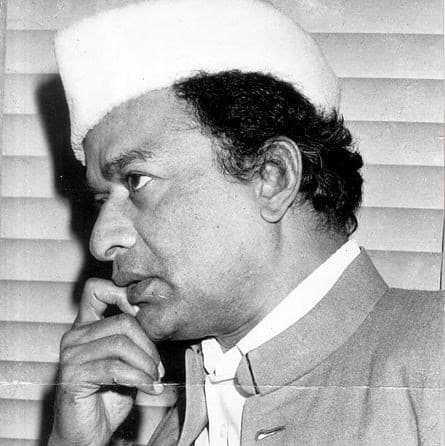
From his earliest silent films through the transition to talkies, the embrace of colour, and the golden era of Hindi cinema in the 1950s and 1960s, Shantaram consistently used the medium not merely as entertainment but as an instrument of social reform. He championed the cause of women's rights and human dignity at a time when Indian society was deeply conservative, producing films that questioned forced marriages, caste prejudice, and communal violence. His deep interest in music, dance, and colour gave his films a distinctive visual texture - one that distinguished them from the realist tradition and placed them in a unique aesthetic space between popular melodrama and humanist cinema.
Shantaram's influence on Indian cinema is difficult to overstate. He was among the first Indian filmmakers to receive sustained international recognition, competing at Venice and Cannes and winning awards at Berlin and at the Golden Globes. He nurtured major talents, introduced significant actors to the screen, and invested in the technical infrastructure of Indian cinema at a time when such infrastructure was still rudimentary. His autobiography, Shantarama, published in Hindi and Marathi, remains a foundational document in the history of Indian cinema, and the numerous institutions established in his name - including the V. Shantaram Motion Picture Scientific Research and Cultural Foundation (1993) and the annual V. Shantaram Award - attest to his enduring stature as a master of the Indian screen.
Known affectionately as Annasaheb and Shantaram Bapu, he was admired by Charlie Chaplin, who praised his Marathi film Manoos (1939) and reportedly watched it with great appreciation. That the creator of City Lights should find kinship in Shantaram's humanist cinema is fitting: both filmmakers believed in the power of cinema to ennoble the common person, to speak truth to social injustice, and to restore dignity to those whom society had marginalised.
Life and Early Work
Shantaram Rajaram Vankudre was born on 18 November 1901 in Kolhapur, then a princely state in British India and today a major city in the state of Maharashtra. He was born into a family of modest means: his father was a Marathi Jain Kasar, and his mother was Hindu. One of five brothers, he grew up in and around Kolhapur, a city with a rich tradition of folk performance, tamasha, and an emerging film culture under the influence of Baburao Painter, the pioneering filmmaker who had established the Maharashtra Film Company there. It was in this culturally vibrant environment that the young Shantaram first encountered the possibilities of the moving image.
Shantaram's formal education was limited, as was common for working-class families of that era in Maharashtra. He was drawn instead to the practical world of the film studio, joining the Maharashtra Film Company owned by Baburao Painter as a general worker doing odd jobs. This apprenticeship was transformative: it gave him an intimate understanding of every aspect of filmmaking - from the handling of equipment and the management of sets to the direction of actors and the organisation of production. He was a gifted learner, and Baburao Painter recognised in him an artistic sensibility that deserved to be cultivated.
He made his acting debut in the silent film Surekha Haran in 1921, the same year he married Vimalabai in an arrangement made by their families. They would go on to have four children together: a son, Prabhat Kumar (named after his future film company), and three daughters, Saroj, Madhura, and Charusheela. It is a telling measure of the cultural interconnections that define Shantaram's lineage that his daughter Madhura would become the wife of the celebrated classical vocalist Pandit Jasraj, and the mother of the musician Shaarang Dev Pandit.
Shantaram was a maternal cousin of the filmmaker Master Vinayak, as well as of Baburao Pendharkar and Bhalji Pendharkar - a family with deep roots in Marathi cinema and theatre. These connections situated him at the heart of an emerging Marathi cultural milieu that was simultaneously engaged with the traditional performing arts and with the new art form of cinema. His directorial talents were quickly evident, and Baburao Painter entrusted him with the direction of Netaji Palkar in 1927, a historical film drawn from the exploits of a lieutenant of the Maratha king Chhatrapati Shivaji. The film established Shantaram as a filmmaker capable of marshalling historical material with visual authority and narrative momentum.
In 1929, Shantaram took the decisive step that would shape Indian cinema for the next two decades. Together with his colleagues Vishnupant Damle, K.R. Dhaiber, S. Fatelal, and the financier S.B. Kulkarni, he co-founded the Prabhat Film Company at Mangalwar Peth, Kolhapur, on 1 June 1929. The company would later relocate to Pune, where it would grow into one of the most important and technically sophisticated studios in the history of Indian cinema. Prabhat's first production, Gopal Krishna (1929), a silent film depicting the life of the child-deity Krishna, was an immediate popular success; the bullock cart race it featured was said to have been the talk of the town across Maharashtra.
Filmmaking
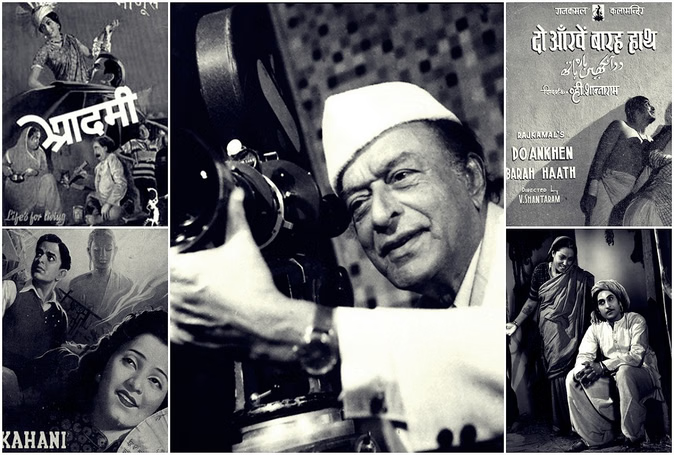
The Prabhat years (1929-1942) represent the most prolific and formative phase of Shantaram's career as a director. When the era of sound arrived in Indian cinema with Alam Ara in 1931, Prabhat responded with characteristic ambition. Shantaram directed Ayodhyecha Raja in 1932 - not only Prabhat's first sound film, but the first Marathi-language talking film, and simultaneously the first bilingual production in the history of Indian cinema, released in both Marathi and Hindi. This capacity for innovation - technical, linguistic, and aesthetic - would define Prabhat's identity throughout the 1930s.
The 1930s were years of extraordinary productivity and artistic risk. Amrit Manthan (1934) was a large-scale costume drama set in ancient India, exploring the conflict between dharma and the corruptions of power, notable for its spectacular visual compositions. Dharmatma (1935) and Chandrasena (1935) pursued similar mythological and historical territory. Amar Jyoti (1936) was among the earliest Indian films to feature a woman as a sea-captain, a choice that reflected Shantaram's consistent interest in unconventional female protagonists.
It was, however, Duniya Na Mane (1937) - also released in Marathi as Kunku - that announced Shantaram as a filmmaker of major social conscience. Adapted from Narayan Hari Apte's novel Na Patnari Goshta, the film tells the story of Nirmala, a young woman deceived into marriage with an elderly widower. The film is one of the earliest examples of proto-feminist cinema in India: a sharp, sustained critique of the patriarchal institution of forced marriage, and of the social conditions that rendered women complicit in their own subjugation. Kunku, the Marathi version, received international recognition at the Venice Film Festival. Shantaram's subsequent social film, Manoos (1939), was praised by Charlie Chaplin, who found in it a humanist vision akin to his own.
Padosi (1941), made in the years immediately before partition and independence, was a remarkable film about Hindu-Muslim friendship and communal harmony - a theme of urgent relevance that would grow only more pressing in the aftermath of 1947. The film stands as one of the most humane documents of the pre-independence era in Indian cinema, and its message of coexistence between communities has lost none of its force.
In 1942, Shantaram departed from Prabhat Film Company to establish Rajkamal Kalamandir in Mumbai. In his personal life, too, this period saw significant change: he had married the actress Jayashree (nee Kamulkar) in 1941, with whom he had worked on several productions including Shakuntala (1943). Rajkamal Kalamandir would, in time, become one of the most technically sophisticated studios in India. Shantaram invested heavily in sound and camera technology, creating a production infrastructure capable of realising his increasingly ambitious artistic vision.
Dr. Kotnis Ki Amar Kahani (1946) stands as one of the most distinguished patriotic films of Indian cinema. Shantaram not only directed but also starred in the film, playing Dr. Dwarkanath Kotnis, the Indian physician who served the Chinese people during the Second Sino-Japanese War. The film is an extraordinary document of internationalist humanism - a tribute to a man who gave his life in service of a people not his own - and it cemented Shantaram's reputation as a filmmaker willing to engage with the largest political and moral questions of his time.
The post-independence decade saw Shantaram pursue increasingly ambitious and eclectic projects. Dahej (1950), a film about the dowry system, was among the earliest mainstream Hindi films to tackle this persistent social evil directly. Amar Bhoopali (1951), a biographical film about the eighteenth-century Marathi poet and folk musician Ram Joshi, demonstrated his enduring interest in music and regional cultural heritage; the film competed at the 1952 Cannes Film Festival and won the prestigious Vulcan Award (Technical Grand Prize) for direction - a significant mark of international recognition for Indian cinema at a time when it was rarely seen abroad.
It was with Jhanak Jhanak Payal Baaje (1955) that Shantaram achieved a major breakthrough in the realm of music and dance cinema. The film - a vivid, colourful celebration of the Kathak dance tradition, featuring the dancer Gopi Krishna - was among the earliest Indian productions to foreground classical dance as both subject and aesthetic principle. It won the President's Silver Medal for Best Feature Film in Hindi at the 3rd National Film Awards and the Filmfare Award for Best Director. His third wife, Sandhya (Vijaya Deshmukh), appeared in the film, and Shantaram married her in 1956; she would become the leading figure of his most celebrated late work.
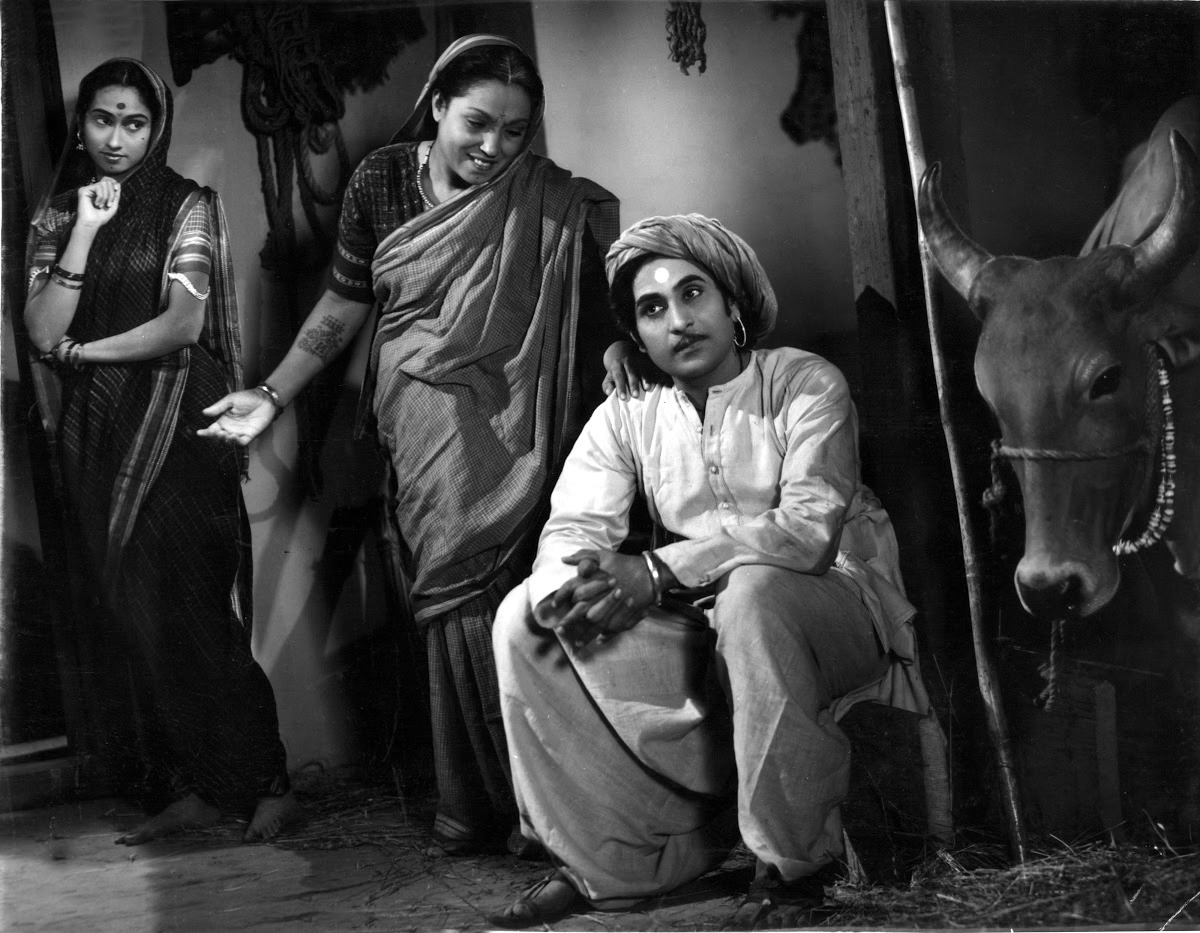
Do Aankhen Barah Haath (1957) is widely regarded as Shantaram's masterwork and one of the defining films of Indian humanist cinema. Based on the true story of a prison warden who attempts to reform six hardened criminals through love, labour, and moral example - housing them on a farm and treating them with trust and dignity - the film is a sustained meditation on the redemptive power of human compassion. It won the President's Gold Medal for the All India Best Feature Film at the 5th National Film Awards, the Silver Bear (Special Prize) at the 8th Berlin International Film Festival, the OCIC Award at Berlin, and the Samuel Goldwyn International Film Award at the 16th Golden Globe Awards in 1959. The Golden Globe recognition made it the first Indian film to win such an award, placing Shantaram in a league of international filmmakers at the height of world cinema's golden era.
Navrang (1959) was Shantaram's most exuberant and visually inventive film: a musical fantasy in which a Marathi poet's relationship with his muse and his jealous wife unfolds through a series of spectacular, colour-saturated song sequences. Sandhya's performance was widely celebrated, and the film's richness - its use of colour as an expressive rather than merely illustrative device - placed it in a distinctive position within Indian cinema. It remains a landmark in the history of Hindi film song and dance.
In the 1960s, Shantaram continued to direct with undiminished energy, introducing his daughter Rajshree and the actor Jeetendra in Geet Gaya Patharon Ne (1964). Sehra (1963) and Jal Bin Machhli Nritya Bin Bijli (1971) extended his interest in song, music, and spectacle. His final significant artistic statement came with the Marathi film Pinjra (1972), a complex psychological drama widely regarded as one of the finest Marathi films of its era. His last film as director was Jhanjhaar (1987), completing a directorial career of sixty years.
The Cinema of Shyam Benegal
Shantaram's cinema occupies a unique and irreplaceable position in the history of Indian film. He was neither a realist in the manner of Satyajit Ray or Ritwik Ghatak, nor a purely commercial entertainer in the mould of the mainstream Hindi film industry. He inhabited a middle space that was entirely his own: a cinema that used the full arsenal of popular entertainment - song, dance, spectacle, melodrama - in the service of social ideas and humanist values. His films were simultaneously crowd-pleasing and morally serious, technically ambitious and ideologically committed.
A central preoccupation across his entire body of work was the relationship between the individual and society. Whether examining the predicament of a young woman trapped in a coerced marriage, the possibility of reforming criminals through trust and labour, the friendship between members of different religious communities, or the sacrificial devotion of a physician to a foreign people, Shantaram consistently returned to the question of how the individual - often marginalised, often wronged - might assert his or her dignity in the face of social oppression. His films offered not revolution but reformation: not the destruction of unjust structures but the possibility of transforming them through personal example, moral courage, and love.
Music and dance were not merely decorative elements in Shantaram's cinema but integral to its meaning. He was himself deeply musical - it is reported that he ghost-wrote music for many of his composers and insisted on extensive rehearsal before approving any song. Films such as Jhanak Jhanak Payal Baaje, Navrang, and Jal Bin Machhli Nritya Bin Bijli are built around dance in a way that goes beyond conventional picturisation: dance becomes a language through which the characters' inner lives are externalised and given form. His use of colour in Navrang anticipates the experiments in colour expressionism that would become more common in Indian cinema decades later.
His technical ambition was equally notable. Shantaram was always alert to the possibilities of the medium as a technical instrument: he invested in equipment, he experimented with camera angles and editing rhythms, and he built studios - first Prabhat, then Rajkamal - that set new standards for technical capability in Indian filmmaking. His transition from silent cinema to sound, and from black-and-white to colour, was managed with creative intelligence; each technological shift was assimilated and turned to expressive advantage rather than merely adopted for commercial necessity.
Key Themes
Social Reform and the Critique of Patriarchy: Throughout his career, Shantaram used cinema as a vehicle for social commentary. Films such as Duniya Na Mane (1937) and Dahej (1950) addressed the exploitation of women within the institution of marriage and the dowry system; Amar Jyoti (1936) imagined a woman as a sea-captain defying patriarchal norms. His social films anticipate many of the concerns that would define the parallel cinema movement of the 1970s, though Shantaram arrived at these concerns through a different aesthetic tradition.
Humanism and Redemption: Do Aankhen Barah Haath (1957) is the fullest expression of a theme that runs throughout Shantaram's work: the belief that no human being is irredeemably corrupt, and that compassion, trust, and productive labour can restore the humanity of even the most hardened criminal. This faith in the transformative power of moral example is at the heart of his artistic vision, and it connects his cinema to a tradition of reformist humanism that runs from Tolstoy through Chaplin to Shantaram himself.
Communal Harmony and Nationalism: Padosi (1941) and Dr. Kotnis Ki Amar Kahani (1946) reflect Shantaram's commitment to a pluralist, internationalist vision of Indian identity. The former champions Hindu-Muslim coexistence on the eve of partition; the latter celebrates the sacrificial service of an Indian doctor in wartime China. Both films engage with the question of what it means to be a good human being in a world divided by religion, ethnicity, and nation.
Music, Dance, and Visual Spectacle: Shantaram was a filmmaker with an unusually developed sense of the visual, and his most celebrated films are those in which music and dance are given the expressive weight they carry in the classical performing arts. In Jhanak Jhanak Payal Baaje, Navrang, and Jal Bin Machhli Nritya Bin Bijli, he created a cinema of sensory richness in which colour, movement, and melody are woven into a single fabric of meaning.
Regional Cultural Heritage: His biographical films - Lokshahir Ram Joshi (1947), Amar Bhoopali (1951) - reflect a deep commitment to the Marathi cultural tradition, particularly its folk and devotional music. His late Marathi film Pinjra (1972) demonstrates that his engagement with regional culture was not merely nostalgic but also capable of psychological and dramatic complexity.
Selected Filmography
Netaji Palkar (1927)
Shantaram's directorial debut, made at the Maharashtra Film Company, Netaji Palkar is a historical film about the life of Netaji Palkar, a general in the Maratha army who was forcibly converted to Islam and eventually returned to his original faith. The film established Shantaram's capacity for historical narrative and large-scale production, and demonstrated the quality of craft he had absorbed during his years as an apprentice under Baburao Painter.
Duniya Na Mane / Kunku (1937)
Simultaneously released in Hindi as Duniya Na Mane and in Marathi as Kunku, this adaptation of Narayan Hari Apte's novel is one of the earliest and most powerful proto-feminist films in Indian cinema. The story of a young woman who refuses to accept the authority of an elderly husband she was tricked into marrying, the film received international recognition at the Venice Film Festival and remains a landmark in the history of Indian social cinema.
Padosi (1941)
Made on the eve of the Quit India Movement and amid gathering communal tensions, Padosi is a film about two neighbours - one Hindu, one Muslim - whose friendship survives the machinations of a scheming landlord intent on dividing them. A plea for communal harmony and human solidarity, the film is among the most humane documents of pre-independence Indian cinema, and its themes remain acutely relevant.
Dr. Kotnis Ki Amar Kahani (1946)
Shantaram directed and starred in this film about Dr. Dwarkanath Kotnis, one of five Indian doctors sent to assist the Chinese Eighth Route Army during the Second Sino-Japanese War. Kotnis stayed in China, married a Chinese nurse, and died in 1942 at the age of thirty-two from epilepsy aggravated by overwork. The film is a tribute to internationalist humanism and self-sacrificial devotion, and remains one of the most distinctive patriotic films in the Hindi canon.
Amar Bhoopali (1951)
A biographical film about the eighteenth-century Marathi shahir (folk poet-singer) Ram Joshi, Amar Bhoopali competed at the 1952 Cannes Film Festival and won the Vulcan Award (Technical Grand Prize). It reflects Shantaram's abiding commitment to the preservation and celebration of Marathi folk culture, and represents an important moment of international recognition for Indian cinema.
Jhanak Jhanak Payal Baaje (1955)
One of the first Indian films to place classical Kathak dance at its dramatic and aesthetic centre, Jhanak Jhanak Payal Baaje won the President's Silver Medal for Best Feature Film in Hindi at the 3rd National Film Awards and the Filmfare Award for Best Director. The film features the dancer Gopi Krishna in a role that demonstrated the full range of Kathak technique, and represents Shantaram's fullest early statement on the expressive possibilities of classical Indian dance as cinematic language.
Do Aankhen Barah Haath (1957)
Widely regarded as Shantaram's masterwork, Do Aankhen Barah Haath tells the true-inspired story of a prison warden who takes six hardened criminals to an open farm and attempts to rehabilitate them through trust, love, and honest labour. The film won the President's Gold Medal for Best Film at the 5th National Film Awards, the Silver Bear at the Berlin International Film Festival, and the Samuel Goldwyn International Film Award at the Golden Globes - the first Indian film to receive such recognition. It remains a touchstone of Indian humanist cinema.
Navrang (1959)
A musical fantasy of remarkable visual inventiveness, Navrang follows a Marathi poet whose imaginative life - populated by a divine muse - comes into conflict with the jealousy of his earthly wife. Sandhya's extraordinary dual performance (as wife and muse) and the film's saturated use of colour as an expressive device make it one of the most distinctive visual achievements in the history of Hindi cinema.
Pinjra (1972)
Shantaram's most celebrated late work, the Marathi film Pinjra (meaning 'cage') is a psychological drama about a schoolteacher who becomes obsessed with a dancing girl and loses himself in the process. The film represents a darker, more psychologically probing aspect of Shantaram's artistic personality, and it is widely regarded as one of the finest Marathi films of the 1970s.
Legacy
Shantaram died on 30 October 1990 in Mumbai at the age of eighty-eight. He was survived by his three wives - Vimalabai, Jayashree, and Sandhya - and seven children. His death marked the passing of one of the last living witnesses to the entire history of Indian cinema, from its silent origins through the talkies, through colour, through the golden era of the 1950s and the social upheavals of the 1970s and 1980s.
The Dadasaheb Phalke Award, conferred upon him in 1985, was the Indian film industry's recognition of a contribution unparalleled in its scope, range, and duration. He was only the seventeenth recipient of this honour, joining the company of such foundational figures as Devika Rani and Prithviraj Kapoor. The posthumous Padma Vibhushan in 1992 was the nation's formal acknowledgment of a filmmaker who had shaped Indian cinema across seven consecutive decades, influencing an entire succession of filmmakers, technicians, and performers.
In 1993, the V. Shantaram Motion Picture Scientific Research and Cultural Foundation was established in his honour, offering annual awards to filmmakers working in India. The V. Shantaram Award, constituted by the Central Government and the Maharashtra State Government, is presented every year on 18 November - his birth anniversary. On 17 November 2001, the Government of India issued a commemorative postage stamp in his memory, marking his birth centenary. In 2017, Google India honoured him with a Doodle on its homepage on 18 November to mark his 116th birthday.
His influence on Indian filmmaking - particularly in Hindi and Marathi cinema - has been profound. His conviction that cinema could be simultaneously entertaining and socially responsible anticipated the concerns of the parallel cinema movement of the 1970s, even if his aesthetic methods were different from those of Shyam Benegal, Govind Nihlani, and their contemporaries. His technical ambition and studio-building enterprise laid the infrastructure that benefited generations of filmmakers after him. And his international recognition - at Venice, Cannes, Berlin, and the Golden Globes - helped establish the credibility of Indian cinema in a world that had not yet fully reckoned with it.
His daughter Madhura Pandit Jasraj published V. Shantaram: The Man Who Changed Indian Cinema (Hay House, 2015), a tribute to his life and work drawn on family memories and documents. His autobiography, Shantarama, remains in print in Hindi and Marathi. The study V. Shantaram: The Legacy of the Royal Lotus (Rupa and Co., 2003), written by his son Kiran Shantaram with Sanjit Narwekar, offers another sustained account of his life and legacy.
Shantaram's cinema endures because it was built on convictions that remain urgent: that the dignity of the individual must be defended against the coercions of society, that compassion is a more powerful reformative force than punishment, that music and dance are not decorations but languages through which the deepest human experiences can be articulated, and that the cinema - this most democratic of art forms - has a responsibility to the people who watch it. These convictions, expressed with energy and sincerity across more than sixty years of filmmaking, constitute a body of work that is irreplaceable in the history of Indian cinema.