ELIPPATHAYAM (The Rat Trap)
Adoor Gopalakrishnan
India. 1982. 120 min
Cast : Jalaja, Karamana Janardanan, Rajam Nair
Introduction
There is a moment in Adoor Gopalakrishnan's Elippathayam (1981) — released internationally as Rat Trap — when the camera lingers on a grandfather clock standing motionless in the corridor of a crumbling tharavad, the traditional ancestral manor of a Nair household in Kerala. The clock is not merely a prop; it is the film's central thesis rendered in wood and metal. Time, for the inhabitants of this decaying house, has ceased to move. The patriarch Unni sleeps through the days, oils his body with ritualistic indifference, and issues commands to his sisters as though the land reforms of independent India and the irreversible dismantling of the feudal order have simply not occurred. Gopalakrishnan's third feature, and the first to draw sustained international attention, is a masterwork of elliptical narration and symbolic precision — a film that chronicles, with extraordinary restraint and formal control, the extinction of an entire social order through the fate of one thoroughly unremarkable man.
Elippathayam occupies a singular position within the history of Indian parallel cinema. Premiering at the 1982 Cannes Film Festival and subsequently winning the British Film Institute's Sutherland Trophy at the London Film Festival — awarded annually for the most original and imaginative film — the film established Gopalakrishnan as a filmmaker of international consequence, in the company of Satyajit Ray, Mrinal Sen, and Ritwik Ghatak. Yet unlike the Bengal school's engagement with urban modernity or colonialism, Elippathayam is rooted in the very specific sociology of mid-twentieth-century Kerala: the collapse of the matrilineal tharavad system, the erosion of caste privilege, and the paralysis of those who, rather than adapting to change, choose to inhabit their obsolescence with the quiet, devastating completeness of a rat entering a trap.
Cast
- Karamana Janardanan Nair - Unni
- Sharada - Rajamma
- Jalaja - Sreedevi
- Rajam K Nair - Janamma
Crew
- Direction - Adoor Gopalakrishnan
- Story - Adoor Gopalakrishnan
- Cinematography - Mankada Ravi Verma
- Editing - M Mani
- Production - K Ravindra Nair

Background and Production
Elippathayam was produced by K. Ravindran Nair under the banner of General Films and shot in Eastmancolour on 35mm — marking Gopalakrishnan's transition from the black-and-white austerity of his earlier features to a palette that could encode social meaning in the very hues worn by his characters. The cinematography was entrusted to Mankada Ravi Varma, who had collaborated with Gopalakrishnan on Kodiyettam (1977), and whose work here demonstrates a remarkable attunement to interior space as psychological condition. The editing was carried out by M. Mani, and the music — characterised by sparse, drone-based compositions on the tambura played at reduced speed, evoking temporal suspension — was composed by M. B. Sreenivasan. The sound design, recognised at the 29th National Film Awards with the prize for Best Audiography (awarded to P. Devadas), is of particular consequence: the film deploys sound not as accompaniment but as a structural element, with percussion rhythms that echo the rat-chasing sequence of the opening finding their full expression in the phantasmagoric finale.
The film emerged from an original screenplay by Gopalakrishnan himself — a practice that distinguishes his entire body of work from directors who adapt literary source material. Writing about a world he knew intimately — Gopalakrishnan was born into a Nair family near Adoor in what is now Kerala's Pathanamthitta district — he drew upon the living memory of a social formation that had been legally and economically dismantled but persisted in pockets of psychological inertia. The Kerala Land Reform Act of 1964, which imposed ceilings on landholding and redistributed agricultural land, had effectively ended the economic basis of the tharavad system; yet the social attitudes, the hierarchies of dependency, and the refusal of a certain class of men to acknowledge their own irrelevance continued well into the decades that followed. It is this temporal lag — the gap between historical change and psychological adaptation — that Elippathayam sets out to anatomise with clinical, compassionate rigour.
Story
The film's narrative is deceptively simple. Unni (Karamana Janardanan Nair), a middle-aged man and nominally the karnavar — the patriarchal head — of a dwindling ancestral household, inhabits the family's tharavad with his three sisters: the eldest Janamma (Rajam K. Nair), who has married and periodically presses legal claims for her share of the property; the middle sister Rajamma (Sharada), who cooks, cleans, presses Unni's clothes, and tends to his every domestic need with selfless, ultimately fatal devotion; and the youngest, Sridevi (Jalaja), who is spirited, romantically inclined, and sufficiently perceptive to understand that she must escape or be consumed. The film opens with a rat infestation — Sridevi sets a trap, catches the creature, and drowns it in the pond behind the house — and closes with Unni himself being carried, terrified and disoriented, to the same pond by a group of men who may be his brother-in-law's agents, or hallucinatory projections of his disintegrating psyche. In between, almost nothing of dramatic consequence occurs. Yet the film is riveting, because it understands that the most devastating forms of human failure are enacted not in crisis but in the slow, daily accumulation of avoidance.
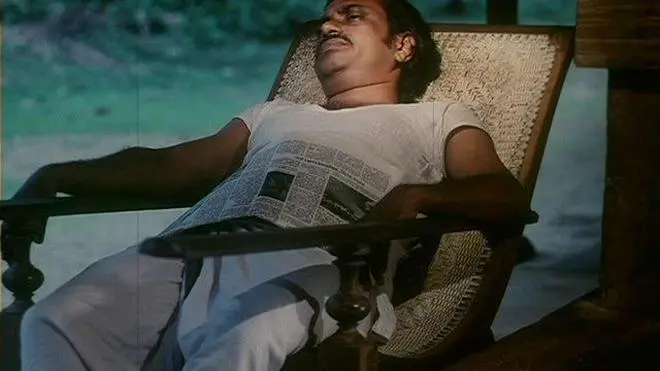
The thematic architecture of Elippathayam is built upon the concept of entrapment — not the melodramatic captivity of popular cinema, but the subtler, more inescapable trap of one's own habituated consciousness. Gopalakrishnan himself has spoken of Unni's 'obliviousness to external realities' as the film's central concern, and this obliviousness functions simultaneously as psychological portrait and social diagnosis. Unni is not a villain; he is not cruel in any deliberate sense. He is, rather, a man whose entire identity is dependent on arrangements — the labour of his sisters, the deference of his tenant Scaria Mappila, the hierarchies of caste and gender — that the modern world has declared null and void. His refusal to arrange marriages for Rajamma and Sridevi is not calculated cruelty but a subconscious preservation of the support system that sustains him. His inability to confront the thieves stealing coconuts from his farm, to respond to Janamma's legal summons, to notice Sridevi's romantic entanglement, or to seek medical care for Rajamma as she wastes away — these are the symptoms of what contemporary psychology might describe as avoidance coping, though Gopalakrishnan frames them, with greater precision, as the natural behaviour of a man who has never needed to cope, because coping was always performed by others. The film's three women are differentiated with equal care: Janamma in green, earthy and pragmatic; Rajamma in blue, gentle and doomed; Sridevi in red, vitality itself — and it is the youngest, the red-clad harbinger of revolt, who elopes and survives, while the blue-clad Rajamma is carried out of the house on a stretcher. The colour symbolism, restrained enough never to feel schematic, organises the film's gender politics with architectural precision.

The Rat Trap
Direction and Craftsmanship
Gopalakrishnan's directorial method in Elippathayam is one of extraordinary economy and intentionality. The film adheres to classical unities of time, place, and action with a rigour that would be at home in Bresson or Dreyer: it is set almost entirely within and immediately around the tharavad, proceeds in the present tense without flashback or flash-forward, and achieves its effects through the patient accumulation of precisely observed detail rather than through conventional dramatic incident. The opening sequence exemplifies the approach: rather than establishing the house with an exterior shot, Gopalakrishnan begins inside, cataloguing the closed front door, the keys on the wall, the inert grandfather clock, the unlighted lamps, the wooden bench — objects that speak a language of stagnation and arrested time. When the camera eventually retreats to show the tiled exterior, the claustrophobic interiority has already been established as the film's governing register. The tharavad is not merely a setting but a character: a rat trap that has consumed its own inhabitants.
The cinematography of Mankada Ravi Varma deploys deep-focus compositions that place characters in relation to the architecture of their entrapment — doorframes, walls, and corridors functioning as pictorial expressions of confinement. Particularly notable is the attic sequence, in which Sridevi climbs into the dark upper reaches of the house to retrieve the rat trap, the camera capturing the low ceiling and the cobwebbed trap in a manner that renders the mise en abyme literally: the trap within the trap within the trap. Karamana Janardanan Nair's performance as Unni is a marvel of understatement — a portrayal of passivity so complete that it becomes its own form of monstrousness. He conveys the character's proud incapacity through the smallest physical details: the deliberate way he applies oil to his body, the glacial speed with which he turns a newspaper page, the slight stiffening of posture when his social assumptions are challenged. Sharada, in what might be the film's most emotionally devastating performance, renders Rajamma's selflessness as something genuinely tragic — a woman so thoroughly shaped by patriarchal expectation that she has become the instrument of her own destruction. M. B. Sreenivasan's score — drone-based, atonal, the tambura slowed to a frequency that feels geological — functions as the aural equivalent of the stopped clock: music that refuses to move forward, that anchors every scene in temporal suspension.
The Cinema of Adoor Gopalakrishnan
Adoor Gopalakrishnan was born in 1941 in the village of Pallickal near Adoor in present-day Kerala's Pathanamthitta district, into a Nair family whose social world would furnish the material for much of his mature work. After completing his education at the Gandhigram Rural Institute, he enrolled in the Film and Television Institute of India in Pune — an institution that, in the 1960s and 1970s, was instrumental in producing the generation of filmmakers who would remake Indian cinema. Returning to Kerala, he co-founded the Chitralekha Film Society (the first film society in Kerala) and the Chitralekha cooperative film production enterprise, catalysing a new wave of Malayalam art cinema that would inspire G. Aravindan, K. G. George, and others. His debut feature, Swayamvaram (1972), won the National Award for Best Film and Best Direction, and inaugurated what critics have since recognised as the most sustained and internally coherent body of work in the history of Malayalam cinema. Elippathayam, his third feature, was pivotal: while Swayamvaram examined the challenges of self-determination against economic precarity, and Kodiyettam (1977) traced a free-spirited man's reluctant passage into social responsibility, Elippathayam deepened the sociological focus, treating the pathology of a social class with the clinical attention of an anthropologist.
Elippathayam's preoccupations resonate across the entirety of Gopalakrishnan's subsequent career. The films that followed — Mukhamukham (1984), Anantaram (1987), Mathilukal (1990), Vidheyan (1993), Kathapurushan (1995), Nizhalkuthu (2002) — each explore, in different registers, the relationship between power, psychology, and social structure. Mukhamukham, which won the FIPRESCI Prize, examined the myth-making around a disappeared communist leader; Mathilukal, based on Vaikom Muhammad Bashir's prison memoir, explored love as transcendence; Vidheyan examined the psychology of absolute submission. But it is Elippathayam that most directly and purely distils Gopalakrishnan's central concern: the way in which social systems shape — and ultimately destroy — the interiority of those who inhabit them. His working method, throughout his career, has been marked by the insistence on original screenplays, an unusually small output (only twelve feature films in five decades), and a refusal of commercial compromise that has made him, alongside Satyajit Ray and Mrinal Sen, one of the three internationally recognised masters of Indian art cinema. His influence on the subsequent generation of Malayalam filmmakers — on directors willing to engage with social reality through formal rigour rather than melodramatic convenience — is incalculable.
Reception and Legacy
Elippathayam's reception at the 1982 Cannes Film Festival, where it was screened in an official section, positioned it within the international art cinema conversation at a moment when Indian parallel cinema was gaining sustained critical attention in the West. The subsequent award at the BFI London Film Festival — the Sutherland Trophy, created in 1958 and awarded for the most original and imaginative work screened at the National Film Theatre during the year — was of particular significance, as it placed Gopalakrishnan in a lineage of formally adventurous filmmakers and demonstrated that Malayalam cinema was capable of speaking to audiences far beyond the subcontinent without any concession to foreign expectations. Janet Maslin, reviewing the film for The New York Times following its 1983 US release, wrote: 'As directed by Adoor Gopalakrishnan, Rat Trap is slow, thoughtful and engrossing. It presents Unni and his family as near-captives, not merely of their house but also of their history. And it accomplishes this through a series of minute, well-chosen details.' At the 29th National Film Awards in India, the film won the National Award for Best Feature Film in Malayalam (shared by producer K. Ravindran Nair and director Gopalakrishnan) and the National Award for Best Audiography. The Kerala State Film Award for Best Film further confirmed its domestic stature.
The film's legacy has grown considerably in the decades since its release. Scholarly analyses have positioned Elippathayam as an exemplary instance of Indian parallel cinema's ability to engage with the specificities of regional social history — the matrilineal Nair tharavad, the Kerala Land Reforms, the collapse of agrarian feudalism — in a cinematic language of universal resonance. Critics have analysed the film's use of the rat trap as a mise en abyme: an object within the film that reflexively replicates the film's own structure, revealing levels of meaning that operate simultaneously as social critique, psychological study, and formal demonstration. The University of Wisconsin-Milwaukee has established the Adoor Gopalakrishnan Film Archive and Research Centre at its Peck School of Arts, housing 35mm prints of his features and facilitating ongoing academic work; Elippathayam occupies a central place in that archive as the film that brought his oeuvre to world attention. Film historian Parthajit Baruah's monograph Face to Face: The Cinema of Adoor Gopalakrishnan (HarperCollins, 2016) devotes sustained attention to the film, and it continues to be screened in retrospectives worldwide and taught in university film studies programmes as a canonical text of postcolonial Indian cinema.

Commentary
What distinguishes Elippathayam from its contemporaries in world art cinema — and what accounts for its growing stature over four decades — is its absolute refusal of sentimentality in the service of genuine compassion. Gopalakrishnan does not ask us to pity Unni, nor does he condemn him with the didactic clarity of the social problem film. He observes him, with the same patient, unblinking attention that a naturalist brings to the observation of a species in its terminal decline. The rat trap of the title operates not as a moral judgement but as a structural description: given the historical formation that produced Unni — the feudal privilege, the matrilineal dependency, the tharavad that insulated him from the necessity of self-development — it is difficult to imagine how he could have been otherwise. The film's true subject is not individual failure but systemic determination, and its politics are all the more effective for being encoded in form rather than argument. A film that simply denounced the feudal patriarch would have been forgotten; a film that shows us, in exquisite detail, how a man and a social order become, finally and completely, identical — each the perfect expression of the other's logic — becomes something approaching tragedy.
Elippathayam's final image — Unni emerging from the pond, shivering, disoriented, hands pressed together in a gesture of supplication or prayer — is, in its ambiguity, one of the most resonant conclusions in the history of Indian cinema. Has he survived, or is this merely the last flicker of a consciousness already extinguished? Is the gesture of folded palms an appeal to the world he refused to acknowledge, or simply the reflex of a body in shock? Gopalakrishnan withholds the answer, because the question itself is the answer: a man who spent a lifetime refusing to engage with reality cannot, in a single moment of cold water and terror, reconstitute himself as a subject capable of genuine action. The film ends not with resolution but with an image of irreducible uncertainty, and it is precisely this uncertainty — this insistence that human beings are not redeemable on schedule — that makes Elippathayam not merely a document of a vanished social order but a meditation on the relationship between consciousness and time that retains its urgency for any audience willing to attend to it.
Awards & Recognition
- Kerala State Film Awards (1982)
- Best Director - Adoor Gopalakrishnan
- BFI London Film Festival (1982)
- Sutherland Trophy - Adoor Gopalakrishnan
- 29th National Film Awards
- Best Audiography - P Devidas
- Best Feature Film in Malayalam
Reference
- Wikipedia - Elippathayam
- IMDB - Elippathayam
- IIFF - Elippathyam (Rat Trap)