Ashadh Ka Ek Din [One Day Before the Rainy Season]
Mani Kaul
India. 1971. 114 min
Cast : Rekha Sabnis, Arun Khopalkar, Om Shivpuri
Introduction
There are few first gestures in Indian cinema as quietly audacious as the one Mani Kaul makes in Ashadhh Ka Ek Din, his second feature, completed in 1971 at the age of twenty-six. To follow the stark rural austerity of his debut, Uski Roti (1969), by turning to Mohan Rakesh's Ashadhh Ka Ek Din—the play widely regarded as the founding text of modern Hindi drama—was to court a double difficulty. Kaul was adapting a canonical work of the modernist stage, one saturated in language, into a medium he had already committed to purifying of theatrical convention. The result is neither filmed theatre nor a betrayal of its source, but a strange third thing: a chamber film of extraordinary formal severity that treats speech, silence, landscape and the human face as equivalent materials to be composed rather than dramatised. Fifty years on, its Bressonian rigour has not softened into period charm; it remains one of the most uncompromising experiments the Indian New Wave produced.
The film concerns itself, ostensibly, with the classical Sanskrit poet Kalidasa, and with the woman, Mallika, whose love he sacrifices to the pursuit of courtly greatness. Yet to describe Ashadhh Ka Ek Din as a biographical romance is to miss almost everything that matters about it. Kalidasa's inner life is never dramatised in the conventional sense; we are given instead the residue of his ambition as it settles upon a single mountainside hut and the woman waiting inside it. The film's true subject is the terrible asymmetry between the artist who converts experience into immortal work and the person whose living substance is consumed to make that conversion possible. That Kaul should have grasped this so completely, and rendered it with such refusal of sentiment, is what earns the film its place in any serious account of Indian art cinema. It merits attention not as an adaptation but as an argument, conducted in images, about what art costs and who pays.
Cast
- Rekha Sabnis as Mallika
- Arun Khopkar as Kalidasa / Dev Matrugupt
- Om Shivpuri as Vilom
- Uma Sahaay as Ambika
- Anuradha Kapur as Princess Priyangmanjari
- Pinchu Kapoor as Matul
Crew
- Director: Mani Kaul
- Writer: Mohan Rakesh (play)
- Cinematography: K.K. Mahajan
- Music: Jaidev
- Editor: Madhu Sinha

Background and Production
Ashadh Ka Ek Din belongs to a decisive moment in the institutional history of Indian cinema. The Film Finance Corporation, established by the state in 1960, had spent its early years underwriting cautious, conventional projects; only under the chairmanship of B. K. Karanjia, an advocate of independent and experimental work, did it begin to channel public money towards films that departed radically from the commercial musical idiom. It was within this brief, hospitable window that a cluster of Film and Television Institute of India graduates - Mani Kaul foremost among them, alongside his contemporary Kumar Shahani, whose Maya Darpan appeared in 1972 - were able to make work of uncompromising formal ambition. Kaul had already used FFC backing for Uski Roti; Ashadh Ka Ek Din extended that patronage to an adaptation whose difficulty guaranteed it would never recover its costs at the box office. Indeed, the films of Kaul and Shahani proved so controversial in film-society circles that no distributor acquired them for general release, a fact that says as much about the audacity of the enterprise as any critical citation.
The source material carried its own weight of prestige and expectation. Mohan Rakesh's Ashadhh Ka Ek Din, first staged in 1958, is conventionally identified as the first modern Hindi play, a work that wrenched the Hindi stage away from mythological pageantry towards psychological and existential enquiry. Rakesh himself was involved in the film's dialogue, lending the adaptation a direct continuity with its theatrical origin even as Kaul set about dismantling theatrical form. Crucial to the undertaking was the cinematographer K. K. Mahajan, Kaul's batchmate from the FTII, whose collaboration across the director's early films amounts to one of the great creative partnerships of the period. The music was entrusted to the distinguished composer Jaidev, who, at Kaul's insistence, confined himself largely to percussion, the tabla in particular, rather than melodic accompaniment. Because synchronised sound was prohibitively expensive, the dialogue was pre-recorded, a constraint Kaul turned to expressive advantage, allowing voice and image to occupy subtly independent planes. Every practical limitation of the production, in other words, was absorbed into its aesthetic.

Story
The film unfolds in three movements, mapped onto the three acts of Rakesh's play. In the first, the young poet Kalidasa, living in obscurity in a Himalayan village, is summoned to the court of Chandragupta II at Ujjayini, offered the laurels of state patronage. Torn between his love for the village woman Mallika and the promise of greatness, he hesitates; it is Mallika herself who urges him to go, sacrificing her own happiness for the flowering of his gift. In the second movement, Kalidasa has attained eminence, married the sophisticated noblewoman Priyangumanjari, and been elevated to the governorship of Kashmir. Passing through his old village in his official retinue, he avoids meeting Mallika altogether; his wife, encountering her instead, offers to raise her station and arrange a respectable marriage, an offer Mallika declines. The third movement returns Kalidasa to the village years later, having renounced his court and his office, only to find everything altered: Mallika's mother dead, Mallika herself sunk in poverty, married to his shadow-self Vilom and mother to his child. The two former lovers confront the wreckage of what was chosen and what was surrendered.

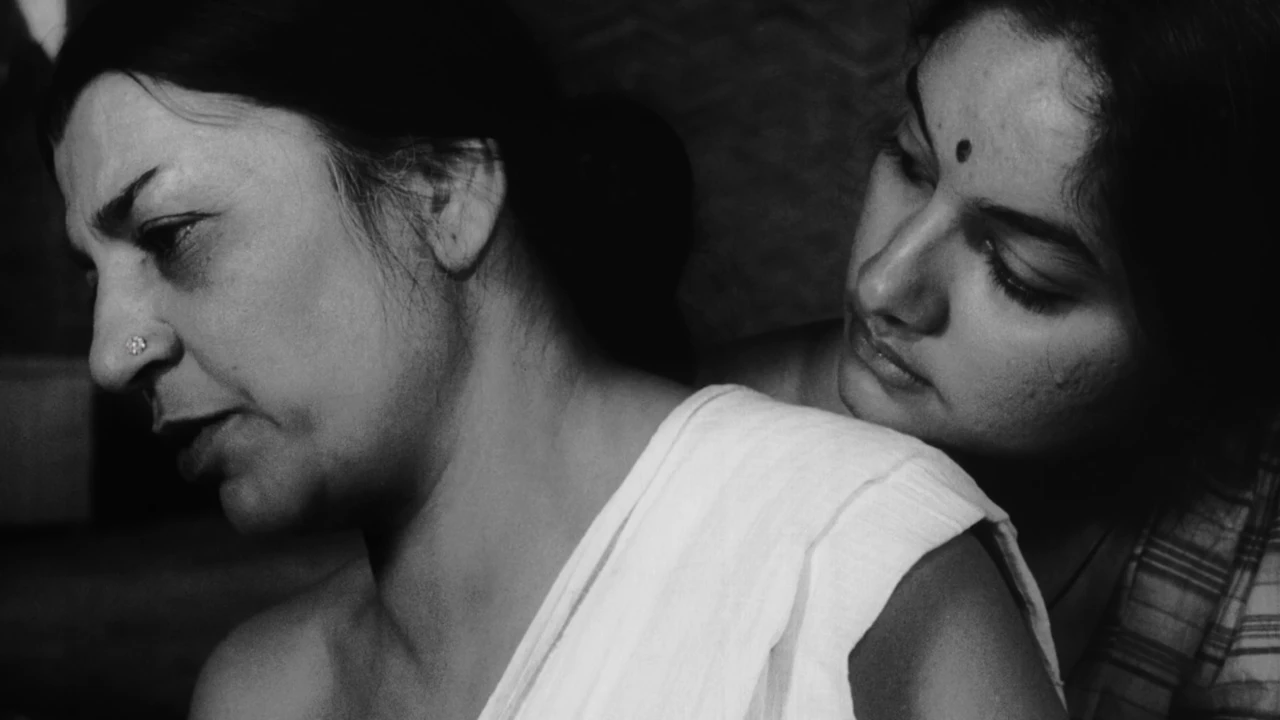
Arun Khopekar and Rekha Sabnis in Ashadh Ka Ek Din (1971)
In this separation lies Kaul's real preoccupation: the predatory relationship between the artist and the muse who nourishes him. Kalidasa's greatness is not, the film insists, self-generated; it is quarried from Mallika's being. In the climactic exchange he confesses that his celebrated works are transcriptions of their shared life—that the Himalaya of the Kumarasambhava is this landscape, that the ascetic Uma is Mallika, that the Yaksha's torment in the Meghaduta is his own, and that in Shakuntala he saw her face. The poems that immortalise him are, by this reckoning, the record of what he took and did not return. The film's most devastating image crystallises the theme: the blank, tear-stained, time-battered book Mallika had prepared for Kalidasa to inscribe his masterpiece upon, its pages gnawed by her in grief, never written on. Gazing at it, Kalidasa declares it the greatest epic ever composed. The judgement is exact and merciless. Mallika's suffering, precisely because it was never converted into art, exceeds any work that could have been made from it. Around this paradox Kaul organises his meditations on sacrifice, longing, the vanity of worldly elevation and the silent productivity of a life spent waiting.
The character of Vilom sharpens the film's moral architecture into something closer to metaphysics. Kalidasa's rival and antithesis, Vilom needles the poet with the suggestion that they are versions of one another—"What is Vilom? An unsuccessful Kalidasa. And Kalidasa, a successful Vilom"—collapsing the distance between the celebrated artist and the failure who claims Mallika in his absence. That Mallika should finally bear Vilom's child rather than Kalidasa's completes a bitter symmetry: the woman who gave herself to the making of immortal poetry is left with its unsuccessful double and the ordinary burdens of survival. Kaul refuses to sentimentalise her endurance or to redeem Kalidasa's return. When the poet admits, simply, that he too has changed, the film withholds any consolation the admission might have offered. What remains is the recognition, shared between Kalidasa and the audience, that no quantity of words could ever capture the endless agony of the one who was left behind—a recognition that indicts the very art the film's protagonist represents.

Rekha Sabnis in Ashadh Ka Ek Din (1971)
Direction and Craftsmanship
Kaul stages almost the entire film as a chamber drama within the dilapidated hut on the foothills of the Himalayas, and this claustral confinement is the ground of its power. By keeping nearly every conversation indoors, he transmits the desolation Mallika endures for years amid the infinite beauty of the surrounding mountains, forests and clouds- a beauty that becomes, through its very exclusion, a form of torment. The compositions are of a painterly minimalism: figure and face are held in precise focus while the external world dissolves into a stark, whitened blur. Mahajan's celebrated "whitening" of the Himalayas lends the hut an almost transcendental quality, transfiguring a hovel of poverty into something like a heavenly abode, so that Mallika's imprisonment and her sanctity are rendered in a single visual stroke. The camera ventures outdoors only twice, and each departure is charged: once when Kalidasa rides uphill through the mountain roads of his village in the second movement, and again in the closing sequence, when Kaul offers an aerial survey of the very landscape that inspired the poet's greatest works, silently reasserting that his art was rooted in a place and a person he abandoned.
The film's most radical decisions concern its handling of speech and sound. Because it derives from a play in which, as Kaul acknowledged, words take precedence over images, the director had to find a means of admitting language without surrendering to theatricality. His solution was to treat the pre-recorded dialogue as an autonomous stratum, its philosophical, psychological and reflective cadences building tension and lifting the love story into a spiritual register rather than merely advancing the plot. Following Robert Bresson, whose influence pervades the film, Kaul used music with extreme parsimony, allowing Jaidev's percussion to mark shifts of mood rather than to underscore emotion. The performances are correspondingly restrained; Kaul draws his players away from the emphatic gestures of the stage towards a flattened, almost affectless delivery that resists identification and keeps the spectator in a posture of contemplation rather than absorption. The overall effect is of a work that has stripped cinema back to a few essential elements—the composed frame, the isolated voice, the withheld cut—and asked what emotional and intellectual weight those elements can bear. That it bears so much is the measure of Kaul's craftsmanship.
The Cinema of Mani Kaul
Ashadh Ka Ek Din occupies the central position in what is often regarded as Mani Kaul's foundational trilogy, flanked by Uski Roti (1969) and Duvidha (1973). Read together, these three films constitute the most radical formalist experiment in Indian cinema of their moment, each pursuing narrative, spatial and temporal dissonance to a degree that few filmmakers anywhere had attempted. Uski Roti, adapted from Mohan Rakesh, dismantled linear storytelling to render the monotonous endurance of a rural wife; Duvidha, drawn from a Vijaydan Detha folk tale and financed by the modernist painter Akbar Padamsee, used saturated colour and a ghost's impersonation to interrogate marriage, duty and desire. Ashadh Ka Ek Din sits between them not merely chronologically but thematically, sharing with Uski Roti the study of a woman's silent suffering and anticipating in its final movement the loveless resignation that closes Duvidha. Across all three, one recognises the same governing intelligence: a refusal of psychological realism, an attention to the woman left behind, and a conviction that cinematic form is itself a mode of thought.
Kaul's formation accounts for much of this singularity. A student of Ritwik Ghatak at the Film and Television Institute of India, where he would later teach, he inherited from his mentor a deep engagement with Indian classical music that would culminate in his documentaries Dhrupad (1983) and the National Award-winning Siddheshwari (1989). From Robert Bresson he took an ethic of reduction and a distrust of the expressive actor; from Bertolt Brecht, the alienation effects that keep his audiences intellectually alert rather than emotionally captured. Fond of describing himself as an "aesthete," Kaul modelled the spacing and photography of his films on the work of modernist Indian painters - Amrita Sher-Gil's depictions of Indian womanhood informed Uski Roti, Padamsee's palette shaped Duvidha - and this cross-pollination between the plastic arts and cinema is nowhere more evident than in the composed austerity of Ashadh Ka Ek Din. In 1976 he would help found the Yukt Film Cooperative, further institutionalising his commitment to avant-garde practice. Winner of four Filmfare Critics Awards and a National Award for Direction over his career, Kaul remained, until his death in 2011, the most intransigent formalist of Indian parallel cinema—the first rebel, as some have called him, whose refusals defined the movement as much as any manifesto.
Reception and Legacy
On its appearance the film was received, within the narrow circles that could see it, as a landmark, and it went on to win the Filmfare Critics Award for Best Movie, one of four such honours Kaul would accumulate. Yet its critical esteem existed in painful disproportion to its public availability. Like the other formal experiments emerging from the Film Finance Corporation's brief adventurous phase, Ashadh Ka Ek Din proved too difficult for commercial distribution; no distributor acquired it for general exhibition, and it circulated chiefly through film societies, festivals and institutional screenings. This condition—celebrated abroad and among cognoscenti, effectively invisible to the general Indian audience—became characteristic of the parallel cinema Kaul helped inaugurate, and it framed the enduring debate about whether such rigorous work could ever reconcile itself with a broad public, or whether its very refusals condemned it to a rarefied afterlife.
That afterlife has, however, proved remarkably durable. Later restoration and the film's circulation through curated platforms have allowed successive generations to encounter its austere power undiminished; critics returning to it decades on continue to find its Bressonian discipline undated. Its influence is legible in the work of subsequent Indian filmmakers who inherited Kaul's conviction that form is meaning—the lineage extends, arguably, to a contemporary art cinema still preoccupied with the ethics of artistic vocation and the disciplining of performance. Kaul's early films are now routinely invoked in international accounts of modernist cinema, and Ashadh Ka Ek Din in particular has come to be seen as a definitive demonstration of how a canonical literary text might be honoured and radically transformed at once. Its legacy is less a matter of imitation than of permission: it established, for those who followed, that Indian cinema could think at the highest level of formal ambition, and that the interior life of a waiting woman could sustain a masterpiece.

Commentary
What lingers, finally, is the film's refusal to let its audience take the side of art against life. It would have been easy—it is the reflex of most films about artists—to celebrate Kalidasa's genius and to treat Mallika's suffering as the noble tribute love pays to greatness. Kaul does the opposite. By withholding Kalidasa's poetry from us almost entirely, and by giving us instead the ruined hut, the whitened mountains, the gnawed and empty book, he forces the recognition that the immortal works exist only because a mortal woman was emptied out to make them. The blank book is the film's supreme provocation: an epic that was never written is judged greater than all the ones that were, because it alone contains the whole of a suffering that language could only have diminished. In this single image Kaul indicts the entire enterprise of art to which he has devoted his own extraordinary talent, and the honesty of that self-implication is what raises the film above mere aestheticism.
Half a century after its making, Ashadh Ka Ek Din endures precisely because it never sought to please and therefore never dated. It belongs to that small company of films that expand one's sense of what the medium can do—that demonstrate how stillness, silence and the withheld gesture can carry more feeling than any amount of dramatic incident. It asks to be met on its own severe terms, and it repays that attention with an emotional and philosophical density few more accommodating works achieve. If Indian parallel cinema needed a single work to justify its refusals, this austere meditation on love, ambition and the cannibalism of the creative act would serve. One leaves it not consoled but clarified, having been shown, with a rigour that admits no evasion, that the greatest epic may be the one that remains forever unwritten, and that the truest subject of any art worth the name is the human cost of art itself.
Awards & Honours
- Filmfare Critics Award for Best Movie (1972)