DOORATWA [Distance]
Buddhadeb Dasgupta
India. 1978. 96 min
Cast : Bijon Bhattacharya, Mamata Shankar, Pradip Mukherjee, Niranjan Ray, Pravas Sarkar
Introduction
A newly asphalted arterial road, gleaming and empty, opens Buddhadeb Dasgupta's Dooratwa, while a voice on the soundtrack observes, with an irony too cold to be mistaken for approval, that the annihilation of the city's 'troublemakers' has proceeded in step with its 'beautification'. In a single, unhurried image the film announces its subject: the manner in which a society disposes of its inconvenient histories, paving over the scars of political violence as one might resurface a thoroughfare. Completed in 1978 as the first feature of a thirty-four-year-old former lecturer in economics, and released to wider audiences in the early years of the following decade, Dooratwa (Distance) arrived at the tail end of a decade in which Bengal had been convulsed by the Naxalite insurrection and its brutal suppression. That the film should choose to register this upheaval not through the spectacle of the barricade but through the interior weather of a solitary schoolteacher is the measure of its distinctiveness, and the source of the title's resonance.
Dooratwa occupies a peculiar and instructive position in the history of Indian art cinema. It is the debut of a director who would become, alongside the inheritors of Mrinal Sen and Ritwik Ghatak, one of the most internationally garlanded of Bengali filmmakers, yet it bears none of the assurance one associates with mature work; rather, it possesses the raw, exposed quality of a first utterance, shot in sixteen days on a budget so meagre that barely twenty thousand feet of film stock were expended. Its significance lies precisely in this economy. The film demonstrates that the political disillusionment of a generation could be rendered without rhetoric, that the great public catastrophe of the Naxalbari years might be most truthfully approached through the small, unglamorous failures of private conscience. It merits attention because it locates the political inside the marital, the ideological inside the intimate, and refuses to let either sphere absolve the other. To watch it is to understand how a national trauma settles into the grain of ordinary lives, and how difficult it becomes, afterwards, to distinguish principle from prejudice.
Cast
- Pradip Mukherjee - Mondar
- Mamata Shankar - Anjali
- Bijon Bhattacharya
- Niranjan Ray
- Pravas Sarkar - Shaibal
Crew
- Direction - Buddhadeb Dasgupta
- Story - Buddhadeb Dasgupta
- Cinematography - Ranjit Roy
- Music - Ain Rasheed Khan, Mahmud Mirza
- Production - Buddhadeb Dasgupta

Background and Production
Buddhadeb Dasgupta came to the cinema by an unusual route, and Dooratwa cannot be understood apart from the biography that produced it. Born in 1944 in Anara, a railway town near Purulia, and educated in economics at Scottish Church College and the University of Calcutta, he had spent the better part of a decade teaching the discipline, first at Shyamsundar College under the University of Burdwan and later at City College, Calcutta. By his own account he grew disenchanted with the widening chasm between the economic theory he expounded from the lectern and the socio-political reality unfolding in the streets outside, where the Naxalite movement and the state's counter-violence had turned the city into a landscape of suspicion and grief. His long membership of the Calcutta Film Society, which he had first attended as a schoolboy in the company of an uncle, had steeped him in the work of Chaplin, De Sica, Rossellini, Bergman, Kurosawa and Antonioni; when he abandoned the academy in the mid-1970s to make films, it was less a change of profession than a change of instrument for the same enquiry into how people live under economic and political pressure.
The film was adapted from a short story by the celebrated Bengali writer Sirshendu Mukhopadhyay, whose fiction furnished Dasgupta with the domestic armature onto which he could graft his political preoccupations. Production was governed throughout by constraint, and constraint became method. Assembled in a mere sixteen days of shooting, with roughly twenty thousand feet of negative exposed and almost nothing to spare, Dooratwa was made by a director who had undergone no formal apprenticeship and who therefore approached the medium with the deliberation of an autodidact rather than the fluency of a technician. Dasgupta wrote, produced and directed the picture himself; the cinematography was entrusted to Ranjit Roy, and the score to Ain Rasheed Khan and Mahmud Mirza. The cast drew on figures of considerable weight in the Bengali cultural firmament, chief among them the playwright and actor Bijon Bhattacharya, a founding presence in the Indian People's Theatre Association, whose participation lent the enterprise an implicit continuity with an earlier tradition of politically committed art. The film's austerity of means was thus inseparable from the historical moment of its making, a moment in which grand gestures had recently and catastrophically failed, and in which a chastened, watchful modesty seemed the only honest register available.

Story
Mondar, a schoolteacher and a former participant in the radical politics of the preceding years, marries a young woman, Anjali. When he discovers that she is already pregnant by another man, he abandons the marriage; and when, shortly afterwards, a Naxalite fugitive seeks refuge with him, he refuses shelter. These twin refusals, the domestic and the political, are the film's structural pivot. In their wake the lonely teacher drifts into an attachment with a woman employed as a personal secretary in a business firm, a relationship overshadowed by the presence of her deranged mother and ultimately foreclosed by the incompatibility of their social stations. Only at the close, when Mondar returns to the woman he had rejected and finds her sufficiently generous to receive him as a friend, does the film permit a guarded intimation that he might yet shed his accumulated prejudices, and that the distance of the title might narrow by some small increment.
The story conducts a searching enquiry into the nature of male conviction and its capacity for self-deception. Mondar imagines himself a man of principle, a rebel whose radicalism should logically extend to a liberality of private conduct; yet when tested by Anjali's honesty about her pregnancy, which she declines to disguise or to be ashamed of, he discovers in himself a proprietary conventionality he had never suspected. The film poses, without answering, the question of whether candour within a marriage matters more than the possession of a bride's virginity, and it exposes the ease with which a professed progressive can harbour the most reactionary of reflexes. Anjali, far from being a passive object of male judgement, emerges as the moral centre of the work, her equanimity a rebuke to Mondar's brittle idealism.

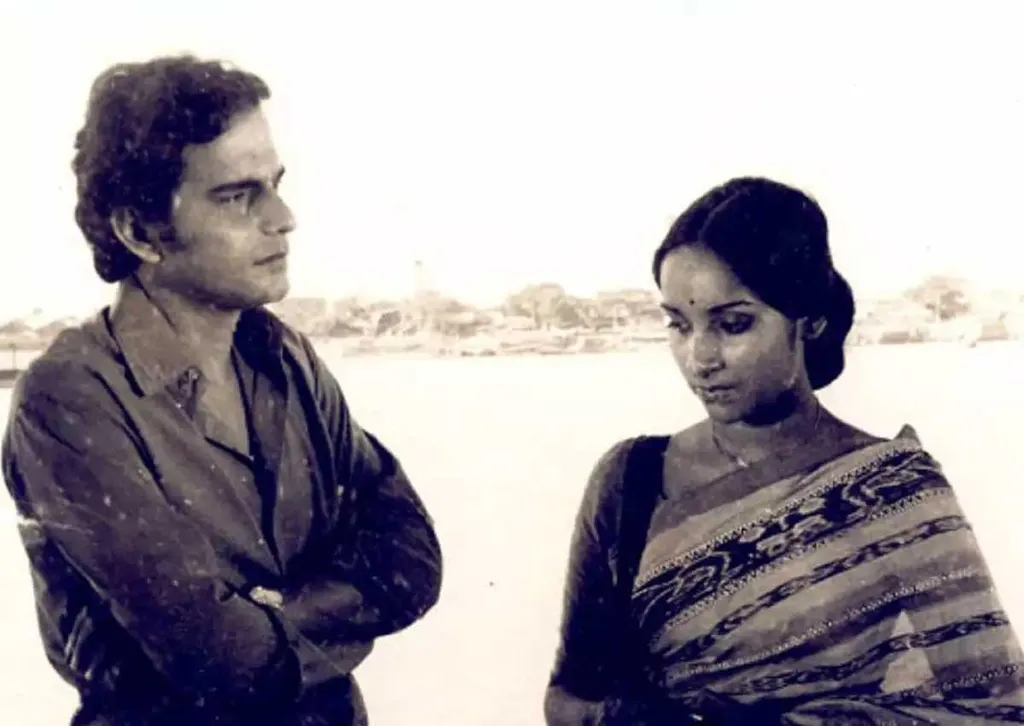
Mamata Shankar as Anjali, Dooratwa (1978)
The political and the personal are braided together so tightly in Dooratwa that neither can be extricated without the other unravelling. Mondar's refusal to harbour the hunted revolutionary rhymes with his refusal to accept Anjali, and both are failures of the same faculty, an incapacity to admit the messy, compromised reality of another person into the tidy schema of his convictions. The film's recurring concern with memory, identity and place, motifs that would preoccupy Dasgupta across his subsequent career, first surfaces here in the figure of a man estranged from his own past, unable to reconcile the radical he was with the diminished, cautious functionary he has become. Distance, in this sense, is not merely the space between two people but the interval between a self and its former convictions, the dooratwa that opens up when a generation's political hopes collapse into private paralysis.
Direction and Craftsmanship
Formally, Dooratwa announces a sensibility already inclined towards restraint and lyricism, though it has not yet acquired the frank surrealism that would characterise Dasgupta's later films. The direction is notable above all for its patient reliance on silence. Long passages unfold with minimal dialogue, the camera dwelling on the protagonist's face or on the vacant geometry of the city, so that Mondar's interior condition is communicated less through what is said than through the duration of what is withheld. Ranjit Roy's cinematography renders Calcutta as a place of hard surfaces and desolate light, and the film's black-and-white palette, austere and unsentimental, refuses the picturesque even as it achieves a grave beauty. The celebrated opening shot of the freshly paved thoroughfare, glossed by a mordant voiceover, exemplifies Dasgupta's method of allowing an image to carry an entire political argument without recourse to speeches.
The film's emphasis on the protagonist's subjectivity has frequently, and rightly, been compared to Satyajit Ray's Calcutta films of the early 1970s, and the resemblance is instructive. Like Ray in Pratidwandi and Jana Aranya, Dasgupta uses the beleaguered individual consciousness as the prism through which the larger social malaise is refracted; but where Ray retained a novelist's density of incident, Dasgupta pares the narrative back towards the condition of a prose poem, an inclination that reflects his own vocation as a published poet. The performances are pitched to match this reticence. Pradip Mukherjee invests Mondar with a watchful, inward quality that keeps the character's self-justifications legible without ever inviting easy sympathy, while Mamata Shankar, in an early screen role as Anjali, achieves a quiet dignity that anchors the film's moral perspective. Bijon Bhattacharya's presence, drawing on decades of politically engaged theatre, lends certain scenes an added gravity. The score by Ain Rasheed Khan and Mahmud Mirza is used sparingly, in keeping with the film's general economy, so that music punctuates rather than pervades, and the surrounding silence retains its expressive weight.
The Cinema of Buddhadeb Dasgupta
Dooratwa inaugurates a body of work that would come to be one of the most distinctive in modern Indian cinema, and in retrospect one can discern in it the seeds of nearly everything that followed. In its immediate aftermath came Neem Annapurna (1979) and Grihajuddha (1982), films that likewise placed middle-class individuals against the backdrop of urban decay and political exhaustion; together this early cluster constitutes Dasgupta's most direct engagement with the Naxalite aftermath and with the realist idiom he had absorbed from Ray. Only later, from Bagh Bahadur (1989) onward through Tahader Katha, Charachar, Uttara and Mondo Meyer Upakhyan, would he move decisively away from realism towards the poetic, dreamlike, often magical-realist manner for which he became internationally celebrated, and towards the recurring image of the journey across open landscape. Yet the preoccupations announced in Dooratwa, memory, loneliness, the discontinuity between political ideal and lived compromise, persist throughout, so that the debut reads less as juvenilia than as a statement of first principles.
Dasgupta's place within national and world cinema is defined by this dual inheritance. He belonged, on one hand, to the lineage of Bengali art cinema descending from Ray, Ghatak and Mrinal Sen, sharing their conviction that the medium was an instrument of social and moral enquiry; on the other, his later avowed affinity with Andrei Tarkovsky signalled an ambition towards a more contemplative, image-driven and metaphysical cinema than his Bengali forebears had generally pursued. That he was also a prolific poet is not incidental, for his films increasingly aspired to the condition of verse, privileging rhythm, image and silence over the machinery of plot. Across a career that would garner five National Film Awards for Best Feature Film, twice the National Award for Best Direction, and a Silver Lion at Venice for Uttara, he remained faithful to the figure of the solitary, displaced individual first embodied by Mondar. Dooratwa, with its economics-lecturer's clear-eyed grasp of how social forces bear upon private life, is the foundation on which that entire edifice was raised.

Reception and Legacy
For a debut made in such straitened circumstances, Dooratwa was received with striking seriousness, and its accolades established Dasgupta at a single stroke as a filmmaker of national consequence. It won the National Film Award for Best Feature Film in Bengali, a recognition all the more remarkable for a first-time director working without formal training, and it was honoured abroad with the critics' award at the Locarno Film Festival, an early indication of the international regard that would accompany Dasgupta throughout his career. The film's critical standing rested not on technical bravura, of which it made no claim, but on the maturity and honesty with which it handled its difficult subject, refusing both the consolations of melodrama and the temptations of political sloganeering.
The film's longer legacy is twofold. Within the trajectory of its maker, it functions as the origin point of a five-decade oeuvre that would place Bengali cinema repeatedly before the juries of Venice, Berlin and Cannes, and it is routinely cited in accounts of his development as the work in which his signature themes first cohered. Within the broader history of Indian political cinema, Dooratwa belongs to that significant body of Bengali films, extending from Mrinal Sen's Calcutta trilogy to Ray's own contemporaneous urban work, which sought to reckon with the Naxalite convulsion and its human residue. Its particular contribution was to insist that the reckoning be conducted not on the barricade but in the bedroom and the schoolroom, that the failure of a revolution be measured in the failures of the individuals who had once believed in it. In an era when the movement's memory was being officially paved over, the film preserved, with unassuming persistence, the interior record of what had been lost.
Commentary
There is a temptation, with any celebrated director's first film, to read it teleologically, as a mere anticipation of the masterpieces to come, and to value it chiefly for what it promises rather than for what it is. Dooratwa resists such condescension. It stands as a complete and coherent achievement in its own right, and in certain respects its very unpolishedness is a virtue that the later, more ravishing films occasionally sacrifice. The film's refusal to resolve its central moral question, its willingness to leave Mondar suspended between his prejudices and his dim, tentative movement towards their relinquishment, gives it an honesty that resists the more consoling symmetries of Dasgupta's mature manner. Here is a work unafraid to indict its own protagonist, to suggest that the rhetoric of revolution can coexist quite comfortably with the pettiest of personal tyrannies, and to locate the failure of a political generation not in the machinations of the state alone but in the unexamined hearts of those who claimed to oppose it.
What endures, finally, is the film's title and the many distances it encompasses: between husband and wife, between the classes, between the radical past and the compromised present, between what a person professes and what, when tested, he proves capable of. Dasgupta understood, with the precision of the economist he had been and the sensitivity of the poet he was becoming, that the largest historical forces are ultimately transmitted through the smallest human transactions, and that a society's capacity for renewal depends less on its slogans than on the willingness of individuals to admit the reality of one another. That Dooratwa ends not in reconciliation achieved but in reconciliation merely glimpsed, in a friendship offered and a prejudice not yet wholly overcome, is its most truthful gesture. The distance is not closed; it is only, perhaps, acknowledged, and in that acknowledgement lies whatever hope the film is prepared to extend.