PAROMA [Parama] (The Ultimate Woman)
Aparna Sen
India. 1985. 139 min
Cast : Raakhee, Mukul Sharma, Deepankar Dey, Anil Chatterjee, Aparna Sen
Introduction
A woman cannot, for much of Aparna Sen's Paroma, remember the name of a flower. It is a small thing, scarcely a plot point, and yet the forgetting hovers over the film with the weight of an unspoken accusation. The flower is a fragment of a self that has been mislaid somewhere in the long performance of being a wife, a daughter-in-law, an aunt, a sister-in-law; the recovery of its name, in the closing moments, is the quiet detonation towards which the entire film has been moving. Completed in 1984 and released in June 1985 under the banner of Usha Enterprise, Paroma (titled Paroma in Bengali, and given the English subtitle The Ultimate Woman) was only Sen's second feature, following the acclaimed 36 Chowringhee Lane. It confirmed, in the most unmistakable terms, that Indian cinema had acquired a new and serious voice on the interior lives of women, one prepared to ask questions that the bhadralok world it depicted preferred to leave unasked.
What gives Paroma its enduring claim on attention is not the sensational outline of its story, a married woman of forty entering into an affair with a younger man, but the gravity and precision with which Sen interrogates the very grammar of female identity. The film is less concerned with adultery as a moral transgression than with the question of whether a woman who exists entirely through her relations to others can be said to possess a self at all. In an Indian commercial cinema then largely content to render women as devoted wives, suffering mothers or objects of romantic pursuit, Sen's insistence that her protagonist's crisis is fundamentally philosophical, a crisis of being rather than of conduct, marked the film as exceptional. It remains one of the most lucid and unsentimental examinations of patriarchy produced in the Indian parallel cinema of the 1980s, and a touchstone for any account of feminist filmmaking on the subcontinent.
Cast
- Rakhee - Paroma
- Mukul Sharma - Rahul
- Deepankar Dey
- Anil Chatterjee
- Aparna Sen
Crew
- Direction - Aparna Sen
- Story - Aparna Sen
- Cinematography - Ashok Mehta
- Music - Bhaskar Chandavarkar

Background and Production
Aparna Sen came to direction already possessed of a formidable reputation as an actress, having worked from her teenage years within the Bengali film industry, including under Satyajit Ray, whose Teen Kanya had given her an early and conspicuous debut. By the early 1980s she had begun to chafe against the limited imaginative range that screen acting afforded her, and turned to writing and directing as a means of articulating concerns that the parts written for her could not accommodate. Her first feature, 36 Chowringhee Lane, made in English and centred on an ageing Anglo-Indian schoolteacher, had won her critical esteem and demonstrated her capacity for the patient, observational study of a marginalised consciousness. Paroma extended that method to the heart of the very Bengali upper-middle-class milieu from which Sen herself had emerged, and to which she could bring the unsparing knowledge of an insider.
Sen wrote the screenplay herself, and the film bears the marks of an authored work in which every element is bent towards a single governing idea. For the central role she cast Raakhee, by then a major star of the Hindi screen, a decision that lent the project both commercial visibility and a productive friction, since the glamour the audience associated with Raakhee is precisely what the film sets out to dismantle and re-examine. The cinematography was entrusted to Ashok Mehta, one of the most gifted image-makers of the period, and the score composed by Bhaskar Chandavarkar, a figure closely associated with the music of the Indian new wave. Sen herself appears in a supporting part as Paroma's emancipated friend, a presence that functions almost as a commentary upon the protagonist's confinement. The production was modest in scale, but its ambitions were considerable, and from the outset Sen seems to have understood that she was making a film likely to discomfit the very class whose drawing rooms it so meticulously reconstructed.
Story
Paroma is the contented mistress of a large, prosperous joint household in Calcutta, her days given over to the management of family ritual and the care of others. Into this settled world arrives Rahul, an expatriate photo-journalist who has returned to India to compile a photo-essay on the Indian housewife, and who selects Paroma as his subject. His camera, and the attention it embodies, awakens in her a sense of herself as a person rather than a function; the photographs make her, in the family's admiring phrase, look glamorous, and through Rahul's gaze she begins to recover a vitality long since surrendered. The affair that follows is less a romance than an act of self-rediscovery. When some of the more intimate photographs are published without her consent, the scandal that erupts shatters her standing within the family. Rejected by her husband and consumed by guilt, Paroma attempts suicide, survives, and is slowly nursed back to physical health, only to refuse, at the last, the absolution her family is finally prepared to extend.

Beneath this narrative Sen conducts a sustained inquiry into the constitution of selfhood under patriarchy. The film's opening insistence on Paroma's relational names, bouma, kaki-ma, boudi, is no incidental detail but the very subject of the work: here is a woman so wholly defined by her position within a kinship system that she has no remaining name of her own. The affair matters not because it is illicit but because it returns to her, however briefly and at whatever cost, the experience of being desired as a particular person. Crucially, Sen declines the consolations of conventional melodrama. Paroma's final refusal of guilt, and her request to her friend for help in finding employment, reframes the entire crisis: what has appeared to be a story of transgression and punishment is revealed as a story of awakening. The film is unsparing about the price of such awakening, the breakdown, the severed hair, the psychiatric prescription, but it refuses to let that price be mistaken for a verdict. Sexuality, in Paroma, is the occasion rather than the substance of liberation; what is truly at stake is a woman's right to be the author of her own life.
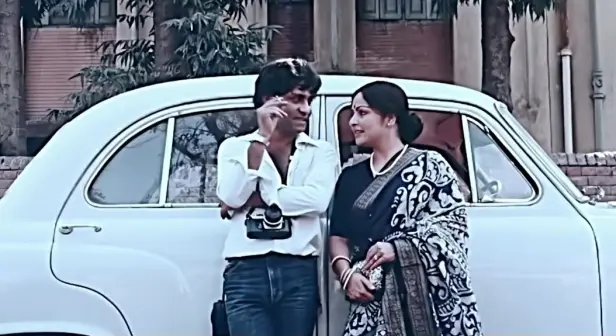
Rahul and Parama visit Rahul’s old family house.
The recurring motif of the half-remembered flower binds these concerns into a single, resonant image. Throughout the film Paroma cannot summon its name, as though some essential vocabulary of the self had been lost to her; that she recalls it at the close, when she has ceased to seek the family's forgiveness, signals an inward restoration that the narrative wisely refuses to overstate. The film ends not in triumph but in a tentative opening: Paroma and her daughter on a bed, a breeze entering through the window. The image is deliberately modest, and all the more eloquent for its modesty, suggesting that what Paroma has won is not happiness but the bare, indispensable condition of an unmortgaged interior life.
Direction and Craftsmanship
Sen's direction is distinguished above all by its spatial intelligence. The joint-family house is rendered as a dense, populated interior in which Paroma is forever in the presence of others, framed within doorways, glimpsed across thresholds, observed at the edge of group compositions; her solitude, when it comes, is felt as a startling exception. Ashok Mehta's cinematography registers this confinement with great tact, modulating between the warm, crowded textures of domestic ritual and the cooler, more isolated light of Paroma's encounters with Rahul, so that the camera's treatment of space becomes itself an argument about the limits placed upon her. The motif of the photograph is handled with particular acuity, since the film is in part a meditation on looking, on who is permitted to look and who is condemned to be looked at, and Mehta's images repeatedly implicate the act of representation in the drama of Paroma's exposure.
At the centre of the film stands Raakhee's performance, which is among the finest in Indian cinema of the decade. She charts Paroma's transformation through the smallest of registers, a loosening of posture, a new directness of gaze, a hesitancy that hardens into resolve, so that the awakening never appears as a sudden conversion but as the slow surfacing of a buried self. The supporting ensemble is calibrated with similar care; Deepankar De's portrayal of the husband, which earned him a National Film Award, avoids caricature, presenting wounded conventionality rather than villainy, and thereby implicating the system rather than the individual. Chandavarkar's restrained score and the film's attentive sound design refuse the emotional underlining that lesser melodramas would have supplied, trusting instead to the eloquence of faces and silences. The cumulative effect of these choices is a work of remarkable formal coherence, in which technique is never display but always the servant of a precise psychological and moral vision.
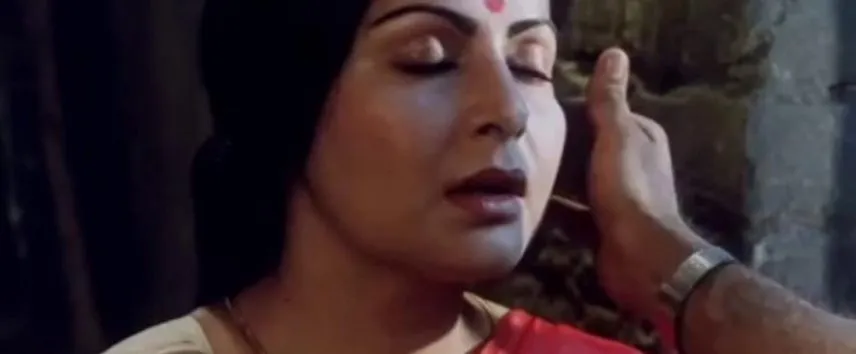
The Cinema of Aparna Sen
Paroma occupies a pivotal position in Sen's evolving body of work. If 36 Chowringhee Lane announced her preoccupation with isolated and overlooked women, Paroma deepened and radicalised it, turning from the marginal figure of the ageing spinster to the apparently fortunate wife at the centre of a flourishing household, and revealing the latter's confinement to be no less complete. The film inaugurates the central concern that would run through much of Sen's subsequent cinema: the predicament of women caught within the structures of Bengali high culture, and the cost exacted by respectability. Across films such as Paromitar Ek Din and Mr. and Mrs. Iyer, and in the recurring collaboration with her daughter Konkona Sen Sharma, Sen has returned repeatedly to the inner lives of women negotiating the boundaries of family, propriety and desire, and Paroma remains the clearest early statement of that abiding interest.
Sen herself has described Paroma as her most feminist film, and the description is just, though her feminism is of a notably unprogrammatic kind, expressed through the patient accumulation of observed detail rather than through polemic. Her sensibility was formed within the tradition of Bengali art cinema descending from Ray, Ritwik Ghatak and Mrinal Sen, and Paroma shares that tradition's commitment to psychological realism and its rootedness in a specific cultural world; yet Sen brought to it a distinctively female interiority that the earlier masters, for all their sympathy, had rarely placed so squarely at the centre. The result is a body of work that is at once intensely local, steeped in the idioms and anxieties of the Bengali bhadralok, and broadly legible, since the questions it raises about autonomy and selfhood transcend their particular setting. Paroma stands as the film in which Sen first fully claimed this dual register, and it established her as one of the most important directors to emerge from the later phase of India's parallel cinema.
Reception and Legacy
On its release the film proved genuinely controversial, and the controversy is itself instructive. Its frank treatment of a married woman's sexual relationship with a younger man scandalised sections of the very middle-class audience whose world it depicted, for Paroma raised, with disquieting directness, the question of a woman's right over her own body and her own desire. That the film should have unsettled the bhadralok so profoundly is a measure of how accurately it had taken that class's measure. Critical opinion, however, recognised its seriousness and craft; contemporary reviews praised it as a complex and unflinching study of womanhood, and at the 33rd National Film Awards in 1986 it was honoured as the Best Feature Film in Bengali, with Deepankar De receiving a Silver Lotus for his supporting performance.
The film's standing has only grown in the decades since, as the concerns it articulated have moved from the periphery towards the centre of cultural conversation. Paroma is now routinely cited as a landmark of feminist cinema in India, frequently discussed alongside Sen's other work in scholarship on gender and the Bengali screen, and regularly revisited by critics tracing the lineage of films that grant women a fully realised interior life. Its influence is discernible in the subsequent generations of Indian filmmakers, women prominent among them, who have made the examination of female subjectivity their central project. That a documentary on Sen's career should take the film's title for its own, presenting her life and work under the rubric of Paroma, is itself a token of the film's emblematic status. More than four decades after it was made, it continues to be taught, screened and argued over, the surest indication that its questions have not been exhausted.
Commentary
What lends Paroma its lasting power is its refusal of the easy resolutions that its premise might have invited. A lesser film would have made of Paroma either a cautionary figure, punished for her transgression, or a triumphant rebel, liberated by her affair; Sen does neither. Her protagonist is left, at the close, neither restored to her old life nor delivered into a new one, but suspended in the difficult, unglamorous condition of having reclaimed responsibility for herself. The genius of the film lies in its insistence that this bare reclamation, the recovery of the right to say I rather than to be only daughter-in-law, aunt or wife, is achievement enough, and that its cost, though severe, does not diminish it. The affair, so easily mistaken for the subject, is finally only the catalyst; the true subject is the slow and painful birth of a self.
Seen from the vantage of the present, Paroma appears both of its moment and well in advance of it. Its setting is unmistakably the Calcutta of the early 1980s, its textures and assumptions those of a particular class at a particular time, and yet its central question, what is owed to a woman as a person in her own right, has lost none of its urgency. The film endures because Sen had the discipline to pursue that question without flinching and without sentimentality, and the artistry to embody it in images and performances of lasting precision. If the recovery of a forgotten flower's name can stand for the recovery of a self, then Paroma is a film about the smallest and largest of victories at once, and that doubleness, the monumental discovered within the domestic, is the source of its quiet, abiding authority.
Awards & Recognition
- 33rd National Film Awards
- Best Supporting Actor - Deepankar Dey
- Best Feature Film in Bengali
Reference
- Wikipedia - Paroma
- IMDB - Paroma
- ITP Global Film - Parama (The Ultimate Woman)