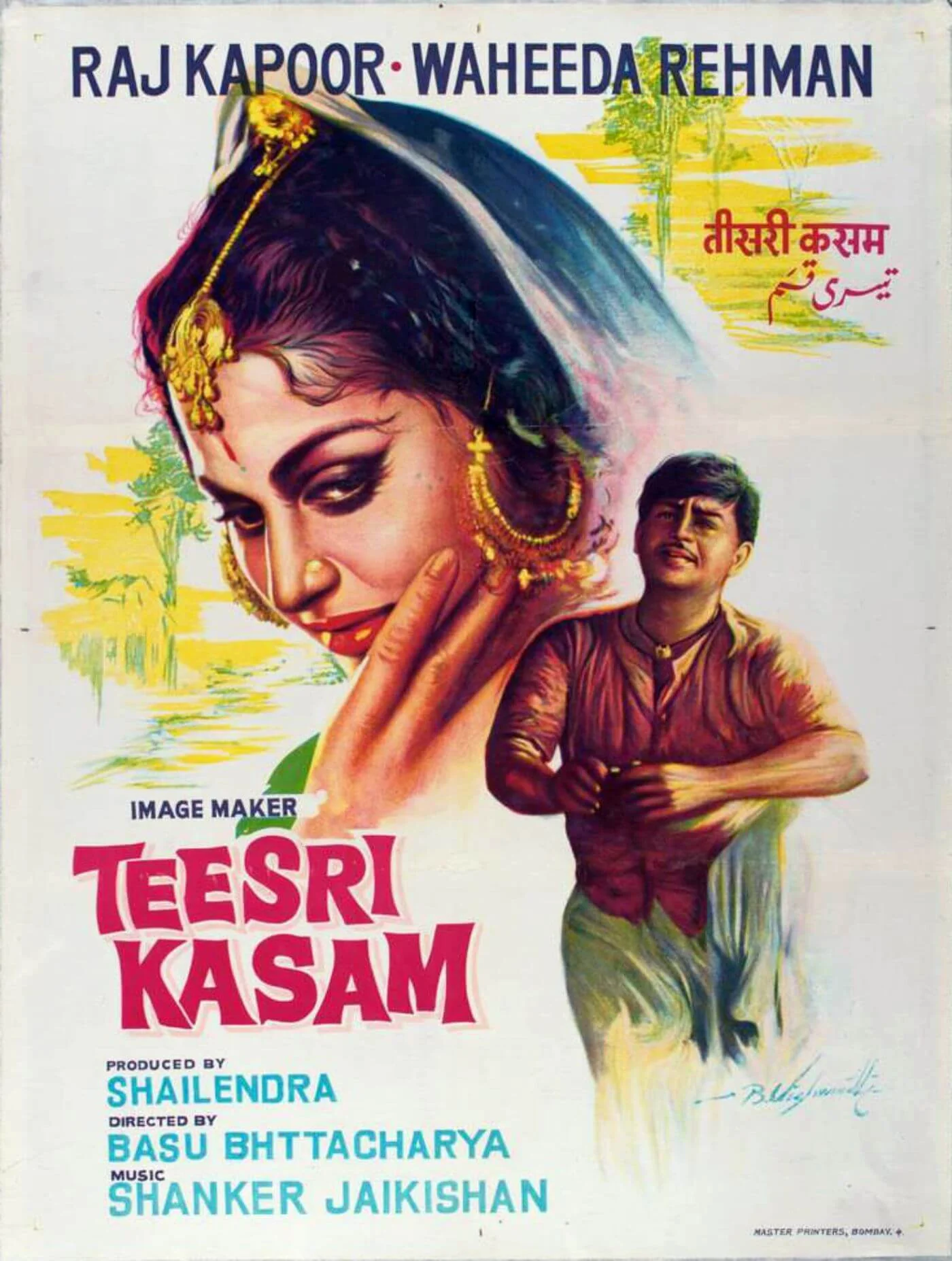
TEESRI KASAM (The Third Vow)
Basu Bhattacharya
India. 1966. 159 min
Cast : Raj Kapoor, Waheeda Rahman, Rehana
Introduction
Few films in the history of Indian cinema carry so heavy a freight of melancholy, both within their frames and in the circumstances surrounding their making, as Teesri Kasam. Released in 1966 and directed by the debutant Basu Bhattacharya, it is a film about a love that arrives unbidden, is held too gently to be spoken, and is lost before it can be named. Adapted from Phanishwarnath Renu's celebrated short story Maare Gaye Gulfam, it follows a guileless bullock-cart driver and a travelling nautanki dancer across the dust roads of rural Bihar, charting an attachment that the rigidities of their respective worlds will not permit to endure. Beneath its rustic surface lies one of the most delicate studies of innocence, class, and unattainable feeling that Hindi cinema has produced, a work whose modesty of register conceals an emotional reach of considerable depth.
That the film should have become a touchstone of the parallel sensibility is one of cinema's enduring ironies, for it was conceived not by a studio or an avowed art-house auteur but by the lyricist Shailendra, who poured his savings and ultimately his life into its realisation. Teesri Kasam failed commercially on release, ruined its producer, and was crowned with the nation's highest cinematic honour only after his death. To revisit it now is to encounter a film whose every frame seems suffused with the foreknowledge of loss, and to recognise in its fusion of folk lyricism, literary fidelity, and luminous monochrome photography a rare instance of popular and serious cinema meeting on common ground. It merits attention not as a curiosity of its period but as a film of permanent value, one that continues to instruct in the art of restraint.
Cast
- Raj Kapoor - Hiraman
- Waheeda Rehman - Hirabai
- Dulari - Hiraman's bhabhi
- Iftekhar - Thakur Vikram Singh
- Keshto Mukherji - Shivratan
- A.K. Hangal - Hiraman's older brother
- Asit Sen - mela announcer
- C. S. Dubey - Birju
Crew
- Direction - Basu Bhattacharya
- Story - Phanishwar Nath Renu
- Screenplay - Nabendu Ghosh, Phanishwar Nath Renu
- Cinematography - Subrata Mitra
- Music - Shankar-Jaikshan
- Lyrics - Shailendra, Hasrat Jaipuri
- Editing - Iqbal
- Production - Shailendra
Background and Production
The genesis of Teesri Kasam lay in an act of literary devotion. Around 1960 the poet and lyricist Shailendra, by then among the most cherished song-writers of the Hindi film industry through his long association with Raj Kapoor's productions, approached Phanishwarnath Renu with the wish to adapt the writer's short story Maare Gaye Gulfam for the screen. Renu, a leading exponent of the aanchalik or regionalist movement in Hindi literature whose novel Maila Anchal had reoriented post-Independence fiction towards the textures of rural life, agreed to participate, contributing the dialogues himself. Shailendra acquired the rights and, against the counsel of those who warned him of the perils of production, resolved to mount the film as producer. He assembled an extraordinary roster of collaborators: Nabendu Ghosh, a veteran of Bimal Roy's unit, wrote the screenplay; the composers Shankar–Jaikishan, Shailendra's frequent partners, provided the score; and Subrata Mitra, the cinematographer who had defined the visual idiom of Satyajit Ray's early masterpieces, was entrusted with the camera.
The production was beset by difficulty from the outset and stretched across several arduous years. Shailendra had intended to shoot in the Terai region of Bihar where Renu's story is rooted, but reports of dacoity in the area forced a relocation, and much of the film was eventually photographed around Igatpuri near Nashik, which stood in for the landscapes of the north. Raj Kapoor, a close friend, is reported to have taken only a token fee for his participation, yet the costs mounted and the schedule lengthened as Shailendra, inexperienced in the practicalities of production, struggled to hold the enterprise together. By the time the film was complete his finances were in ruin. Teesri Kasam was at last released in 1966 to commercial indifference, and Shailendra, broken by the strain and the failure, died on 14 December of that year at the age of forty-three, on the very birthday of the friend whose presence had graced his film. The honours that followed came too late for him to witness.
Story
The narrative is deceptively simple. Hiraman, a gentle and unworldly bullock-cart driver, is engaged to transport Hirabai, a dancer with a travelling nautanki troupe, to a distant village fair. Over the slow miles of their journey an unspoken tenderness grows between them, nourished by Hiraman's artless songs and stories and by Hirabai's responsiveness to a kindness she has rarely been shown. At the fair she becomes the celebrated attraction of the nautanki, courted and demeaned in equal measure by men who see in her only a body to be purchased, while Hiraman watches from the margins, wounded by a world that reduces her to spectacle. When circumstances at last compel her departure, Hiraman is left to carry her away to the railway station and to the life that claims her, and he resolves upon his third vow: never again to carry a nautanki dancer in his cart. The title gathers into itself the renunciations by which an ordinary man tries to shield himself from a sorrow he cannot otherwise master.

Beneath this slender story Teesri Kasam unfolds a sustained meditation on innocence and its impossibility in a world organised by hierarchy and exchange. Hiraman's purity of feeling is precisely what renders him defenceless; he loves without calculation in a society that prices everything, and Hirabai, who has learned to expect only transaction, finds in him a mirror of a self she had thought lost. Their attachment is doomed less by any failure of feeling than by the immovable facts of class, gender, and the social stigma attached to the performing woman, whose art secures her livelihood at the cost of her respectability. The film is alert throughout to the cruelty by which a culture both consumes and condemns the woman who entertains it, and to the loneliness of those, like Hiraman, whose decency finds no purchase in the order of things. What it dramatises, finally, is not the failure of love but the failure of the world to make room for it, and the quiet dignity with which the wounded learn to renounce what they cannot keep.

Waheeda Rahman as Hirabai in Teesri Kasam
Direction and Craftsmanship
Basu Bhattacharya's direction is distinguished by its patience and its refusal of melodramatic emphasis. Working in his first feature, he resists the temptation to underline the pathos of his material, allowing the relationship between Hiraman and Hirabai to accumulate through small gestures, exchanged glances, and the rhythms of the journey rather than through declaration. The pacing is unhurried, attuned to the gait of the bullock cart and the slow unfurling of the rural day, and this measured tempo becomes itself an expressive instrument, drawing the viewer into a temporality remote from the urban velocity of mainstream Hindi cinema. The performances are calibrated to the same restraint. Raj Kapoor, sublimating his familiar tramp persona into something graver and more interior, gives what many regard as the most sensitive performance of his career, while Waheeda Rehman invests Hirabai with a grace shadowed by weariness, suggesting in every poised movement the accommodations a hard life has demanded of her.
The film's most celebrated achievement is its photography. Subrata Mitra, drawing on the command of naturalistic light he had developed in his work for Satyajit Ray, renders the Bihar countryside in monochrome of remarkable tonal richness, and his compositions of the cart upon the open road, of faces caught in the glow of the nautanki lamps, and of mist-laden fields rank among the finest black-and-white camerawork in Indian cinema. Equally integral is the music of Shankar–Jaikishan, who set aside their customary orchestral opulence for melodies rooted in folk idiom and coloured by flute, traditional strings, and percussion. Shailendra's own lyrics, in songs such as Sajan Re Jhoot Mat Bolo and Sajanwa Bairi Ho Gaye Hamaar, and Hasrat Jaipuri's contributions, are not ornamental interludes but vehicles of narrative and feeling, expanded from the very song-fragments embedded in Renu's prose. Sound, image, performance, and verse are bound together in a unity of tone that makes the film's craftsmanship inseparable from its meaning.

The Cinema of Basu Bhattacharya
Teesri Kasam stands at the threshold of a career that would become central to the parallel cinema of the 1970s. Born in 1934 into a Bengali family, Basu Bhattacharya had served his apprenticeship in the milieu shaped by Bimal Roy, into whose family he married, and his work bears the imprint of that lineage in its literary seriousness and its sympathy for the socially marginal. Yet where his debut turned outward to the rural world of Renu's fiction, his subsequent and most characteristic films turned sharply inward, to the enclosed spaces of the modern urban marriage. In the trilogy of Anubhav (1971), Aavishkar (1974), and Griha Pravesh (1979) he fashioned an intimate cinema of domestic discord, dispensing with the conventions of star glamour to scrutinise the erosions, silences, and quiet betrayals of married life with an unsentimental candour that was new to Hindi cinema.
Across this body of work certain preoccupations recur with the consistency of an authorial signature: the difficulty of communication between men and women, the loneliness that persists within relationships rather than apart from them, and the gap between the longings of the inner life and the compromises exacted by society. Teesri Kasam announces these concerns in embryo, for its subject too is the impossibility of union and the solitude of feeling, transposed from the bourgeois drawing room to the open road. If Bhattacharya never again achieved a work of such lyrical breadth, it was in part because his later films deliberately narrowed their focus, trading the expansiveness of folk romance for the austere chamber drama of marital estrangement. Within the wider landscape of Indian art cinema he occupies a distinctive place as the poet of the failing relationship, a filmmaker who, alongside contemporaries such as Mani Kaul and Mrinal Sen, helped to establish that serious cinema in Hindi might take the interior life as its proper subject.
Reception and Legacy
On its release in 1966 Teesri Kasam met with the indifference of audiences who found its slow rhythms and unhappy ending ill-suited to their expectations, and it failed conclusively at the box office, inflicting upon Shailendra the financial losses that hastened his end. Yet the critical estimation of the film was of a wholly different order. It was widely admired for the integrity of its adaptation, the beauty of its photography, and the gravity of its central performances, and in 1967 it received the National Film Award for Best Feature Film, the highest such recognition the country can bestow. That this laurel arrived only after the death of the producer who had staked everything upon the film lends its history an air of tragedy that has become inseparable from the work itself, so that Teesri Kasam is remembered as much for the sacrifice it exacted as for the artistry it embodies.
In the decades since, the film's reputation has steadily risen, and it is now firmly established among the enduring achievements of Hindi cinema, routinely cited in surveys of the form's finest work and revered for its songs, which have outlived the commercial fortunes of the film to become permanent fixtures of the popular memory. It is valued, too, as a rare example of a successful translation of serious literature to the screen, a fidelity to Renu's regionalist vision that helped legitimise the rural and the vernacular as worthy subjects for ambitious filmmaking. For the parallel cinema that gathered force in the years that followed, Teesri Kasam offered an instructive precedent: proof that a film of literary substance and formal refinement could be made within the popular industry, and a sober reminder of the precariousness that attended such ambition. Its influence persists less in direct imitation than in the standard it set for the marriage of poetry, place, and feeling.
Commentary
There is a temptation, in writing of Teesri Kasam, to let the sorrow of its production overwhelm the achievement of the film, and certainly the story of Shailendra's ruin and early death casts a long shadow over any account of it. Yet to dwell only upon that shadow is to miss what is most remarkable about the work, which is the equanimity, even the tenderness, with which it regards the losses it depicts. The film does not rage against the world that separates Hiraman from Hirabai; it observes that separation with a clear and compassionate eye, and finds in Hiraman's final vow not defeat but a kind of fragile self-preservation, the dignity of one who, having loved and lost, chooses to protect what remains of himself. In this refusal of bitterness lies the film's particular moral beauty, and its lasting capacity to move.
What secures its place in the history of cinema is the completeness with which its disparate elements are made to serve a single vision. The regionalist fidelity of Renu, the folk lyricism of Shailendra and Shankar–Jaikishan, the luminous photography of Subrata Mitra, and the restrained direction of Basu Bhattacharya converge upon a story of the smallest scale to produce an effect of unexpected amplitude. More than half a century after its making, Teesri Kasam retains its power to disquiet and to console, a film that understands that the deepest feelings are often the least articulate, and that the most ordinary lives may contain the most affecting tragedies. It endures, finally, as a meditation on the cost of innocence in a calculating world, and as a quiet monument to the man who gave everything to bring it into being. That it survives him, luminous and unhurried, is perhaps the truest vindication of his faith.
Awards & Recognition
- 15th National Film Awards
- Best feature Film - Shailendra and Basu Bhattacharya
- Filmfare Awards
- Best Lyricist - Shailendra
- Moscows International Film Festival
- Grand Prix - Basu Bhattacharya