IJAAZAT [Permission]
Gulzar
India. 1987. 137 min
Cast : Rekha, Naseeruddin Shah, Anuradha Patel
Introduction
Rain falls on an unremarkable railway platform somewhere in western India, and two people who once shared a marriage find themselves marooned together in a waiting room, obliged for the length of a night to sit with the wreckage of what they were to one another. From this deceptively slight premise Gulzar fashions Ijaazat (1987), one of the most emotionally exacting films of the Hindi parallel cinema, and arguably the most refined distillation of his lifelong preoccupation with the afterlife of love. There is no melodramatic reckoning here, no villain, no restorative embrace; there is only the slow, courteous excavation of a shared past by two adults who have learned, too late, the cost of the choices they made. The film belongs to that rare category of Indian cinema that treats divorce not as scandal or catastrophe but as a mature and grievous fact of ordinary life.
Adapted from Subodh Ghosh's Bengali story Jatugriha, Ijaazat announces its seriousness through its structure as much as its subject. The entire drama is retrospective, filtered through the fallible memory of its two principals, so that the past arrives not as objective record but as confession, evasion and self-justification. Rekha, Naseeruddin Shah and Anuradha Patel give performances of unusual restraint, and R. D. Burman's spare score, wedded to Gulzar's oblique, image-laden lyrics, supplies the film with an emotional undertow that its dialogue is often too dignified to voice. That the film's most celebrated song, 'Mera Kuch Saamaan', should take the form of an inventory of returned belongings is entirely characteristic: Ijaazat is a film about what cannot be given back, and about the permission one must finally seek to walk away.
Cast
- Rekha - Sudha
- Naseeruddin Shah - Mahendra
- Anuradha Patel - Maya
- Shammi Kapoor - Mahendra's grandfather
- Dina Pathak - Principal
- Sulabha Deshpande - Sudha's mother
- Shashi Kapoor - Sudha's husband
Crew
- Direction - Guzar
- Story - Subodh Bose, Gulzar
- Cinematography - Ashok Mehta
- Music - R.D. Burman
- Editing - Subhash Sehgal
- Production - R.K. Gupta

Background and Production
The origins of Ijaazat lie in a moment of literary discovery. Gulzar has recounted encountering Subodh Ghosh's story Jatugriha at the home of the actor Abhi Bhattacharya, and being seized by the image at its centre: two former spouses meeting again, years after their parting, in the enforced intimacy of a railway waiting room. Ghosh's story had already been filmed once, in 1964, as the Bengali Jatugriha directed by Tapan Sinha, and the material's pedigree in the Bengali literary and cinematic tradition sat comfortably with Gulzar's own sensibility, steeped as it was in Urdu poetry and in the humane realism of the Bimal Roy school in which he had served his apprenticeship. He purchased the rights and set about transposing the tale into a Hindi idiom, retaining the essential situation while reshaping its emotional geometry into the triangular configuration of husband, wife and the other woman.
Produced by R. K. Gupta and released in September 1987 with a running time of some one hundred and thirty-seven minutes, the film gathered around Gulzar a group of collaborators whose contributions were decisive. The cinematographer Ashok Mehta lent the interiors their muted, rain-washed intimacy, while the editor Subhash Sehgal was charged with the delicate task of threading present and past so that memory might surface without jarring the viewer. Above all, the film reunited Gulzar with the composer R. D. Burman, a partnership already responsible for some of the most sophisticated song-writing in Hindi cinema. Casting Rekha, then at the height of her powers, opposite Naseeruddin Shah, the pre-eminent actor of the parallel movement, signalled Gulzar's ambition to marry the emotional legibility of the mainstream with the interior seriousness of the art film, a balance the production sustains with remarkable consistency. Around them a distinguished supporting ensemble, including Shammi Kapoor, Dina Pathak and Sulabha Deshpande, together with a memorable late cameo by Shashi Kapoor, lends the world of the film a lived-in solidity.
Story
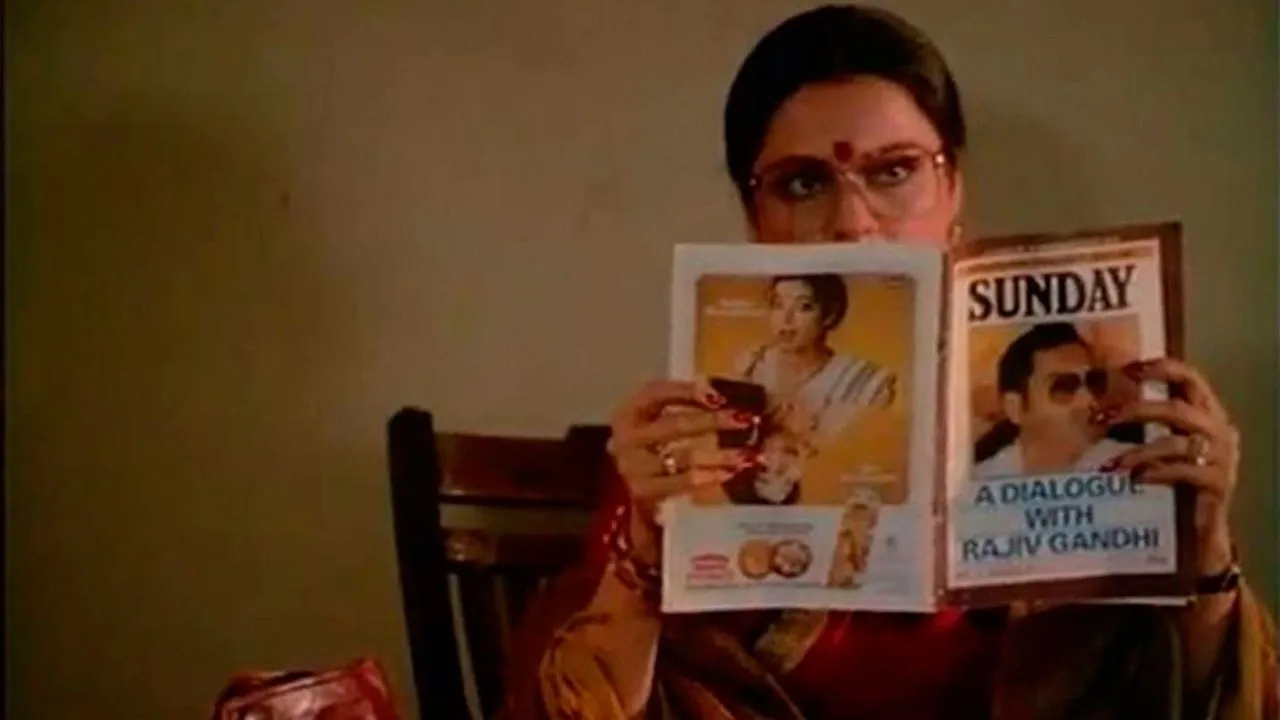
Mahender, having long delayed honouring his engagement to Sudha, is bound to another woman, the free-spirited and volatile Maya, whose hold on him he can neither renounce nor domesticate. Under family pressure he marries Sudha, yet he cannot sever his tie to Maya, and the marriage is slowly poisoned less by infidelity than by his failure to relinquish a divided heart. Maya's attempted suicide, Sudha's growing sense of being a stranger in her own home, and a series of misunderstandings drive Sudha at last to leave. Maya returns to nurse Mahender through a heart attack, only to die in an accident when her scarf catches in the wheel of her departing motorcycle. In the present, meeting in the waiting room, Sudha and Mahender review this history until the arrival of Sudha's new husband closes the account, and she seeks from Mahender the permission to leave that she was never granted the first time.

Mahender (Naseeruddin Shah) and Sudha (Rekha) meet in a desolate railway station waiting room one rainy night. Ijaazat (1987)
Beneath its narrative of a love triangle, Ijaazat is an inquiry into the ethics of indecision. Mahender's tragedy is not that he loves two women but that he cannot choose between them, and the film is unusually clear-eyed about the damage that a well-meaning irresolution inflicts upon those who depend on it. Where a conventional treatment would apportion blame, Gulzar distributes sympathy, allowing each figure a claim on our understanding while refusing to absolve any of them entirely. The film is also, profoundly, about memory and possession. Its recurring motif of objects left behind, crystallised in the song 'Mera Kuch Saamaan', proposes that intimacy leaves residues that cannot be catalogued or returned; the belongings Maya demands back are moments, weathers, sensations. What Sudha finally asks for is subtler still: not restitution but release, the formal ijaazat that would let her close a chapter that circumstance had left cruelly open.
Direction and Craftsmanship
Gulzar's direction is founded on an ethic of understatement. He trusts silence, the held look and the incomplete sentence to carry emotional weight that lesser films would consign to declamation, and the confinement of the framing narrative to a single waiting room becomes a formal virtue, concentrating attention on faces and pauses rather than incident. Ashok Mehta's cinematography favours soft, enclosing light and a palette of subdued tones appropriate to a story recollected in the half-dark; the recurrent motif of rain functions both as literal weather and as an emotional register, sealing the estranged couple within a temporary, watery privacy. The editing, which must move fluidly between the present of the waiting room and the layered past of the marriage, achieves its transitions without the mechanical signposting common to the flashback film, so that memory seems to well up unbidden rather than to be summoned.
The performances are calibrated to this discreet register. Rekha, in what many regard as her most controlled screen work, renders Sudha's wounded dignity without recourse to the histrionic, conveying jealousy and grief through the smallest inflections of posture and gaze. Naseeruddin Shah invests Mahender with a plausible, exasperating weakness, refusing to make his vacillation either heroic or contemptible, while Anuradha Patel gives Maya a mercurial charge that explains the man's helpless attachment. Yet the film's supreme achievement is the integration of its music. Burman's compositions, sung throughout by Asha Bhosle to Gulzar's lyrics, are not interludes but instruments of narration; 'Mera Kuch Saamaan', built around the plea 'mujhe lauta do', famously abandons conventional metre and rhyme, and the story of Burman's initial bafflement before he grasped its cadence has become part of the film's legend. Sound, image and word here operate as a single expressive fabric.

The Cinema of Gulzar
Ijaazat occupies a central place in Gulzar's body of work because it gathers, in unusually pure form, the concerns that recur across his filmography. Trained in the humane realism of Bimal Roy and Hrishikesh Mukherjee, and possessed of a poet's ear honed in the ghazal tradition, Gulzar had already explored the fractures of marriage and the persistence of longing in films such as Aandhi (1975), Mausam (1975) and Namkeen (1982). What distinguishes Ijaazat within this lineage is the rigour with which it subordinates plot to feeling, and its willingness to leave its central questions morally unresolved. The film represents the mature flowering of a sensibility that had always preferred suggestion to statement, and that regarded the popular song not as commercial obligation but as a legitimate vehicle for the most delicate emotional truths.
Positioned within the parallel cinema of the nineteen-seventies and eighties, Gulzar occupies a distinctive middle ground. He was never as austere as Mani Kaul or Kumar Shahani, nor as sociologically driven as Shyam Benegal or Govind Nihalani; his subject was the interior life of the couple rather than the structures of society, and his instrument was lyricism rather than polemic. In this he stands closer to the intimate chamber dramas of Bengali cinema, an affinity underscored by his repeated recourse to Bengali literary sources, of which Jatugriha is one. Ijaazat may thus be read as the point at which Gulzar's twin vocations as film-maker and poet achieve their most seamless fusion, and it remains the film to which admirers most often turn to argue for his standing as an auteur rather than merely a gifted lyricist working in the popular idiom.


Reception and Legacy
The film's most conspicuous vindication came at the 35th National Film Awards, where 'Mera Kuch Saamaan' earned Gulzar the award for Best Lyrics and secured Asha Bhosle the Best Female Playback Singer honour, the second National Award of her career. Critics singled out the film for its emotional maturity and its rare, unsentimental treatment of divorce; Filmfare would later describe it as among Gulzar's most sensitive works and as the vehicle for Rekha's most poignant performance, while the film historian Lalit Mohan Joshi praised its recreation of the tingling sensation of a mature romance and its willingness to broach a male-female relationship seldom examined in Hindi films. Writing on the cinema of 1987, the critic M. L. Dhawan commended Gulzar for bringing a grown-up treatment to the familiar triangle of husband, wife and the other woman, and singled out Asha Bhosle's soul-stirring voice for particular praise.
In the decades since, Ijaazat has passed from respectful reception into something closer to canonical status, cited routinely among the finest Hindi films of its era and as a landmark in the depiction of adult relationships on the Indian screen. Its songs, and 'Mera Kuch Saamaan' above all, have enjoyed an afterlife independent of the film, admired as a high-water mark of Hindi film lyric-writing and frequently invoked as evidence that the popular song could sustain genuine poetry. The critical literature has continued to grow, including a book-length study by the Pakistani writer Mira Hashmi published in 2019, testifying to the film's enduring capacity to reward close attention. For later film-makers seeking to portray separation with restraint and dignity, Ijaazat has served as a quiet precedent and a standard against which such attempts are measured.
Commentary
What secures Ijaazat its lasting place is its refusal of consolation. It declines the reconciliations that its genre invites and the judgements that its situation seems to demand, choosing instead to sit, as its characters do, with the irreducible sadness of choices that cannot be unmade. The film understands that the deepest injuries between intimates are often inflicted not by cruelty but by weakness, and that forgiveness, when it comes, may be less a healing than a formality that permits the wounded to depart. In making the granting of permission its final gesture, the film locates dignity precisely where sentimental cinema locates catharsis, and in doing so it honours the intelligence of its audience.
There is, finally, a quiet radicalism in the film's insistence that the ordinary sorrows of adult life are worthy of the fullest artistic seriousness. Ijaazat does not raise its voice; it neither pleads for its characters nor condemns them, and it trusts the accumulated force of small moments, a half-finished poem, an inventory of returned things, a touch of the feet in a station waiting room, to say what it will not say outright. That such a film could be made within, and partly against, the conventions of popular Hindi cinema remains a source of its continuing authority. Nearly four decades on, it endures not as a period curiosity but as a living account of how two decent people may wound one another, and of the grace that lies in learning, at last, to let go.
Awards & Honours
- 35th National Film Awards
- Best Lyrics - Gulzar
- Best Female Playback Singer - Asha Bhosale
Reference
- Wikipedia — https://en.wikipedia.org/wiki/Ijaazat
- IMDb — https://www.imdb.com/title/tt0091256/
- Letterboxd — https://letterboxd.com/film/ijaazat/
- The Print — https://theprint.in/feature/ijaazat-is-a-strangely-poetic-take-on-divorce-that-was-rare-in-1980s-hindi-films/501040/
- Cinemaazi — https://www.cinemaazi.com/film/ijaazat