PAANCH
Anurag Kashyap
India. 2003. 130 min
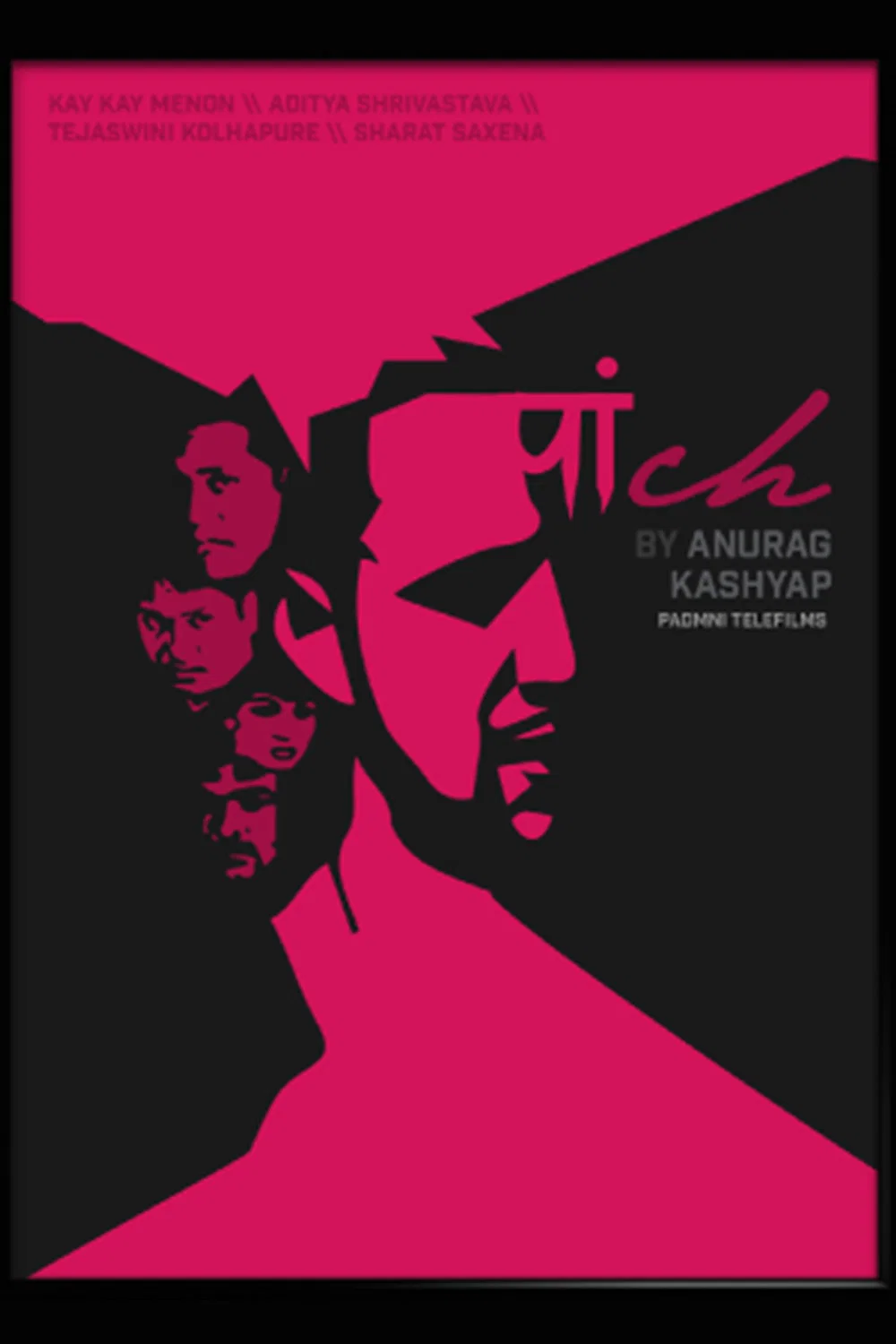
Cast : Kay Kay Menon, Aditya Srivastava, Vijay Maurya, Joy Fernandes, Tejaswini Kolhapure, Vijay Raaz
Introduction
Few debut features in the history of Indian cinema occupy so paradoxical a place as Anurag Kashyap's Paanch. Completed at the turn of the millennium, cleared after cuts by the Central Board of Film Certification in 2001, and yet never granted a theatrical or home-video release, the film exists chiefly as rumour, as a leaked artefact circulated on torrent sites and unspooled at a handful of festivals from Hamburg to Los Angeles. It is, in the most literal sense, a film that the Indian public was never permitted to see in the manner its maker intended, and this enforced invisibility has lent it an almost mythic charge. To write about Paanch is therefore to write about an absence as much as a presence: a work whose reputation has been built less on its viewing than on the controversy surrounding its suppression, and whose influence on the subsequent course of Hindi cinema has been disproportionate to the number of people who have actually watched it.
Yet to treat Paanch merely as a censorship cause célèbre would be to mistake its significance. Beneath the lurid surface that so alarmed the certifying authorities lies a serious and unsettling enquiry into the appetites of young urban India at the end of the twentieth century, its drift toward nihilism, and the seductive logic by which ordinary people may be drawn into extraordinary violence. Loosely derived from the Joshi-Abhyankar serial murders that convulsed Pune in 1976 and 1977, the film transposes that grim case into a contemporary register of struggling rock musicians, narcotics and squalid ambition. In doing so it announced, fully formed, the preoccupations and the formal restlessness of a filmmaker who would go on to reshape the grammar of mainstream Hindi cinema. The film merits attention not as a curiosity but as a foundational text of the Indian new wave that emerged in the following decade.
Cast
- Kay Kay Menon - Luke Morrison
- Aditya Srivastava - Murgi
- Vijay Maurya - Pondy
- Joy Fernandes - Joy
- Tejaswini Kolhapure - Shiuli
- Sharat Saxena - Inspector Deshpande
- Pankaj Saraswat - Nikhil Ranjan
- Vijay Raaz - Anish Ranjan
Crew
- Direction - Anurag Kashyap
- Story - Anurag Kashyap
- Cinematography - Natty Subramaniam
- Editing - Aarti Bajaj
- Music - Vishal Bhardwaj
- Production - Padmini Films
"Five very ordinary college kids viciously murdered nine people. I got what I needed to finish my script then."
Background and Production
The genesis of Paanch lies in a period of close, almost ethnographic observation. In September 1993 the young Kashyap, then finding his feet in the film world after abandoning a science degree, lodged at the St. Xavier's Boys' Hostel in Bombay, where he fell in with a group of aspiring musicians, among them Adam and Eddie Avil, Luke Kenny and Ulysses Veyra, whose band passed through the names Greek and Pralay. Kashyap kept a small notebook in which he recorded their daily lives across some forty pages, and these jottings became the raw material for a script he assembled in fragments under the provisional title Mirage. The portrait of dissolute, talented, perpetually broke young men chasing a dream that perpetually eludes them was thus drawn from life before it acquired its murderous architecture. It was only later, while working alongside others in the industry, that Kashyap encountered the files relating to the Joshi-Abhyankar serial murders, the series of killings carried out in Pune in the mid-1970s by a handful of unremarkable college students. "Five very ordinary college kids viciously murdered nine people," he recalled; "I got what I needed to finish my script then."
Backed by Padmini Films, with Padmini Kolhapure as presenter and Tutu Sharma and Jaydev Banerjee among the producers, the film was shot on a modest budget with a cast that would become a roll-call of fine character actors: Kay Kay Menon as the domineering frontman Luke Morrison, Aditya Srivastava, Vijay Maurya and Joy Fernandes as his bandmates, and Tejaswini Kolhapure as Shiuli, the sole woman in the group. The crew, too, was studded with future luminaries. The cinematographer was Natty Subramaniam, the editor Aarti Bajaj, and the score was composed by Vishal Bhardwaj, then still establishing himself as a musician before his own emergence as a major director. Crucially, Kashyap had arrived at his debut having already served a formative apprenticeship as a writer, most notably on Ram Gopal Varma's Satya in 1998, an experience that steeped him in the textures of the urban underworld and in a documentary-inflected realism that Paanch would push to a harsher extreme.
Story
The narrative of Paanch follows five young people bound together by a struggling rock band and by their dependence on Luke, the charismatic and manipulative leader who secures their accommodation, their drugs and their food, and who thereby ensures his dominion over the others. Adrift in a haze of intoxication, frustrated ambition and mounting debt, the group conceives a plan to stage a fake kidnapping in order to extract ransom money. The scheme curdles into catastrophe when one of their own is killed, and the survivors find themselves drawn into a widening spiral of concealment, betrayal and further bloodshed as paranoia corrodes the bonds that once held them together. What begins as the portrait of a marginal subculture hardens into a study of how violence, once unleashed, develops a remorseless momentum of its own.
Beneath this crime-thriller scaffolding, the film is an enquiry into nihilism and the collapse of moral restraint among the young and the disaffected. Its characters live wholly outside the structures of conventional morality, and the picture refuses the consolation of a redemptive figure or an instructive moral; the certifying board's complaint that the film "has no positive characters" and "does not carry a social message" was, in this sense, an accurate description of its artistic intent rather than a flaw. Kashyap is interested in the way crime and self-destruction can present themselves to the dispossessed as a perverse form of freedom, a means of asserting agency against a world that offers them no legitimate route to significance. The film anatomises the dynamics of a small group under pressure, the way charisma shades into tyranny, loyalty into complicity, and friendship into mutual surveillance.

Equally, Paanch can be read as a sour anti-elegy for a certain dream of artistic success. The band is the engine of the characters' fantasies, the promise that their squalor is merely a prelude to recognition, and it is the gap between that fantasy and the grinding reality of their circumstances that generates the pressure under which they fracture. Music, drugs and violence become interchangeable intensities, each a way of escaping the tedium and humiliation of failure. In its unsparing depiction of a generation's appetites and its refusal to moralise about them, the film captured an undertow of urban Indian life that mainstream cinema of the period had largely declined to acknowledge.
Direction and Craftsmanship
Even in a work compromised by the circumstances of its suppression, the assurance of Kashyap's direction is striking. He stages the descent of his characters with a claustrophobic intensity, favouring cramped interiors, restless framing and an editing rhythm, shaped by Aarti Bajaj, that mirrors the jagged, drug-addled consciousness of the group. Natty Subramaniam's cinematography eschews the burnished gloss of contemporary Hindi cinema in favour of a grimy, desaturated palette that renders Bombay as a place of perpetual half-light and moral murk. The handheld immediacy and the willingness to let scenes run on past the point of comfort owe something to the realism Kashyap had absorbed while writing Satya, but the sensibility is already more abrasive, more willing to implicate the viewer in the spectacle of degradation.
The performances are central to the film's power, and chief among them is Kay Kay Menon's Luke, a portrait of charismatic menace that established the actor as one of the most compelling presences of his generation. Menon makes the character's manipulations feel at once seductive and repellent, so that the audience understands precisely why the others submit to him even as they recoil. The supporting players, Aditya Srivastava, Vijay Maurya, Joy Fernandes and Tejaswini Kolhapure, sustain an ensemble texture of frayed nerves and shifting allegiances. Vishal Bhardwaj's score, including the song "Main Khuda", was notable for departing from the conventions of Bollywood film music, lending the picture an idiom closer to the rock subculture it depicts. The use of strong, demotic language, so offensive to the censors, is in fact integral to the film's verisimilitude, refusing the sanitised dialogue that had long governed Hindi cinema in favour of speech that sounds as it is actually spoken on the street.
The Cinema of Anurag Kashyap
Paanch is the keystone of Anurag Kashyap's body of work, the film in which the preoccupations that would define his career first cohered. The fascination with violence as a sociological and psychological phenomenon, the affection for marginal and morally compromised characters, the refusal of easy moralising, the documentary-inflected realism and the deployment of unsanitised language all recur across the films that followed. One can trace a direct line from Paanch through Black Friday, his forensic reconstruction of the 1993 Bombay bombings that itself fell foul of legal obstruction, to the sprawling criminal saga of Gangs of Wasseypur and the deglamorised noir of Ugly. In each case Kashyap returns to the territory he first mapped here: the underbelly of Indian society, the seductions of transgression, and the moral vacancy that mainstream cinema preferred to ignore.
His significance, however, extends beyond his own filmography. Having served his apprenticeship as a writer for Ram Gopal Varma, Kashyap became, in turn, the central figure of a new wave of Hindi filmmaking in the first decades of the twenty-first century, a mentor and producer who opened space for a generation of directors and actors working outside the commercial mainstream. The struggle over Paanch, and his repeated subsequent clashes with the Central Board of Film Certification over films such as Black Friday and, later, Udta Punjab, made him the most visible standard-bearer for artistic freedom in Indian cinema, a position he occupied with characteristic combativeness. That his career as a director should have begun with a film that was never released is a fitting irony: it cast him from the outset as an outsider battling the gatekeepers of an industry he would help to transform, and it lent his subsequent work the aura of hard-won independence.
Reception and Legacy
The immediate reception of Paanch was dominated by its collision with the Central Board of Film Certification. The board objected to the film's depiction of violence, its portrayal of drug abuse and its profanity, holding that the picture glorified violence, demonstrated the modus operandi of a crime, contained dialogue with sexual undertones, offered no positive characters and carried no social message. After cuts, the film secured certification in 2001, yet it was still not approved for release in the form its maker sought; the story was deemed too disturbing for general audiences, and the production lacked the resources for the reshoots that might have salvaged it. It thus became one of the most celebrated instances of an Indian film that was effectively suppressed despite eventual clearance, denied both a theatrical and a home-video life.
Deprived of conventional distribution, Paanch found its audience by unconventional means, circulating through torrent sites and screening at festivals including Filmfest Hamburg in 2003, the Osian's Cinefan Festival in 2005, the Indian Film Festival of Los Angeles in 2006 and the Jagran Film Festival in 2016. This underground afterlife transformed the film into a genuine cult object, the missing link in the evolution of modern Indian cinema, discussed and dissected by cinephiles who had to seek it out rather than encounter it in a multiplex. Its legacy is inseparable from the career it inaugurated: the very qualities that made it unreleasable in 2001 became, within a decade, the hallmarks of a respected and influential strain of Indian filmmaking, and the controversy surrounding it helped to establish Kashyap as a figure synonymous with the challenge to mainstream convention.
Commentary
There is a particular melancholy in considering Paanch, a film whose enduring reputation rests upon a viewing experience that was systematically denied to its intended audience. The questions it raises about censorship are not easily resolved. The certifying board was not wrong about the content of the film; it is violent, profane and morally bleak, and it offers neither comfort nor instruction. Where the board erred was in the assumption that art must be sanitised, that cinema must carry an improving message, and that audiences must be protected from representations of the world as it can actually be. Paanch is a reminder that the most valuable works are often those that disturb, and that the impulse to suppress them frequently outlives its own justification, leaving behind a record of timidity rather than of harm averted.
Viewed from the vantage of the present, Paanch reads less as a finished masterpiece than as a remarkable and prophetic fragment, a film whose roughness is part of its authenticity and whose influence has long since exceeded its visibility. It announced a sensibility that would, within a few years, help to recalibrate the ambitions of an entire national cinema, expanding the range of what Hindi films could depict and how they could speak. That it did so while remaining, for most of its existence, an unseen and semi-legendary object only deepens its fascination. In the final reckoning, Paanch endures not despite its suppression but partly because of it, a work whose troubled passage into the world became inseparable from its meaning, and a debut that continues to repay the attention of anyone seeking to understand how contemporary Indian cinema came to be what it is.