
Basu Bhattacharya
Basu Bhattacharya (1934–1997) was an Indian film director whose work occupies a distinctive place in the history of Hindi cinema, bridging the lyrical humanism of the Bimal Roy school in which he was trained and the introspective, chamber-scale realism that came to define the parallel cinema movement of the 1970s. Best remembered for his debut feature Teesri Kasam (1966) and for an unflinching cycle of films examining the interior life of the modern Indian marriage, Bhattacharya pursued a cinema of psychological intimacy at a time when the commercial mainstream was dominated by spectacle, melodrama, and star vehicles. His films turned away from external event toward the quiet erosions and unspoken tensions of domestic life, making him one of the earliest Bombay filmmakers to treat marital relationships as serious dramatic subject matter in their own right.
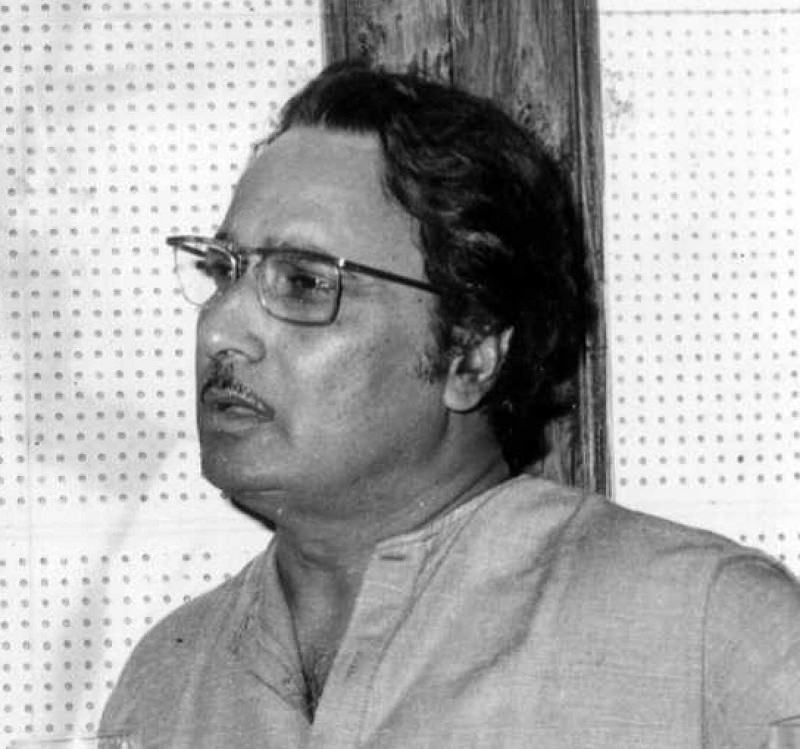
Bhattacharya worked predominantly in Hindi, though his sensibility was shaped by his Bengali origins and by the Bengali tradition of literary realism. His reputation rests above all on what is often described as his marital trilogy—Anubhav (1971), Avishkaar (1973), and Griha Pravesh (1979)—a sequence of films that anatomised the boredom, estrangement, and possibility of renewal within urban middle-class married life. These works are widely regarded as among the finest treatments of the subject in Indian cinema, and they established a register of understated, dialogue-driven realism that influenced later filmmakers working outside the commercial idiom.
His films were recognised at the highest levels of national honour. Teesri Kasam, produced by the lyricist Shailendra and starring Raj Kapoor and Waheeda Rehman, won the National Film Award for Best Feature Film. Anubhav received the National Film Award for Second Best Feature Film. As a producer, Bhattacharya backed Sai Paranjpye's Sparsh (1980), which won the National Film Award for Best Feature Film in Hindi and the Filmfare Award for Best Film. His most commercially and critically resonant directorial work, Avishkaar, brought Rajesh Khanna a Filmfare Best Actor Award and remains a touchstone of restrained performance in popular Hindi cinema.
Beyond the films themselves, Bhattacharya was an influential figure in the institutional life of Indian cinema. He served as president of the Indian Film Directors' Association from 1976 to 1979, sat on government bodies concerned with national film policy, and was associated with the National Film Development Corporation. In 1981 he served on the jury of the Moscow International Film Festival. Though his later career was marked by diminishing commercial success and a turbulent personal life, his contribution to the maturation of a serious, character-centred Indian cinema is secure.
Life and Early Work
Basu Bhattacharya was born in 1934 into an orthodox Bengali Brahmin family of hereditary priests at Cossimbazar, near Berhampore in the Murshidabad district of Bengal. His family had long served the Cossimbazar royal household, and he grew up within a traditional milieu of ritual and learning. He was educated in Berhampore before moving to Calcutta for his college studies, absorbing the intellectual and literary currents of a city that was then the cultural capital of eastern India and the crucible of much of the country's modern artistic ferment.
Like many ambitious young Bengalis of his generation drawn to the cinema, Bhattacharya made his way to Bombay in the early 1950s in search of a foothold in the film industry. The decisive turn in his early life came when he entered the orbit of the celebrated director Bimal Roy, himself a Bengali émigré who had transplanted the realist ethos of New Theatres in Calcutta to the Bombay studios. From 1958 Bhattacharya worked as an assistant to Roy, contributing to films including Madhumati and Sujata. This apprenticeship was formative: from Roy he absorbed a commitment to social observation, a humane attention to character, and a belief that popular cinema could carry serious emotional and moral weight without abandoning accessibility.
The relationship with his mentor was, however, complicated by personal circumstance. Bhattacharya fell in love with Roy's daughter, Rinki, and the two married in 1961—a union of which Bimal Roy disapproved, and which created a lasting rift between master and protégé. Rinki Bhattacharya would herself become a notable writer, critic, and documentary filmmaker. The couple had three children, among them the son Aditya Bhattacharya, who would go on to direct the acclaimed film Raakh (1989). The marriage eventually broke down; Rinki moved out in 1983 and the couple divorced in 1990, and she later became an outspoken voice on the subject of domestic violence in India. The strains of his domestic life would resonate, with painful aptness, against the marital themes that preoccupied his cinema.
The Bombay to which Bhattacharya arrived was a city in which the Bengali presence in the film industry was already substantial, and his apprenticeship placed him within a lineage of literary, socially conscious cinema that connected the New Theatres heritage of Calcutta to the new realism taking shape in the studios. The years assisting Bimal Roy were not merely technical training but an immersion in a particular ethic of filmmaking—one that prized sincerity of feeling, fidelity to lived experience, and the conviction that the cinema bore a responsibility toward its audiences. These commitments would surface, transmuted into a more austere and interiorised idiom, when Bhattacharya came to direct on his own terms.

Filmmaking
Bhattacharya's directorial career began with a film whose making was as fraught as it was eventually celebrated. Teesri Kasam (1966), adapted from Phanishwar Nath 'Renu's short story "Maare Gaye Gulfam," was a passion project of the poet-lyricist Shailendra, who produced it. Starring Raj Kapoor as a simple bullock-cart driver and Waheeda Rehman as a travelling nautanki dancer, the film is a tender, melancholy fable of innocence and disillusionment set in rural Bihar. Its production was protracted and its commercial reception initially poor—a failure that is often said to have hastened Shailendra's death—but the film won the National Film Award for Best Feature Film and has since been recanonised as a classic of lyrical Hindi cinema. The same year, Bhattacharya also made Uski Kahani (1966), an early experiment in interior, mood-driven narration.
It was in the following decade that Bhattacharya found the subject that would define him. With Anubhav (1971), he turned decisively away from the epic and the rural toward the enclosed world of the urban marriage. Starring Sanjeev Kumar and Tanuja, the film observes a busy newspaper editor and his neglected wife as their relationship is tested by routine, by emotional distance, and by the reappearance of a figure from the wife's past. Spare in incident and concentrated in its psychology, Anubhav was a departure from the conventions of the commercial film—it dispensed with subplots, songs deployed as spectacle, and external action in favour of the unspoken negotiations of a couple rediscovering one another. It won the National Film Award for Second Best Feature Film and announced a new kind of intimate realism in Bombay cinema.
Bhattacharya extended this enquiry in Avishkaar (1973), the second film of what would become his marital trilogy. Featuring Rajesh Khanna—then at the height of his stardom—opposite Sharmila Tagore, the film charts the disenchantment that settles upon a married couple some years into their life together, moving between present-day estrangement and flashbacks to earlier ardour. That Bhattacharya could draw from a reigning romantic idol a performance of such interiorised restraint was itself notable; Khanna received the Filmfare Best Actor Award for the role, and the film is frequently cited among his finest. Avishkaar confirmed that the territory of marital disillusion, far from being uncinematic, could sustain drama of real intensity.
The trilogy reached its culmination with Griha Pravesh (1979), in which Bhattacharya examined the temptation of an extramarital attraction and the quiet labour of preserving a marriage against the dissatisfactions of middle age and middle-class aspiration. Across the three films he had built a sustained, almost novelistic study of the same essential predicament—the difficulty of remaining genuinely present to another person over the long span of a shared life—returning to it from successive vantage points. Through the 1970s he also directed films including Tumhara Kalloo (1975), Sangat (1976), and Madhu Malti (1978), working steadily if not always to wide acclaim.
Bhattacharya's significance was not confined to direction. As a producer he played an important enabling role in the parallel cinema of the period, most notably backing Sparsh (1980), Sai Paranjpye's delicately observed drama of a blind school principal and the widow who enters his life. The film won the National Film Award for Best Feature Film in Hindi and the Filmfare Award for Best Film, and stands as one of the most admired works of its moment. In the 1980s and 1990s Bhattacharya's output slowed and his commercial fortunes declined—it is often observed that none of his films found real success after the early 1980s—but he continued to work, directing for television and returning to the cinema with his final feature, Aastha: In the Prison of Spring (1997). A frank treatment of a married woman's transgression and the material temptations of contemporary urban life, Aastha revisited, at the very end of his career, the themes of marriage, desire, and compromise that had animated his most enduring work. Bhattacharya died in Mumbai on 19 June 1997.
Bhattacharya's career thus traced an arc characteristic of many serious Indian filmmakers of his generation, who worked in uneasy proximity to a commercial industry that neither fully accommodated nor entirely rejected them. He drew leading stars and reached general audiences, yet his subjects and his methods set him apart from the prevailing entertainment film. The relative neglect of his later work, and the financial precariousness that accompanied it, reflect the structural difficulty of sustaining such a cinema in the absence of dependable patronage—a difficulty that the institutions of state support and the parallel cinema movement sought, with mixed success, to address during precisely the years of his greatest activity.

The Cinema of Basu Bhattacharya
The cinema of Basu Bhattacharya is defined by its scale of attention. Where the dominant Hindi film of his era expanded outward toward incident, spectacle, and resolution, Bhattacharya's best work contracted inward, toward the small gestures, silences, and evasions through which intimate relationships are lived. His characteristic form was the chamber drama: a handful of figures, a domestic interior, and a slow accretion of feeling rather than a chain of dramatic events. In choosing the marriage as his central subject, he claimed for Indian cinema a domain that the mainstream had largely reduced to courtship and ceremony, insisting instead on what happens after the wedding, in the long unglamorous middle of a shared life.
Trained in the realist tradition of Bimal Roy, Bhattacharya retained that school's humane sympathy for ordinary people while paring away its narrative amplitude. His films are notable for their restraint—in performance, in music, in mise-en-scène—and for a willingness to let scenes breathe at the pace of real conversation. This was a deliberate aesthetic of understatement, one that asked audiences accustomed to emotional declamation to attend instead to nuance, subtext, and the unsaid. In drawing interiorised, naturalistic performances from major commercial stars such as Rajesh Khanna and Sanjeev Kumar, he demonstrated that the gap between popular and parallel cinema could be narrowed by sensibility rather than by budget.
Key Themes
Marriage and its discontents. The recurring centre of Bhattacharya's work is the institution of marriage examined from within—its boredom, its compromises, its capacity for both estrangement and renewal. His marital trilogy treats the long-term relationship as a serious moral and emotional arena, refusing both sentimental idealisation and cynical dismissal.
The interior life. Bhattacharya was drawn to psychological states rather than external plot. His films privilege mood, memory, and the unspoken, often using flashback and quiet domestic ritual to render the inner weather of his characters.
Temptation and fidelity. The pull of an outside attraction—whether a figure from the past or a present-day possibility—recurs across his films as a test of the marriage, from Anubhav through Griha Pravesh to Aastha, where desire and material aspiration intertwine.
Realist restraint. Against the spectacle of the commercial film, Bhattacharya cultivated economy: few characters, enclosed settings, naturalistic dialogue, and a sparing use of song and melodrama. Understatement is itself a thematic statement about the texture of ordinary life.
The persistence of innocence. In his earliest and most lyrical work, particularly Teesri Kasam, Bhattacharya was drawn to the encounter between innocence and a disenchanting world—a romantic, elegiac strain that complements the harder realism of his marital films.
Selected Filmography
Teesri Kasam (1966) — Bhattacharya's debut feature, adapted from Phanishwar Nath 'Renu' and produced by Shailendra, with Raj Kapoor and Waheeda Rehman. A lyrical, melancholy tale of a bullock-cart driver and a nautanki dancer; winner of the National Film Award for Best Feature Film and now regarded as a classic of Hindi cinema.
Uski Kahani (1966) — An early, mood-driven experiment in interior narration, marking Bhattacharya's turn toward psychological subject matter.
Anubhav (1971) — The first film of the marital trilogy, starring Sanjeev Kumar and Tanuja. A spare study of a neglected marriage rekindled, which won the National Film Award for Second Best Feature Film and pioneered a new intimate realism in Bombay cinema.
Avishkaar (1973) — The second of the trilogy, with Rajesh Khanna and Sharmila Tagore tracing the disenchantment of a married couple. Khanna won the Filmfare Best Actor Award; the film remains among the most admired of his career.
Griha Pravesh (1979) — The culmination of the trilogy, examining extramarital temptation and the effort to sustain a marriage amid middle-class aspiration.
Sparsh (1980) — Produced by Bhattacharya and directed by Sai Paranjpye, a tender drama of a blind school principal and a widow. Winner of the National Film Award for Best Feature Film in Hindi and the Filmfare Award for Best Film.
Aastha: In the Prison of Spring (1997) — Bhattacharya's final feature, a frank treatment of marital transgression and material temptation that returned to the themes of his defining work.
Legacy
Basu Bhattacharya's legacy rests on his early and sustained insistence that the inner life of the Indian marriage was a subject worthy of serious cinema. At a moment when the commercial Hindi film treated romance largely as prelude and resolution, he made films about the long aftermath—about disenchantment, routine, and the quiet work of staying together—and in doing so opened a thematic territory that later filmmakers would continue to explore. His marital trilogy, Anubhav, Avishkaar, and Griha Pravesh, is regularly cited as among the most accomplished treatments of the subject in Indian cinema, and his realist economy offered an alternative model to directors seeking to work between the poles of the commercial and the avant-garde.
As a producer and institutional figure, Bhattacharya helped widen the space in which a more serious cinema could be made. His backing of Sparsh contributed a landmark to the parallel cinema of the period, and his presidency of the Indian Film Directors' Association from 1976 to 1979, his service on government committees concerned with national film policy, his association with the National Film Development Corporation, and his place on the jury of the 1981 Moscow International Film Festival reflect the standing he held among his peers. He was, in these respects, both a maker of films and a steward of the conditions under which difficult films could survive.
His influence also passed directly into the next generation through his son Aditya Bhattacharya, whose Raakh extended the family's engagement with a darker, more interior cinema. If Bhattacharya's later years were shadowed by commercial decline and personal difficulty, the core of his achievement endures: he brought to popular Hindi cinema a vocabulary of restraint, psychological attention, and domestic realism, and he proved that the unspectacular drama of two people trying to understand one another could hold the screen. He remains a significant transitional figure between the humanist studio realism of Bimal Roy and the introspective parallel cinema that followed, and his finest films retain their force as studies of intimacy and its discontents.
Basu Bhattacharya on Art House Cinema

Teesri Kasam (1966)
Teesri Kasam (1966) is Basu Bhattacharya’s National Award-winning Hindi film, adapted from Phanishwarnath Renu’s story, about a naive bullock-cart driver who falls in love with a travelling nautanki dancer, a tender meditation on innocence, unfulfilled love, and the exploitation of folk performers in rural India.