
PYRE Chita
- Director
- Vinod Kapri
- Country
- India
- Language
- Hindi, Kumaoni
- Year · Runtime
- 2024 · 111 min
- Starring
- Padam Singh Kapri, Hira Devi
Introduction
Two old people live on a hillside in Kumaon, in eastern Uttarakhand, waiting for a son who left for Mumbai twenty-eight years ago. While they wait, the village leaves. Neighbours lock their doors and go down to the towns. The young men who still carry Tulsi to the hospital start talking about leaving, and Padam, her husband, begins to count. He reckons they have one month to live and two to die. Pyre, written and directed by Vinod Kapri, is about that arithmetic.
Its Hindi title is Chita, the funeral pyre. The question underneath every scene is who will light one when the time comes, since cremation needs mourners and the mourners have gone. Padam's answer is practical. He stacks the wood himself, outside the door of the house, one pyre for each of them.
Kapri spent more than twenty years in television news before he made films, and the casting is a reporter's decision. The couple are played by people who had never stood in front of a camera: Padam Singh Kapri, a retired army havildar and the director's uncle, and Hira Devi, a widow who farms near Berinag in Pithoragarh district. The film had its world premiere at the 28th Tallinn Black Nights Film Festival in November 2024, where the audience voted it their favourite film. It then spent two years on the festival circuit and reached Indian cinemas on 30 October 2026.
Cast
- Padam Singh Kapri Padam Singh, called Bubu
- Hira Devi Tulsi, called Aama
- Subhash Chandra Laxman
- Shubham Chaudhary Jeevan
- Sadab Khan Bishan, the postman
- Alok Verma Jeevan's father
- Jaya Shah Jeevan's mother
- Gopa Nayal, Deewan Kanwal, Pushpa Pandey Neighbours
Crew
- Direction Vinod Kapri
- Screenplay Vinod Kapri
- Production Sakshi Joshi, Vinod Kapri, Suresh Joshi
- Executive producer Arindra Rai Chaudhuri
- Cinematography Manas Bhattacharyya
- Editing Patricia Rommel, Subhajit Singha
- Music Mychael Danna, Amritha Vaz
- Lyrics Gulzar
- Sound design Soustav Naskar
- Re-recording mixer Alok De
- Production design Vinod Kapri, Donna Bose
- Costume design Nandini Sengupta, Vinod Kapri
- Casting Anoop Trivedi
- Production companies Bhagirathi Films, Mashakbeen Studios, Calcutta Cineverse
- Distribution (India) Cinépolis

Background and production
The story began on a trek. In 2017 Kapri was walking the hills around Munsiyari, in the Kumaon region his family comes from, when he saw an old couple grazing thirty or forty goats on a slope above him. He climbed for an hour to reach them. They told him, as he later recalled to Cinema Express, that Indira Gandhi was doing nothing for them, and he understood how long they had been cut off. The man's real worry was his wife. If she fell ill, someone had to carry her down to a doctor, and he paid each helper with a goat. Kapri asked what would happen when the goats ran out. "Before the goats are done, we will be gone," the man said, in the translation Kapri gave The Indian Express. The line is in the film.
His first plan was to film the couple themselves. After ten days of trying to make them act he gave up. From 2018 to 2020 he auditioned actors from the hills and found no one he believed. He then took the script to Naseeruddin Shah and Ratna Pathak Shah, who agreed to play the parts. Shah fell ill, and his doctors advised him against working at altitude. Kapri told Cinema Express that it was Shah who then told him to look for non-actors from the region. In the meantime Kapri turned to documentary work.
The lead was found at a birthday party. On 8 July 2022 Kapri gathered his father's relatives for his father's eightieth birthday, and an uncle, Padam Singh Kapri, a retired havildar who had acted in Ramlila performances in his village, asked to be auditioned. Kapri gave him the scene in which Padam calls out to the village after his wife's death. The room applauded. A second test of eighteen to twenty scenes, run with a friend trained at the National School of Drama, settled it.
Finding Tulsi took longer. The crew searched the hill villages for a woman of seventy or eighty, and on about the fifteenth day they found one cutting grass on a slope. She and her neighbours first took the strangers for forest officials come to arrest them. When a girl explained that the men from Bombay wanted a heroine, Hira Devi threw down her bundle of grass and announced that she was one. She told Kapri that she spoke no Hindi, only Kumaoni. Her son persuaded her to take the part. Some of it cost her grief. As a widow she no longer wore a nath, the nose ring, and putting one on again for the role upset her, as did a line about losing children.
No producer would put money into a film about an old couple played by villagers, so Kapri and his wife, Sakshi Joshi, made it themselves through Bhagirathi Films. The shoot lasted thirty-five days on location in Pithoragarh district, with Berinag, Kapri's native village, as the main base. Kapri insisted on the real monsoon and on no green screen, though the slopes were known for leopards. He told the Khaleej Times that ninety-five per cent of the crew came from Kolkata and that most worked for a quarter of their usual fee. The German editor Patricia Rommel, who had cut The Lives of Others, spent a year on the film without charge. Mychael Danna, who won the Academy Award for the score of Life of Pi, saw a first cut and wrote the music for nothing. Gulzar wrote his lyrics without a fee as well.

Padam Singh Kapri and Hira Devi as Padam and Tulsi, Pyre
Story
The film opens on a cliff. Padam (Padam Singh Kapri) has led his wife Tulsi (Hira Devi) up to a ledge above a waterfall and proposes that they jump together. They do not move. Neither can quite say how old they are. He was born, he thinks, when the Second World War began, and she when the bombs fell on Japan. She was ten when they married, and they have been together about sixty-five years.
Their days are habit. He drinks and she smokes beedis, he complains about her cooking and she complains about him, and the quarrelling is how they talk. "Let's quarrel, it's your best talent," he tells her. Padam takes a goat almost everywhere and hangs his umbrella from the collar of his jacket. Only a few households are left on the hill. When Tulsi falls ill, Padam gets two young neighbours, Laxman (Subhash Chandra) and Jeevan (Shubham Chaudhary), to carry her to the hospital, a five-hour round trip, and pays them in goats. Then Laxman and Jeevan begin to talk about leaving, and the family next door says it will move to town within the month. Padam begs them all to stay a little longer.
A letter comes through Bishan, the postman (Sadab Khan). It is from Hariya, their only child, who went to Mumbai twenty-eight years earlier and never came back. He apologises and promises a visit. The news revives them both. The couple give a feast for the neighbours who remain, and the day comes and goes without him. The guests eat and leave. The camera finds the scraps on the ground.
More letters follow and more waiting. The monsoon breaks, the radio reports storms and deaths across the country, and water comes in through every crack of the house, which loses a little more to each storm. Padam stacks wood outside the door. "I'm making this for you," he tells Tulsi. When he suggests the cliff again she waves it away and goes to cook dinner. At last he admits what has happened to them. Their son is not lost, he says. They are the ones who got lost, in their own hills and their own house.
Padam walks out to his pyre, sits down on it and dies. Tulsi cremates him herself. A revelation in the closing minutes alters the meaning of all that waiting. Alone, Tulsi goes from house to house knocking on the locked doors of neighbours who are long gone. Given the choice to leave, she stays. "How can I leave my Bubu?" she asks. "My Bubu is in the Himalayas."

Tulsi and Padam at the windows of their house, Pyre
Direction and craftsmanship
Kapri and his cinematographer, Manas Bhattacharyya, work with two scales. In close shots the faces carry the film: Padam's beard and cap in the glow of the cooking fire, Tulsi's grey hair against the blue shutters of the house. Then the camera pulls away, sometimes on a drone, until the couple are two dots on a green hillside. Amber Wilkinson of Eye for Film noted how often the frame lifts away from them, and how it sometimes slides sideways instead. One such lateral move discovers the remains of the feast after Hariya has failed to arrive.
The weather is real, and it does much of the dramatic work. The worst things in the film happen in rain that was never added in post-production. Victor Fraga of DMovies pointed out that water and fire, the cloudburst and the pyre, are the two elements the film is built on. Rahul Desai, reviewing for The Hollywood Reporter India, made a sharper point. The misty long shots, he wrote, flatter the urban viewer's idea of mountain living, and the film then corrects it through repetition: the same chores and the same weather, day after day.
The performances were shaped with simple methods. Kapri told Cinema Express that his leads could learn their lines but not the pauses, so he asked them to count to five in their heads before answering, as people married for sixty-five years would. The result is dialogue with long gaps in it, which suits a house where there is little to say and nobody new to say it to. Padam Singh Kapri plays Padam as a performer of sorts, a man who keeps entertaining his neighbours so that they will have a reason to stay. Desai called it a complicated and moving turn.
Language is where critics part company. Kapri chose Hindi for the dialogue, though Kumaoni is the leads' mother tongue and Hira Devi told him at their first meeting that she spoke no Hindi. Desai heard the strain: phrases that sound new in mouths that have used other words all their lives. Hridayesh Joshi, writing in Live Hindustan, heard the opposite: dialogue delivered with such care over its small inflections that it sounds like a real Kumaoni village. Both are describing the same sound. Kumaoni comes back through the folk songs Padam sings, among them one about a Tibetan come from far away, who must be hungry in a strange land.
The music is less sure of itself. Danna and Amritha Vaz scored the film, partly with a flute that recurs over the pine slopes, and Gulzar wrote the lyrics for its songs. Desai observed that the score swells at the expected moments, and the montages set to song are the most conventional passages in an otherwise plain film. Rommel and Subhajit Singha cut slowly and let scenes run their length. Murtaza Ali Khan, writing in The Tribune, praised exactly that restraint.

Hira Devi and Padam Singh Kapri on a hillside, Pyre
The cinema of Vinod Kapri
Vinod Kapri was born in Secunderabad, the son of an army man from a Kumaoni family with roots in Pithoragarh. "As a journalist I did a lot of stories on the Himalayas and in that way relearned my family's history," he told the Khaleej Times. His first career was in television news, where he worked for more than twenty years.
His first film was a documentary. Can't Take This Shit Anymore (2014) followed six young wives in Kushinagar district, Uttar Pradesh, who went back to their parents because their husbands' homes had no toilets. It won a National Film Award. His first feature, Miss Tanakpur Haazir Ho (2015), with Om Puri, Annu Kapoor and Sanjay Mishra, was a satire about a village headman who uses the law to settle a private score. Pihu, which Kapri presented at the International Film Festival of India in Goa in November 2017 and released in 2018, put a two-year-old girl alone in a flat with her dead mother and kept the camera on her. It came from a newspaper report. Then came 1232 KMS (2021), a documentary that rode with seven migrant workers as they cycled from Ghaziabad to their villages in Bihar during the first Covid lockdown of 2020.
Seen together, the films share a habit. Each starts from something that happened, and each holds on one situation for longer than is comfortable. 1232 KMS and Pyre belong together. The first follows the men who leave for the cities and then have to come back. The second stays with the people they leave behind in the hills. Pyre is also the first of his features in which the documentary-maker's trust in real people is the whole method rather than a source of stories. Murtaza Ali Khan, in The Tribune, wrote that Kapri keeps raising the bar in his work with non-actors, a skill already tested on a two-year-old in Pihu.

Vinod Kapri with Myra Vishwakarma of Pihu and the director Kamal Swaroop at a press conference at the 48th International Film Festival of India, Panaji, 22 November 2017
Reception and legacy
Pyre was the only Indian film in Tallinn's Official Competition that year, and the audience award surprised its director. "It's like a fairytale," Kapri told the Press Trust of India. Victor Fraga called the film extraordinarily beautiful and heartbreaking. At the cliff edge, wrote Amber Wilkinson, the couple are like Beckett's Vladimir and Estragon in Waiting for Godot: they do not move.
In 2025 the film travelled. It opened the 16th Bengaluru International Film Festival, its Indian premiere, and received a jury special mention in the Asian Cinema Competition there. Padam Singh Kapri and Hira Devi were nominated for best actor and best actress at the New York Indian Film Festival. In July it won audience awards at the Asian Summer Film Festival in Vic, in Spain, and at the London and Birmingham Indian film festivals, and the Grand Jury award for best feature at the Indian Film Festival Stuttgart. Best feature prizes followed at the DC South Asian Film Festival and the India International Film Festival of Boston, which also named Kapri best director. Shabana Azmi presented the audience award at the Chicago South Asian Film Festival. In Delhi, at the Habitat Film Festival in May, the audience stood when the credits rolled. By the producers' count the film collected eighteen international awards.
Not every response was a prize. Prince Tomar, a doctoral researcher at Tallinn University, reviewed the film for HIMALAYA, the journal of the Association for Nepal and Himalayan Studies. He read the emptying village through Marc Augé's idea of the non-place and praised the film for looking at the mountains from inside. He also faulted it for reducing the Himalaya to remoteness and missing infrastructure, while saying little about ecology or the damage that reckless building does to the hills.
An Indian release came slowly. Kapri said that no studio or streaming service would watch the film, and that after Deepa Mehta handed him the best film and best music awards at the Mosaic International South Asian Film Festival in Canada he announced it would be his last film. His executive producer, Arindra Rai Chaudhuri, then met the London businessman Suresh Joshi, who agreed to back a limited theatrical release. Before it opened, the film was shown in inflatable cinemas in Bageshwar, Berinag and Srinagar between 14 and 18 October 2026, 41 shows at 99 rupees a ticket, to about 3,700 people. Cinépolis was to distribute it. The release was announced for 23 October and then moved to 30 October.
It opened on about eighty screens. Kapri said word of mouth took it past four hundred shows within days, and that three quarters of them were cut after Ramayana: Part 1 opened. On 12 November he announced that more than two hundred shows would be added from the next day. Desai's review called it a meditative tragedy. Aishani Biswas in Outlook admired its refusal to beautify the hills and thought it lost momentum in the middle. Kaveree Bamzai in Open found it elegiac and also remarkably warm and funny.
Their pauses are the film's real music.
Awards & honours
- Won Audience Award (best film), Official Competition, 28th Tallinn Black Nights Film Festival, Estonia, 2024
- Won Jury Special Mention, Asian Cinema Competition, 16th Bengaluru International Film Festival, 2025
- Nominated Best Actor, Padam Singh Kapri, 25th New York Indian Film Festival, 2025
- Nominated Best Actress, Hira Devi, 25th New York Indian Film Festival, 2025
- Won Best Film Audience Award and Jury Special Mention, 22nd Asian Summer Film Festival, Vic, Spain, 2025
- Won Best Film Audience Award, London Indian Film Festival, 2025
- Won Best Film Audience Award, Birmingham Indian Film Festival, 2025
- Won Grand Jury Best Feature Film Award (German Star of India), 22nd Indian Film Festival Stuttgart, 2025
- Won Best Feature Film, 14th DC South Asian Film Festival, 2025
- Won Best Feature Film and Best Director, 8th India International Film Festival of Boston, 2025
- Won Best Film Audience Award, 16th Chicago South Asian Film Festival, 2025
- Won Best Director, 3rd Novi Sad Film Festival, Serbia, 2025
- Won Best Film and Best Music, Mosaic International South Asian Film Festival, Canada, 2025
- Entry 49th São Paulo International Film Festival, 2025
- Entry 30th International Film Festival of Kerala, 2025
Reference
- Pyre (Tuleriit), Tallinn Black Nights Film Festival (PÖFF), film page
- Vinod Kapri's 'Pyre' selected for Tallinn Black Nights Film Festival, The Times of India, 19 October 2024
- Vinod Kapri's 'Pyre' wins Audience Award at Tallinn Black Nights Film Festival, Hindustan Times (PTI), 24 November 2024
- Pyre, Victor Fraga, DMovies, 19 November 2024
- Pyre (2024) film review, Amber Wilkinson, Eye for Film, 11 February 2025
- Pyre is a film about lonely parents in the Himalayas. It stars real villagers as actors, Sakshi Mehra, ThePrint, 29 May 2025
- Meet the lead actors of Pyre, an ode to the reality of migration, old age and loneliness, Aiswarya Raj, The Indian Express, 13 July 2025
- Himalayan Drama 'Pyre' Claims Audience Award at London and Birmingham Indian Film Festivals, Variety, 25 July 2025
- Vinod Kapri's 'Pyre': Quiet decisions made to live, love, prepare for death, Murtaza Ali Khan, The Tribune, 27 July 2025
- Oscar vijeta No Man's Land se kam nahin hai Vinod Kapri ki Pyre (in Hindi), Hridayesh Joshi, Live Hindustan
- Vinod Kapri's Pyre wins Best Feature at DC South Asian Film Festival, Diya TV, 18 September 2025
- Vinod Kapri's 'Pyre' wins award at Chicago South Asian Film Festival, The Tribune, 22 September 2025
- Double win at MISAFF for Vinod Kapri's Pyre, New India Abroad, 1 December 2025
- Ko su pobednici trećeg Novi Sad Film festivala (in Serbian), Novi Sad Film Festival, 22 September 2025
- Review of Pyre, directed by Vinod Kapri, Prince Tomar, HIMALAYA 44(2): 97-100, 2025
- Vinod Kapri's Award-Winning Drama 'Pyre' To Release In India On October 23, The Hollywood Reporter India, 29 September 2026
- Vinod Kapri's Pyre to release in theaters on October 30, 2026, Bollywood Hungama, updated 23 October 2026
- 'Pyre' Movie Review, Rahul Desai, The Hollywood Reporter India, 29 October 2026
- Pyre director Vinod Kapri: It's very difficult to get an indie film out on OTT, Kartik Bhardwaj, Cinema Express, 30 October 2026
- Pyre film review, Aishani Biswas, Outlook, 30 October 2026
- 'Pyre' is a film about death as much as a meditation on how to live with dignity and love, Kaveree Bamzai, Open, 4 November 2026
- How Vinod Kapri took Himalayan drama 'Pyre' to remote villages with inflatable cinemas, Justin Rao, The Hollywood Reporter India, 11 November 2026
- Vinod Kapri on Pyre's reduced shows due to Ramayana, Siddhi Chatterjee, Outlook, 12 November 2026
- Pyre adds over 200 shows from November 13, ANI via NewKerala, 12 November 2026
- 'Pyre', the Indian movie holding its ground against 'Ramayana: Part 1', Manju Ramanan, Khaleej Times, 15 November 2026
Pyre trailer on YouTube
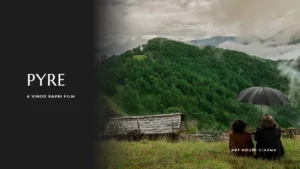
Image credits: Banner: Bhagirathi Films; press still from the Tallinn Black Nights Film Festival (PÖFF), All rights reserved; used for criticism and review, via source. Image: Press Information Bureau, Ministry of Information and Broadcasting, Government of India, GODL-India, via Wikimedia Commons. Image: Bhagirathi Films, festival poster; via IMDb, All rights reserved; used for criticism and review, via source. Image: Bhagirathi Films; press still from the Tallinn Black Nights Film Festival (PÖFF), All rights reserved; used for criticism and review, via source. Image: Bhagirathi Films; press still from the Tallinn Black Nights Film Festival (PÖFF), All rights reserved; used for criticism and review, via source. Image: Bhagirathi Films; press still from the Tallinn Black Nights Film Festival (PÖFF), All rights reserved; used for criticism and review, via source.







Commentary
Pyre is at its best when it does least. The goats paid out for every favour, and the line about running out of them, come straight from the couple Kapri met on a hillside in 2017. The best scenes have the same plainness, above all the wood stacked by the door and the scraps left on the ground after the feast. The film is honest about the economics of being old in an empty village. Care is paid for in goats, and when the goats run out, so does the care. It looks at migration from the side of those who stay.
Padam Singh Kapri is the reason to see it. His Padam is vain, needy, funny and frightened, and he keeps performing for the neighbours as if a good enough show might keep them on the hill. Hira Devi has the harder part, since Tulsi is ill for much of the film, and she makes the last minutes hers. Their pauses are the film's real music.
The reservations are real too. The Hindi dialogue sometimes sounds like a translation. It is easy to see why Kapri chose Hindi, and easy to hear what it cost. The score and the Gulzar songs pull the film towards the festival lyricism it otherwise resists, and the montages are its weakest passages. The middle stretch of letters and waiting loses momentum, as Biswas noted, and the closing revelation, which Desai called predictable, explains the waiting more neatly than the rest of the film needs. Tomar's objection also holds. A film this attentive to the rain says little about the land itself, its ecology or what careless building is doing to it.
Those faults are smaller than the film. It is a film about people left behind that was itself nearly left behind: by producers who would not fund it, by streaming services that would not watch it and by cinemas that dropped it for a bigger picture. It survived because audiences, from Tallinn to Berinag, kept asking to see it.