KODIYETTAM (The Ascent)
Adoor Gopalakrishnan
India. 1982. 128 min
Cast : Bharath Gopy, Lalitha, Kuttyedathi Vilasini, Kaviyoor Ponamma
Introduction
Kodiyettam — translated variously as Ascent, The Climb, or Taking Wing — stands as one of the defining works of the Malayalam New Wave and, by extension, of Indian parallel cinema. Released in 1977 and directed by Adoor Gopalakrishnan, the film secured its place in the canon not through grand proclamation or radical formal experiment, but through the quiet, almost unbearable precision with which it observes a single unremarkable man navigating the equally unremarkable routines of his existence. In Shankarankutty — its protagonist, a feckless, daydreaming young man from a Nair household in rural Kerala — Adoor created one of Indian cinema's most enduring anti-heroes: a figure whose smallness is never diminished by the camera's gaze but is instead treated with a compassion that borders on the philosophical.
The film won the National Film Award for Best Direction, catapulting Adoor into the national consciousness following his debut with Swayamvaram (1972), itself a landmark of the new Indian cinema. Where Swayamvaram had dealt with the collision of idealism and social constraint through the institution of marriage, Kodiyettam turns inward, finding its drama not in collision but in drift — the slow, almost imperceptible manner in which a life can pass without being truly lived. That this condition is rendered with such warmth, intelligence, and formal grace is the achievement that makes Kodiyettam irreplaceable.
Cast
- Bharath Gopi - Shankarankutty
- K. P. A. C. Lalitha - Shanthamma
- Kuttyedathi Vilasini - Sarojini
- Kaviyoor Ponnamma - Kamalam
- Azeez - Truck Driver
- Thikkurisi Sukumaran Nair - Sukumara Pillai
- Adoor Bhawani - Shanthamma's mother
- Adoor Pankajam - Pankajakshi
- Aranmula Ponnamma - Neighbour
Crew
- Direction - Adoor Gopalakrishnan
- Story - Adoor Gopalakrishnan
- Cinematography - Mankada Ravi Verma
- Editing - M Mani
- Production - Chitralekha Film Society

Background and Production
Adoor Gopalakrishnan had founded the Chitralekha Film Co-operative in Thiruvananthapuram in 1965, alongside a group of film enthusiasts committed to producing cinema outside the commercial apparatus of the Kerala film industry. This institution, which Adoor helped establish after graduating from the Film and Television Institute of India (FTII) in Pune, became a crucial infrastructure for the emergence of independent Malayalam cinema. The co-operative model allowed for artistic autonomy — modest budgets, long shooting schedules, and a refusal to compromise aesthetic vision for box-office consideration — that would have been impossible within the mainstream studio system.
Kodiyettam was conceived as a study in arrested development, drawing on the social fabric of the Kerala caste system and the particular psychology of a feudal milieu in decline. The screenplay, written by Adoor himself, was developed over an extended period and reflects his characteristically methodical approach to storytelling: every detail is purposeful, every silence calibrated. Filming took place in and around Kerala, with Adoor using real locations that carry the visual and cultural weight of the landscape — coconut groves, narrow village paths, tiled-roof houses — without resorting to picturesque exoticism.
The cinematography was handled by Ravi Varma, who had also shot Swayamvaram. Their collaboration had already established a visual grammar notable for its restraint: static or very slowly moving frames, natural light, a rejection of the expressive camera pyrotechnics associated with commercial cinema. For Kodiyettam, this approach intensified. The camera watches rather than intervenes. It records the world with the patient neutrality of a documentarian while achieving, through precise composition, a poetic density that is anything but neutral.
Story
Shankarankutty (played with extraordinary naturalism by Ramankutty) is a young man who works as a messenger of sorts — running errands, carrying letters, drifting between households and social obligations — in a small Kerala town. He is not a rebel, not a visionary, not a sufferer in any demonstrable sense. He is simply a man unable to take hold of his own life. He procrastinates on marriage, avoids responsibility, and finds comfort in the small pleasures and gentle vagaries of day-to-day existence. The narrative, to the extent that it possesses a conventional arc, follows Shankarankutty across a period of time during which nothing of great consequence happens and yet everything quietly shifts.
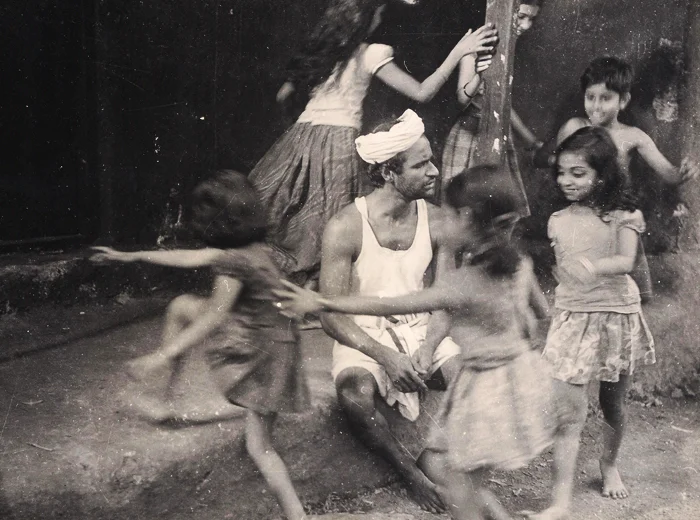
Shankarankutty and children
At the thematic core of Kodiyettam lies an interrogation of what it means to be a man in a society organised around duty, expectation, and patriarchal inheritance. Shankarankutty inhabits a world in which the roles assigned to him — son, husband, breadwinner, head of household — are well understood by everyone around him. His failure is not ignorance of these roles but an incapacity, or perhaps an unwillingness, to inhabit them. Adoor never moralises. He does not condemn Shankarankutty, nor does he romanticise his drift. The film holds both the comedy and the pathos of its protagonist's condition in careful suspension.
The concept of 'kodiyettam' itself — the raising of a flag or pennant, often in a temple context — carries connotations of ceremonial assertion, of a life formally inaugurated. The irony of the title is gentle but devastating: Shankarankutty's ascent, such as it is, remains perpetually deferred, always about to begin. In this sense, the film participates in a broader literary and cinematic tradition of the paralysed male, from Chekhov to Satyajit Ray's Apur Sansar, though Adoor's treatment has its own distinctively Keralite texture.

Shankarakutty and Shanthamma
The film also engages, obliquely but significantly, with caste and class in transitional Kerala. The Nair community to which Shankarankutty belongs was historically positioned at a juncture between an older feudal order and the emerging egalitarian impulses of post-Independence Indian society. The disorientation of this in-between position — the old privileges eroding, the new order demanding a self-reliance that tradition had never cultivated — is legible in Shankarankutty's very posture, his habit of looking askance at decisions that require him to act.

The times of despair and hopelessness.
Direction and Craftsmanship
Adoor Gopalakrishnan's direction of Kodiyettam is a masterclass in the virtues of restraint. Working in a mode that owes debts to Italian Neo-Realism and to the quietly observational cinema of Satyajit Ray, Adoor develops a style that is nevertheless entirely his own — more composed than De Sica, less melancholy than Ray, attuned to a particular quality of light and social texture that is unmistakably Keralite. His camera placement is deliberate to the point of severity: scenes are allowed to breathe, to unfold without editorial intervention, without music cuing emotional response.
The editing, by M. Mani, eschews conventional dramatic rhythm in favour of a kind of temporal honesty. Sequences extend to their natural conclusion rather than to the beat of a conventional cut. The effect is not slowness in any pejorative sense but a quality of presence — the viewer is made to inhabit Shankarankutty's time, to experience its texture rather than simply to observe its passing. This temporal strategy is one of the film's most radical and rewarding formal choices.
Ravi Varma's cinematography achieves its effects through accumulation rather than spectacle. Individual shots are quietly beautiful — the play of filtered light through palm fronds, the geometry of a doorframe against which Shankarankutty habitually leans — without ever announcing their beauty. The visual register matches the thematic one: dignity without self-consciousness, observation without judgment.
The performances throughout are governed by an aesthetic of understatement. Ramankutty's Shankarankutty is a creation of extraordinary subtlety: there are no actorly moments, no speeches, no emotional climaxes. He communicates through a quality of physical stillness interrupted by small, revealing movements — the way he avoids a direct gaze, the slight smile that betrays pleasure in inconsequential things. The supporting cast, drawn largely from non-professional or theatre backgrounds, contribute to an overall texture of social realism that feels wholly achieved.
The Cinema of Adoor Gopalakrishnan
Kodiyettam occupies a pivotal position in Adoor's filmography: it consolidates the approach announced by Swayamvaram and establishes the thematic and formal preoccupations that would define his mature work. Adoor is, above all, a filmmaker of social anthropology — his films examine the structures of Kerala society, particularly its caste hierarchies and the psychological formations those hierarchies produce, with a rigour that places him in the company of the great humanist directors of world cinema.
His subsequent films — Elippathayam (1981), Mukhamukham (1984), Anantaram (1987), Mathilukal (1990), Vidheyan (1993) — trace an increasingly dark inquiry into the pathologies of power and submission. Elippathayam, with which Adoor won the British Film Institute Award for Best Film, extends the study of the paralysed male into something more explicitly Kafkaesque, while Vidheyan explores the psychodynamics of absolute domination with a near-allegorical intensity. Kodiyettam may be the warmest and most humanely comic of his films — it retains a tenderness towards its protagonist that some of the later work sacrifices in the service of a harder analytical vision.
Within the broader context of the Indian New Wave (or Parallel Cinema), Adoor belongs to the first generation of FTII-trained filmmakers who transformed Indian cinema in the 1970s, alongside Shyam Benegal, Mrinal Sen, Kumar Shahani, and Mani Kaul. His work is distinguished from that of his contemporaries by its regional rootedness — his films are not merely set in Kerala but are constituted by Kerala, shaped at the level of rhythm and image by a particular landscape and social formation. This regional depth gives his work a specificity that prevents it from ever becoming merely programmatic.
Reception and Legacy
Kodiyettam was received with considerable critical enthusiasm upon its release, winning the National Film Award for Best Direction in 1978 — a recognition that brought Adoor to national attention and placed Malayalam cinema firmly within the discourse of serious Indian filmmaking. The film also won the Kerala State Film Award for Best Film and Best Actor (Ramankutty), confirming its standing within the regional critical establishment.
Internationally, Kodiyettam was among the early Malayalam films to gain a substantial festival audience, screened at events in Europe and Asia where Indian art cinema was beginning to attract serious critical attention. Critics drew connections to the Italian Neo-Realist tradition and, more locally, to the work of Satyajit Ray, though Adoor's formal distinctiveness was increasingly recognised as the work of an original intelligence rather than a follower.
The film's legacy is threefold. First, it established Adoor Gopalakrishnan as a filmmaker of international importance, a status he would consolidate over the following decades. Second, it contributed to the cultural legitimisation of a certain kind of Malayalam cinema — serious, regionally grounded, formally ambitious — that would produce remarkable work through the 1970s, 80s, and 90s in the hands of directors including Aravindan G., Shaji N. Karun, Bharathan, and Padmarajan. Third, and perhaps most enduringly, Kodiyettam offered a portrait of a particular human type — the man who cannot begin — that has continued to resonate across generations of viewers who recognise in Shankarankutty something of their own unbegun lives.
Commentary
To watch Kodiyettam in the second decade of the twenty-first century is to be struck, above all, by its contemporaneity. The condition it diagnoses — a species of inertia rooted not in laziness but in an inability to negotiate the space between received identity and authentic selfhood — has, if anything, become more widespread in the intervening decades. Shankarankutty belongs to a long lineage of literary and cinematic characters who find the passage from youth to responsibility not simply difficult but somehow beside the point. Yet Adoor's treatment of this condition is neither despairing nor complacent. The film ends not with redemption in any conventional sense but with the suggestion of possibility — of a flag, perhaps, about to be raised.
The great achievement of Kodiyettam is to render this condition with such formal precision and such human warmth that it transcends its sociological specificity. This is a film about a Nair man in 1970s Kerala; it is also a film about the human tendency to defer the life that is waiting to be lived. That Adoor accomplishes this double register without ever straining for universality — allowing the universal to emerge, quietly and inevitably, from the thoroughly particular — is the mark of a filmmaker working at the height of his powers. Kodiyettam is, in the fullest sense of the phrase, a small masterpiece: modest in scale, immeasurable in depth.
Awards & Recognition
- 25th National Film Awards (1978) - Best Feature Film in Malayalam, and Best Actor (Bharath Gopi)
- Kerala State Film Awards (1978) - Best Film, Best Actor (Bharath Gopi), Best Story (Adoor), Best Director (Adoor), Best Art Direction (N Sivan)
Reference
- Wikipedia - Kodiyettam
- Bharat Gopy - Kodiyettam (1977)