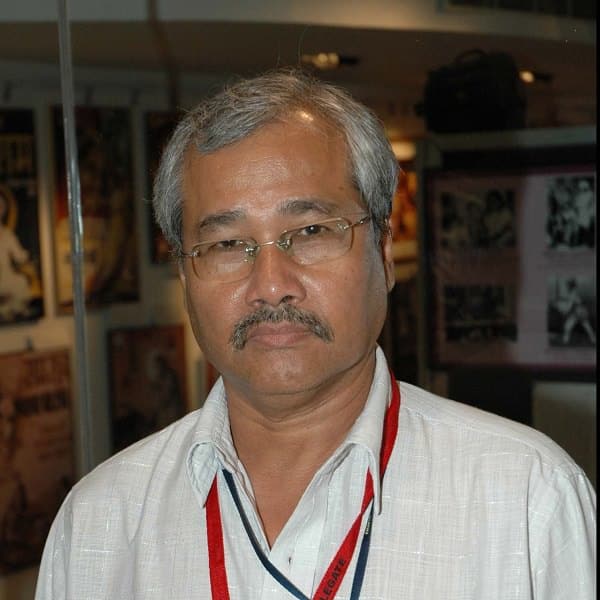
Bhaskar Hazarika has directed two feature films. Both are in Assamese, both are frightening, and both carried Assamese cinema to festivals it had rarely reached. Kothanodi (2015) recast four folk tales from Lakshminath Bezbaroa’s Burhi Aair Sadhu into a study of infanticide, witch-hunting and household cruelty. It had its world premiere at the 20th Busan International Film Festival in October 2015 and won the National Film Award for Best Feature Film in Assamese at the 63rd ceremony, announced on 28 March 2016. Aamis (2019), in which a married paediatrician and a younger doctoral student move from shared meals to cannibalism, premiered in the International Narrative Competition at the Tribeca Film Festival in April 2019.
Reviewing Aamis in The Indian Express on 21 November 2019, Shubhra Gupta called it “an unusual, brilliant film, and Hazarika one of India’s most gifted filmmakers.” Allan Hunter in Screen Daily heard an echo of The Lunchbox in its early scenes. Deborah Young, writing for The Hollywood Reporter from Tribeca, thought the closing movement a retreat: “The moralistic ending really takes it down a notch.” The split was instructive. Reviewers divided on exactly the point Hazarika had gambled on, which is how far an audience will follow two characters past the line.
Beyond his own direction, Hazarika works as a writer and producer through Metanormal Motion Pictures, the studio he founded in Assam. He wrote Emuthi Puthi (2022) with Sunayana Dutta and produced it with Shyam Bora and Sunil Agarwal. Kulanandini Mahanta directed it. Shot entirely on an iPhone, the first full-length Assamese film made that way, it took the National Film Award for Best Feature Film in Assamese at the 70th ceremony, announced on 16 August 2024. That gave Hazarika a second National Award in eight years, the first as director, the second as writer and producer.
He is candid about the view of people that produces such films. “We are forever ruled strongly by our egos,” he told IANS in April 2024. “Why should we assume ourselves to be the most heroic of species, only because we have intelligence? This superiority complex has made us destroy so many other beings in the world.” He described his own outlook in the same conversation as cynical. Assam, he noted, has perhaps eighty screens, so films made there have to travel or die.
Life and Early Work
Bhaskar Hazarika was born in 1975 and grew up in Dergaon, a small town in Assam on the south bank of the Brahmaputra. He read History at St Stephen’s College, University of Delhi, then took a Master’s degree in Film and Drama at the University of Reading in England. The training mattered later, in an industry where he found the study of cinema counted for little. What he wanted first was to write novels. He turned to film, he told the Press Trust of India in October 2019, on realising that nobody read books, “also because it’s supposed to be more glamorous and I was young.”
Documentary work came before fiction. Hazarika produced and directed documentaries for the Film and Television Institute of India, the United Nations Development Programme and the Government of India. His 2007 documentary Nobody’s Perfect was awarded at the 2nd National Film Festival on Disability Issues in 2008. In 2010 he co-directed Live From Peepli, a film about the making of Peepli [Live], which brought him into the orbit of Anusha Rizvi and Mahmood Farooqui.
Television paid the bills through the Mumbai years. He wrote for the serials Left Right Left and Ssshhhh...Phir Koi Hai, and co-wrote the screenplay of Abbas-Mustan’s heist thriller Players (2012), a Hindi reworking of The Italian Job. The experience curdled. “In Bollywood, there’s no respect for writers,” he told PTI. “I’m not saying this out of angst, this is a fact. They don’t value writing. People here treat writing as a hobby.” He described having to unlearn much of what he had been taught about screenwriting, and objected to a production culture organised around where the star would stand: “Where ‘Bhai’ stands, shot will be taken there. That’s not what I wanted to do because I had studied cinema.”
So he left. Hazarika quit the Hindi film industry, went back to Assam and set about raising money for a feature in a language with almost no commercial infrastructure. “Bombay was challenging and stressful,” he said later. “I’m much happier doing independent cinema.”
Filmmaking
Kothanodi began as a childhood memory of Bezbaroa’s tales and as a plan for a short film about Tejimola, the girl beaten to death by her stepmother and reborn as a plant. Rizvi and Farooqui told him to make it a feature instead. Hazarika chose four stories from Burhi Aair Sadhu, which Bezbaroa had compiled in the early twentieth century, and braided them: Tejimola, Champawati, Ou Kuwori and Tawoir Sadhu. He wrote the screenplay with the Assamese novelist Arupa Patangia Kalita. The endings changed. “This is my cultural heritage and I can take liberties with it,” he told Nandini Ramnath in Scroll.in in September 2015. “I like stories that are dark and macabre, and I changed the endings. For instance, the original elephant apple story is about a king and his seven queens, one of whom gives birth to the fruit. I made the story about common people.”
Money came in pieces. A campaign on the crowdfunding platform Wishberry raised part of the budget between the film’s two shooting schedules in 2014. Kothanodi then won the Busan Asian Cinema Fund’s Post Production Fund Award for 2015, the first Assamese film to receive it, and colour grading was done at the Korean Film Council laboratory in Seoul under that grant. The period setting created its own costs. Hazarika needed landscapes without the markers of modern Assam, which in practice meant landscapes without tea gardens, and he ended up on Majuli, the river island in the Brahmaputra. Barges had to be hired to carry equipment across the water. He estimated the island added five or six per cent to the budget.
The cast was strong for a first feature: Seema Biswas as the mother who marries her daughter to a python, Adil Hussain as the merchant pursuing the mystery of the elephant apple, Zerifa Wahid as the murderous stepmother Senehi, with Urmila Mahanta, Kopil Bora, Asha Bordoloi and the child actor Kasvi Sharma as Tejimola. Vijay Kutty shot the film, Suresh Pai cut it, Amarnath Hazarika wrote the music and Jatin Sharma designed the sound. Anurupa Hazarika and Utpala Mukherjee produced for Metanormal Motion Pictures. The running time is 115 minutes.
After Busan the film travelled. It played the 59th BFI London Film Festival, the 17th Jio MAMI Mumbai Film Festival and the 4th Dharamshala International Film Festival, then took a Nordic premiere at the 39th Göteborg International Film Festival in January 2016 under the title The River of Fables. A United States premiere came at the 14th Indian Film Festival of Los Angeles in April 2016. The National Film Award had been announced that March. Kothanodi also took four Prag Cine Awards from ten nominations, including Best Screenplay for Hazarika, and the Prix du Jury etudiant at the Festival du Film d’Asie du Sud in Paris in October 2016. It reached Assamese cinemas on 16 September 2016 and ran four weeks. The Assam premiere was held on Majuli itself, where most of the shoot had taken place, the first time a film had been premiered on the island.
The idea for Aamis arrived while Hazarika watched two people eat KFC chicken. He noticed how connected they seemed although they were not looking at each other, absorbed instead in the food. “Ridiculous right?” he said to PTI. “But that’s how it came through.” From that he built a film about taboo, which he finds compelling because most people have at least entertained crossing a line. “The mental lines which society draws on your head, ‘you can do this, you can’t do that’, in the end you’re an individual. Those impulses are in everyone.”
Financing took years. Under the working title Voracious, the film arrived at Busan’s Asian Project Market in October 2017 with $110,000 of a $200,000 budget raised from private equity. Poonam Deol produced for Signum Productions and Shyam Bora for Metanormal Motion Pictures, and Wishberry Films came in late to rescue the production from what Hazarika called post-production hell. Neither lead had acted before. Lima Das, cast as the paediatrician Nirmali while the script was still being written, is a Sattriya dancer and a doctor by profession. Arghadeep Baruah was found in a music video three weeks before the schedule began. Hazarika put the cast through a ten-day acting masterclass conducted by Seema Biswas and Daulat Vaid, and thought the inexperience helped, producing “a pair of awkward, shy lovers that really added a fresh dimension to the story.” Riju Das shot the film, Shweta Rai Chamling edited it, Quan Bay composed the score and Gautam Nair designed the sound. It runs 108 minutes.
Aamis premiered at Tribeca on 28 April 2019 and reached Indian screens on 22 November that year, presented by Anurag Kashyap. The Indian reviews were unusually engaged. Anannya Baruah, writing in HuffPost, read the film politically: “Meat isn’t just Nirmali and Sumon’s means of sublimating their desire and feeling better about not committing adultery; it has always been the object of caste, religious and regional discrimination.” Tanul Thakur in The Wire took the opposite tack, treating it as an argument against the sufficiency of love. At the Assam State Film Awards for 2019 the film won Best Direction, Best Screenplay, Best Music, Best Audiography and Best Actress. The Singapore South Asian International Film Festival gave Hazarika Best Director and Lima Das Best Female Actor, and he took the Prag Cine Award for Best Director in 2020.
Since then Hazarika has largely worked behind other directors. Emuthi Puthi, released on 17 June 2022, follows a teenage girl who slips out of the house at midnight to help her grandmother hunt for a fish, pursued by a police officer who is the girl’s mother and the grandmother’s daughter. Metanormal also co-produced Subhadra Mahajan’s black-and-white debut Second Chance, which premiered in the Proxima competition at Karlovy Vary in 2024 and opened in Indian cinemas on 13 June 2025. The streaming market that once sustained such films has since closed to them. He recovered the cost of Kothanodi the moment it was picked up, Hazarika said in 2024, and then the platforms set up Indian offices, cut their payments and stopped considering independent films at all.
The Cinema of Bhaskar Hazarika
Hazarika looks east rather than west, and says so plainly. “I try to seek aesthetic inspiration from South East Asia and the Far East for my Assamese content, because I feel we are more culturally analogous to those regions rather than to the pan-Indian mainstream.” The reference points he names are Japanese and Chinese: Kaneto Shindo’s Onibaba and the portmanteau ghost film Kwaidan for Kothanodi, Nagisa Oshima’s In the Realm of the Senses and Fruit Chan’s Dumplings for Aamis. The results look nothing like the social realism that Indian art cinema has usually taken as its default. A woman gives birth to an elephant apple that rolls after her down a village path. A man asks a veterinarian friend to cut flesh from his own thigh, and cooks it.
He has described the two films as opposites in method. “I like to believe Kothanodi was like a sledgehammer, elemental and raw. Aamis is all about feel.” That is accurate. Kothanodi opens with a man burying a screaming newborn in the jungle and keeps its violence in the frame. Aamis withholds almost everything, shooting the courtship in daylight cafes and text messages, the transgressions in ellipsis. The strategy was partly defensive. “Everybody thought it would be heavily censored as it dealt with a taboo subject,” Hazarika said in 2024. “Precisely why it was given a pastoral look, that nothing much ‘happened’ on the screen. However, the ideas conveyed were radical. Now, the Censor Board can cut scenes, but not ideas.”
The reservation worth registering is Deborah Young’s. Aamis spends ninety minutes dismantling the audience’s sense of what is permitted, then hands its lovers over to the police and the television cameras, and the final image of the two of them holding hands under covered faces is closer to consolation than to anything the preceding hour earned. Something similar limits Kothanodi. The python wedding and the infant burials were beyond the budget, as Hazarika conceded at the time, and the seams show. He was forty when the film premiered and said he had stopped watching it.
Key Themes
Taboo and the crossing of lines. Hazarika treats the forbidden as ordinary human traffic rather than pathology. His examples are small: the Gujarati man who eats an omelette to rebel, the Muslim man who announces he is turning vegetarian. Aamis extends the same logic to cannibalism without changing register, which is what makes it disturbing.
Women inside the household. Kothanodi is about what mothers, stepmothers and mothers-in-law do to girls when the men are away on business. Hazarika set out to offer alternative readings of the female characters in Bezbaroa’s tales, and the film connects its period setting to infanticide and witch-hunting as they persist in Assam.
Food as a social boundary. Meat in Aamis is never only meat. What a person eats marks caste, religion and region in India, and Hazarika builds an entire romance out of two people eating together in a state where the question of who eats what is politically live.
Folklore without consolation. The endings of the Burhi Aair Sadhu stories are softened for children. Hazarika removed the softening and left the cruelty, treating the tales as a horror inheritance rather than a heritage exhibit.
The withheld resolution. Both films decline to explain their supernatural or psychological events. The elephant apple is never accounted for. Nirmali’s appetite is never diagnosed.
Selected Filmography
Nobody’s Perfect
(2007). Documentary, awarded at the 2nd National Film Festival on Disability Issues in 2008. Part of a body of commissioned non-fiction work made for the Film and Television Institute of India, the UNDP and the Government of India.
Live From Peepli
(2010). Co-directed documentary on the making of Peepli [Live].
Players
(2012). Co-writer of the screenplay for the Abbas-Mustan heist thriller, and the film that ended his interest in the Hindi mainstream.
Kothanodi
(2015). Debut feature as writer and director. Four Bezbaroa fables interwoven and shot on Majuli. Winner of the Busan Asian Cinema Fund post-production award and the National Film Award for Best Feature Film in Assamese at the 63rd ceremony. The first Assamese film taken by Netflix for worldwide digital distribution.
Aamis
(2019). Second feature as writer and director. World premiere in the International Narrative Competition at Tribeca, Indian release November 2019. Best Direction, Screenplay, Music, Audiography and Actress at the Assam State Film Awards for 2019.
Emuthi Puthi
(2022). Co-writer with Sunayana Dutta and co-producer, directed by Kulanandini Mahanta. Shot entirely on an iPhone. National Film Award for Best Feature Film in Assamese at the 70th ceremony.
Second Chance
(2024). Co-produced by Metanormal Motion Pictures. Subhadra Mahajan’s debut feature, premiered in the Proxima competition at Karlovy Vary.
Legacy
Two features in a decade is a thin output by any measure, and Hazarika’s importance to Assamese cinema does not rest on volume. It rests on proof. Before Kothanodi no Assamese film had won the Busan Asian Cinema Fund’s post-production grant, and none had opened at Busan and then played London, Göteborg and Los Angeles inside six months. The film was crowdfunded, shot on an island for want of a landscape without tea gardens, and finished in a Seoul laboratory. Assamese producers who came afterwards had a template for how a film from a state with eighty screens gets financed and seen. Nobody had shown them that route before.
The wider shift he belongs to is a regional one. Hazarika and Rima Das worked in the same language at the same moment, out of the same commercial vacuum, and by different routes arrived at films that travelled internationally without translating themselves into Hindi or English. His own answer to the problem of a small home market was to stop treating the pan-Indian mainstream as the reference point at all and to align his films with East and South East Asian genre traditions instead. That reorientation, more than any single film, is what younger directors in the region have taken from him.
Metanormal Motion Pictures has become the more durable instrument. Through it Hazarika has put his name to work he did not direct: Emuthi Puthi, made on a phone and awarded a National Film Award, and Second Chance, a Himachali film in black and white that reached Karlovy Vary. The studio keeps money and technical capacity inside the North East rather than borrowing them from Mumbai each time. That is the point of it.
The awards are two National Film Awards, four Prag Cine Awards for Kothanodi and five Assam State Film Awards for Aamis, along with a student jury prize in Paris and Best Director at the Singapore South Asian International Film Festival. What his films will finally be worth is harder to settle. Aamis has the wider claim, and its reputation has grown since 2019 among audiences who found it on streaming rather than in cinemas. Kothanodi is the rougher film and the more unusual one, because nothing else in Indian cinema has treated a canonical children’s collection as raw material for horror without apology. Hazarika is still working, still cynical about his species, and still making the films in Assamese.