
AAMAR BHUVAN This, My Land
- Director
- Mrinal Sen
- Country
- India
- Language
- Bengali
- Year · Runtime
- 2002 · 107 min
- Starring
- Nandita Das, Kaushik Sen, Saswata Chatterjee
Introduction
Gunfire and the whistle of falling bombs fill the soundtrack before there is much to see. Flashes of light break up a dark screen, and a girl is bent under a bundle across her shoulders that turns out to be a child. A line of Bengali text says that the world breaks, burns and falls apart, and that people go on living all the same, thanks to love, compassion and fellow feeling. For a moment it looks like the Mrinal Sen of old. Then Srikanta Acharya begins to sing Tagore, a title card says the film is enriched by Tagore's songs, and the titles give way to open countryside. Nothing after that sounds like the opening.
Aamar Bhuvan (This, My Land) was Mrinal Sen's last film, the twenty-seventh feature of a career that began with Raat Bhore in 1955. It came almost ten years after Antareen (1993). Adapted from Afsar Ahmed's Bengali novel Dhanjyotsna, it runs 107 minutes and stays inside one poor Muslim village in West Bengal. Three people carry it: Sakhina (Nandita Das), her first husband Nur (Saswata Chatterjee) and her second, Meher (Kaushik Sen).
Sen had spent forty years refusing his audience comfort. For his farewell he made a film about affection, and he said exactly why. "When bigotry, vulgarity and unending violence spread in a mad fury," he said, "the film moves away from the abyss of despair and walks quietly in a tranquil village." Whether that walk was wisdom or retreat is the question the film leaves with anyone who knows the rest of his work.
Cast
- Nandita Das Sakhina
- Kaushik Sen Meher
- Saswata Chatterjee Nur
- Bibhas Chakraborty
- Arun Mukherjee
- Shubhannita Guha Saira
- Anjan Dutt Narrator (voice)
Crew
- Direction and screenplay Mrinal Sen
- Novel Afsar Ahmed (Dhanjyotsna)
- Cinematography Avik Mukhopadhyay
- Editing Mrinmay Chakraborty
- Art direction Gautam Basu
- Music Debojyoti Misra
- Playback Srikanta Acharya

Background and production
Antareen, made from a story by Saadat Hasan Manto, came out in 1993, and for most of the next decade Sen had no film in production. He wrote a treatment of Bimal Kar's novel Bhubaneshwari and went as far as approaching Dilip Kumar to play its old lead. The project went nowhere. The idea that did become a film arrived from the television. After the Kargil war Sen watched a news correspondent ask a roadside vendor in Islamabad what the war had meant to him. The vendor answered with one word, nuksan, loss. "See the dimensions one single word can offer," Sen told his biographer. "I may even make a film based on this word!" The story is told on the official Mrinal Sen archive and in Shantanu Ray Chaudhuri's essay on the film for Cinemaazi.
For a plot he turned to Dhanjyotsna, a novel by Afsar Ahmed, a Bengali writer who won the Sahitya Akademi award for Sei Nikhoj Manushta and again for a translation, made with Kalim Hazique, of Abdus Samad's Urdu novel Do Gaz Zamin. Sen took the characters and loosened the plot. The past is dealt with in one stretch of voice-over at the start, spoken by Anjan Dutt as Nur rides into the village on his motorbike. After that the film moves in episodes. Sen's own note on the film promised "no flashbacks, no dramatics about the ups and downs of their past."
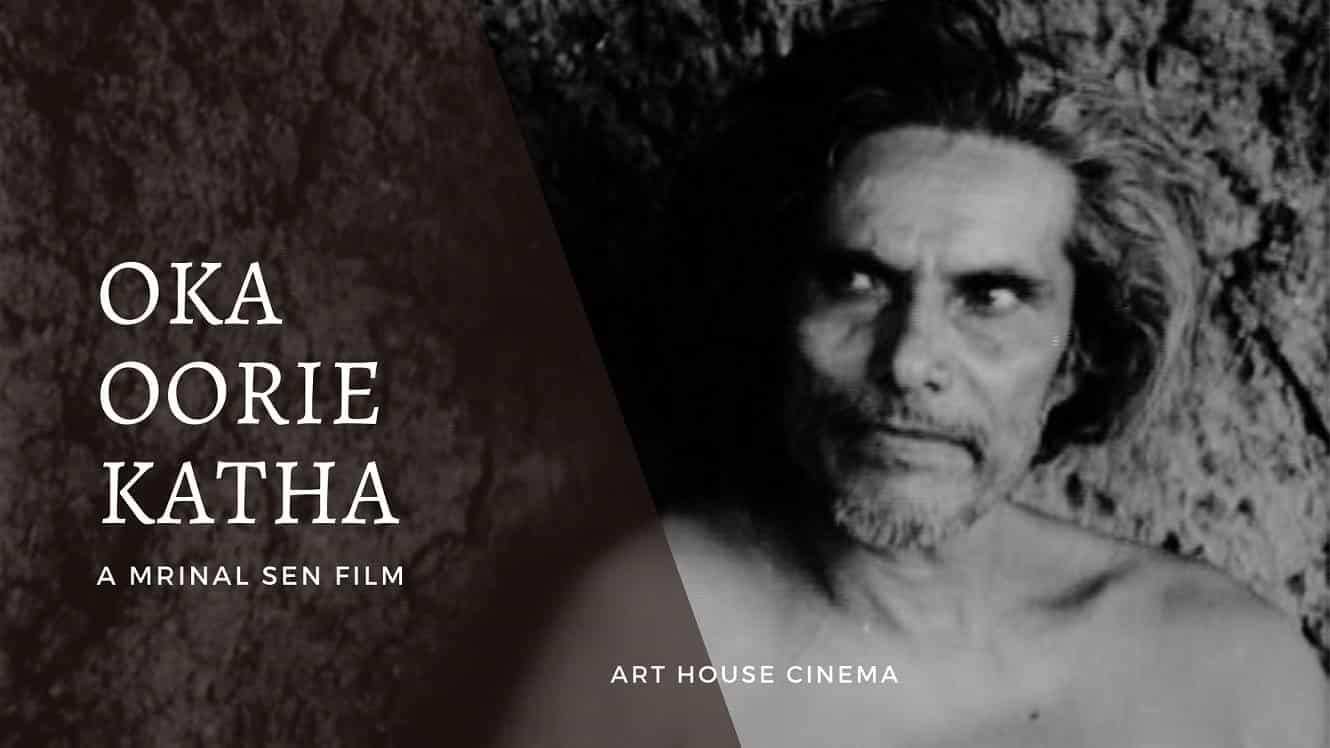
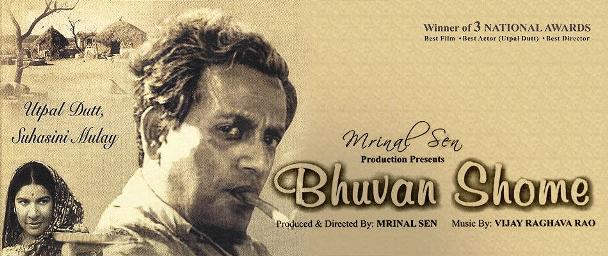
It was his first village film in about twenty-five years, since the Telugu Oka Oori Katha (1977). Ray Chaudhuri points out that Akaler Sandhane and Khandhar also left the city, but with an urban sensibility. Asked whether a countryside that had changed so much in the meantime worried him, Sen said it made no difference, because he never went to a village on its own. In 1969 he had followed Bhuvan Shome into rural Gujarat and looked through his eyes. In 1980 he had gone along with a film unit to a Bengal village where it was making a film about the famine of 1943. "This time also I will go as an observer with my urban sensitivities," he said. "This is the best way to look at the countryside."
Avik Mukhopadhyay shot the film, though the Mrinal Sen archive's credit list names the cameraman as Avik Bandhopadhay. Mrinmay Chakraborty edited it, Gautam Basu did the art direction and Debojyoti Misra wrote the music. The archive also keeps a photograph of Rituparno Ghosh, by then a director of the next generation, sitting beside Sen during the location shoot. The film was released on 11 October 2002.

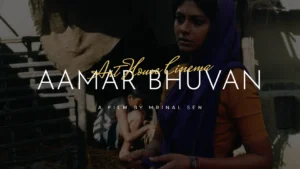
Nandita Das as Sakhina, Aamar Bhuvan (2002)
Story
Nur rides into the village on a motorbike, and the narrator fills in the years. Nur was married to Sakhina until his family forced a divorce. He left for the Gulf, made money, came home and married again. Meanwhile his cousin Meher, a day labourer, fell in love with Sakhina and married her. They have three children, and a fourth is on the way.
One day Nur stops at Meher's house and asks for a glass of water. Sakhina hands him the tumbler. Their fingers may or may not touch, the glass falls, and both of them bend to pick it up. Meher takes whatever work he can find and keeps out of the moneylender's way. Nur offers him work at his pond site. The moneylender chooses a visit for an hour when he knows Sakhina will be alone in the house. She glares at him, he drops his flashlight, and he goes.
The nose-ring is the one object in the film with a history. Nur gave it to Sakhina while they were married. Now it is pawned to clear the moneylender, and the money also buys Sakhina the radio Meher has been pricing in an electronics shop. The man who takes the nose-ring in pawn is Nur. When he returns it to her, Sakhina is hurt, and she takes the gift as an insult.
Nur is giving a feast for the village, and he comes to invite the family. He finds their son Shaju playing with his motorbike, gives him a ride and takes him home for the night. Sakhina wonders aloud whether Nur and his wife are working some tuk-tak, black magic, on the boy, and then laughs at the idea. She refuses to go to the feast. Meher and their daughter try to talk her round, and she gives her reason: she has no proper sari and no rubber slippers. Then she bursts out laughing.
The feast closes the film. The village eats together, and an elderly man from a nearby village, Mr Chatterjee, the only Hindu in the story, turns up uninvited and is welcomed. Sen's note on the film says of the three: "with no malice against anyone, they arrive at a moment of truth." Nobody is punished.
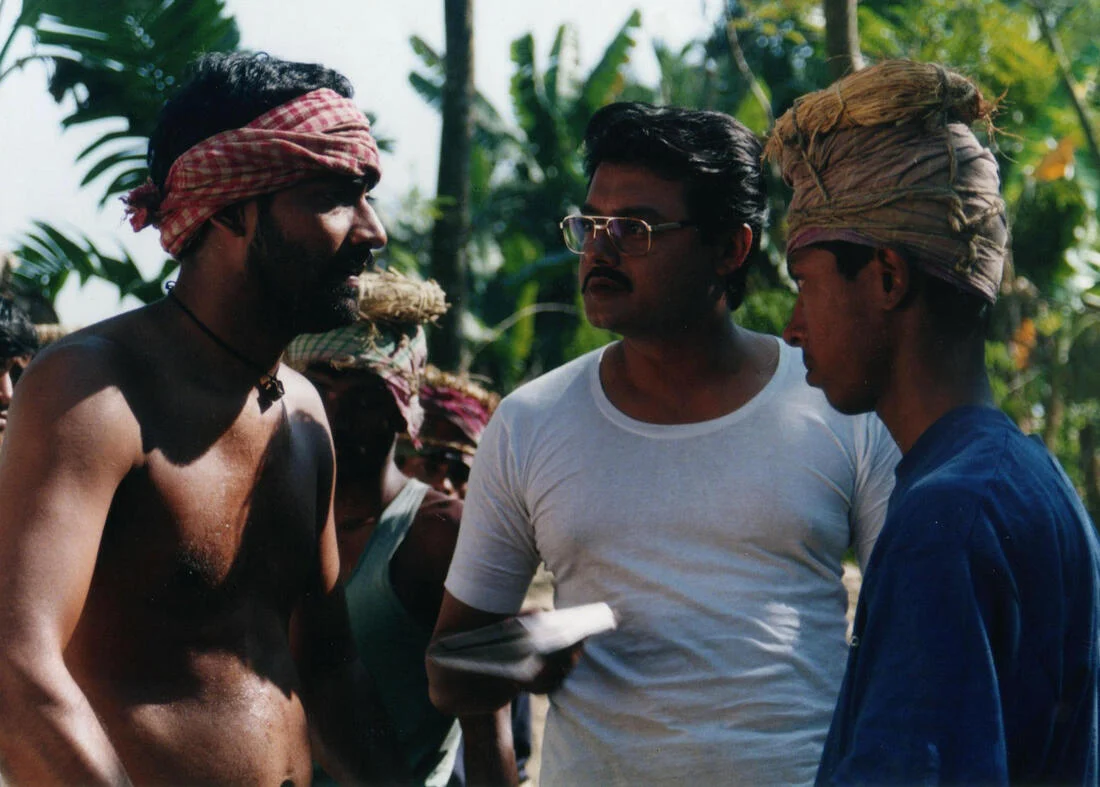
Kaushik Sen and Saswata Chatterjee in the village, Aamar Bhuvan (2002)
Direction and craftsmanship
The music matters more here than in any other Sen film, because of what he had kept out of the others. Ray Chaudhuri notes that Sen, unlike Satyajit Ray or Ritwik Ghatak, never used a Tagore song in his films apart from one in Pratinidhi (1964), and never filmed a Tagore story. Ray Chaudhuri traces the reluctance to August 1941, when Sen attended Tagore's cremation. In the crush of the procession a man waiting with the body of his small child lost his hold on it, and the child's body fell and was trampled by the mourners. When Sen later made a film about the end of a marriage, he set the couple's anniversary on the 22nd of Shravan, the day of Tagore's death, and called the film Baishey Shravan (1960).
In Aamar Bhuvan he lets Tagore in at last. The song "Mamo chitte niti nritye" returns through the film, most pointedly when Meher brings home the radio bought with the nose-ring money. A couple of lines from a folk song, "Bhanga chaal bhenge gechhe", play while Sakhina turns the nose-ring over in her box of belongings. The songs say what the dialogue leaves unsaid.
Sen was relaxed enough at seventy-nine to show his debts. Meher stands in an electronics shop pricing a radio and is held by Charlie Chaplin on a television set. Ray Chaudhuri notes that Sen thought of Chaplin as a major influence, and the scene that follows makes the point: Meher's dodging of the moneylender is staged as a cat-and-mouse chase that copies Chaplin's escapes from the policeman playing on the screen. It is the closest Sen came to slapstick.
The camera work is plain and warm. Subhajit Ghosh, reviewing the film for Boloji, singled out one passage that moves from darkness to the first light of day across two consecutive shots. The cutting is unhurried and lets the episodes end where they end.
Nandita Das carries the film, and the reviews disagree about how well. Ghosh thought she looked "much too urbane in many sequences." Ray Chaudhuri called her brilliant throughout and picked out the scene of the refused feast, in which Sakhina's stubbornness collapses into laughter. Both are right. In the village lanes Das can look like a visitor, and inside the house, opposite Kaushik Sen's Meher, she is entirely at home.

Sakhina (Nandita Das) with the new radio, Aamar Bhuvan (2002)
The cinema of Mrinal Sen
Mrinal Sen was born on 14 May 1923 in Faridpur, in what is now Bangladesh, and made his first feature, Raat Bhore, in 1955. His name was made by Bhuvan Shome (1969), which won the National Film Awards for Best Feature Film and Best Direction. The films of the early 1970s, Interview, Calcutta 71 and Padatik, turned Calcutta into the subject and the accused. Akaler Sandhane (1980) sent a film unit into a village to make a film about the famine of 1943. It won the Grand Jury Prize at Berlin in 1981. Kharij won the Jury Prize at Cannes in 1983. He also worked outside Bengali, in Odia with Matira Manisha (1966) and in Telugu with Oka Oori Katha.
Set against that record, Aamar Bhuvan is the odd one out. Sen's films had looked at poverty as something done to people, and they tended to hold the audience partly responsible. This one looks at people who are poor and finds them content enough to joke, flirt and throw a feast. Ray Chaudhuri reached for Iranian cinema to describe it and named Abbas Kiarostami's Where Is My Friend's Home, as he titled it. The comparison fits the small errands that carry the plot and the trust in ordinary decency. It does not fit the Tagore, which belongs to Sen alone, and which he had kept out of his films for almost half a century.
Sen made no feature after it. He received the Dadasaheb Phalke Award for 2003, presented in 2005, and died at his home in Bhowanipore, Kolkata, on 30 December 2018, aged 95.

Mrinal Sen with Rituparno Ghosh during location shooting of Aamar Bhuvan
Reception and legacy
The film went into competition at the Cairo International Film Festival in 2002 and won two prizes, Best Director for Sen and Best Actress for Nandita Das. The Mrinal Sen archive lists both, and Wikipedia's article on Sen gives the director's award as the Silver Pyramid.
In Bengal the response was mixed. Shantanu Ray Chaudhuri wrote that the film's gentleness "worked against the film when it came to be evaluated by critics expecting Mrinal Sen to do a Mrinal Sen." Subhajit Ghosh described a screening after which he heard a spectator announce that Sen himself did not know what he was trying to say. Ghosh's answer was a four-out-of-five rating and the claim that Sen was possibly the only Indian film-maker to capture the love and bonding in the lives of the downtrodden.
Its later reputation rests on being the last film. Ray Chaudhuri's essay, published by Cinemaazi on 29 December 2020, the second anniversary of Sen's death, called it a fitting finale to a great career. The full film is now on YouTube, on Angel Digital's Bengali film channel.
The tenderness in Aamar Bhuvan is a decision taken by a man who had looked at the world as hard as any Indian director, and it is a large claim to end on: after all the anger, he chose to say that people with almost nothing can still be kind to one another.
Awards & honours
- Won Best Director, Cairo International Film Festival, 2002: Mrinal Sen
- Won Best Actress, Cairo International Film Festival, 2002: Nandita Das
- Nominated Golden Pyramid, Cairo International Film Festival, 2002
Reference
- What a Wonderful World: Mrinal Sen's Amaar Bhuvan, Shantanu Ray Chaudhuri, Cinemaazi, 29 December 2020
- Amar Bhuban (2002), Subhajit Ghosh, Boloji
- Amar Bhuban (This, My Land), Mrinal Sen archive, mrinalsen.org
- Feature films, Mrinal Sen archive, mrinalsen.org
- Aamar Bhuvan, Wikipedia
- Mrinal Sen, Wikipedia
Aamar Bhuvan on YouTube
Image credits: Banner: mrinalsen.org (Mrinal Sen archive), All rights reserved; used for criticism and review, via source. Image: mrinalsen.org (Mrinal Sen archive), All rights reserved; used for criticism and review, via source. Image: Release poster; via Letterboxd, All rights reserved; used for criticism and review, via source. Image: mrinalsen.org (Mrinal Sen archive), All rights reserved; used for criticism and review, via source. Image: mrinalsen.org (Mrinal Sen archive), All rights reserved; used for criticism and review, via source. Image: mrinalsen.org (Mrinal Sen archive), All rights reserved; used for criticism and review, via source.






Commentary
The easy reading of Aamar Bhuvan is biographical: an old radical mellows. The film supports that reading and gains nothing from it. Sen was too deliberate a film-maker to drift into kindness. He had spent forty years showing poverty stripping people of their dignity, and here he set himself the harder job of showing dignity that survives without pretending the poverty away. The debt is there, and the day labour, and a marriage held together by love and very little money. What the film adds is the claim that these lives are enough for a film's whole attention.
The date gives the film its edge. In 2002 communal suspicion was hardening across India, and Sen's reply contains no speech and no villain, only a Muslim village and an old Hindu neighbour who walks into its feast and is fed. The argument is made through hospitality and a song, and it is stronger for being made that way.
The weakness is the evenness that troubled the first audiences. Each time the plot reaches for menace, Sen turns it aside. The rich cousin's job offer hides no trap. The moneylender collapses into comedy. The nose-ring, the one thing that could break the household, is handed back. After the third or fourth such turn the pattern is visible, and the middle of the film goes slack because nothing is at stake and the film seems content that nothing should be. Nandita Das's polish adds to the problem. A film this committed to the texture of village life needed a Sakhina who never looked like an actress among villagers.
Sen paid that price knowingly. The tenderness in Aamar Bhuvan is a decision taken by a man who had looked at the world as hard as any Indian director, and it is a large claim to end on: after all the anger, he chose to say that people with almost nothing can still be kind to one another.