
PATHER PANCHALI Song of the Little Road
- Director
- Satyajit Ray
- Country
- India
- Language
- Bengali
- Year · Runtime
- 1955 · 125 min
- Starring
- Kanu Banerjee, Karuna Banerjee, Subir Banerjee, Uma Das Gupta, Chunibala Devi
Introduction
Pather Panchali (Song of the Little Road) is a 1955 Bengali film directed by Satyajit Ray. The film is based on Bengali author Bibhutibhushan Bandopadhyay's novel of the same name, published in 1929. It was Ray's first film, begun in October 1952 when he was 31 and still working in an advertising agency, and finished two and a half years later with money from the Government of West Bengal. Neither Ray nor his cinematographer had worked on a feature before.
The film had its first screening at the Museum of Modern Art in New York in May 1955 and opened in Calcutta that August. At Cannes in 1956 the jury gave it a prize as the best human document. Along with the two films which followed it, Aparajito (1956) and Apur Sansar (1959), it forms the Apu Trilogy. In the 2022 Sight and Sound poll, critics placed it 35th among the greatest films ever made.
Cast
- Kanu Banerjee Harihar Ray, Apu's father
- Karuna Banerjee Sarbajaya, Apu's mother
- Subir Banerjee Apu
- Uma Das Gupta Durga, Apu's sister
- Chunibala Devi Indir Thakrun, the old aunt
- Shampa "Runki" Banerjee Durga as a young girl
- Reba Devi Sejo Thakrun, the bitter neighbour
- Aparna Devi Nilmoni's wife, the kind neighbour
- Tulsi Chakraborty Prasanna, the schoolteacher
- Binoy Mukherjee Baidyanath Majumdar, a village elder
- Haren Banerjee Chinibas, the sweets seller
- Harimohan Nag The doctor
- Haridhan Nag Chakravarti, a village elder
- Kshirod Roy The priest
- Roma Ganguli Ranu, Durga's friend
Crew
- Direction Satyajit Ray
- Screenplay Satyajit Ray
- Novel Bibhutibhushan Bandopadhyay
- Production Government of West Bengal
- Cinematography Subrata Mitra
- Editing Dulal Dutta
- Art direction Bansi Chandragupta
- Music Ravi Shankar
- Sound Bhupen Ghosh
- Production manager Anil Choudhury

Background and production
Ray came to the novel as its illustrator. He was a commercial artist at the advertising agency D. J. Keymer in Calcutta, and he had drawn the pictures for an edition of Bandopadhyay's book. When he returned from a six-month business trip to London late in 1950, he collected a group of young men as his crew and spent about two years looking for a producer. The novelist's widow had promised him the rights and kept her word, although a better offer came along. Producers looked at his notebook of sketches and dialogue with curiosity, and none of them put up money.
So Ray decided to shoot a few sequences himself and use them to prove the film could be made. He borrowed against his insurance policy and from relatives and friends, and he shot on Sundays, the one day the agency did not need him. The first shot was taken on 27 October 1952. It was the scene in which Apu and Durga discover the railway line in a field of kash flowers. When the unit returned the following Sunday, cattle had eaten the flowers, and the scene had to wait a full season for them to grow back.
A producer named Ana Dutta paid for a month of shooting and then ran out of money after one of his own films failed. Some of the jewellery of Ray's wife, Bijoya, was pawned to keep the unit going for a few more days. The footage was cut to about 4,000 feet and shown around Calcutta without result, until the production manager, Anil Choudhury, suggested approaching the Chief Minister of West Bengal, B. C. Roy. The state agreed to fund the film. Barun Roy, writing in Business Standard, records that the loan was ordered in the belief that the film was a documentary on road development. The money came in instalments, each released only after the previous accounts had been cleared, and shooting resumed early in 1954 after a break of almost a year.
The delays could have finished the film. Ray later described three miracles that saved it: "One, Apu's voice did not break. Two, Durga did not grow up. Three, Indir Thakrun did not die." Chunibala Devi, who played the old aunt, was 80 and a retired theatre actress when she was cast. The village of Boral, on the outskirts of Calcutta, was the main location.
The technical team consisted of several first-timers. Subrata Mitra, the cinematographer, was a still photographer who had never shot a feature, and he had to be persuaded to take the job. There was never a finished script. Ray worked from sketches in black ink and kept the dialogue in his head. Subir Banerjee, who plays Apu, lived next door to the Rays on Lake Avenue. In a memoir published by The Telegraph in 2022, he recalls that Bijoya Ray had watched him playing on his verandah, and that Ray told him he had seen more than 200 boys for the part. It was his only film, as it was for Uma Das Gupta, who came to her audition as Durga wearing pearls.
In the autumn of 1954 Monroe Wheeler of the Museum of Modern Art saw stills from the film in Calcutta and offered it a premiere. Ravi Shankar, between tours, saw about half the film and recorded the score in a single session of about eleven hours. "It was a marathon session and left us exhausted but happy, because most of the music sounded wonderful," Ray wrote in My Years with Apu. It was not Shankar's first film score, since he had written the music for Chetan Anand's Neecha Nagar in 1946. Mitra devised the tune for the sweets seller and played sitar for one sequence. Ray and his editor then worked for ten days and nights to meet the museum's date, and the print went to New York without subtitles.

Subir Banerjee as Apu, Pather Panchali (1955)
Story
Pather Panchali is the story of Apu, a small boy who lives with his family in a village in Bengal early in the twentieth century. Apu's father Harihar Ray is a village priest who earns a meagre living and is too meek to ask for the wages due to him. As a result, his family lives in penury. Apu's sister, Durga, is forever stealing guavas from the neighbour's orchard, often for the old aunt, Indir Thakrun, who lives with the family. All this adds to the daily struggles of the mother, Sarbajaya, who resents having to share her bare kitchen with the old woman. Once, the wealthy neighbour blames Durga for stealing a bead necklace. Sarbajaya bears the neighbour's innuendo blaming her for Durga's propensity to steal.
In their poverty, Apu and Durga manage to find happiness. They share the simple joys of life, such as sitting quietly under a tree, running after the sweets seller who passes through the village, viewing pictures in a bioscope shown by a travelling vendor, and watching a jatra by a troupe of actors. In the evening, they can hear the whistle of trains far away. One day they wander across the fields to catch a glimpse of the train. On the way back, they find the old aunt dead.
Unable to earn enough in the village, Harihar decides to go to the city to earn. He promises his wife that he will come back with good money so that they can repair their run-down house, but he stays away far longer than he said. In his absence, the family sinks deeper into poverty. Sarbajaya grows increasingly lonely and desperate.
The monsoon arrives. One day Durga plays in the rain for a long time. She falls ill with a high fever, and her condition worsens as a storm batters the crumbling house through the night. By morning she is dead. Soon Harihar returns to the village with the money he has earned while away. When he shows Sarbajaya the gifts he has brought from the city, she, who has been silent through her grief, finally breaks down. It is then that Harihar knows that he has lost his daughter.
The family decides to leave the village for Benares. As they pack their belongings, Apu finds the bead necklace which Durga was accused of having stolen. He quietly throws it into a pond, and the weeds close over the place where it fell. The film ends with the family leaving on an ox-cart.

Apu (Subir Banerjee) and Durga (Uma Das Gupta) in the field of kash flowers, Pather Panchali (1955)
Direction and craftsmanship
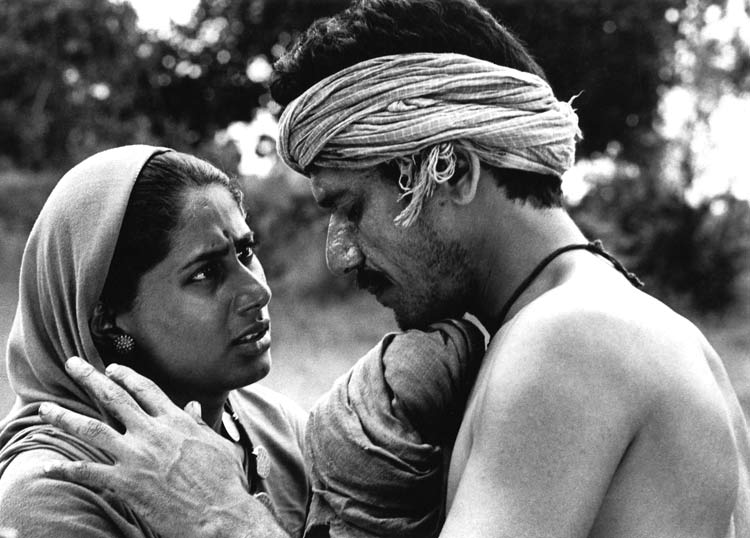
Pather Panchali contains great moments of sadness, but for the most part it concentrates on the beauty of the world around its children. Instead of resorting to melodrama to depict the miseries of life, the film takes them on with a straight face. Bosley Crowther, reviewing it for The New York Times in 1958, found it too slow. It does develop its characters and its atmosphere slowly and resolutely, reaching a silent crescendo by the time the credits roll. Ray defended the pace as something the material dictated, a rhythm set by nature and the landscape, and he kept some of the looseness of the novel because, as he put it, "life in a poor Bengali village does ramble."
The looseness is planned. Ray shot the film in sequence, knowing he would be learning as he went, and he believed that Indian directors of his time had neglected what he called "the musical aspect" of a film's structure. Pather Panchali is built on recurring sounds as much as images: the aunt's old songs, the rain, the train whistle heard from far away. Before the storm that kills Durga, the film holds on dragonflies and water striders skimming the water, cut to a raga on Ravi Shankar's score. In the storm itself, the camera keeps returning to the house as the wind tears at it.
There are moments in the film which stay with the viewer for decades. The scene where Durga and Apu discover the train is the best known of them. Both the director and the cinematographer were making their first feature, which makes the scene's assurance more remarkable. Similarly, in the scene where Apu and Durga follow the pot-bellied sweets seller through the village, a stray dog trots along behind them and the little procession is reflected upside down in the water. It is touching in its own silent way.
Late in the film, Durga paints kajal under her eyes in a mirror, a girl trying on an adult face she will not live to have. Uma Das Gupta never acted again. Her performance has none of a professional's habits, and the scenes involving the old Indir Thakrun are just as free of them. Chunibala Devi plays the aunt's greed and her slow humiliation without asking for pity. Crowther, who had little patience for the film's tempo, still called her "fantastically realistic".

Chunibala Devi as Indir Thakrun, Pather Panchali (1955)
The cinema of Satyajit Ray
Satyajit Ray (1921 to 1992) was born in Calcutta, the grandson of Upendrakishore Ray and the son of Sukumar Ray. He studied art at Rabindranath Tagore's university at Santiniketan and worked as a commercial artist from 1943. In 1947 he co-founded the Calcutta Film Society, and in 1949 he met Jean Renoir, who had come to Bengal to make The River. Ray later wrote that all through his stay in London in 1950, the lessons of Bicycle Thieves and neo-realist cinema stayed with him.

Satyajit Ray at the recording of Ravi Shankar's score for Pather Panchali, from Sandip Ray's book Satyajit Ray's Ravi Shankar
Pather Panchali changed his life. After its success he left advertising and became a full-time film-maker. He had not planned to continue Apu's story, but Aparajito followed in 1956 and Apur Sansar in 1959. His later films include Jalsaghar, Charulata, Aranyer Din Ratri and Shatranj Ke Khilari, and he also wrote fiction and edited the children's magazine Sandesh. In 1992, the year of his death, he received an honorary Academy Award.
Reception and legacy
The Calcutta release came on 26 August 1955. Ray used his advertising experience to design five billboards for it. The film did only moderately well in its first two weeks, but by the third week it was playing to full houses, and after its booked six weeks it moved to another chain of cinemas for seven more. B. C. Roy arranged a screening for the Prime Minister, Jawaharlal Nehru, who saw to it that the film was entered at Cannes in 1956. There it was first shown at midnight on a festival holiday, and most of the jury stayed away. Lindsay Anderson and André Bazin were among those who insisted on a second screening for the full jury, and the film won its prize for the best human document.
At home, it won the President's Gold Medal for the best Indian feature film of 1955 and the President's Silver Medal for the best Bengali film. The Prime Minister presented the State Awards in New Delhi in September 1956, because the President was unwell.
In London, Isabel Quigly of The Spectator reviewed it in January 1958 and wrote that "it has the smell of reality, though the smell is always freshened by affection". New York was cooler. When the film opened at the Fifth Avenue Cinema on 22 September 1958, Crowther called it "one of those rare exotic items, remote in idiom from the usual Hollywood film" and complained that it "would barely pass as a 'rough cut' with the editors in Hollywood." He conceded that by its sad end "it has the substance of a tender threnody." The film nonetheless ran for eight months in New York.
Pauline Kael, writing later, called it "Beautiful, sometimes funny, and full of love" and said that "it brought a new vision of India to the screen." Akira Kurosawa described Ray's cinema as one that "flows with the serenity and nobility of a big river." In The Village Voice in 1995, J. Hoberman called it the "last masterpiece of neorealism". Time placed the Apu Trilogy, taken as a whole, in its All-TIME 100 Movies in 2005, and in 2022 the Sight and Sound polls put Pather Panchali 35th among critics and joint 22nd among directors.
The film nearly survived only in damaged copies. In 1993 a fire at a London laboratory burned the original negatives of the trilogy, and what was left was kept at the Academy Film Archive. The Criterion Collection and L'Immagine Ritrovata in Bologna later restored the three films from what survived of the negatives, along with other film elements, and the 4K restorations opened at Film Forum in New York on 8 May 2015.
Every scene is concrete, and the film trusts the audience to add up the details.
Awards & honours
- Won President's Gold Medal for the best Indian feature film of 1955, State Awards for Films (3rd National Film Awards), New Delhi, 1956
- Won President's Silver Medal for the best Bengali film of 1955, State Awards for Films (3rd National Film Awards), New Delhi, 1956
- Won Prix du document humain (Best Human Document), 9th Cannes Film Festival, 1956
- Entry Competition for the Palme d'Or, 9th Cannes Film Festival, 1956
- Won Diploma of Merit, Edinburgh International Film Festival, 1956
- Won Two Golden Carabao awards, film festival in Manila, 1956
- Won Golden Gate Awards for Best Film and Best Director, San Francisco International Film Festival, 1957
- Won Critics' award for best feature film, Stratford Film Festival, Ontario, 1958
- Won Best Foreign Language Film, National Board of Review, United States, 1958
- Nominated Best Film from any Source, BAFTA Awards, 1958
- Won Best Foreign Film, Kinema Junpo Awards, Japan, 1966
- Won Bodil Award for Best Non-European Film, Denmark, 1969
Reference
- Pather Panchali, The Criterion Collection (cast, credits and running time)
- The Apu Trilogy: Every Common Sight, Terrence Rafferty, The Criterion Collection, 17 November 2015
- Constant Compass: Uma Das Gupta in Pather Panchali, Durga Chew-Bose, The Criterion Collection, 8 May 2017
- Restoring The Apu Trilogy, The Criterion Collection, 8 May 2015
- Making of Pather Panchali and Triumph of Pather Panchali, SatyajitRay.org
- State Awards for Films / Film in India, 1956, Ministry of Information and Broadcasting, 1957
- Pather Panchali, Festival de Cannes
- Screen: Exotic Import, Bosley Crowther, The New York Times, 23 September 1958
- The Real India, Isabel Quigly, The Spectator, 3 January 1958
- The hidden facets of greatness, Barun Roy, Business Standard, 4 March 2015
- Subir Bandyopadhyay, Apu in Pather Panchali, recalls his stint in Satyajit Ray's film, The Telegraph, 21 January 2022
- Satyajit Ray's Pather Panchali, Charles Silver, MoMA Inside/Out, 13 November 2012
- Pather Panchali, British Film Institute
- Pather Panchali, San Francisco Film Society festival history
- Indian Film Honored, The New York Times, 14 July 1958
- 1958 Award Winners, National Board of Review
- Film Awards 1958, BAFTA
- Bodilprisen 1969, Bodil Awards
- Neecha Nagar, Festival de Cannes
- The Apu Trilogy, Richard Schickel, Time All-TIME 100 Movies, 2005
The Apu Trilogy restoration trailer on YouTube
Image credits: Banner: Satyajit Ray/Government of West Bengal; publicity still, Museum of Modern Art collection, Public domain, via Wikimedia Commons. Image: Unknown author; scanned from Sandip Ray's book Satyajit Ray's Ravi Shankar: An Unfilmed Visual Script, Public domain, via Wikimedia Commons. Image: Original Bengali release poster (distributed by Aurora); National Film Archive of India scan, via IMDb, All rights reserved; used for criticism and review, via source. Image: Satyajit Ray Productions/Janus Films, via SFMOMA, Public domain, via Wikimedia Commons. Image: Janus Films; frame from the official 2015 restoration trailer of The Apu Trilogy on the Janus Films YouTube channel, All rights reserved; used for criticism and review, via source. Image: Janus Films; frame from the official 2015 restoration trailer of The Apu Trilogy on the Janus Films YouTube channel, All rights reserved; used for criticism and review, via source.





Commentary
Seventy years on, Pather Panchali still looks like a film made by someone discovering the medium as he went, and that is its strength. Ray had no studio habits to unlearn. He was told that rain had to be shot in a studio, and he went out with a 16mm camera to test the real monsoon instead. The village is a place with weather and seasons, and the family's poverty is shown through things, a bare kitchen and a crumbling house that lets in the storm. Every scene is concrete, and the film trusts the audience to add up the details.
Its best idea is to let the children see the world before the adults explain it. The train in the kash field means nothing to Apu and Durga except wonder. To Harihar it would mean a journey to the city for work, and the film keeps both meanings in play without stating either. Durga's death works the same way. The film never announces it as a tragedy, and Sarbajaya's silence when Harihar comes home with his presents carries more weight than any speech could.
The reservation is Harihar. Kanu Banerjee is gentle and believable, but the script gives the father little more than optimism and absence, and the long middle stretch while he is away leans on Sarbajaya alone. Crowther's complaint about structure was overstated, though not baseless: a few of the village episodes in the first hour, the jatra above all, idle instead of building. It is a patient film, and it asks for patience in return.