
Shaji N. Karun
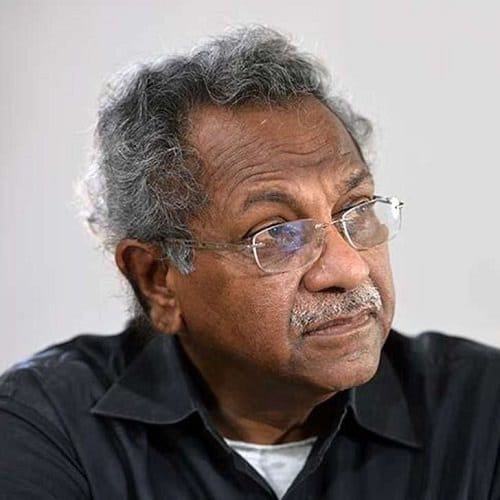
Shaji N. Karun (1952–2025) was among the most internationally celebrated figures of Malayalam cinema and one of the principal architects of the Malayalam New Wave. Trained as a cinematographer, he spent more than a decade as the unobtrusive eye behind the films of such auteurs as G. Aravindan and K. G. George before turning to direction, and he carried into his own work an extraordinary sensitivity to light, landscape, and the silent interior life of his characters. His debut feature, Piravi ("The Birth", 1988), won the Caméra d’Or – Mention d’honneur at the 1989 Cannes Film Festival and announced the arrival of a major new voice in world cinema, drawing comparisons with the contemplative traditions of Satyajit Ray and the European art film.
Across a directorial career that produced a comparatively small but uncommonly distinguished body of work, Karun achieved a feat unmatched by any other Malayalam filmmaker: three of his films — Piravi (1988), Swaham (1994), and Vanaprastham (1999) — were selected for the official sections of the Cannes Film Festival in succession, with Swaham competing for the Palme d’Or. His films repeatedly won the National Film Award for Best Feature Film — for Piravi, Vanaprastham, and Kutty Srank (2009) — making him the only director to secure that honour three times for Malayalam-language cinema.
Karun’s cinema is distinguished by its meditative pace, its painterly compositions, and its preoccupation with grief, memory, loss, and the porous boundary between the seen and the unseen. Working chiefly in Malayalam, with one Hindi feature, Nishad (2002), he transformed the coastal and riverine landscapes of Kerala into vehicles for metaphysical reflection. Water, in particular, recurs throughout his work as an image of memory, mortality, and transcendence.
His contributions extended well beyond the films he directed. He was the inaugural chairman of the Kerala State Chalachitra Academy — the first state academy for film and television in India — and was instrumental in establishing the International Film Festival of Kerala (IFFK) as an internationally competitive event. He was honoured with the Padma Shri (2011), made a Chevalier of the Ordre des Arts et des Lettres by the Government of France (1999), and received the J. C. Daniel Award, Kerala’s highest cinematic honour, for lifetime achievement. He died in Thiruvananthapuram on 28 April 2025, at the age of seventy-three.
Life and Early Work
Shaji Neelakantan Karunakaran was born on New Year’s Day, 1 January 1952, in the Kollam district of what was then the state of Travancore–Cochin (now Kerala), the eldest son of N. Karunakaran and Chandramati. In 1963 the family relocated to Thiruvananthapuram, the state capital, where he completed his schooling at Palkulangara High School. He went on to take a bachelor’s degree at University College, Thiruvananthapuram, before entering the Film and Television Institute of India (FTII) in Pune in 1971.
At the FTII, Karun specialised in cinematography, immersing himself in the institute’s rigorous craft training and its exposure to world cinema. His diploma film, Genesis (1974), directed by Rahul Dasgupta, was widely noticed and helped launch his professional career. He graduated in 1974 with the gold medal in cinematography, the institute’s highest distinction in his discipline. In his early professional years he took on assignments with diverse employers, including the Indian Space Research Organisation in Ahmedabad and television and film work in Mumbai and Madras, before returning to Kerala as the state’s film infrastructure began to take shape.
In 1975 Karun married Anasuya Devaki Warrier, the daughter of P. K. R. Warrier and his neighbour in Thiruvananthapuram; the couple had two sons, Anil and Appu. After a brief period in Madras he returned in 1976 to Thiruvananthapuram, where he was appointed film officer in the newly formed Kerala State Film Development Corporation (KSFDC). This appointment placed him at the centre of an ambitious effort to relocate the centre of gravity of Malayalam filmmaking away from Madras and back to Kerala, and to foster a culture of serious, meaningful cinema within the state.
It was during this period that Karun formed the defining creative partnership of his early career, with the painter and filmmaker G. Aravindan. As a cinematographer he shot a series of landmark films of the Malayalam New Wave, working not only with Aravindan but also with K. G. George and M. T. Vasudevan Nair. His photography for Aravindan’s Kanchana Sita (1977) and Esthappan (1979), and for George’s Onnu Muthal Poojyam Vare (1986), earned him repeated Kerala State Film Awards for cinematography, while his black-and-white camerawork on Aravindan’s Thampu (1978) brought him the National Film Award for Best Cinematography. This long apprenticeship behind the camera — attentive to natural light, to the textures of landscape, and to the discipline of restraint — would become the foundation of his own directorial style.

A Scene from Piravi (1989)
Filmmaking
Karun made his directorial debut in 1988 with Piravi, a film of quiet devastation that drew on one of the darkest episodes of recent Indian history. Loosely inspired by the Rajan case — the disappearance of an engineering student taken into police custody during the Emergency of 1975–77 and never seen again — the film follows an ageing father, Raghava Chakyar, who waits day after day at a rural bus stop for the return of a son who will never come. Rather than mounting an explicit political indictment, Karun concentrated on the texture of private grief: the father’s mounting anxiety, his fragile hope, and the conspiracy of silence by which his family shields him from the unbearable truth. The film won the Caméra d’Or – Mention d’honneur at Cannes in 1989, the Silver Leopard at Locarno, honours at the London, Hawaii, and Chicago festivals, and the first Sir Charles Chaplin Award at Edinburgh, marking the centenary of Chaplin’s birth. At home it won the National Film Awards for Best Feature Film and Best Direction.
Karun’s second feature, Swaham (1994), extended his preoccupation with bereavement and endurance. Set in a poor rural household, it traces the struggle of a widowed mother and her children to survive on the meagre takings of a small coffee shop, and the further blow the family suffers when the son, who seeks military recruitment to lift them out of poverty, is lost to them. Swaham was selected to compete for the Palme d’Or at the 1994 Cannes Film Festival — a rare distinction for an Indian film — and won the National Film Award’s Special Jury Award as well as the Kerala State Film Award for Best Director.
With Vanaprastham ("The Final Dance", 1999), Karun turned from rural poverty to the world of classical art and the anguish of the performing self. The film centres on a Kathakali dancer of low caste, played by Mohanlal in one of the most acclaimed performances of his career, whose consummate artistry on stage cannot resolve the humiliations and contradictions of his life off it, including his ill-fated relationship with an upper-caste woman drawn to the heroic characters he embodies. An Indo-French co-production, Vanaprastham was screened in the Un Certain Regard section at Cannes in 1999, won the National Film Award for Best Feature Film and the Kerala State Award for Best Director, and took the FIPRESCI Prize at the Mumbai International Film Festival and the Grand Jury Prize at Istanbul. The film confirmed Karun’s standing as a director capable of fusing intense psychological drama with a profound meditation on art, identity, and caste.
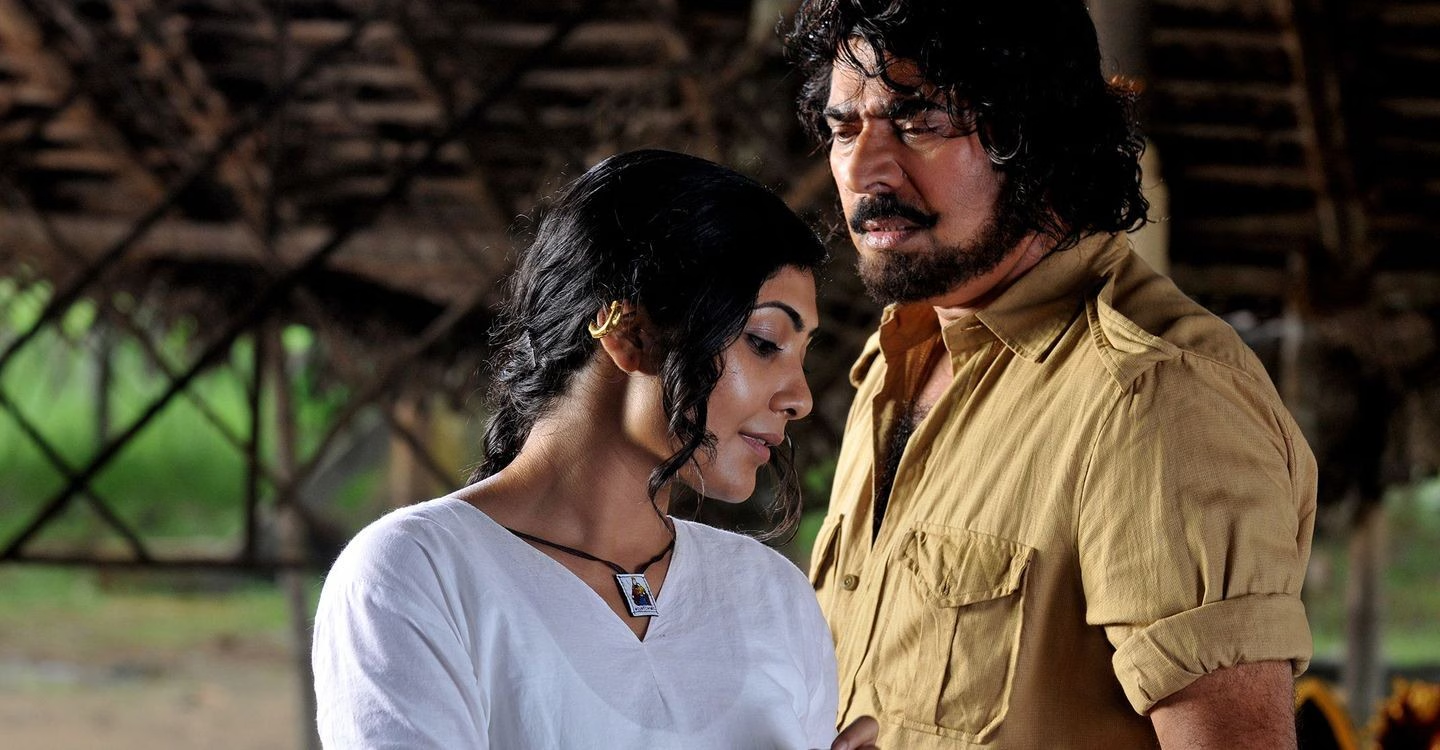
In 2002 Karun directed his only Hindi feature, Nishad, which premiered at the Fukuoka International Film Festival in Japan. He returned to Malayalam with Kutty Srank (2009), starring Mammootty, a film constructed in the manner of magical realism around the figure of a mariner working the cargo routes near the historic port of Kodungallur, his story recounted from the perspectives of three women. Kutty Srank won the National Film Award for Best Feature Film, giving Karun his third Best Film honour, along with several further national awards. His later features Swapaanam (2014), a study of a temple percussionist starring Jayaram that had its world premiere at the Dubai International Film Festival, and Olu (2018), a fantasy-inflected meditation on a woman, water, and survival, continued his lifelong dialogue with music, memory, and the metaphysics of the Kerala landscape; Olu won the National Film Award for Best Cinematography. Alongside his features, Karun directed around a dozen short films and documentaries, including Sham’s Vision, which won the National Film Award for Best Non-Feature Film, and portraits of artists such as G. Aravindan and K. G. Subramanyan.
The Cinema of Shaji N. Karun
Karun’s cinema is unmistakably the work of a cinematographer turned director. Image precedes incident; meaning is carried less by dialogue than by light, duration, and the placement of the human figure within an expansive natural world. His camera lingers, observes, and waits, allowing emotion to accumulate slowly rather than be declared. The result is a body of work that is contemplative without being inert, attentive to the smallest gestures of grief and endurance while opening onto large questions of mortality, art, and the spirit. Critically, he occupies a place in Indian cinema beside the masters of the parallel and New Wave movements, and internationally his films extended the contemplative lineage associated with Ray, Tarkovsky, and the European art film into a distinctly Malayali idiom.
Key Themes
Grief and absence. Across Piravi, Swaham, and beyond, Karun returned again and again to the experience of loss — the missing son, the dead provider, the family bound together by the person who is no longer there. His films treat mourning not as a single event but as a condition that reshapes time, hope, and the rhythms of daily life.
Water and the landscape of Kerala. The backwaters, rivers, rain, and coast of Kerala are not mere backdrops in Karun’s work but active presences. Water in particular recurs as a medium through which life’s mysteries are perceived — an image of memory, dissolution, and transcendence that binds his films into a single poetic universe.
Art, performance, and identity. In Vanaprastham and Swapaanam, Karun examined the predicament of the artist whose public mastery cannot heal a divided private self, probing how performance, caste, and desire intersect and how the roles one plays come to haunt the person who plays them.
The political refracted through the personal. Karun rarely engaged politics directly, but the violence of the state and the inequities of caste and poverty press upon his characters from the margins of the frame. Piravi turns the trauma of the Emergency into an intimate domestic tragedy, locating history in the silences of a single grieving household.
Silence, stillness, and contemplation. His formal signature is restraint: long takes, sparse dialogue, attentiveness to natural sound and light, and a refusal of melodrama. This contemplative aesthetic invites the viewer into a meditative relationship with the image and gives his films their distinctive spiritual gravity.
Selected Filmography
Piravi (1988). Karun’s debut feature, the story of an ageing father awaiting a son who has disappeared into police custody during the Emergency. Loosely based on the Rajan case, it won the Caméra d’Or – Mention d’honneur at Cannes, the Silver Leopard at Locarno, and the National Film Awards for Best Feature Film and Best Direction, establishing Karun’s international reputation overnight.
Swaham (1994). A study of a widowed mother and her children struggling against poverty, and of the further loss that befalls them. Selected to compete for the Palme d’Or at Cannes and awarded the National Film Award’s Special Jury Award, it deepened Karun’s exploration of grief and survival.
Vanaprastham (1999). An Indo-French co-production centred on a low-caste Kathakali dancer, played by Mohanlal, whose artistry cannot reconcile the contradictions of his life and caste. Screened in Un Certain Regard at Cannes and winner of the National Film Award for Best Feature Film, it is widely regarded as one of the finest achievements of modern Indian cinema.
Nishad (2002). Karun’s only Hindi-language feature, which premiered at the Fukuoka International Film Festival in Japan.
Kutty Srank (2009). A magical-realist narrative built around a mariner of the Kerala coast, told through the perspectives of three women, with Mammootty in the title role. It won Karun his third National Film Award for Best Feature Film.
Swapaanam (2014). The story of a temple percussionist, starring Jayaram, that had its world premiere at the Dubai International Film Festival — a rare recognition for Malayalam cinema abroad — and continued Karun’s engagement with music, art, and inner torment.
Olu (2018). A fantasy-inflected meditation on a young woman, violence, and the sustaining mystery of water, which served as the inaugural film of the Indian Panorama at the International Film Festival of India and won the National Film Award for Best Cinematography.
Legacy
Shaji N. Karun’s influence on Indian cinema rests on both his films and his institution-building. As a director he gave Malayalam cinema one of its most enduring presences on the world stage, achieving a hat-trick of Cannes selections and three National Awards for Best Feature Film that no other Malayalam filmmaker has equalled. His debut, Piravi, is routinely ranked among the finest Indian films ever made, and his work as a whole helped define the contemplative, image-led sensibility that distinguishes the Malayalam New Wave from the louder registers of mainstream Indian cinema.
His decade as a cinematographer for G. Aravindan, K. G. George, and others was itself a formative contribution, shaping the visual language of an entire generation of Kerala’s art cinema. As the inaugural chairman of the Kerala State Chalachitra Academy and a driving force behind the International Film Festival of Kerala, which gained FIAPF recognition as an internationally competitive festival during his tenure, he built the institutional foundations on which Kerala’s vibrant film culture continues to rest. He later served as chairman of the Kerala State Film Development Corporation from 2019 until his death.
Karun’s honours reflect the breadth of this achievement. He received the Padma Shri in 2011, was made a Chevalier of the Ordre des Arts et des Lettres by France in 1999, and was awarded the J. C. Daniel Award, Kerala’s highest cinematic honour, for lifetime achievement, together with lifetime achievement awards from festivals in India, Austria, and Sri Lanka. His films won seven National Film Awards and an equal number of Kerala State Awards across direction, cinematography, and best film.
When he died in Thiruvananthapuram on 28 April 2025, tributes described him as a gentle auteur and a creator of everlasting images whose legacy transcends the modest size of his filmography. For subsequent Malayalam and Indian filmmakers reaching toward the international art-cinema circuit — a path renewed in the 2020s by a new generation of festival successes — Karun remains a foundational figure: proof that a cinema rooted in the particular landscapes, sorrows, and spiritual textures of Kerala could speak, without compromise, to the whole world.