
C.I.D.
- Director
- Raj Khosla
- Country
- India
- Language
- Hindi
- Year · Runtime
- 1956 · 146 min
- Starring
- Dev Anand, Shakila, Waheeda Rehman, Johnny Walker, K. N. Singh
Introduction
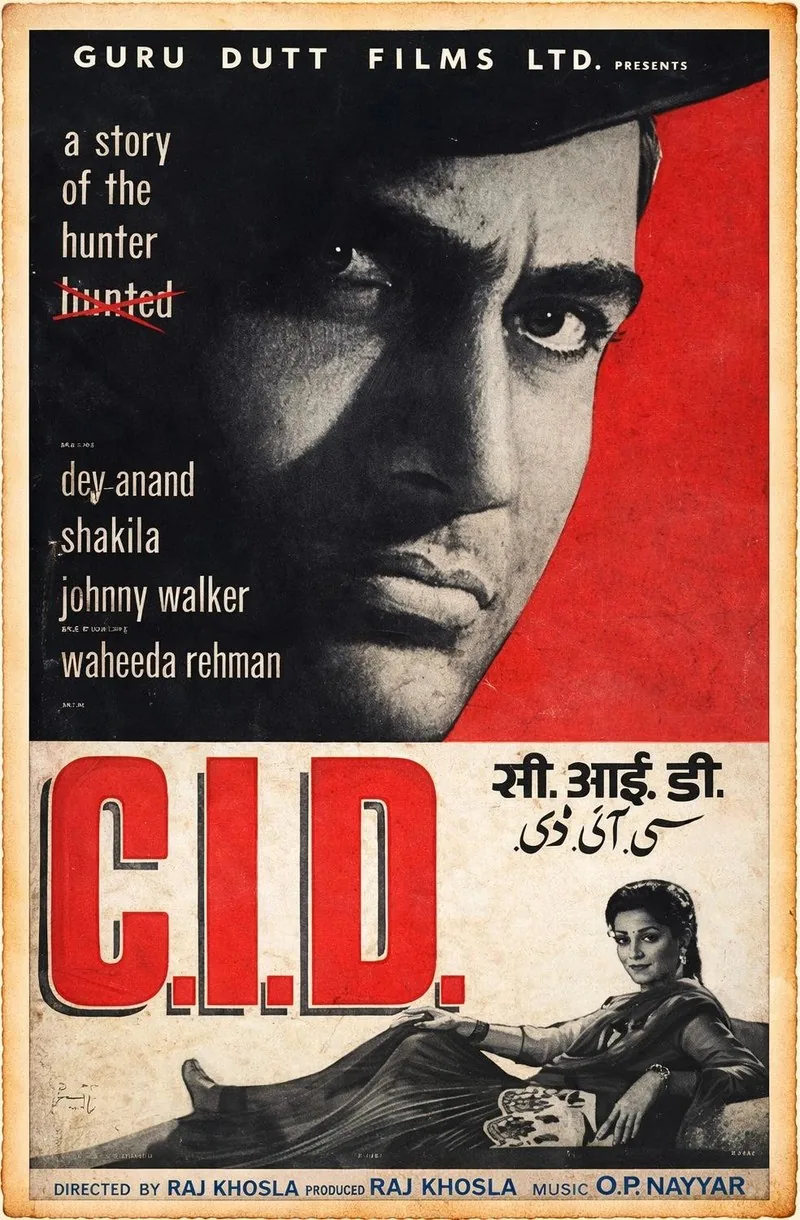
Early in C.I.D. a police inspector commandeers a stranger's car to chase a killer through the Bombay rain, and the young woman at the wheel throws the ignition key into the mud. The chase is lost. The gesture is comic, and it sets the temper of the film. This is a police thriller in which order keeps slipping out of the hands of the people paid to hold it, and in which the law and the lawless walk the same wet pavements.
Raj Khosla directed. Guru Dutt produced, through Guru Dutt Movies Pvt. Ltd., and Inder Raj Anand wrote the script. Box Office India's listing for 1956 puts the film at the top of that year's Hindi releases. It gave Waheeda Rehman her first Hindi role, gave Khosla his first hit after a debut that had failed, and gave Bombay a song about itself that has outlived most of what surrounds it. Its real subject is corruption, which it locates in the drawing rooms of the respectable.
The argument is carried lightly, inside chases and songs. That is one reason it has lasted.
Cast
- Dev Anand Inspector Shekhar
- Shakila Rekha, Mathur's daughter
- Waheeda Rehman Kamini
- K. N. Singh Superintendent Mathur
- Johnny Walker Master, a pickpocket
- Kum Kum Master's girlfriend
- Mehmood Sher Singh
- Bir Sakhuja The gang's patron
- Minoo Mumtaz Dancer
Crew
- Direction Raj Khosla
- Story and screenplay Inder Raj Anand
- Cinematography V. K. Murthy, Anwar
- Editing Y. G. Chawan
- Music O. P. Nayyar
- Lyrics Majrooh Sultanpuri, Jan Nisar Akhtar
- Choreography Zohra Sehgal
- Costumes Bhanumati (Bhanu Athaiya)
- Production Guru Dutt, Guru Dutt Movies Pvt. Ltd.
Background and production
C.I.D. begins in a promise between two men with no work. Dev Anand and Guru Dutt agreed, while both were struggling, that Dev Anand would give Dutt a film to direct and that Dutt would one day cast Dev Anand as his hero and direct him. The first half was kept with Baazi in 1951, Dev Anand's production for Navketan. The second half was only ever half kept. Dutt produced C.I.D. and handed the direction to his chief assistant.
That assistant was Raj Khosla, who had come to Bombay to be a singer and had worked on the music staff of All India Radio. Dev Anand thought his gifts lay elsewhere and pushed him towards direction, which put him at Guru Dutt's side from the days of Baazi. His first film, Milap, with Dev Anand and Geeta Bali, failed at the box office. C.I.D. was his second, and Waheeda Rehman later recalled that it nearly became someone else's. On the day of the muhurat Guru Dutt directed the first shot himself and wanted to make the film in his own style. Khosla politely refused and asked for a free hand. Dutt gave it to him.
The crew came from Dutt's own circle. V. K. Murthy photographed the film with Anwar, Y. G. Chawan cut it and O. P. Nayyar wrote the music. Majrooh Sultanpuri wrote every lyric but one: 'Aankhon Hi Aankhon Mein' is by Jan Nisar Akhtar. Zohra Sehgal choreographed the songs. The costumes were credited to a newcomer billed as Bhanumati, who later worked as Bhanu Athaiya and became the first Indian to win an Academy Award. Pramod Chakravorty and Bhappi Sonie assisted Khosla, and both went on to direct.
Accounts of how Waheeda Rehman was found disagree. Filmfare's 2016 retrospective says Guru Dutt saw her in the Telugu film Rojulu Marayi (1955), in which she had a single song. In her own account to The Hindu in 2010, he saw her in a Telugu dance drama in Hyderabad in 1955 and came to her family directly. Both agree on what followed. Dutt had her in mind for Pyaasa, and the supporting part of Kamini, a woman in the gang's employ who changes sides, was a way of putting her in front of a Hindi camera first. She came from a conservative family and refused to show her back on screen, which led to a quarrel with Khosla that Dev Anand smoothed over.
The film's most famous three minutes have their own story. Milon Gupta, a harmonica player who arranged for Nayyar, used to play short tunes from which Nayyar built songs. One day at Famous Studios, with Guru Dutt and Majrooh present, Nayyar asked him to play back a tune from an earlier session. Majrooh wrote the lyric on the spot, and Gupta played the harmonica on the recording. The tune is the American folk song 'Oh My Darling, Clementine'. The result was 'Aye Dil Hai Mushkil Jeena Yahan'.
The release date is unsettled. Wikipedia's article on the film gives 2 November 1956 in its summary and, in its body, a grand opening on 30 July 1956 at the Strand, the Minerva, the Kohinoor and other Bombay houses. Filmfare's retrospective says July 1956. The Indiancine.ma catalogue gives 17 August. Filmfare reviewed the film on 14 September 1956, which rules out November.
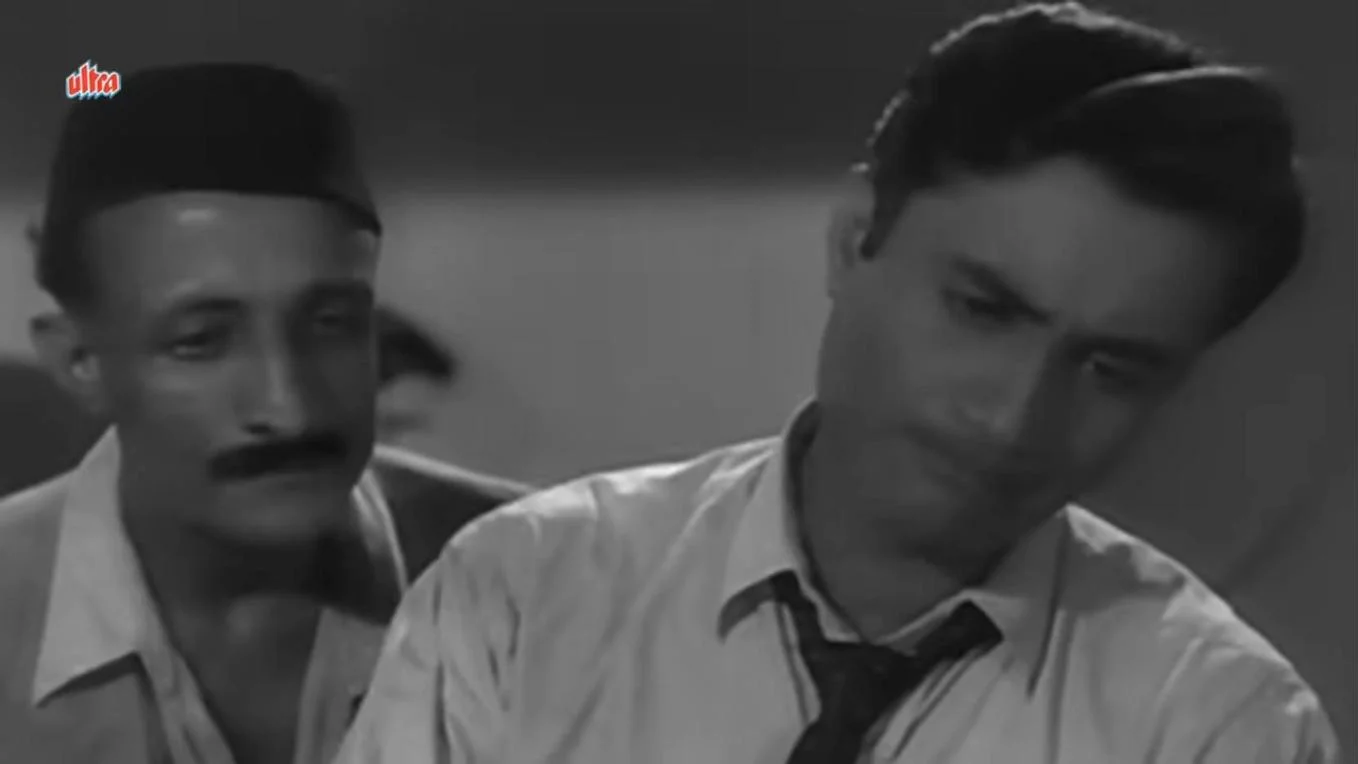
Dev Anand as Inspector Shekhar (right), C.I.D. (1956)
Story
The film opens on telephones. Close-ups of dials and short conversations, before and after the titles, arrange the killing of a newspaper editor who is about to expose an honoured member of society. The editor is attacked and calls his friend Inspector Shekhar of the Criminal Investigation Department, but he is dead by the time Shekhar arrives. Shekhar remembers a suspicious figure by the lift, borrows a passing woman's car and loses the chase when she throws the keys into the mud. A pickpocket called Master has seen the killing and picks out the killer, Sher Singh, at an identification parade. Sher Singh goes to jail. The woman with the car turns out to be Rekha, daughter of Superintendent Mathur, Shekhar's superior.
Kamini arrives to buy Shekhar off and set Sher Singh free. When he refuses she drugs his drink, and the gang leaves him on the street, where Rekha finds him and takes him home. Kamini reappears at Rekha's birthday party as an old friend of the family, which is the film's neatest joke about class and access. The man behind the gang, a rich and respected figure played by Bir Sakhuja, decides to remove the threat. (Wikipedia's synopsis calls him Dharamdas. Suresh Kohli, writing in The Hindu in 2009, calls him Seth Dinanath.) His men kill Sher Singh in custody and arrange for Shekhar to be blamed for both murders.
Shekhar goes on trial. On the eve of the verdict Master persuades him to run, since only a free man can find the real killer. Wounded by the gang, Shekhar reaches the mastermind's house unseen and is cornered by Kamini, whom he convinces that she can plan a crime and cannot commit one. She nurses him. When the master of the house returns, the two of them are chased through a warren of hidden corridors and rooms below it. They get out, and Shekhar telephones the police to say he is surrendering, but Kamini is shot by the gang's men just short of the police station gate.
Mathur is slow to believe him. To get proof the police plant a newspaper item saying Kamini will testify, move her to Room 15 and have the desk tell the mastermind she is in Room 13. A door left open gives the switch away, and he finds the right room. Shekhar and Mathur arrive just in time. The mastermind is taken. Shekhar must still answer for running away, and Mathur promises to speak for him. Rekha and Shekhar end the film together.
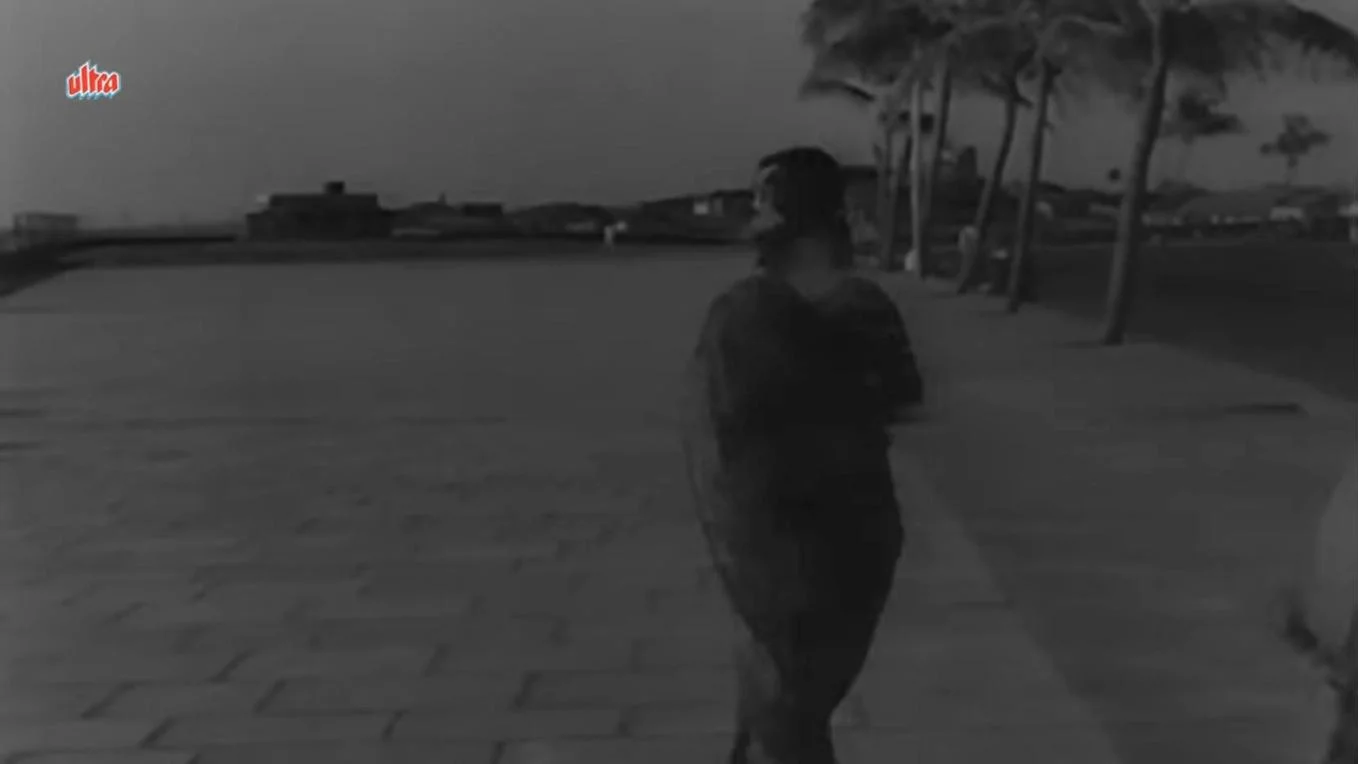
A song sequence on the Bombay sea front, C.I.D. (1956)
Direction and craftsmanship
Tempo comes first. In 1956 Filmfare's reviewer called the film a sleek entertainer moving at a swift pace, and the description has not dated at all. The car chase is shot through a windscreen streaming with rain, and the darkness inside the car is nearly total. V. K. Murthy, a regular on Guru Dutt's films, lights interiors in pools and leaves faces half in shadow. Filmfare's 2016 retrospective calls the film heavily influenced by American noir in its narrative, camerawork and lighting. The courtroom, by contrast, is flat and bright, with tall arched windows and a crowded public gallery. Shekhar stands before the court in flat daylight, and for once the lighting hides nothing, though the case against him is a lie.
Khosla came out of music, and it shows in how the songs are placed. They belong to the plot. Waheeda Rehman, looking back, picked out his picturisation of 'Kahin Pe Nigahen Kahin Pe Nishana', sung by Shamshad Begum, as the proof of his craft. She called it the climax song. 'Aye Dil Hai Mushkil Jeena Yahan', sung by Mohammed Rafi and Geeta Dutt, is picturised on Johnny Walker. Its refrain, 'yeh hai Bombay meri jaan', is wry and faintly desolate about a city that makes fortunes and discards lives at the same rate. It is the film's chorus.
Rehman also remembered the scene in which Kamini first bargains with Shekhar for Sher Singh's release. Dev Anand lifts his left eyebrow and delivers his lines with total confidence. Khosla told her to answer his anger by smiling, underplaying and using a Bharatanatyam mudra on the line 'To phir kar lijiye giraftar'. The gesture is small and exactly right, a dancer's hand in a gangster's parlour. After the take Dev Anand shook her hand and promised her a part in one of his own productions. He kept it, she said, ten years later with Guide.
The playing suits the mixture. Kohli thought Dev Anand unusually natural as the investigating officer, free of the mannered acting his image later demanded. Johnny Walker's comedy is threaded into the investigation, since Master is the only witness, and Kum Kum gives him someone to play against. Shakila, as Kohli put it, has little to do.
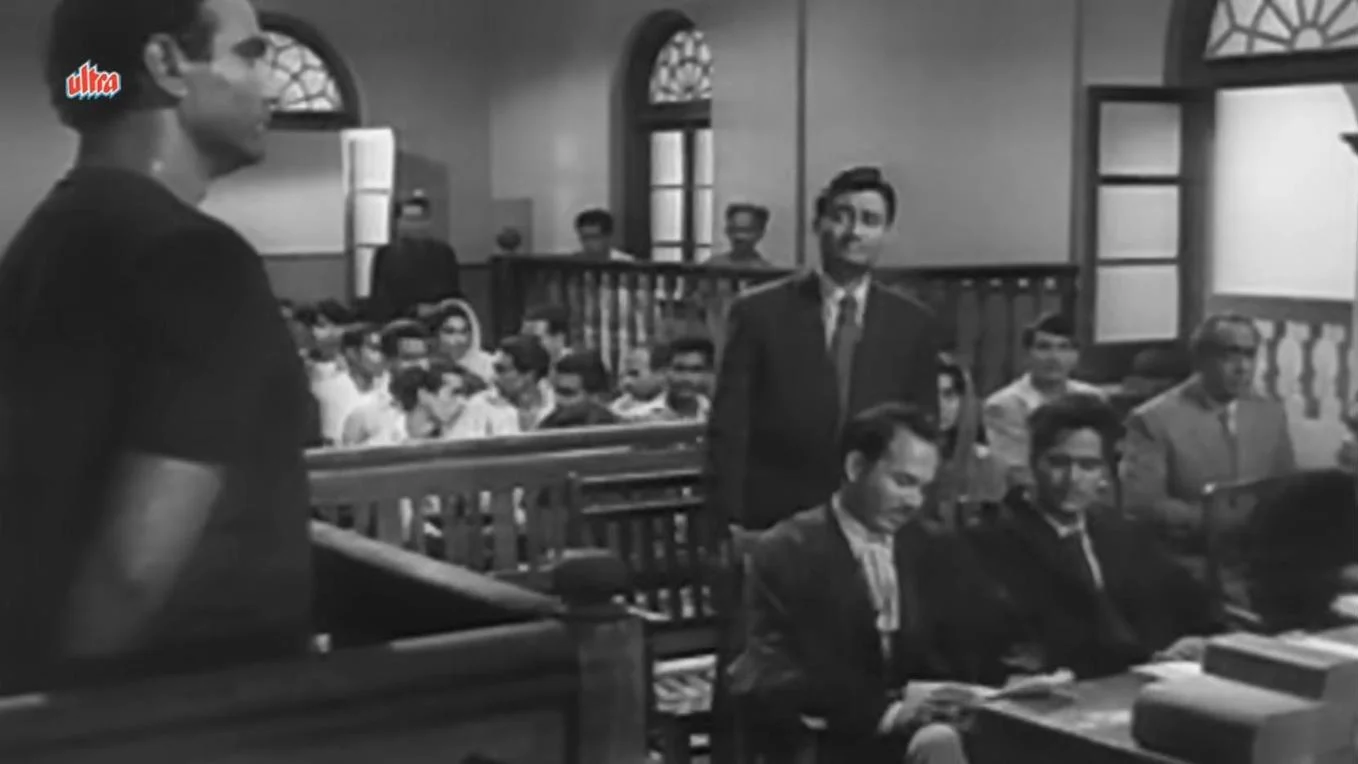
Shekhar (Dev Anand, standing) on trial for murder, C.I.D. (1956)
The cinema of Raj Khosla
C.I.D. is often filed under Guru Dutt, and the filing is understandable. Dutt produced it and staffed it from his own unit, and his hand is visible in the camera style and in the use of song. Set beside Pyaasa (1957) and Kaagaz Ke Phool (1959), it takes a similar disenchantment with a money-minded society and pours it into an extrovert form. The direction is Khosla's, though, and the career that followed makes the point.
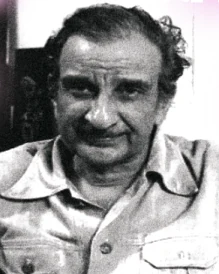
Raj Khosla on a 2025 India Post stamp
Khosla moved from genre to genre and added his own touch to each. There were the crime films C.I.D. and Kala Pani (1958), and Solva Saal (1958), the story of a single night. Bambai Ka Babu followed in 1960. Then came the mystery trilogy with Sadhana: Woh Kaun Thi? (1964), Mera Saaya (1966) and Anita (1967). Do Badan (1966) and Do Raaste (1969) were melodramas. Mera Gaon Mera Desh (1971) was a dacoit film that inspired Sholay. He was known in the industry as a women's director because his films kept giving actresses their best parts, and Main Tulsi Tere Aangan Ki (1978), which won the Filmfare Award for Best Film, is the usual example.
The line from C.I.D. through Kala Pani to Woh Kaun Thi? is the line of a home-grown Hindi noir, urban and morally uncertain and set to music. Khosla never stopped being a singer who directed. His later films stopped working, he took to drink, and he died in Bombay on 9 June 1991.
India Post issued stamps in his honour on 3 May 2013 and 1 May 2025. In November 2025 the 56th International Film Festival of India, in Panaji, announced that it would mark the centenaries of a group of film-makers that included both Raj Khosla and Guru Dutt.
Reception and legacy
The first notice was warm and specific. Filmfare's review of 14 September 1956 called the film a sleek entertainer interspersed with good songs. The same reviewer found the story full of inconsistencies, which he put down to a poor grasp of police-court procedure and of detection methods. Dev Anand, he wrote, was very convincing as the inspector, and Johnny Walker was exceptionally good, with Kum Kum an excellent foil. Nayyar's music was the high point. The choreography, he thought, was not particularly good, a verdict on Zohra Sehgal that the film does not obviously deserve.
The film's commercial fate is clearer than its release date. Box Office India's archived listing for 1956 puts C.I.D. first, at a gross of 2.5 crore rupees and a net of 1.25 crore. Filmfare's retrospective gives the 1.25 crore figure. Guru Dutt is said to have given Khosla a foreign car to thank him. The songs travelled further than the film. All six became famous, by Filmfare's account.
Later writers have been cooler. Suresh Kohli, revisiting the film for The Hindu in 2009, found yawning gaps in the script and the direction, and noted that the film was a colossal hit all the same. He also wrote that Waheeda Rehman mesmerises as the good-hearted vamp. Rehman herself, interviewed in 2010, said the film set a trend by showing the first death in police custody at the hands of a criminal's own associates. She thought it would have caused a sensation at a festival.
The longer legacy is Rehman and the genre. She arrived at Pyaasa the next year with a Hindi film behind her. Filmfare's retrospective notes that although Shakila was the actual heroine, it was Rehman people talked about. And C.I.D. showed that a police thriller with a shadowed city in it could top the Hindi box office.
The film is more curious about Kamini than it will admit, and it gets rid of the curiosity along with her.
Reference
- Blast from the past: C.I.D. 1956, Suresh Kohli, The Hindu, 15 August 2009 (archived)
- Waheeda's first break, Ranjan Das Gupta, The Hindu, 7 January 2010 (archived)
- 60 Years of CID, Devesh Sharma, Filmfare, 4 July 2016
- Guru Dutt's 'C. I. D': A Crime Thriller Highlighted By Nayyar's Music, Filmfare, 14 September 1956, p. 13 (scan), quoted on Wikipedia
- Box office 1956, Box Office India (archived 2 January 2010)
- CID (1956), Indiancine.ma
- IFFI 2025 to break tradition, open with a vibrant street carnival in Panaji, The Statesman, 7 November 2025
- C.I.D. (1956 film), Wikipedia
- Raj Khosla, Wikipedia
- Bhanu Athaiya, Wikipedia
C.I.D. on YouTube
Image credits: Banner: Guru Dutt Movies Pvt. Ltd. (producer); frame from the Ultra Movie Parlour upload on YouTube, All rights reserved; used for criticism and review, via source. Image: Guru Dutt Films Ltd., release poster; via IMDb, All rights reserved; used for criticism and review, via source. Image: Guru Dutt Movies Pvt. Ltd. (producer); frame from the Ultra Movie Parlour upload on YouTube, All rights reserved; used for criticism and review, via source. Image: Guru Dutt Movies Pvt. Ltd. (producer); frame from the Ultra Movie Parlour upload on YouTube, All rights reserved; used for criticism and review, via source. Image: Guru Dutt Movies Pvt. Ltd. (producer); frame from the Ultra Movie Parlour upload on YouTube, All rights reserved; used for criticism and review, via source. Image: India Post, Government of India, GODL-India, via Wikimedia Commons.




Commentary
What holds up in C.I.D. is the balance between pleasure and disquiet. It is efficient popular film-making, brisk and tuneful and built for a large audience, and it was demonstrably successful at that. It is also alert to the moral weather of a young republic, and to how easily money corrupts the institutions meant to restrain it. The two registers sit together without friction. That is harder to do than it looks.
The case against the film is worth stating properly, and Filmfare's critic made most of it in 1956. The legal machinery is nonsense. A serving officer runs from his own trial, investigates the case against himself and is then promised a kind word, and none of it would survive five minutes in a real court. The larger reservation is political. C.I.D. locates corruption at the top of society and then cures it by arresting one man, which leaves the order that produced him intact. The mastermind is caught, Mathur is proved right and the film asks nothing further of the state. Its critique is narrower than its atmosphere promises.
A second reservation concerns Kamini. Waheeda Rehman has the only part in the film with a shadow on it, and the script does with her what scripts of the period did with such women. She repents, she nurses the hero, and she is shot. Rekha, who has done nothing more interesting than throw a set of keys, gets the romance and the ending. The film is more curious about Kamini than it will admit, and it gets rid of the curiosity along with her.
None of this undoes the film. What remains is Bombay: the wet streets, the borrowed tune, the pickpocket singing about how hard it is to live here and staying anyway. Khosla would make better-plotted films, and Guru Dutt would make deeper ones. Nothing either of them made moves this fast.