
Amit Dutta
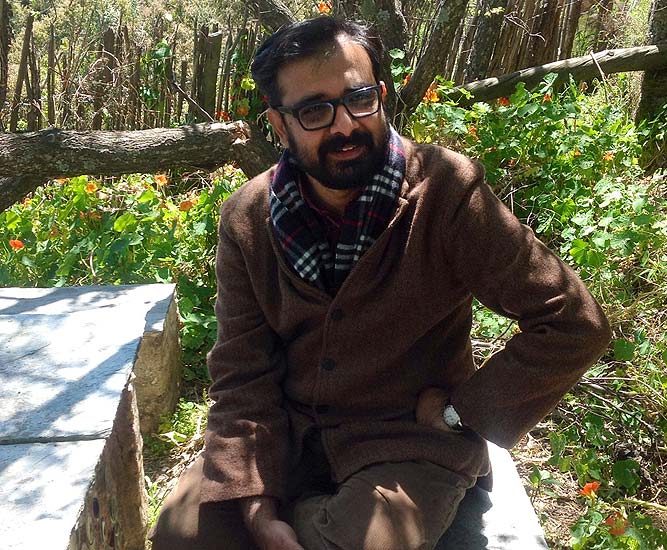
Amit Dutta is among the most singular and uncompromising figures in contemporary Indian cinema, an experimental filmmaker and writer whose work has redefined the relationship between the moving image and the older arts of painting, music, and literature. Born in 1977 in Jammu and trained at the Film and Television Institute of India in Pune, Dutta has built, over more than two decades, a body of work that stands almost entirely apart from the commercial and even the art-house mainstream of Indian filmmaking. His films, which now number more than forty, are rooted in patient field research and a deeply personal symbolism, and they have most often taken as their subject the history of Indian art, the textures of regional and tribal cultures, and the transmission of artistic knowledge across generations.
Working largely outside conventional systems of production and distribution, Dutta has nonetheless earned an exceptional degree of international critical esteem. The film critic Jonathan Rosenbaum included his short film Kramasha (2007) in his personal list of the thousand essential films of all time, and in 2024 Richard Brody, writing in The New Yorker, named his first feature, Nainsukh (2010), among the finest biographical films ever made. His work has been honoured at festivals from Venice and Oberhausen to Rotterdam and Rome, and shown at institutions including the Museum of Modern Art in New York, the Centre Pompidou in Paris, and the Smithsonian. He has received the National Film Award of India on four occasions.
Dutta's cinema resists easy categorisation. Critics have struggled to place his films within familiar genres, describing them variously as documentary, essay film, fairy tale, and living painting, often within the span of a single work. His montages interweave historical reminiscence, myth, children's stories, and dense visual texture, producing images that one writer described as without precedent in world cinema except for a distant echo of Sergei Parajanov. The near-silence of many of his films, their sumptuous photography and intricate sound design, and their refusal of psychological exposition have made him a difficult but rewarding figure, a filmmaker whose work demands and rewards contemplation.
Beyond filmmaking, Dutta is a prolific author in Hindi and English, having published several books of fiction, art-historical inquiry, and personal reflection. He has taught at the National Institute of Design in Ahmedabad and held a Tagore Fellowship at the Indian Institute of Advanced Study in Shimla. His parallel careers as filmmaker and writer are not separate enterprises but facets of a single sustained meditation on art, memory, and the act of seeing.
Life and Early Work
Amit Dutta was born in 1977 in Jammu, in the northernmost reaches of India, a region whose Dogra cultural heritage would later be formally recognised when the state conferred upon him the title of Dogra Ratan in 2013 for his contributions to art and culture. The landscapes, folklore, and domestic memory of this region recur throughout his early films, which return repeatedly to the imagined past of village and family. Although biographical detail about his upbringing remains characteristically sparse, the persistence of childhood memory, rural texture, and inherited story in his work suggests a formative attachment to place and to the oral and visual traditions of his surroundings.
The decisive event of Dutta's early development was his admission to the Film and Television Institute of India in Pune, the country's premier film school and the crucible of much of India's parallel cinema. He graduated in 2004, and several of the diploma and early experimental films he made there immediately marked him as an unusual talent. Even as a student his sensibility ran counter to prevailing currents: rather than narrative realism or social drama, he pursued a cinema of association, texture, and reverie. His student notebooks, later published in Hindi as Khud Se Kayi Sawal (Many Questions to Myself, 2018) in a translation by the writer Geet Chaturvedi, reveal a young artist already preoccupied with the philosophical and formal possibilities of the medium.
In the years immediately following film school, Dutta undertook the kind of patient ethnographic research that would become a hallmark of his practice. He spent many months interviewing painters of the Gond tribal community of Madhya Pradesh who had migrated to Bhopal in the wake of the success and untimely death of the pioneering Gond artist Jangarh Singh Shyam, work that issued in the film Jangarh Film Ek and, much later, in a full-length art-historical book. He also made Ramkhind, a feature-length documentary observation of everyday life in a Warli village renowned for its folk painters. These early encounters with living traditions of tribal and folk art established the abiding concern of his career: the life of art outside the museum and the academy, and the fragile means by which artistic knowledge is preserved, transmitted, or lost.
Dutta's formation was thus as much that of a scholar and ethnographer as of a filmmaker. His later collaborations with eminent art historians, and his own substantial output as a writer, are continuous with these beginnings. From the outset he conceived of cinema not as entertainment or even primarily as storytelling, but as an instrument of inquiry, a means, as he once put it, of exploring that which escapes ordinary perception.
Filmmaking
Dutta's career began with a series of short experimental films that critics found almost without precedent in their formal daring. The breakthrough came in 2007 with Kramasha (To Be Continued), a twenty-two-minute work shot on 35-millimetre film that wove together village legend, family memory, and dreamlike imagery into what Rosenbaum called a dazzling, virtuoso piece of mise en scène. The film won the FIPRESCI critics' prize at the Oberhausen International Short Film Festival, where the jury praised the sensual pleasures of its handling of celluloid, and the following year it took the Golden Conch for Best Film of the Festival at the Mumbai International Film Festival. Its inclusion in Rosenbaum's list of the thousand essential films of all time announced Dutta, while still in his twenties, as a filmmaker of international significance.
In 2009 Dutta completed his first feature, Aadmi Ki Aurat Aur Anya Kahaniyan (The Man's Woman and Other Stories), a triptych adapting three short stories with what one critic described as such exquisite, gemlike colour and feeling for rhythm that their narrative content seemed almost to recede behind their sensual surface. The film received the Special Mention of the Orizzonti jury at the 66th Venice Film Festival, where the jury observed that it opened a window on a new form of filmmaking. The jury member and film artist Bady Minck wrote that Dutta created images at once poetic and unsettling, oscillating between the fantastic and the concrete.
The most decisive turn in Dutta's career came through his collaboration, begun in 2007, with the Swiss art historian Eberhard Fischer, with whom he undertook research in the Kangra Valley of Himachal Pradesh. This work culminated in Nainsukh (2010), a feature based on the life of the eighteenth-century Pahari master painter of the same name. The film meticulously recreates Nainsukh's miniatures as living tableaux, staged amid the ruins of the Jasrota palace where the artist served his patron. Almost wordless, built from the careful juxtaposition of image and sound, Nainsukh was hailed by the critic Olaf Möller as a true masterpiece of Indian modernism and a thought-provoking investigation into the nature of realism and its representation in the arts. It premiered at the 67th Venice Film Festival and travelled to Rotterdam, Vancouver, Beijing, the San Francisco Film Society, and the Museum of Modern Art in New York, and was later named by Richard Brody among the best biographical films ever made.
After Nainsukh, Dutta's attention settled increasingly on the art-historical and cultural life of the Kangra region and the wider Pahari tradition. Between 2011 and 2012 he recorded extensive conversations with the eminent art historian B. N. Goswamy, the foremost authority on Pahari painting, as part of an archival project; from this process emerged the short films The Museum of Imagination (2012), an abstract portrait of Goswamy subtitled A Portrait in Absentia, and Field-Trip (2013). The Museum of Imagination premiered at the Rome Film Festival and was shown at Rotterdam and Oberhausen, with the curator Andrea Picard praising its quietude and its sense that the study of art is a way of seeing the world.
Through the 2010s Dutta sustained an extraordinary productivity, alternating feature-length works with shorter, more essayistic films. Sonchidi (The Golden Bird, 2011) followed two travellers in quest of a flying craft they believe will release them from the cycle of rebirth, a work Rotterdam described as a truly cinematic connoisseur's piece. Saatvin Sair (The Seventh Walk, 2013) followed a painter into the forest in a meditation on art and nature, while Gitagovinda (2014) drew on Jayadeva's twelfth-century devotional poem. Chitrashala (House of Paintings, 2015) was shown at the Berlin Film Festival, and The Unknown Craftsman (2017) and Notes on Guler (2019) extended his inquiry into the makers and milieus of Pahari art. In 2013 the Venice Film Festival invited him, as one of seventy directors, to make a short film on the future of cinema for its seventieth anniversary.
Dutta's more recent work has continued to expand his range while remaining faithful to his central preoccupations. Wittgenstein Plays Chess with Marcel Duchamp, or How Not to Do Philosophy (2020) turned his playful intellect toward the philosophy of art and the game of chess, a subject he also pursued through a project supported by a grant from France's Centre National des Arts Plastiques. In 2024 his animated biographical film Rhythm of a Flower, based on the life of the Hindustani classical singer Kumar Gandharva, had its world premiere at the MAMI Mumbai Film Festival, where it won the Golden Gateway Award in the South Asia Competition. Across this long and varied filmography, Dutta has accumulated honours including four National Film Awards, the Gold Mikeldi at Bilbao, the John Abraham National Award, the main prize of the international jury at the 70th Oberhausen festival, and the Hubert Bals award of the Rotterdam festival for his screenplay; the Ferroni Brigade group of critics named him among the best new filmmakers of the decade in 2011.
The Cinema of Amit Dutta
The cinema of Amit Dutta is, before all else, a cinema of the image conceived as a repository of memory and knowledge. Where most narrative film subordinates the image to story, Dutta inverts the relation, allowing plot to dissolve into a sequence of richly composed and densely textured pictures whose logic is associative rather than causal. His films move like reverie or like the act of remembering, drawing the viewer into a state of contemplation in which the boundaries between documentary observation, historical reconstruction, dream, and myth become productively unstable. The result is a body of work that critics have repeatedly found impossible to classify, and whose difficulty is inseparable from its rewards.
Central to Dutta's method is a practice of patient field research that precedes and underwrites the finished film. Whether interviewing Gond painters in Bhopal, recording an art historian's recollections, or studying the miniatures of the Pahari schools, Dutta approaches his subjects with the rigour of a scholar, and his films are saturated with this acquired knowledge even when they wear it lightly. At the same time, the research is always transmuted by a personal and poetic sensibility, so that fact and imagination, the documentary and the fantastic, are held in a single, shimmering suspension. This fusion of scholarship and reverie is perhaps the defining signature of his art.
Equally distinctive is Dutta's treatment of sound. Many of his films are nearly silent, dispensing with dialogue in favour of an intricately layered soundscape that works in counterpoint to the image. This near-wordlessness compels a heightened attentiveness to the visual and the aural, and lends his films their characteristic hypnotic quality, the sense of a fusion of imagery and sound that conjures up a lost age. His cinema thus stands self-consciously within, and in dialogue with, the older Indian arts of painting and classical music, seeking through the modern medium of film to extend and reinterpret traditions that long preceded it.
Key Themes
Art history and the life of painting. Dutta's most sustained concern is the history of Indian art, above all the Pahari miniature tradition of the Kangra Valley. His films do not merely depict paintings but seek to enter and animate them, recreating their compositions as living tableaux and interrogating the conditions under which they were made.
Cultural inheritance and transmission. Across his work runs a preoccupation with how artistic knowledge passes from one generation to the next, and with what is lost when those chains of transmission break, a concern crystallised in his studies of the Gond painter Jangarh Singh Shyam and his kin.
Memory, childhood, and the imagined past. Especially in his early films, Dutta returns to the textures of village and family memory, reconstructing an imagined past through the associative logic of dream and recollection rather than linear narrative.
Myth, folklore, and the philosophical. Legend, fairy tale, devotional poetry, and philosophical speculation interweave throughout his films, from the rebirth-quest of Sonchidi to the chess-playing dialogue of Wittgenstein and Duchamp, giving his cinema its labyrinthine density of allusion.
The image and silence. Dutta privileges the composed image and the designed soundscape over speech, producing near-silent films whose meaning resides in visual and acoustic texture, and which ask of the viewer a contemplative, almost meditative attention.
Selected Filmography
Ramkhind (2001). A feature-length documentary observation of everyday life in a Warli village known for its folk painters. An early statement of Dutta's interest in living traditions of tribal art and the rhythms of rural existence.
Kramasha (2007). Also known as To Be Continued, this twenty-two-minute work on 35-millimetre film blends village legend, family memory, and dreamlike imagery. It won the FIPRESCI prize at Oberhausen and the Golden Conch at MIFF, and was included by Jonathan Rosenbaum in his list of the thousand essential films of all time.
Aadmi Ki Aurat Aur Anya Kahaniyan (2009). Dutta's first feature, The Man's Woman and Other Stories, a triptych of three short stories rendered with extraordinary chromatic richness. It received the Special Mention of the Orizzonti jury at the Venice Film Festival.
Nainsukh (2010). A near-wordless feature on the life of the eighteenth-century Pahari master painter Nainsukh, recreating his miniatures as living tableaux amid the ruins of the Jasrota palace. Widely regarded as Dutta's masterpiece and named by Richard Brody among the finest biographical films ever made.
Sonchidi (2011). The Golden Bird follows two travellers seeking a flying craft they believe will free them from the cycle of rebirth, a philosophical and intensely cinematic short praised at Rotterdam.
The Museum of Imagination (2012). An abstract portrait, subtitled A Portrait in Absentia, of the art historian B. N. Goswamy, drawn from extensive recorded conversations. It premiered at the Rome Film Festival.
Saatvin Sair (2013). The Seventh Walk, a feature following a painter into the forest, meditating on the relationship between art, nature, and perception.
Gitagovinda (2014). A short film drawing on Jayadeva's twelfth-century Sanskrit devotional poem, extending Dutta's engagement with classical Indian art and literature.
The Unknown Craftsman (2017). A feature-length inquiry into the anonymous makers of Pahari art, continuing Dutta's investigation of artistic labour and tradition in the Kangra region.
Notes on Guler (2019). A mid-length film exploring Guler, one of the cradles of Pahari painting, and the milieu from which its great artists emerged.
Rhythm of a Flower (2024). An animated biographical film on the Hindustani classical singer Kumar Gandharva, which won the Golden Gateway Award at the MAMI Mumbai Film Festival.
Legacy
Amit Dutta occupies a place in Indian cinema unlike that of any of his contemporaries. At a moment when celluloid and the short experimental film alike seemed to be passing out of fashion, he insisted on the sensual and intellectual pleasures of both, and in doing so he extended the lineage of India's parallel and avant-garde cinema into the twenty-first century. His work has carried that tradition into spaces it had rarely reached, the major art museums and avant-garde film programmes of Europe and North America, where retrospectives of his films have been mounted at the Centre Pompidou, the Smithsonian, the Berkeley Art Museum and Pacific Film Archive, and through online platforms that have introduced his cinema to new audiences.
His influence has been felt as much in the realm of art history as in cinema. By animating the miniatures of Nainsukh and the Pahari schools and by dramatising the lives of artists both celebrated and forgotten, Dutta has done, in the words of the art historian Milo Beach, more for public interest in Indian painting than a great many scholarly essays. His parallel career as a writer has reinforced this contribution: his Hindi novel Kaljayi Kambakht (2016), for which he received the Krishna Baldev Vaid Fellowship and which was shortlisted for the Armory Square Prize for South Asian Literature in Translation, his art-historical study Invisible Webs (2018) on Jangarh Singh Shyam, and his children's writing have together established him as a significant literary as well as cinematic figure.
The critical recognition accorded to Dutta has been remarkable for an artist working so far from any commercial centre. Four National Film Awards, prizes at Venice, Oberhausen, Bilbao, Mumbai, and Rotterdam, a place on Rosenbaum's canon of essential films, and Brody's later endorsement testify to an international stature rarely achieved by an Indian experimental filmmaker. The publication of a full-length critical study of his work, Srikanth Srinivasan's Modernism by Other Means (2021), marks the degree to which his cinema has become an object of serious scholarship in its own right.
Perhaps Dutta's most enduring legacy lies in the example he sets of artistic integrity and independence. In an industry overwhelmingly oriented toward narrative spectacle, he has demonstrated that a cinema of research, contemplation, and formal rigour remains not only possible but vital, and that the moving image can serve as a bridge between the modern world and the deep traditions of Indian art, music, and thought. For younger filmmakers and artists drawn to the essayistic and the experimental, his career stands as a model of how to make uncompromising work on one's own terms, and as proof that such work can find, against considerable odds, a discerning audience across the world.