
Bijukumar Damodaran
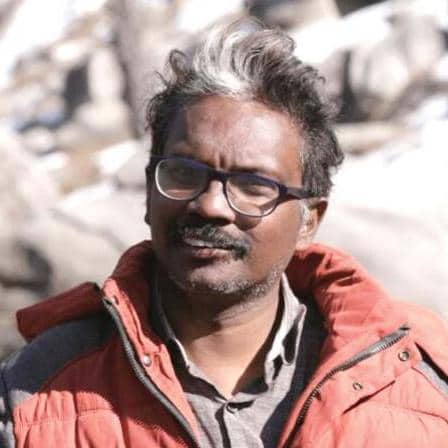
Bijukumar Damodaran, widely known as Dr. Biju, is a pivotal figure in contemporary Indian cinema whose work resides at the intersection of aesthetic rigor and social conscience. Recognized internationally for his formally inventive and thematically incisive films, Damodaran has emerged as one of the most consequential voices in Malayalam cinema’s parallel and world cinema traditions. His filmmaking consistently engages with pressing socio-political concerns—such as caste, environmental degradation, marginalization, and historical memory—while articulating a cinematic language marked by poetic density and moral urgency. Over the course of his career, Dr. Biju has been honored with multiple National Film Awards and has had his films screened and awarded at esteemed international festivals including Cannes, Shanghai, and Montreal, thereby establishing his stature in both national and global contexts.
Life and Early Work
Born on 31 May 1971 in Kerala, Bijukumar Damodaran’s early life was shaped by both the socio-cultural milieu of his home state and an intellectual curiosity that would later inform his artistic praxis. Professionally trained as a homeopathic doctor, Damodaran’s initial vocational pursuits were guided by medical practice; however, his engagement with literature, philosophy, and visual culture cultivated an enduring interest in cinematic expression. This dual identity—as a medical practitioner and an autodidactic artist—would become characteristic of his career, situating him both within and outside the institutional frameworks of Indian cinema. His inaugural feature, Saira (2005), marked his transition from medicine to filmmaking and announced his commitment to cinema that confronts systemic injustices and human suffering with ethical sensitivity and formal restraint.
Filmmaking
Damodaran’s oeuvre is distinguished by a consistent engagement with marginality, structural violence, and existential inquiry. Saira (2005), which premiered in the “Cinema of the World” section at the Cannes Film Festival, set the tone for a career defined by thematic boldness and international resonance. Subsequent films such as Veettilekkulla Vazhi (The Way Home, 2010), Perariyathavar (Names Unknown, 2014), and Valiya Chirakulla Pakshikal (Birds With Large Wings, 2015) foreground the plight of displaced persons, environmental catastrophe, and the daily realities of India’s socio-economically disenfranchised.

Beyond their social commitments, Damodaran’s works exhibit a meticulous formal sensibility: narratives unfold with a measured rhythm, images are composed with painterly precision, and silence often functions as a critical expressive register. In Sound of Silence (2017), for example, he employs multilingual narratives and evocative landscapes to explore solitude, belonging, and human resilience. His engagement with genre and form is further evident in Painting Life (2018), an English-language English film that reflexively interrogates the nature of cinematic creation itself.
The director’s later works—such as Veyilmarangal (Trees Under the Sun, 2019) and Adrishya Jalakangal (Invisible Windows, 2023)—continue to deepen his exploration of caste, displacement, and metaphysical questions, even as they expand his formal palette through co-productions and genre inflections.
The Cinema of Bijukumar Damodaran
Damodaran’s cinema emphasizes its commitment to humanistic realism and ethical interrogation. His films do not merely depict social conditions; they persistently question the cultural, economic, and political structures that produce marginalization. Through a cinema that privileges long takes, non-professional and professional actors alike, and an aesthetic that negotiates lyricism with documentary immediacy, Damodaran articulates a poetics of observation that resists spectacle in favor of contemplative engagement.
His work situates hegemony and resistance in a shared frame, compelling audiences to confront historical amnesia, embodied trauma, and collective responsibility. The recurrent motifs of mobility, loss, and the unspoken reveal a cinematic philosophy attentive to the fraught interstices of personal and communal histories. This philosophical commitment aligns his practice with global art cinema while retaining rootedness in local cultural narratives and ethical imperatives.
Selected Filmography
Saira (2005) – Debut feature; Cannes selection.
Raman (2008).
Veettilekkulla Vazhi (The Way Home, 2010).
Akashathinte Niram (Color of the Sky, 2012).
Perariyathavar (Names Unknown, 2014).
Valiya Chirakulla Pakshikal (Birds With Large Wings, 2015).
Kaadu Pookkunna Neram (When the Woods Bloom, 2016).
Sound of Silence (2017).
Painting Life (2018).
Veyilmarangal (Trees Under the Sun, 2019).
Orange Marangalude Veedu (House of Orange Trees, 2020).
The Portraits (2021).
Invisible Windows (Adrishya Jalakangal, 2023).
Legacy
Bijukumar Damodaran’s legacy within Indian cinema is multifaceted, encompassing his contributions as a socially committed auteur, a cinematic humanist, and a bridge between regional filmmaking and global artistic discourse. He is a three-time National Film Award winner, with his films consistently recognized for their artistry and social relevance. Moreover, his works have garnered international accolades, including significant honors at the Shanghai International Film Festival—where Veyilmarangal achieved a first for Indian cinema in the Golden Goblet competition—and widespread festival screenings that situate him within the broader currents of world cinema.
His films continue to be studied for their ethical depth, formal innovation, and unwavering commitment to representing voices and experiences that remain peripheral within mainstream cultural imaginaries. As such, Dr. Biju’s body of work has not only enriched Malayalam cinema but also contributed significantly to contemporary debates about cinema’s role in articulating justice, memory, and human dignity.