Introduction
In 1987, Adoor Gopalakrishnan completed what many critics now regard as the most formally audacious film of his distinguished career: Anantaram (Monologue), a work whose very title — meaning 'thereafter' or 'and then' in Malayalam — signals its preoccupation with the fundamental grammar of narrative. Released on Diwali, 21 October 1987, this 125-minute psychological drama represents one of Indian cinema's most sophisticated meditations on the relationship between storytelling, memory, and psychological disintegration. Where Gopalakrishnan's earlier masterworks — Elippathayam (1981) and Mukhamukham (1984) — had examined the social and political textures of Kerala with austere precision, Anantaram turns its gaze inward, to the territory of individual consciousness and the unreliable mechanisms by which human beings construct narrative from experience. The Malayalam word that forms the film's title is not merely a linguistic curiosity but a philosophical proposition: 'anantaram' designates the connective principle of narration itself, the 'and then' by which episodes are linked into story, and in choosing it as his title Gopalakrishnan announces, with characteristic economy, that the film will be as much about the act of narration as about the events narrated.
The film stars Ashokan as Ajayan, a young man of uncertain psychological stability who narrates his own story to an unseen interlocutor in what amounts to an extended, fractured monologue. Mammootty appears as Dr. Balu, Ajayan's foster brother, while the then seventeen-year-old Shobana delivers a remarkable dual performance as both Suma, Balu's new wife, and Nalini, a woman who may or may not exist outside Ajayan's imagination. The film's engagement with psychosis, childhood trauma, and the indeterminacy of perception situates it not merely within the Malayalam new wave but within a wider tradition of modernist cinema that includes the works of Alain Resnais, Michelangelo Antonioni, and Robert Bresson. That Anantaram received only mixed reviews upon its initial release, whilst subsequently earning recognition as one of the greatest achievements in Indian film history — included in the IBN Live poll of the 100 Greatest Indian Films of All Time — speaks to the essential ambition of Gopalakrishnan's enterprise: to make a film that exceeds the comprehension available to any single viewing and that deepens, irreducibly, with each subsequent encounter. Critic Simran Bhargava, writing in India Today at the time of the film's release, captured something essential when she observed that Gopalakrishnan 'doesn't insult his audience by laying it out straight' — a remark that functions simultaneously as praise and as an honest acknowledgement of the demands the film places upon its viewers.
Cast
- Ashokan - Ajayan
- Mammootty - Dr. Balu
- Shobhana - Sumangali and Nalini
- Sudheesh - Young Ajayan
- Bahadoor - Driver Mathai
- Vembayam Thambi - Raman Nair
- Azeez - Gambler
- Cuckoo Parameswaran - Nurse
- Kaviyoor Ponnamma - Yogini Amma
- Adoor Pankajam - Lakshmi Amma
Crew
- Direction - Adoor Gopalakrishnan
- Story - Adoor Gopalakrishnan
- Cinematography - Mankada Ravi Verma
- Editing - M Mani
- Production - General Pictures

Background and Production
Anantaram emerged from the characteristic gestation period of Gopalakrishnan's creative process, a period during which the director allows a subject or preoccupation to develop from intuition to fully formed conception before a single frame is shot. Following the international triumph of Elippathayam — which won the British Film Institute's prestigious Sutherland Trophy in 1982 for the 'most original and imaginative film' of the year, an honour previously reserved, in the Indian context, for Satyajit Ray — and the politically complex Mukhamukham (1984), which drew upon the history of the Communist movement in Kerala, Gopalakrishnan found himself preoccupied with questions that were more philosophical than sociological. His interest shifted towards the epistemological: not the content of experience but the processes by which experience is perceived, stored, and retrieved in narrative form. His own account of the film's origins reveals the depth of this preoccupation: 'Anantaram is basically about perceptions. About a young, impressionable boy who is an introvert and an extrovert at the same time. My treatment was not very familiar, though I was searching for the familiar experience of growing up, struggling with life and relationships. What is in the frame and what is juxtaposed to it just outside the frame... it has to do with attuning to the reality just beyond perception. Actually, this is part of the daily experience though we don't analyse it.' This statement illuminates the ambition of the project: to render, through cinematic form, an aspect of consciousness that is universal yet almost never directly represented.
The film was produced by K. Ravindran Nair under the banner of General Pictures and photographed by Mankada Ravi Varma, a cinematographer who had established himself as one of Malayalam cinema's most disciplined and uncompromising visual stylists. Gopalakrishnan wrote the screenplay himself — as he has done for every film in his oeuvre — developing a script whose formal complexity was matched by its emotional precision. The dual-narrative structure required an approach to scripting that acknowledged the film's inherent indeterminacy, and the screenplay was designed not to resolve but to sustain productive ambiguity across its entire running time. The film was shot across the landscape of Kerala, with Varma deploying natural and available light to invest the domestic spaces of the narrative with the texture of lived social reality. The sound design — a dimension of filmmaking to which Gopalakrishnan has always devoted exceptional attention, having pioneered the use of sound as a structural and emotional leitmotif in his debut feature Swayamvaram — was developed in collaboration with recordists P. Devadas, T. Krishnanunni, and N. Harikumar, whose contributions would subsequently be recognised with the National Film Award for Best Audiography. The music by M.B. Sreenivasan was composed with full awareness of Gopalakrishnan's preference for restraint: music in his films is never used as emotional insurance but as a precisely calibrated element within a larger acoustic architecture in which silence, ambient noise, and the human voice carry equal expressive weight.
Story
The narrative of Anantaram is structured, as its title suggests, as a sequence of connected episodes whose connections are subject to perpetual revision. The film opens with an infant's cry — the cry, we gradually understand, of Ajayan, who has been abandoned by his mother at a hospital and subsequently adopted by a kindly senior doctor, referred to throughout as 'Doctor Uncle.' Raised alongside the doctor's biological son, Balu, in a large household staffed by three servants of deeply questionable moral character, the young Ajayan navigates an environment of social hostility and psychological destabilisation: the servants remind him constantly of his orphaned status, physically torment him, and systematically exploit his isolation to blur the boundary between reality and fabrication. Their collective malevolence, evoking something of the Three Witches of Macbeth in their capacity to erode their victim's grip upon the real, constitutes the formative experience from which all subsequent disturbance flows. In adulthood, Ajayan (Ashokan) narrates this history in the first person to an unseen interlocutor, presenting himself as a gifted, multi-talented individual who succeeded in every undertaking he set himself. The film offers this self-account with neither endorsement nor refutation, inviting the audience to inhabit the uncertainty of Ajayan's perspective from the outset.

What makes Anantaram formally exceptional is its deployment of two distinct and mutually qualifying narrative threads, which do not cancel each other but coexist in a state of productive tension. In the first, Ajayan's story proceeds largely according to his own self-presentation: he is a man of gifts, wrestling with a forbidden attraction to Suma, the new wife of his foster brother Balu, and subsequently with his feelings for Nalini — a young woman who appears to him at a moment of particular loneliness, encountered as though by chance on a public bus, and who then disappears as mysteriously as she arrived. In the second thread, the same events are re-examined from an exterior perspective, and what emerges is a portrait not of a gifted man but of one whose childhood trauma has calcified into undiagnosed psychosis. The two versions do not contradict each other so much as occupy entirely different epistemological registers. The film's climax — in which Ajayan, confusing Suma with the possibly imaginary Nalini, erupts in distress and demands that Balu remove her from the house, whereupon Balu's quiet enquiry as to whether Ajayan has taken his medication confirms the clinical dimension of what the audience has been witnessing — arrives not as a revelation but as a quiet, devastating clarification of what was always already present within the film.
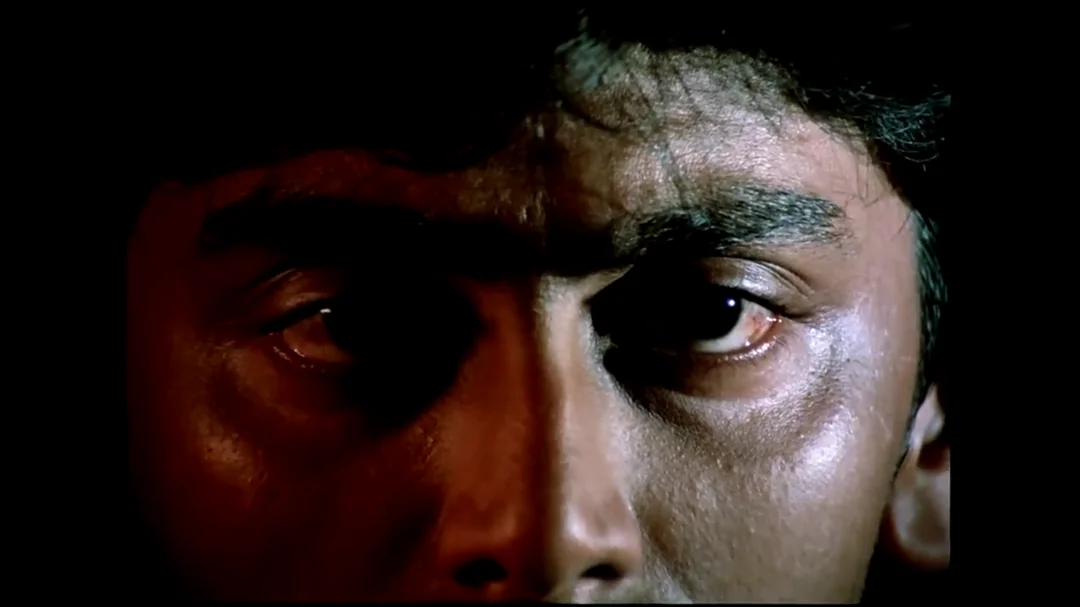
Ashokan in Anantaram
Beneath its psychological architecture, Anantaram engages with themes of identity, belonging, and the wound inflicted by early abandonment. Ajayan's orphan status is not merely a biographical detail but the generative trauma from which all subsequent psychological instability flows. His sense of self is constitutively incomplete — he exists in relation to a lack he has never been able to name or address — and this incompleteness manifests in the twin distortions of grandiosity and psychosis that the film traces with extraordinary patience. The figure of Nalini — whose reality the film steadfastly refuses to confirm or deny — functions simultaneously as the object of Ajayan's longing and the limit-point of his capacity to distinguish between experience and imagination. Gopalakrishnan also frames Anantaram as a meditation on the very process of artistic creation and storytelling. In his own account of the film's concerns, he has pointed to its interest in what lies 'just outside the frame' of perception — the way in which reality exceeds any single account we might give of it, and the way in which narrative, in its selection and sequencing of events, necessarily distorts as it represents. In this register, Anantaram is not only a study of one man's psychosis but a philosophical enquiry into the epistemological conditions of all narrative, including cinema itself.
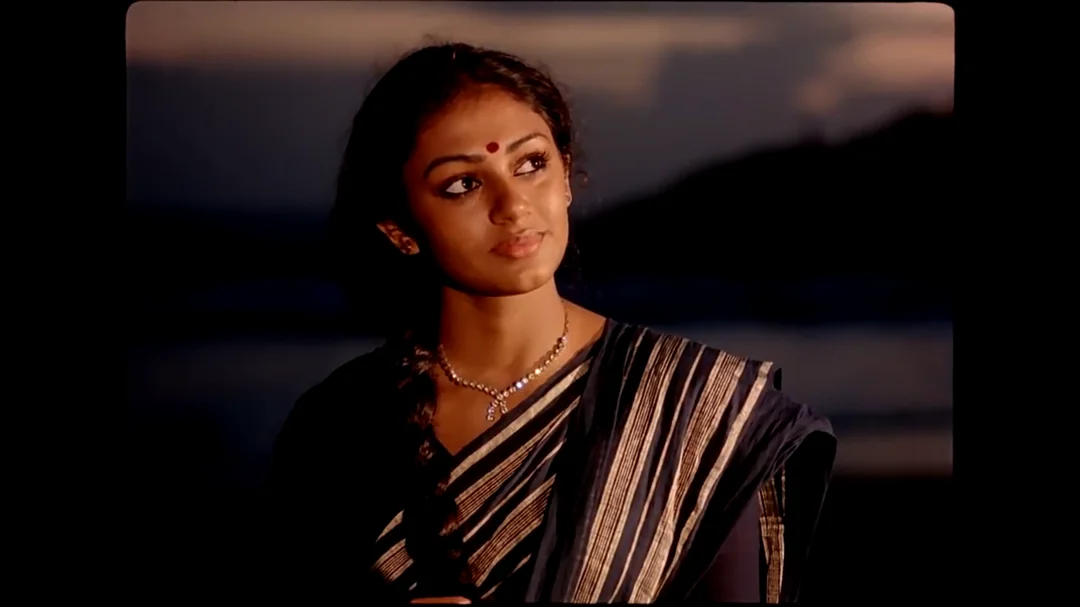
Shobana in Anantaram
Direction and Craftsmanship
Gopalakrishnan's direction of Anantaram demonstrates the full maturity of a formal intelligence that had been developing across fifteen years and five feature films. The film's most radical formal choice is simultaneously its most immediately apparent: the decision to structure the entire work as a monologue delivered by the protagonist to an unnamed, unseen interlocutor — revealed, without ceremony, to be a psychiatrist — who listens without intervening. This device, which aligns Anantaram with certain traditions of literary modernism as much as with cinema, creates a sustained tension between what is being narrated and what is being shown, between Ajayan's account of events and the visual and aural evidence with which Gopalakrishnan surrounds that account. The narration proceeds in the first person, yet the camera — Mankada Ravi Varma's lens, responsive to the natural light of Kerala's interiors and exteriors — frequently reveals what the narration cannot or will not acknowledge. This gap between word and image is the film's primary instrument of psychological investigation. Gopalakrishnan employs extended long takes and carefully composed medium shots that draw attention to the physical and spatial dimension of performance, allowing actors' bodies and the spaces they inhabit to carry meanings that the narration suppresses or deflects. The non-linear structure — itself an index of Ajayan's psychological condition — is handled with the discipline of a filmmaker who understands that formal experimentation achieves its effect only when subordinated to a precise emotional purpose.
Mankada Ravi Varma's cinematography is an achievement of understated but decisive formal authority. His deployment of deep-space compositions — particularly congruent with Gopalakrishnan's Brechtian instinct for 'distancing,' which prevents uncritical identification with the protagonist — ensures that the frame always holds within it the social and physical context of the action, preventing any slide into pure psychological interiority. Natural and available light invests the domestic spaces of the film with the texture of lived reality: the light in Ajayan's household is the light of a specific world, specific social circumstances, a specific historical moment in Kerala. The film's sound design — recognised with the National Film Award for Best Audiography, shared by P. Devadas, T. Krishnanunni, and N. Harikumar — is equally deliberate. M.B. Sreenivasan's music is employed with exceptional restraint, supplemented by a dense, precise soundscape of ambient sound that contextualises Ajayan's psychological fragmentation within a world that continues its business around him. The performances, directed with Gopalakrishnan's characteristic insistence on absolute unified vision — he has stated that he does not seek 'different interpretations of roles that may clash with each other' — are defined by their economy and precision. Ashokan's portrayal of Ajayan is haunted and inward, a performance calibrated to suggest depths of disturbance without ever becoming theatrical. Mammootty's Dr. Balu is warm, rational, and subtly fraught. And Shobana, in the dual role that the film's central ambiguity demands, manages the distinction between Suma and Nalini with a precision that is, in retrospect, the most disturbing aspect of the film: the two women are different, but the difference is small enough to be the difference between the real and the imagined.

The Cinema of Adoor Gopalakrishnan
Adoor Gopalakrishnan was born on 3 July 1941 in Kerala, and his formation as a filmmaker was shaped by the double inheritance of Kerala's rich classical performance traditions — his family patronised Kathakali and other art forms — and the rigorous modernist pedagogy of the Film and Television Institute of India in Pune, where Ritwik Ghatak was among his teachers. After founding Chitralekha Film Society, the first film society in Kerala, and co-establishing Chalachithra Sahakarana Sangham, India's first film cooperative for the production, distribution, and exhibition of quality films, Gopalakrishnan made his debut feature Swayamvaram (1972), which announced the arrival of a new wave in Malayalam cinema with a force comparable to the impact of Pather Panchali on Bengali cinema in the preceding generation. Swayamvaram's achievement — four National Film Awards, including Best Film and Best Direction, and a place in the history of Indian cinema as the first film to use sound as a structural leitmotif — was not merely technical but philosophical: it insisted on the social and economic dimensions of experience with an austerity that commercial Malayalam cinema had systematically avoided. It established the formal signatures that would characterise all of Gopalakrishnan's subsequent work: a refusal of conventional dramatic contrivance, a rigorously observational relationship with social reality, the deployment of silence and natural sound as structural elements, and the Brechtian distancing effect that prevents the audience from collapsing into uncritical emotional identification with the protagonist. In a career spanning more than five decades, Gopalakrishnan has made only twelve feature films — a rate of production that reflects his conviction that each film must represent a genuine formal and philosophical advance upon its predecessors.
Anantaram occupies a distinctive and pivotal position within Gopalakrishnan's oeuvre. It follows Mukhamukham (1984), in which the director had already begun to blur the boundary between documentary and fiction through the deployment of talking-head interviews about a fictional revolutionary hero — a film that the director Girish Kasaravalli has cited as a meditation on 'how much of an event is real, how much is imagined' — and it anticipates the concerns of Mathilukal (1990), in which storytelling across the walls of a prison becomes the film's central action, and the fiercely autobiographical Kathapurushan (1995). Anantaram is the pivot in Gopalakrishnan's career — the film in which his social and psychological investigations converge in a comprehensive formal experiment with narrative itself. Jean-Michel Frodon, in the preface to Parthajit Baruah's book Face-to-Face: The Cinema of Adoor Gopalakrishnan (2016), characterised the director's achievement as one of 'inventing creative use of the musical score (and of the absence of it)' and deploying 'an extraordinarily large array of cinematic tools' in the service of a vision that 'not only proclaims his own achievement but serves as a kind of anthem for the very nature of filmmaking at its best.' The FIPRESCI Prize awarded to Anantaram at the Karlovy Vary International Film Festival in 1987 — one of six successive FIPRESCI Prizes that would come to Gopalakrishnan over his career — confirmed that this formal ambition was recognised by the international critical community as a significant contribution to world cinema. Along with Satyajit Ray and Mrinal Sen, Gopalakrishnan stands as one of the figures through whom Indian cinema has been understood and valued internationally, and Anantaram represents his most direct engagement with the formal questions that animated European art cinema of the same era: the unreliability of memory, the indeterminacy of identity, the impossibility of purely objective narrative.
Reception and Legacy
Anantaram's critical reception at the time of its release was, paradoxically, a measure of its ambition. The film garnered mixed reviews from the Indian press, with the general consensus holding that it had not met the expectations established by Elippathayam and Mukhamukham — expectations calibrated, in retrospect, for a kind of social-realist precision that Anantaram had deliberately abandoned in favour of something more unsettling and harder to categorise. The Times of India subsequently identified it as one of the most significant experiments in Malayalam cinema, noting that its experimental nature was not something the audience of the time was prepared to accept. Simultaneously, however, the film's recognition at the 35th National Film Awards — winning three major categories, for Best Director, Best Screenplay, and Best Audiography — indicated that the Indian film establishment had identified Anantaram as an exceptional achievement even where popular reception had been uncertain. The FIPRESCI Prize at Karlovy Vary in 1987 placed the film within the international art cinema discourse in which it had so deliberately situated itself. The critical dichotomy between mixed popular reception and strong institutional recognition is itself instructive: Anantaram was a film that could be appreciated in full only by those already equipped with the conceptual vocabulary to engage with its particular form of ambiguity, and such an audience, in 1987, was necessarily limited.
The long-term critical reputation of Anantaram has undergone a transformation that is itself instructive about the relationship between formal ambition and cultural reception. From a film that left early audiences uncertain or dissatisfied, it has become, over the decades, one of the most celebrated works in the history of Malayalam cinema and a touchstone in scholarly discourse on Indian cinema, narrative experimentation, and the representation of mental illness. Its inclusion in the IBN Live poll of the 100 Greatest Indian Films of All Time situates it within the very highest tier of the national cinema's achievements. Scholarly attention has deepened correspondingly: Babu Subramanian's 2022 article in the Journal of Indian Cinema, 'Polyphony in time: Narrational strategy in Adoor Gopalakrishnan's Anantaram (1987) and the film's multiple interpretations,' examines its narrational strategies in relation to global developments in art cinema and advances the argument that the film's dual monologue constitutes a formal analogue for the schizophrenic duality it depicts — a claim that, if sustained, would position Anantaram as a work in which form and content are not merely complementary but identical. The film's influence on subsequent Malayalam filmmakers is perceptible in the willingness of the new generation — a generation that has drawn widespread international attention since the 2010s — to engage with psychological ambiguity, non-linear structure, and the unreliable narrator as legitimate and productive cinematic instruments.
Commentary
What distinguishes Anantaram from most films concerned with mental illness or psychological disturbance is the rigorous refusal of any position of clinical superiority on the part of the director. Gopalakrishnan does not present Ajayan's psychosis from the outside, as a condition to be observed and diagnosed from a position of confident rationality; he presents it from the inside and from the outside simultaneously, permitting the viewer no stable vantage point from which to adjudicate between the two perspectives with certainty. This formal decision is an ethical one: to refuse the conventional cinematic hierarchy by which the 'sane' viewer is positioned above and beyond the 'mad' subject. The film is haunted by the possibility that what it presents as Ajayan's delusion — his perception of gifts he may not possess, his love for a woman who may not exist — is not simply error but a different, equally legitimate mode of engaging with the irreducible complexity of experience. In this respect, Anantaram belongs to a distinguished tradition of modernist art that treats psychological distress not as aberration but as a form of heightened, if catastrophically unsustainable, awareness — a tradition that encompasses Virginia Woolf's Mrs Dalloway, Ingmar Bergman's Persona, and John Cassavetes' A Woman Under the Influence. Like these works, Anantaram refuses the consolations of diagnosis, insisting instead on the co-presence of multiple truths within a single life, and on the irreducible dignity of a consciousness that constructs the world it needs in order to survive.
Nearly four decades after its release, Anantaram continues to resist the kind of settled interpretation that would convert it from a living formal challenge into a safely historicised monument. Its central question — which of Ajayan's two stories is true? — is not merely unanswerable but, as the film progressively reveals, poorly posed: both stories are true in the ways that stories can be true, and the effort to determine which is 'really' true is itself a symptom of the demand for certainty that lived experience does not provide and that Gopalakrishnan's cinema has always refused to satisfy. The film's title is its final and most precise statement: 'anantaram' — thereafter — points always forward, to the next episode, the next revision, the continuation of a story that has no natural terminus. Gopalakrishnan's achievement in Anantaram is to have constructed a film that enacts, at the level of form, the very condition it depicts at the level of content: a state of perpetual becoming, of narrative that cannot arrive at closure because the consciousness generating it is itself in a state of unresolved tension between the imagined and the real. It is a film that rewards every return with not new answers but deeper questions — which is to say, it does precisely what the finest works of cinema are said to do, and what very few actually accomplish.