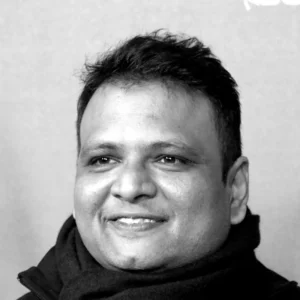
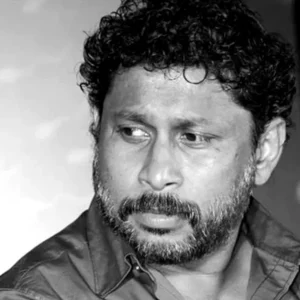
Vidhu Vinod Chopra
- Role
- Filmmaker
- Works in
- English, Hindi
- Born
- 5 September 1952
- On Art House Cinema
- No films yet
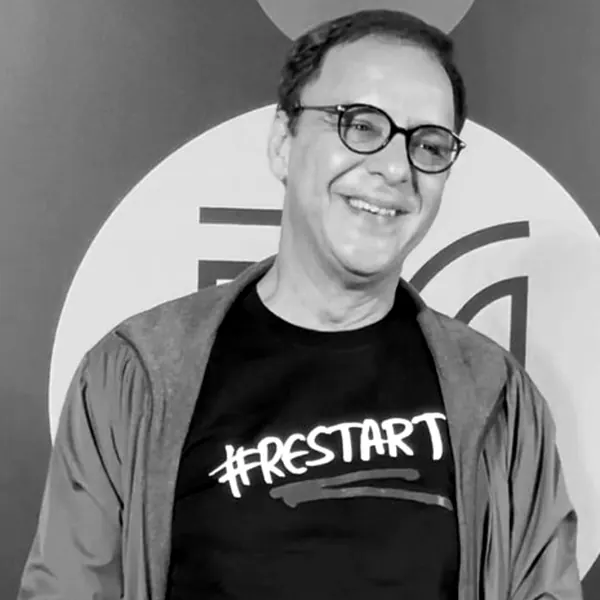
Vidhu Vinod Chopra was born in Srinagar on 5 September 1952. He has worked in Hindi cinema for close to fifty years as director, producer, writer and editor. His diploma film at the Film and Television Institute of India won a National Film Award. His second short was nominated for an Academy Award before he had shot a single feature. What followed has moved between two positions Indian criticism usually keeps apart. On one side sit small, hard thrillers made for a few lakh rupees. On the other sit mass-market comedies that have broken national box-office records.
The films he has directed are few for so long a career. Sazaye Maut (1981), Khamosh (1986), Parinda (1989), 1942: A Love Story (1994), Kareeb (1998), Mission Kashmir (2000), Eklavya: The Royal Guard (2007), Broken Horses (2015), Shikara (2020) and 12th Fail (2023) make up the list. Parinda is the one that altered the vocabulary of the Hindi crime film. It won two National Film Awards, for Nana Patekar’s supporting performance and Renu Saluja’s editing, and was India’s submission to the Academy Award for Best Foreign Language Film in 1990. It was not nominated.
As a producer Chopra has been busier than as a director, and far more consequential in commercial terms. Vinod Chopra Films, founded in 1985, backed the five features Rajkumar Hirani has made: Munna Bhai M.B.B.S. (2003), Lage Raho Munna Bhai (2006), 3 Idiots (2009), PK (2014) and Sanju (2018). Chopra co-wrote the first three. Each of those three won the National Film Award for Best Popular Film Providing Wholesome Entertainment, and Lage Raho Munna Bhai also took the National Film Award for Best Screenplay. He has five National Film Awards and ten Filmfare Awards.
Two subjects return. One is Kashmir, where he grew up and from which his mother was driven in 1990. The other is examination in the literal Indian sense: the boy who fails, the boy who sits the paper again. 12th Fail (2023), made for twenty crore rupees and taking more than sixty-nine crore worldwide, won Best Feature Film at the 71st National Film Awards. Chopra was seventy-one when it opened.
Life and Early Work
Chopra’s parents came from Peshawar in British India and settled in Kashmir, and he was brought up in a Punjabi Hindu household in Srinagar. His father was D. N. Chopra. The director Ramanand Sagar was his half-brother, though the two careers had almost nothing to do with each other. His elder brother, Vir K. Chopra, was a scholar of Indian politics and worked as a producer. His mother, Shanti Devi Mahalakshmi, stayed in the valley until 1990, when the violence that emptied Kashmir of most of its Hindu population forced her out. Thirty years later he dedicated Shikara to her.
He studied film direction at the Film and Television Institute of India in Pune. His diploma film, Murder at Monkey Hill (1976), was shot in black and white and won the National Film Award for Best Short Experimental Film together with the Guru Dutt Memorial Award for Best Student Film. He was still a student. The short that followed, An Encounter with Faces (1976), was a documentary about destitute children, and it was nominated for the Academy Award for Best Documentary Short Film at the ceremony held in 1979. It took the Grand Prix at the Tampere Film Festival in 1980.
Five years separated the Oscar nomination from his first feature. Sazaye Maut (1981) expanded Murder at Monkey Hill to full length, with Naseeruddin Shah, Radha Saluja and Dilip Dhawan, and a score by Vanraj Bhatia. It did no commercial business at all. Chopra had married the editor Renu Saluja in 1976; the marriage ended in 1983 and the working partnership did not, and she cut his films through the whole first half of his career. He founded Vinod Chopra Films in 1985.
Filmmaking
Khamosh (1986) cost around eight lakh rupees and is set on a film unit shooting in Pahalgam. Its conceit is that Shabana Azmi, Amol Palekar and Soni Razdan play versions of themselves, actors on location, and that one of them is found dead. Naseeruddin Shah arrives claiming to be an investigating officer and is not one. The writing credits include Ranjit Kapoor, Saeed Akhtar Mirza, Sudhir Mishra, Kundan Shah and Manjul Sinha, which reads like a register of the parallel cinema of the period. No distributor would buy it. Chopra put out a single print at the Regal Cinema in Mumbai.
That failure produced Parinda. Chopra has said in interviews that nobody would take Khamosh, so he set out to make a film with stars and a street in it. The story of two orphaned brothers on opposite sides of a Bombay gang war drew on a real pair of brothers who worked for the gangster Ashwin Naik. The working title was Kabutarkhana. Nana Patekar was cast after Chopra saw him in the Marathi play Purush, first as the elder brother and then, at Anil Kapoor’s suggestion, as the killer Anna.
Shooting ran to sixty-six working days on a budget of about twelve lakh rupees. Binod Pradhan, the cinematographer, hung tracing paper and white cloth in front of his lights to soften them and worked from the shadow-heavy example of Gordon Willis on The Godfather. He and Chopra looked at Rembrandt before settling the texture of the film. The water tank where Musa meets Kishan was a municipal site at Antop Hill, rented from the corporation for five hundred rupees. The climax at the Gateway of India was shot across three successive New Year’s Eves because there was no money to hire a crowd. The song Pyar Ke Mod Pe was filmed inside one sunset, in six or seven minutes.
The fire that ends the film nearly killed Nana Patekar. The crew built it out of rubber solution and petrol, lost control of it, and Patekar spent close to two months in hospital with burns. He returned to the film a year later. The set was rebuilt at Film City and the sequence shot again under conditions the unit could hold.
Parinda opened on 3 November 1989 and took around nine crore rupees. Chopra went to the Alankar cinema in Girgaon to watch the audience and found some of them unhappy that both brothers die. At the 37th National Film Awards the film won Best Supporting Actor for Patekar and Best Editing for Renu Saluja. At the 35th Filmfare Awards it was nominated in six categories and won five, including Best Director for Chopra and Best Actor for Jackie Shroff. Sanjay Leela Bhansali worked on it as associate director for the songs.
1942: A Love Story (1994) set Anil Kapoor and Manisha Koirala inside the last years of the Raj. R. D. Burman wrote its songs and died on 4 January 1994, six months before the film reached cinemas on 15 July. His Filmfare Award for Best Music Director was collected posthumously, one of nine the film won at that ceremony. A restoration in 8K with remastered sound was announced for theatrical re-release on 21 August 2026. Kareeb followed in 1998.
Mission Kashmir (2000) took him back to the valley. Sanjay Dutt plays a policeman who kills a boy’s family in a raid and then raises the boy; Hrithik Roshan plays the boy grown up and returned to kill him. It was the third highest-grossing Hindi film of the year. After it, Chopra directed rarely and produced constantly.
The partnership with Rajkumar Hirani began with Munna Bhai M.B.B.S. (2003) and ran through Lage Raho Munna Bhai (2006), 3 Idiots (2009), PK (2014) and Sanju (2018). Chopra co-wrote the first three. 3 Idiots and PK each became on release the highest-grossing Indian film at home and abroad, and both travelled unusually far into East Asian markets. He also wrote and produced Parineeta (2005), Ferrari Ki Sawaari (2012) and Wazir (2016).
His own films of those years did badly. Eklavya: The Royal Guard (2007), with Amitabh Bachchan as a palace guard losing his sight, lost money, and its selection as India’s official entry for the Academy Award for Best Foreign Language Film was contested. It beat Dharm by six votes to five, and the decision was challenged publicly. Broken Horses (2015) went worse. An English-language remake of Parinda shot in America with Vincent D’Onofrio, Anton Yelchin and Chris Marquette, it opened on 9 April 2015, holds a 22 per cent rating on Rotten Tomatoes and took about sixty lakh rupees in its Indian opening weekend.
Shikara (2020) is about the exodus of 1990, and it is the film in which Chopra’s own history sits closest to his material. It grossed a little over eight crore rupees, his weakest return since Khamosh. Some Kashmiri Pandits attacked it for softening what had been done to them. The commentator Anand Ranganathan dismissed it as a mediocre love story that passed over the killings. Chopra answered that Kashmiri Hindus at screenings had told him the film had their story right. The two accounts have never been reconciled.
12th Fail (2023) came from Anurag Pathak’s 2019 book about Manoj Kumar Sharma, who failed his Class 12 examinations in the Chambal and became an Indian Police Service officer. Vikrant Massey plays him, and Medha Shankr plays Shraddha Joshi, who married him. Chopra shot in Agra, the Chambal, Mussoorie and the coaching districts of Old Rajendra Nagar and Mukherjee Nagar in Delhi, and filled the classroom scenes with real civil service aspirants. Vikas Divyakirti, who runs a coaching institute, appears as himself. Shantanu Moitra’s score borrows from Ravi Shankar’s work on Pather Panchali, a debt both film-makers acknowledged. Chopra cut the film himself with Jaskunwar Kohli.
It opened on 27 October 2023 to a small first day and then grew for weeks. Made for twenty crore rupees, it took more than sixty-nine crore worldwide. Anuj Kumar in The Hindu called it another hug of hope, more earnest than magical. Shubhra Gupta in The Indian Express gave it three stars and wrote that the multitudes crowding into tiny rooms near the coaching centres, cramming day and night, made up an India story. At the 69th Filmfare Awards the film won five prizes, among them Best Film, Best Director and Best Editing. At the 71st National Film Awards it won Best Feature Film, and Massey shared Best Actor with Shah Rukh Khan for Jawan. In December 2024 Chopra released Zero Se Restart, a documentary about how it was made.
The Cinema of Vidhu Vinod Chopra
Chopra directs like a man who thinks in cuts. He was married to Renu Saluja, whose editing of Parinda won a National Award, and he cut 12th Fail himself. The habit shows in where his scenes stop. The reunion at Kabootar Khana in Parinda is over almost as soon as the pigeons lift off Prakash. The interview scene near the end of 12th Fail, in which Manoj tells the board he failed Class 12 because he could not cheat, holds for one beat and goes. What is absent from his work is the long held reaction shot that Hindi cinema of the 1980s used to sell feeling to the back rows.
Money, or the lack of it, has shaped his images more than any stated theory. The natural light of Parinda was not a manifesto but a way of shooting without a lighting budget, and Chopra has said so plainly. Three New Year’s Eves at the Gateway of India were a poverty solution that produced an exact effect: a wedding night surrounded by a crowd that belongs to nobody in the story. Khamosh cost eight lakh rupees and answered the figure by locking itself inside one hotel and one film unit. The constraint did the composing.
There is a break in the career around 1989 that he has never bothered to disguise. Khamosh was unsellable, and after it he went deliberately after stars. What he carried across is the interesting part. Parinda has R. D. Burman songs, four leads at the top of their market value and a plot about brothers and revenge, and it also has a corpse fed into a wood machine and an ending in which everyone worth caring about is dead. He treated the mainstream as a container he could work inside.
Kashmir runs beneath the whole body of work and is the place his judgement is least steady. Khamosh uses Pahalgam as somewhere for a film unit to be stranded, which is honest about how little the plot needs it. Mission Kashmir converts an insurgency into a father-and-son revenge structure with songs. Shikara goes at the exodus directly and then softens its own subject. He is from there, and it has not made the films better.
Key Themes
The orphan and the substitute family. Kishan and Karan in Parinda were raised on the street by nobody, and the elder brother works for a gangster to pay for the younger one’s education in America. Altaaf in Mission Kashmir is brought up by the police officer who killed his parents. Manoj in 12th Fail leaves his family in the Chambal and is taken in by Gauri Bhaiya, a failed aspirant who feeds him and gives him a place to read. The person who provides is almost never the person who gave birth.
Failure before anything else. Chopra’s most successful film is named after an examination its hero did not pass. 3 Idiots, which he co-wrote, turns on a student who kills himself under academic pressure. Gauri Bhaiya, having used up his last attempt at the civil service, opens a tea shop and calls it Restart. The films are interested less in the moment of arrival than in the years of not arriving.
Light and shadow carrying the argument. Pradhan’s diffusion cloth on Parinda produced faces half lost in the dark, and the film’s Bombay is a set of pools of light with black between them. Ranjani Mazumdar, in Bombay Cinema: An Archive of the City, writes that the Gateway of India, the fountain beside it and the Babulnath temple are turned into nodes of violence and death. The city of dreams is photographed as a city of hiding places.
The institution as antagonist. Medical college in Munna Bhai M.B.B.S., engineering college in 3 Idiots. In 12th Fail it is the coaching industry of Mukherjee Nagar. The examination hall recurs in his work the way the courtroom recurs in other film-makers. The enemy in them is the sorting machine.
Kashmir that will not resolve. Four of his films are set there or reach for it, and none of them settles. The valley is a backdrop in Khamosh and a plot engine in Mission Kashmir. Shikara was the attempt to pay the debt directly. His mother’s departure in 1990 sits behind all of it.
Selected Filmography
An Encounter with Faces (1976)
A short documentary on destitute children, nominated for the Academy Award for Best Documentary Short Film at the 1979 ceremony and winner of the Grand Prix at Tampere in 1980. Made before Chopra had directed a feature.
Sazaye Maut (1981)
His first feature, a full-length version of his FTII diploma film, with Naseeruddin Shah and a score by Vanraj Bhatia. It found no audience and is now mostly a footnote to Khamosh.
Khamosh (1986)
A thriller about a film unit in Pahalgam, in which Shabana Azmi, Amol Palekar and Soni Razdan play versions of themselves. It went out on one print at the Regal Cinema in Mumbai after every distributor refused it.
Parinda (1989)
Two orphaned brothers on opposite sides of a Bombay gang war, with Jackie Shroff, Anil Kapoor, Nana Patekar and Madhuri Dixit. Two National Film Awards, five Filmfare Awards, India’s Oscar submission for 1990. The film that changed how the Hindi underworld looked on screen.
1942: A Love Story (1994)
A romance set in the last years of British rule, with Anil Kapoor and Manisha Koirala, carrying the final songs R. D. Burman wrote. Nine Filmfare Awards, including a posthumous one for Burman.
Mission Kashmir (2000)
Sanjay Dutt as the policeman, Hrithik Roshan as the orphan he raises and who returns to kill him. The third highest-grossing Hindi film of its year and the closest Chopra came to a commercial statement on the insurgency.
Eklavya: The Royal Guard (2007)
Amitabh Bachchan as a Rajput bodyguard whose eyesight is going. India’s official Academy Award entry that year, chosen over Dharm by six votes to five, and a financial failure at home.
Broken Horses (2015)
An English-language remake of Parinda shot in the United States with Vincent D’Onofrio and Anton Yelchin. It failed with reviewers and at the box office in both countries.
Shikara (2020)
A love story built around the flight of the Kashmiri Pandits in 1990, dedicated to his mother. His lowest-grossing release since Khamosh, and the most argued-over film of his career.
12th Fail (2023)
Vikrant Massey as Manoj Kumar Sharma, from a cheating scandal in a Chambal school to the Indian Police Service. Best Feature Film at the 71st National Film Awards and five Filmfare Awards, on a budget of twenty crore rupees.
Legacy
Parinda is the piece of work that other film-makers keep returning to. Anurag Kashyap has named it, with Shiva (1990), as one of the two Indian films whose violence reached him, and has spoken about the body in the wood machine and the fire at the end. Dibakar Banerjee has called it a game-changer for him. Nikkhil Advani credits it with making him want to direct. The cinematographer Sudeep Chatterjee has said that the image had lost its importance in Hindi films of the 1970s and 1980s and that Parinda started a new trend. Ashish Rajadhyaksha and Paul Willemen, in the Encyclopaedia of Indian Cinema, describe it as a postmodern variation on the crime genre.
The production house has had a wider reach than the direction. Rajkumar Hirani has made every one of his features under Chopra, and the run from Munna Bhai M.B.B.S. to Sanju changed what a socially minded Hindi comedy could earn. 3 Idiots did more to put the Indian examination system into public argument than any policy paper of its decade, and it was Chopra who co-wrote it and paid for it. A producer who spends fifteen years protecting one director’s voice is doing something unusual in Bombay.
He has also worked at keeping the material record. In April 2017 he deposited supplementary matter from six of his films with the preservation vaults of the National Film Archive of India: lobby cards, posters, song booklets, contact sheets, promotional catalogues and working stills from Khamosh, Parinda, 1942: A Love Story, Mission Kashmir and Eklavya. Several of his films were re-released theatrically in a 2012 retrospective. In 2021 he published Unscripted: Conversations on Life and Cinema.
The record is uneven and he has never pretended otherwise. Between 2000 and 2023 he directed four features, of which three lost money and one, Broken Horses, was an embarrassment in two countries at once. His Kashmir films are the weakest part of the body of work, and Shikara left the community it was made for divided about whether it had helped them. What survives is narrower and harder than the awards list suggests: a thriller nobody would distribute, a gangster film shot for twelve lakh rupees that taught Hindi cinema how to photograph a city at night, and a late film about a boy from the Chambal who kept sitting the paper. He was seventy-one when the last of those opened, and it won Best Feature Film.