
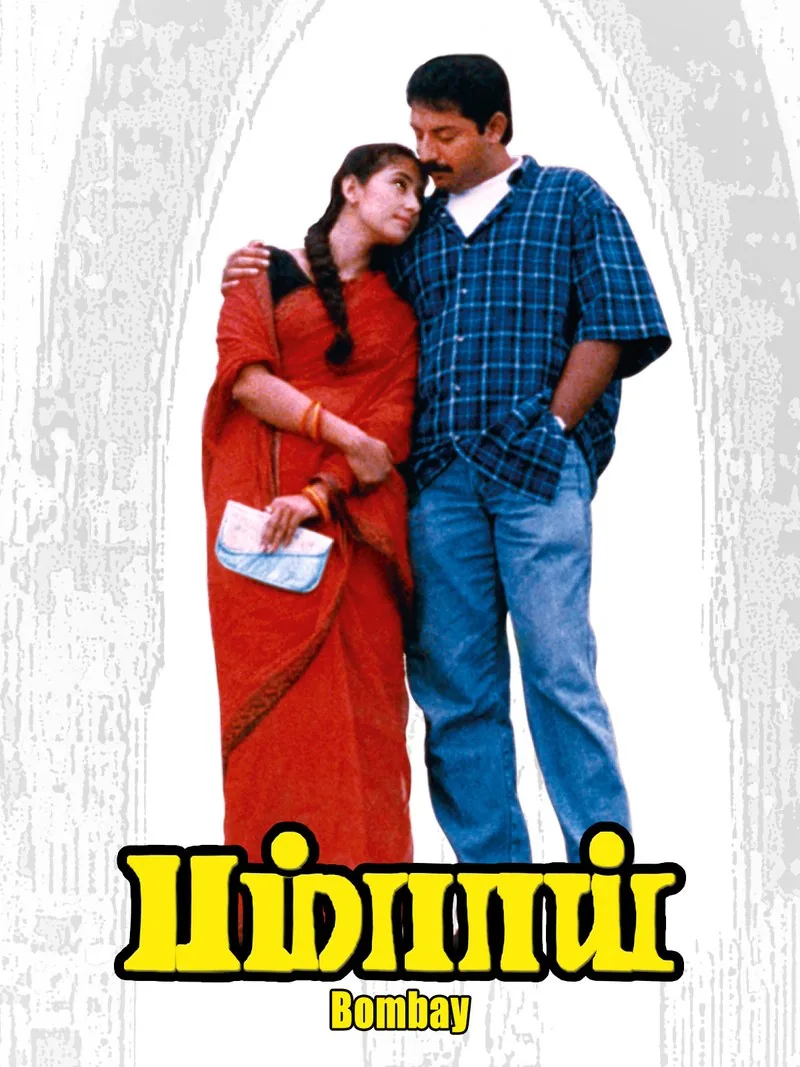
BOMBAY
- Director
- Mani Ratnam
- Country
- India
- Language
- Tamil (dubbed in Hindi and Telugu)
- Year · Runtime
- 1995 · 130 min
- Starring
- Arvind Swamy, Manisha Koirala, Nassar, Kitty
Introduction
About nine hundred people were killed in Bombay between December 1992 and January 1993, most of them Muslims. Mani Ratnam was at work on Thiruda Thiruda when the violence began. He told Baradwaj Rangan years later that he had thought of Bombay as the most metropolitan, cosmopolitan city in the country, and that if this could happen there it could happen anywhere. The film he made out of that shock opened on 10 March 1995, the day after the last round of polling in a Maharashtra election that brought a Shiv Sena and Bharatiya Janata Party alliance to power for the first time. Bombay is a love story. Shekhar Pillai, a Hindu journalism student from Mangudi, a village near Tirunelveli, marries Shaila Banu, a Muslim schoolgirl from the same village, against the refusal of both their fathers. The couple settle in the city and raise twin sons across both faiths.
The choice of form is the argument. Ratnam passes over the thriller and the courtroom drama and puts an ordinary household inside a dated, documented atrocity. The audience is asked to grieve rather than to allocate blame. Everything rests on the marriage. If a Hindu and a Muslim can share one home in Bombay and raise children who carry both grandfathers' names, then the killing in the street outside has no necessity behind it. By the second half the question has narrowed to something harder to answer. Private affection may well survive organised hatred, but it is far from obvious that its survival proves anything about a country.
The cost of asking was immediate. By Ratnam's account the film was not cleared until the Maharashtra elections were over. Bal Thackeray and senior police officers saw it before the public did, about a minute and a half was cut, and in July 1995 two crude bombs were thrown at Ratnam as he sat on the patio of his house in Chennai. Singapore and Malaysia banned the film. Its Hindi version was one of the ten highest-grossing Hindi releases of the year.
Cast
- Arvind Swamy Shekhar Narayanan Pillai
- Manisha Koirala Shaila Banu (voice: Rohini)
- Nassar Narayanan Pillai
- Kitty Basheer Ahmed
- Tinnu Anand Head of the Shakti Samaj
- Akash Khurana Muslim leader
- Master Harsha Kabir Narayan
- Master Hriday Kamal Basheer
- Prakash Raj Kumar
- Rallapalli Transgender woman
- Sonali Bendre Song "Humma Humma"
Crew
- Direction and screenplay Mani Ratnam
- Production S. Sriram, Jhamu Sughand, Mani Ratnam (Aalayam Productions)
- Cinematography Rajiv Menon
- Editing Suresh Urs
- Music A. R. Rahman
- Lyrics (Tamil) Vairamuthu, Vaali
- Art direction Thotta Tharani
- Choreography Prabhu Deva, Raju Sundaram
Background and production
The project began in Malayalam. Ratnam wanted a film about a boy who gets lost in a riot and asked M. T. Vasudevan Nair to write it. It would have been his second Malayalam film after Unaroo (1985). The script never materialised, and the idea moved into Tamil, growing outward from the lost child into the marriage that produced him. Ratnam has always resisted the label of political cinema. "Roja, Bombay and Dil Se weren't planned as political films," he told Lavina Melwani of The Hindu in 2015. "It was a phase India was going through and these things affected me and found their way into my work." In January 1995, still in the editing rooms, he told Saritha Rai of India Today that it was a positive film about communal harmony, and that his subject was a helpless, innocent man caught up in violence not of his own making.
Casting went through several reversals. Aishwarya Rai was considered for Shaila, but the dates collided with the Miss World pageant, which she went on to win. Ratnam held a photo session with Vikram opposite Manisha Koirala and then dropped him, because Vikram would not shave the beard and long hair he had grown for Pudhiya Mannargal (1994). Arvind Swamy, Ratnam's lead in Roja (1992), took the part. Koirala accepted Shaila against advice that playing a mother would damage her career, and her Tamil lines were dubbed by the actress Rohini. The two fathers were cast against their own lives. Nassar, a Muslim, plays the orthodox Hindu Narayanan Pillai, and Kitty, a Hindu, plays the devout Muslim Basheer Ahmed. Ratnam told Rangan the inversion was deliberate. He saw more than seventy pairs of twins before choosing Harsha and Hriday for Kabir and Kamal, and the film remains Harsha's only release.
Rajiv Menon, until then known for advertising work, was given a brief rather than a script. Ratnam told him the film was about the riots, and that what came before them had to be as beautiful as possible. Menon's answer was to shoot in the rain. Interiors were filmed in Pollachi in Tamil Nadu and village exteriors in Kasaragod and Kannur in Kerala. Some outdoor scenes were shot in Bombay itself, including a sequence at the Gateway of India, and the rest on sets in Chennai. "Kannalane" was filmed inside the Thirumalai Nayakkar Mahal at Madurai and "Uyire" at Bekal Fort. A. R. Rahman scored the film, his third for the director after Roja and Thiruda Thiruda, with Tamil lyrics by Vairamuthu apart from "Humma Humma" and "Halla Gulla", which went to Vaali. Suresh Urs, who had come to Ratnam from the television series Malgudi Days by way of Thalapathi (1991), edited.
The certification fight decided what the finished film looks like. On 8 January 1995 the Indian Express reported that five senior police officers had been deputed by the home ministry to help the Censor Board's revising committee, under its chairman Shakti Samanta, decide whether the film could be shown at all. A line given to Tinnu Anand's leader, "Shastra uthao, chudiyan mat pehno" (take up arms, do not wear bangles), had already drawn objections. Ratnam had built a miniature of the mosque's dome and staged the demolition from inside it: a dark interior, debris falling through, light coming in behind. He called it the saddest moment in the film. It was replaced with a montage of newspaper cuttings, which he later described to Rangan as a harsher reminder, "a factual statement" where his own version had been "a wail." About a minute and a half went in cuts. One of them, he said, was a policeman shooting and killing someone, "which happened a lot in real life."
Two more cuts came from outside the Board. Thackeray and top police officials were shown the film before release, an arrangement that Akash Sarraf, writing for ASAP in 2024, calls a direct violation of the Cinematograph Act of 1952. Sarraf quotes Rustom Bharucha's In the Name of the Secular (1998), which called it "one of the most insidious affirmations of how violence can be legitimised by its own political agency." After Thackeray objected, Ratnam removed a speech in which Tinnu Anand's leader hands out bangles to his followers after the murder of two Mathadi workers and talks of saving the city for Maharashtrian Hindus, in words taken from a real Thackeray speech. He also removed a later scene of the same man repenting. Both cuts moved the release print further towards laying the violence at Muslim doors. That is a fact about the print, and it complicates every later charge of bias against Ratnam himself.
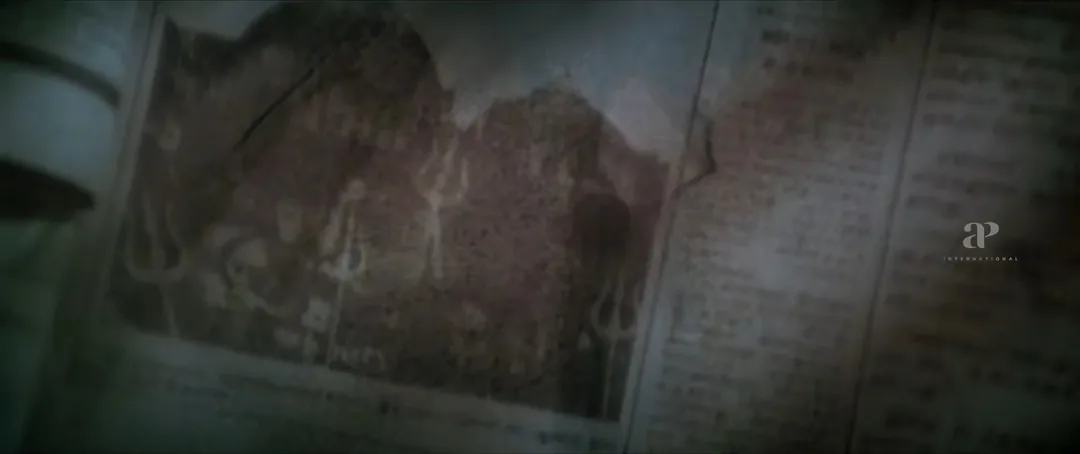
A frame from the newspaper montage, Bombay (1995)
Story
Shekhar Pillai, a journalism student working in Bombay, comes home to Mangudi. At the boat jetty the wind lifts the veil from Shaila Banu's face, and he is decided in that second. She holds back, then relents. Shekhar asks her father Basheer for her hand and is refused on grounds of religion. His own father, Narayanan, reacts with the same fury, and the two men end up abusing each other in front of the village. Shekhar returns to the city and posts Shaila a train ticket. Basheer finds the letters and arranges a marriage for her at once. She takes the ticket and goes.
They marry in a civil ceremony and make a decent life. Shekhar works for a newspaper, Shaila keeps the house, and twin boys arrive: Kabir Narayan and Kamal Basheer, named for both grandfathers and raised with both faiths. Six years pass. On 6 December 1992 the Babri Masjid is pulled down in Ayodhya and Bombay burns. The twins are caught in the street and nearly burnt alive before their parents get them home. Narayanan travels from the village to make peace and moves in. Basheer and his wife follow, and for a short while the two old men compete over the grandchildren. On 5 January 1993 a second and deadlier round begins. A mob fires the building. Narayanan, Basheer and Basheer's wife die inside it, and the twins are lost in the crowd.
Kamal is taken in and hidden by a transgender woman. Kabir wanders the streets alone. Shekhar and Shaila search the hospitals and then the morgues, and Shekhar uses his position as a journalist to bring religious leaders and ordinary citizens into public appeals for the killing to stop. The riots subside. The parents find both boys alive. Strangers from both communities join hands across the street in a human chain, and the film ends on that image.
The household is the film's working model of the country. Shaila tries on a bindi, Shekhar puts on a skullcap for fun, and the boys carry a grandfather from each side in their names. This is what Bombay sets against the mob. When the second fire comes it is Narayanan, the orthodox Hindu, who saves a copy of the Quran from it. The film is at its sharpest when it shows hatred being manufactured. A rumour circulates, a leader speaks, two murders are reported in a particular way, and the second wave starts. Nothing ancient is at work in these scenes. Somebody makes the violence happen, on camera.
The trouble is the symmetry. The film issues each community a fanatic and each fanatic a moment of remorse, and it keeps the demolition itself at arm's length behind newsprint. Sarraf tracked how the framing loads the difference between the two sides. Basheer draws a machete twice in a scene where Narayanan offers only verbal threats, and in the first riot sequence Muslim men abandon prayer with swords in hand while Hindu men appear briefly and mostly away from the violence. Nandini Ramnath, in Scroll in December 2020, pointed out that the complicity of the Shiv Sena and the city police is ignored, and that the film builds a false equivalence between a Muslim fundamentalist and the head of a party modelled on the Sena. Both charges hold against the film as released. Both also describe a film that had already been cut.
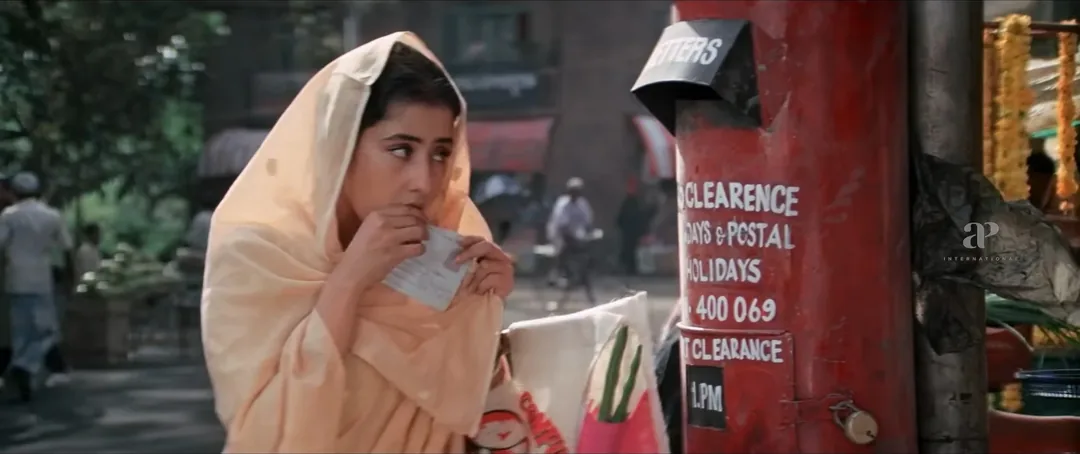
Manisha Koirala as Shaila Banu in Bombay, Bombay (1995)
Direction and craftsmanship
Menon photographs the first half for maximum loss. The courtship happens in rain, in saturated greens and blues: Shekhar beside a black umbrella in a downpour, a river in spate behind a boat full of veiled women, village lanes so wet that the monsoon seems to have got inside the houses. When the fire comes the palette goes to smoke, and then to the bare rooms of hospitals and morgues. The beauty of the earlier reels turns into an inventory of what has been destroyed. That was the brief from the start.
Suresh Urs cuts the two halves on different clocks. The romance holds its shots and lets scenes finish. The riots arrive as short fragments of fire and separation, at a speed the first hour never approaches, and the change is abrupt enough to feel like an assault on the film's own manner. James Berardinelli, who saw it at the Philadelphia Festival of World Cinema in 1996, wrote of cameras moving relentlessly through mobs of men hacking at each other with machetes. The technique is very good, and that is the difficulty. Violence choreographed this well invites the eye, and the film never quite settles what it wants an audience to feel while it watches.
Rahman's score does structural work. The songs bind the audience to Shekhar and Shaila in the first hour so that the second hour costs something. "Kannalane" is staged among the columns and arches of a seventeenth-century palace, all symmetry and stone, for a woman who is about to lose her family and her city. The "Bombay Theme" grew out of a musical storyboard that Rahman and Ratnam worked out together and handed to the flautist Naveen. It carries the film's grief without a word of text. The music makes the film's case seductive rather than arguable.
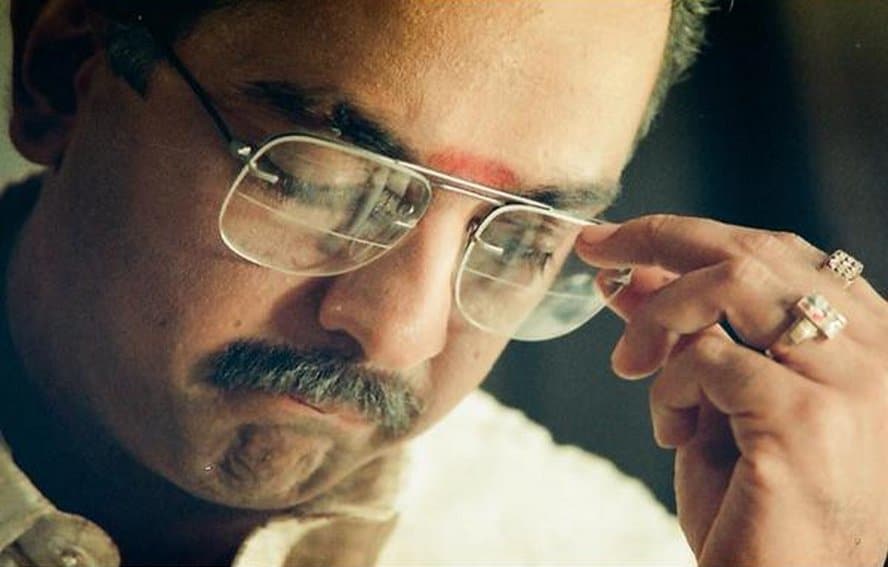
Arvind Swamy plays Shekhar as decent and faintly stiff, which suits a character built to be the film's conscience and given little to do but be right. Manisha Koirala carries the second half. Her Shaila begins as a girl who will not meet a stranger's eye and ends searching the morgues for her sons, and the change registers without any single scene announcing it. Rohini's voice does more of that work than the credits suggest. Nassar and Kitty, playing across their own religions, get the film's best comic passage as the reconciled grandfathers squabbling over how the boys should be raised. It makes their deaths in the fire land harder than the structure alone would manage.

Arvind Swamy as Shekhar in the monsoon, Bombay (1995)
The cinema of Mani Ratnam
Bombay is the middle film of three. Roja set a Tamil wife against militancy in Kashmir, and Dil Se.. (1998), Ratnam's first Hindi film, sent an All India Radio reporter after a woman from an Assamese suicide squad. In each a national conflict reaches the audience through one couple. That is Ratnam's method, and it is also his boundary. The largest political questions arrive scaled down to the size of a household, and what will not fit inside a household tends not to arrive at all.
By 1995 he had already made Nayakan (1987), loosely drawn from the life of a Bombay gangster, Anjali (1990) and Thalapathi, a reworking of the Mahabharata. Few directors of his generation had brought the ambitious Tamil film and the profitable one so close together. Bombay is the fullest test of that position. The gloss and the appetite for catharsis that serve a gangster picture are harder to justify across nine hundred dead, and the film goes wrong at the very points where its maker is most fluent. Iruvar (1997) would return to politics with a colder eye and far less consolation on offer, and it is the better film for it. Bombay is the one where the method is stretched until the seams show.
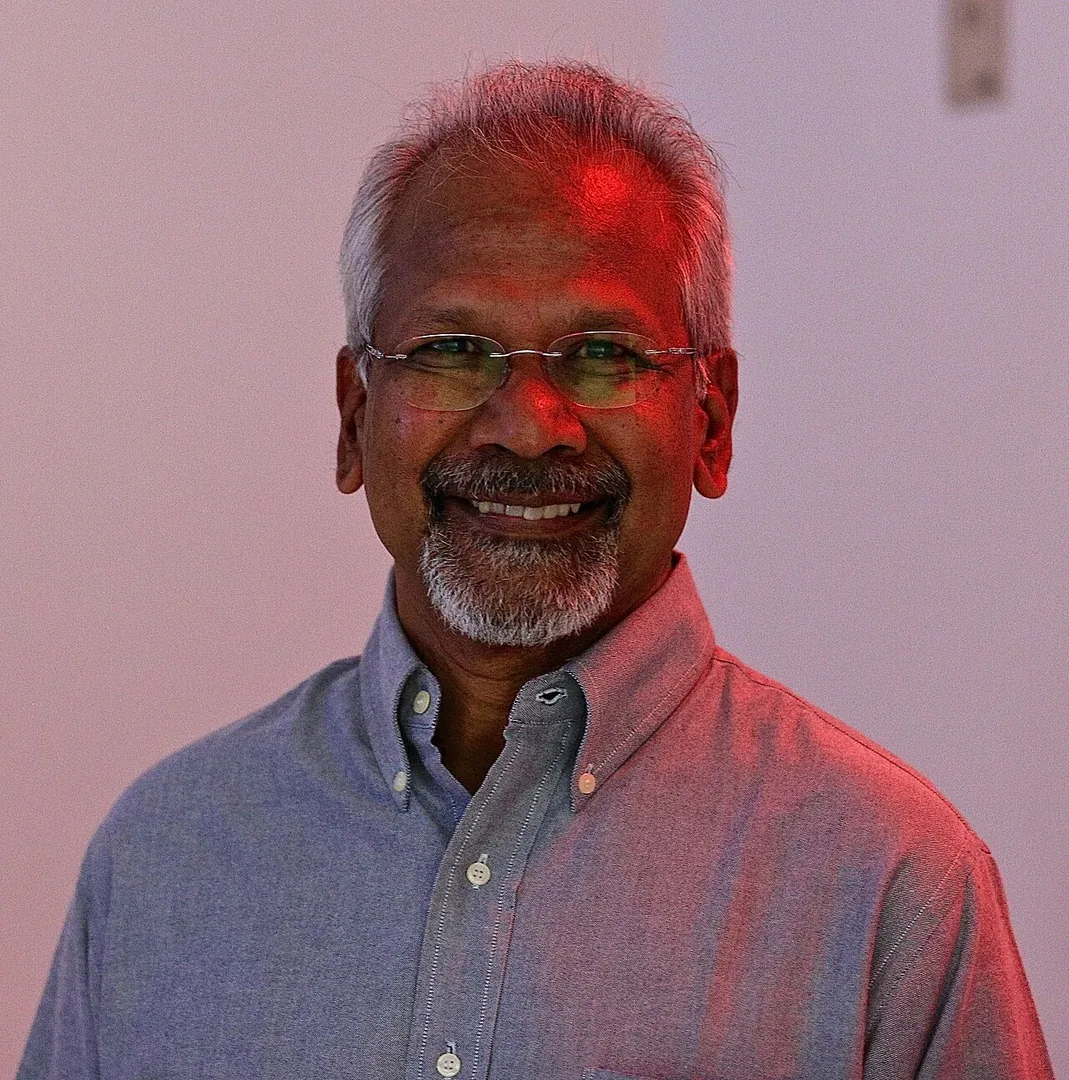
Mani Ratnam at the Museum of the Moving Image, New York, August 2015
Reception and legacy
Reviews divided along the line the film had drawn for itself. Ananda Vikatan rated it 53 out of 100 on 19 March 1995. R. P. R., writing in Kalki a week later, held that the film raised a thousand questions about social morality and had given every Indian a reason to be proud. India Today reported in April 1995 both the critical acclaim and the howls of protest, and later that month that Muslim leaders in Bombay had been incensed by it. Berardinelli gave it three and a half stars out of four in 1996. He called it the fourteenth feature from a celebrated director, credited Ratnam with great courage, since bombs had been thrown at his house after it opened, and concluded that it "recalls how forceful a motion picture can be." The Hindi version took around 140 million rupees, according to Box Office India.
The bombs came in July 1995. According to an Associated Press report of 10 July, the attackers allegedly belonged to a Muslim fundamentalist group, and Ratnam was hurt in the leg and briefly kept in hospital. The threats outlasted the year. In January 2003 Mumbai police reported that he was being threatened by a Middle East-based underworld figure because of the film. The bans and the bomb, taken together, are easy to read as proof of the film's even-handedness. Being attacked from two directions is a different thing from being fair to both.
The soundtrack outlived the argument. It sold around fifteen million units, one of the largest figures for an Indian album. The Guardian included the record in its 1000 Albums to Hear Before You Die and "Kannalane", sung by K. S. Chithra, in its 1000 Songs Everyone Must Hear. BBC Music named it among twenty greatest soundtracks in 2014. Rahman reused the "Bombay Theme" in Deepa Mehta's Fire (1996), and it turned up again in Elia Suleiman's Divine Intervention (2002) and Andrew Niccol's Lord of War (2005).
Serious study followed. Lalitha Gopalan published a monograph on the film in the BFI Modern Classics series in July 2005, and the British Film Institute has placed it among the top twenty Indian films in its rankings. Later writing has been harder on it than the reviews of 1995 were. Bharucha's account of the Thackeray screening and Sarraf's scene-by-scene reading of its stereotypes treat the film as a record of institutional pressure as much as a work of authorship. Ramnath's verdict cuts both ways. She finds its handling of the politics simplistic, and she notes that it remains among the few mainstream productions to dramatise the riots at all.
Ratnam had the craft to end harder and did not.
Awards & honours
- Won Nargis Dutt Award for Best Feature Film on National Integration, 43rd National Film Awards, 1996
- Won Best Editing, 43rd National Film Awards, 1996: Suresh Urs
- Won Critics Award for Best Film, 41st Filmfare Awards, 1996
- Won Critics Award for Best Actress, 41st Filmfare Awards, 1996: Manisha Koirala
- Won Best Film (Tamil), 43rd Filmfare Awards South, 1996
- Won Best Director (Tamil), 43rd Filmfare Awards South, 1996: Mani Ratnam
- Won Best Actress (Tamil), 43rd Filmfare Awards South, 1996: Manisha Koirala
- Won Best Music Director (Tamil), 43rd Filmfare Awards South, 1996: A. R. Rahman
- Won Gala Award, Edinburgh International Film Festival, 1996
- Won Honourable mention, Spirit of Freedom Award, Jerusalem Film Festival, 1996
- Entry Philadelphia Festival of World Cinema, 1996
Reference
- Bombay (film), Wikipedia
- A war for love: Mani Ratnam's 'Bombay' explored an inter-faith marriage battered by bigotry, Nandini Ramnath, Scroll, 1 December 2020
- Mani Ratnam's Bombay: The Politics of Censorship and Stereotyping, Akash Sarraf, ASAP, 15 June 2024
- Mani Ratnam's Bombay views communalism through eyes of common man, Saritha Rai, India Today, 15 January 1995
- Police officials turn censors for Mani Ratnam's Bombay, Seema Sinha, The Indian Express, 8 January 1995 (CSCS archive)
- Mani Ratnam's film Bombay invites critical acclaim and howls of protest, Vijay Jung Thapa and Sudha G. Tilak, India Today, 15 April 1995
- Up close and personal with Mani Ratnam, Lavina Melwani, The Hindu, 26 September 2015
- Tuesday Trivia, Bombay: Communal riots post Babri Masjid demolition to Vikram opting out, Logesh Balachandran, India Today, 4 August 2020
- Bombay, James Berardinelli, ReelViews, 1996
- Bombay, Brian Cady, Turner Classic Movies, 20 May 2003
- Bombay (soundtrack), Wikipedia
- Bombay riots, Wikipedia
- Jerusalem Film Festival 1996, Jerusalem Film Festival
Bombay: scenes from the film on YouTube
Image credits: Banner: Aalayam Productions (producer); frame from AP International's official upload on YouTube, All rights reserved; used for criticism and review, via source. Image: Santosh Kumar T K, CC BY-SA 2.0, via Wikimedia Commons. Image: Aalayam Productions, release poster; via IMDb, All rights reserved; used for criticism and review, via source. Image: Aalayam Productions (producer); frame from AP International's official upload on YouTube, All rights reserved; used for criticism and review, via source. Image: Aalayam Productions (producer); frame from AP International's official upload on YouTube, All rights reserved; used for criticism and review, via source. Image: Aalayam Productions (producer); frame from AP International's official upload on YouTube, All rights reserved; used for criticism and review, via source.






Commentary
Bombay is a good film that cannot be defended on the terms it offers. Those terms are that hatred is symmetrical, that extremists exist in equal measure on either side, and that decent people in the middle can stop a riot by joining hands. None of it describes what happened in Bombay in December 1992 and January 1993. The Srikrishna Commission documented the police's complicity in targeting Muslims and held the Shiv Sena largely responsible for the second phase of the killing. A film that puts a Hindu journalist at the head of the peace movement and keeps the Sena out of the fire is tilted. It was then tilted further by men who saw it before the public did.
The case for the film rests elsewhere. In 1995 almost nobody in mainstream Indian cinema would touch this subject, and Ratnam went at it with the largest resources available to him and paid for it with a wounded leg. When the censor board's chairman asked him how he could show a Hindu and a Muslim marrying, Ratnam answered that it happened every other day, and that many of his classmates had married that way. He put a Muslim woman on screen as a wife and a mother rather than as a symbol or a corpse. He cast a Muslim actor as a Hindu patriarch to show how little the labels hold when a competent performer wears the other one. He gave two children two names and refused to make either boy choose. These are small gestures set against a large history. In that year they were more than the industry had otherwise managed.
The ending is where the film is least persuasive. Three grandparents have burned to death and a city has killed nine hundred of its own, and the resolution arrives in one sequence of strangers holding hands. Ratnam had the craft to end harder and did not. The choice is defensible as an act of hope in 1995 and indefensible as an account of what a riot does to the people who live through it. The film would be stronger and more honest if it stopped at the morgue and left the parents there. That it does not stop is worth holding against it, and worth understanding as the price of getting the rest of it past a censor board in an election season.
What survives is the friction. Bombay is beautiful about ugliness and popular about a subject that resists popularity, and it argues for a reconciliation it cannot demonstrate. Ratnam did not resolve any of that, and the strain shows in every print. Three decades on, the film is worth returning to for the reason it was attacked at the time. It took a subject the country wanted closed and refused to close it. Then it flinched in the final reel, and the flinch is itself a piece of evidence about the year it was made.