
Gulzar
Gulzar, born Sampooran Singh Kalra, is among the most distinguished figures in the history of Indian cinema and modern Urdu and Hindi literature, a writer whose career across more than six decades has fused the discipline of the poet with the craft of the filmmaker. Equally celebrated as a lyricist, screenwriter, dialogue writer, film director, and author of verse and fiction, he has shaped the literary texture of popular Hindi cinema while simultaneously directing a body of films distinguished by their restraint, psychological subtlety, and humane attention to the inner lives of ordinary people. His name has become synonymous with a particular sensibility in Indian art: one that locates the extraordinary within the everyday and that treats language as both an instrument of meaning and a source of music.
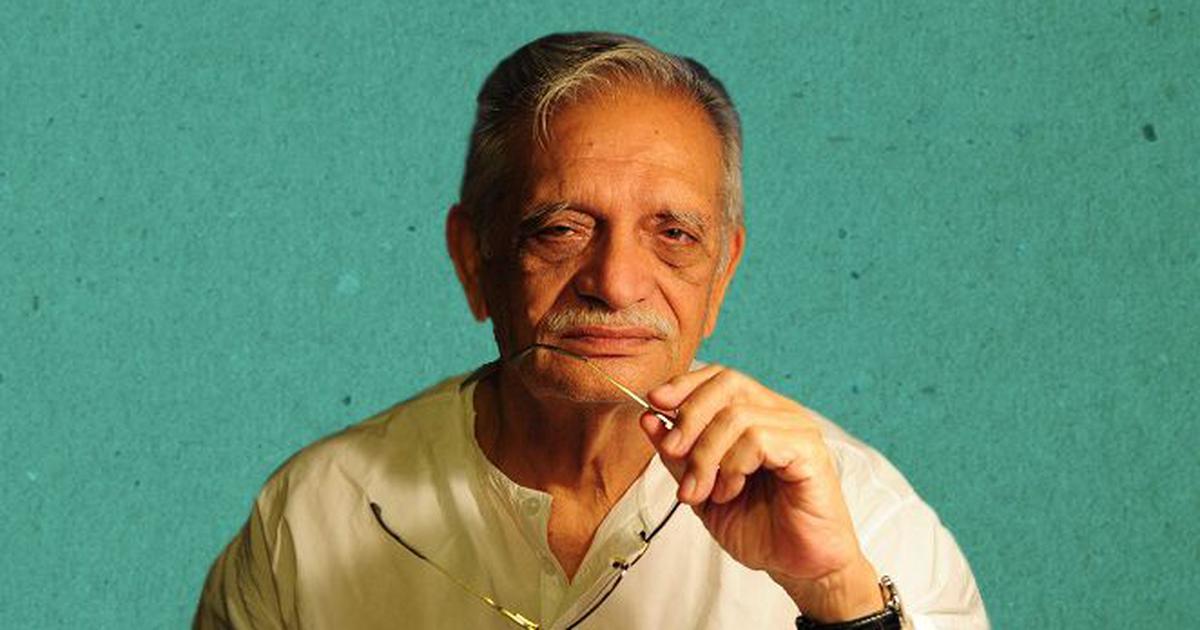
Working chiefly in Hindi and Urdu, with deep roots in the Punjabi and broader north Indian cultural milieu, Gulzar emerged from the orbit of the great Bengali and Hindi filmmakers of the post-Independence era and forged an independent voice that bridged the worlds of mainstream entertainment and the parallel cinema movement. As a director he is associated with such films as Mere Apne, Koshish, Aandhi, Mausam, Khushboo, Ijaazat, Angoor, Lekin, and Maachis, works that combined commercial viability with a seriousness of theme rarely attempted within the popular industry. As a lyricist he transformed the idiom of the Hindi film song, introducing imagery of remarkable originality and an intimacy of address that has influenced generations of writers who followed him.
The breadth of recognition accorded to Gulzar is virtually unmatched among Indian artists. He has received the Padma Bhushan, one of the nation’s highest civilian honours; the Dadasaheb Phalke Award, the highest distinction conferred by the Government of India in the field of cinema; the Sahitya Akademi Award and, in 2024, the Jnanpith Award, India’s most prestigious literary honour; numerous National Film Awards across the categories of screenplay, lyrics, and direction; and a large number of Filmfare Awards. His international standing was confirmed when, together with the composer A. R. Rahman, he won the Academy Award for Best Original Song and a Grammy Award for “Jai Ho” from the film Slumdog Millionaire.
Beyond the catalogue of honours, Gulzar occupies a singular cultural position. He is a writer who has carried the literary inheritance of Mirza Ghalib and Rabindranath Tagore into the popular imagination, a filmmaker who insisted that commercial cinema could accommodate ambiguity and silence, and a public intellectual whose work continues to engage questions of memory, displacement, gender, and the wounds of history. His career constitutes one of the most sustained attempts in Indian cinema to reconcile poetry with the moving image.
Life and Early Work
Sampooran Singh Kalra was born on 18 August 1934 in Dina, a town in the Jhelum district of Punjab, in what is now Pakistan, into a Sikh family. His mother died when he was an infant, and the early experience of loss and the absence of maternal presence would echo through much of his later writing. The defining rupture of his childhood, however, was the Partition of the Indian subcontinent in 1947, which uprooted his family and compelled their migration across the new border. The trauma of displacement, the severing of a person from the landscape of belonging, and the persistence of memory across enforced separation became enduring preoccupations of his art, returning explicitly in works such as the television serial on the upheaval of Partition and the film Maachis.
After the family’s migration the young Sampooran Singh spent formative years in Delhi before moving to Bombay, the centre of the Hindi film industry. In Bombay he supported himself through manual labour, working for a time in a garage in the Worli district where he developed a skill for mixing paints to match the faded colours of motor cars. This period of economic struggle coincided with an intense literary apprenticeship. He read widely, drawing in particular on the poetry of Rabindranath Tagore, whose lyric sensibility left a lasting imprint, and he became associated with the Progressive Writers’ Movement and its circle of Urdu poets and intellectuals. It was in these years that he adopted the pen name “Gulzar,” under which he would publish poetry and write for the screen.
Gulzar’s entry into cinema came through the patronage of established figures of the industry. The lyricist Shailendra introduced him to the celebrated director Bimal Roy, and his first film song, “Mora Gora Ang Lai Le,” was written for Roy’s Bandini in 1963. Working under the guidance of Bimal Roy, and alongside collaborators such as the writer-director Hrishikesh Mukherjee and the music director Sachin Dev Burman, Gulzar received a rigorous education in the disciplines of narrative construction and screen writing. Before directing his own films he established himself as a screenwriter and dialogue writer of distinction, contributing to films including Aashirwad, Khamoshi, Anand, Guddi, and Namak Haraam, several of them landmarks of the socially engaged popular cinema of the late 1960s and early 1970s.
This grounding in literature and in the collaborative crafts of cinema shaped the artist who would soon move behind the camera. Gulzar never abandoned his identity as a poet; rather, he carried the poet’s attentiveness to image, rhythm, and the unspoken into every role he undertook in film. His apprenticeship under the masters of an earlier generation connected his work to the humane, literary tradition of Indian cinema even as he prepared to extend it in new directions.
Filmmaking
Gulzar made his debut as a director in 1971 with Mere Apne, an adaptation of Tapan Sinha’s Bengali film Apanjan. The film cast Meena Kumari as an elderly widow who becomes a figure of care for rival gangs of unemployed and disaffected young men, and it announced at once the themes that would define his cinema: the dignity of the marginalised, the restlessness of a generation without prospects, and the possibility of tenderness within social decay. The film’s engagement with youth unemployment and urban frustration placed it in dialogue with the political anxieties of its moment.
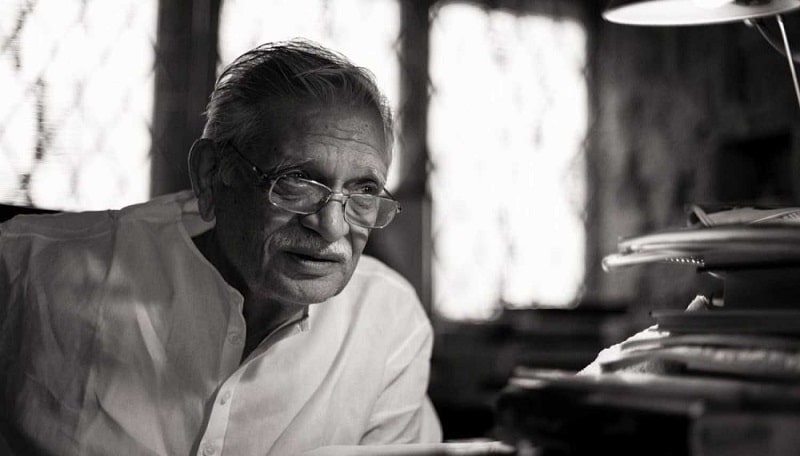
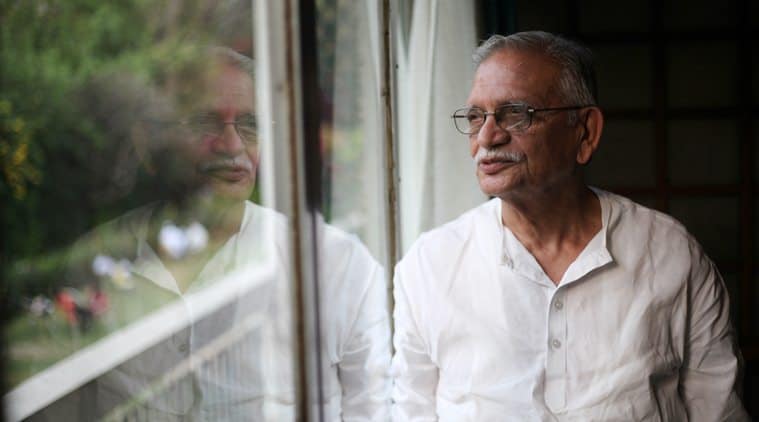
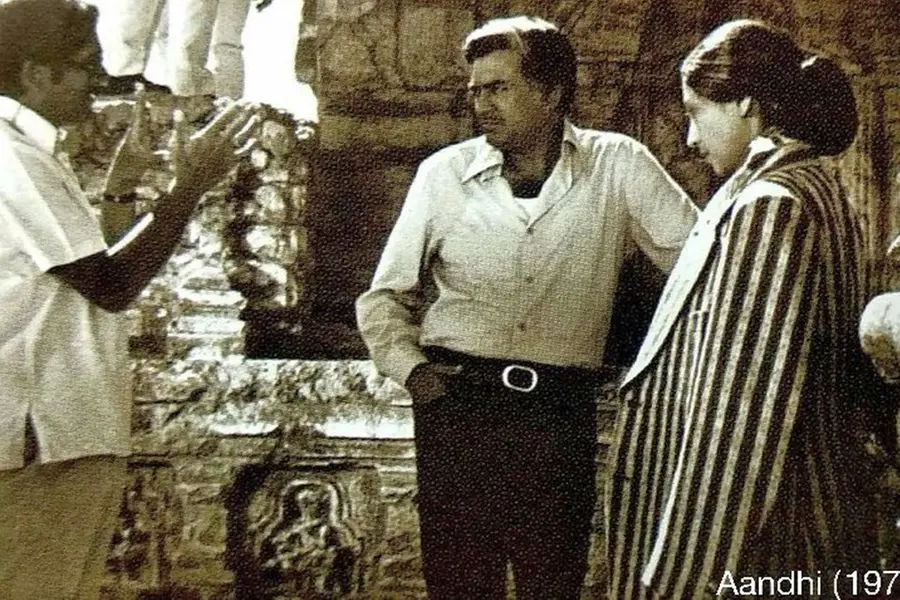
In quick succession Gulzar produced a series of films that consolidated his reputation. Koshish (1972) told the story of a deaf-mute couple, played by Sanjeev Kumar and Jaya Bhaduri, who marry and build a family against considerable odds; the film’s compassionate treatment of disability and its insistence on the resilience of love earned Gulzar the National Film Award for Best Screenplay. Parichay (1972), loosely inspired by the narrative of The Sound of Music, and Achanak (1973) followed, the latter a taut drama derived from a real criminal case. With Aandhi (1975) Gulzar entered more controversial territory, presenting the estrangement and partial reconciliation of a politician, played by Suchitra Sen, and her husband, played by Sanjeev Kumar; widely read at the time as an oblique commentary on contemporary political life, the film was temporarily withdrawn during the Emergency.
The same year saw the release of Mausam (1975), a meditation on guilt, time, and responsibility in which a doctor returns to confront the consequences of a youthful relationship, and Khushboo (1975), inspired by a story of Sharat Chandra Chattopadhyay. Sanjeev Kumar became Gulzar’s most frequent and most sympathetic collaborator across these years, an actor whose range allowed the director to explore interior states of longing and remorse. Through the later 1970s Gulzar continued with Kinara (1977), Kitaab (1977), a sensitive study of childhood, and Angoor (1982), a sparkling adaptation of Shakespeare’s The Comedy of Errors that demonstrated his command of comic timing and remains among the most admired comedies of Hindi cinema.
Gulzar’s directorial work reached a peak of refinement with Ijaazat (1987), an intimate chamber drama, adapted from a Bengali story, that examines the residue of a failed marriage through a conversation between estranged partners in a railway waiting room. Its delicate structure, emotional honesty, and extraordinary songs, including “Mera Kuch Saaman,” for which Gulzar won the National Film Award for Best Lyrics, made it a touchstone of mature Indian filmmaking. Lekin… (1991), a haunting supernatural romance set against the desert landscapes of Rajasthan and built around the music of Lata Mangeshkar and Hridaynath Mangeshkar, extended his interest in memory and the unquiet past.
His final feature as director, Maachis (1996), confronted the violence of militancy in Punjab and the manner in which ordinary young people are drawn into cycles of insurgency and state repression. Unsparing yet compassionate, the film won the National Film Award for Best Popular Film Providing Wholesome Entertainment and stands as a powerful summation of his lifelong concern with the human cost of political conflict. Hu Tu Tu (1999) followed, returning once more to the corruption of the political class and the alienation it produces within families. Across his work in television, Gulzar also directed the acclaimed serial Mirza Ghalib (1988), a reverent dramatisation of the life of the great Urdu poet, and the children’s programmes and adaptations that reflected his enduring commitment to younger audiences.
Even as his own directorial output slowed, Gulzar remained the most sought-after lyricist in the Hindi industry, sustaining a celebrated collaboration with the composer Rahul Dev Burman and, in later decades, with Vishal Bhardwaj and A. R. Rahman. His songs for films such as Dil Se.., Omkara, Slumdog Millionaire, Kaminey, and Raazi demonstrated a continuing capacity for reinvention, ensuring that his voice remained central to popular cinema well into the twenty-first century.
The Cinema of Gulzar
The cinema of Gulzar is governed by an aesthetic of suggestion. Trained as a poet and steeped in the literary traditions of Urdu and Bengali, he approached film as a medium in which the unspoken carries as much weight as the spoken, and in which silence, gesture, and image are made to do the work that lesser filmmakers entrust to dialogue and incident. His films characteristically eschew melodramatic excess in favour of understatement, building emotional power through accumulation and restraint rather than through spectacle. The result is a body of work that occupies a distinctive middle ground between the commercial mainstream and the austere parallel cinema, popular in its accessibility yet serious in its ambitions.
Central to Gulzar’s vision is a profound humanism. His protagonists are frequently the wounded, the disabled, the displaced, and the misunderstood, and his sympathy extends without condescension to figures whom society overlooks. Equally distinctive is his treatment of women, whom he consistently presents as persons of intelligence, self-respect, and moral courage rather than as objects of sentiment. The integration of his songs into narrative is another hallmark; in Gulzar’s cinema the lyric is never ornamental but functions as an extension of character and theme, the poetry of the screen and the poetry of the page proceeding from a single sensibility.
Key Themes
Memory and the persistence of the past: Across his films estranged lovers and divided families confront the residue of earlier choices, finding either reconciliation or a melancholy closure in later years. Memory operates as both a wound and a form of survival, most explicitly in Ijaazat, Mausam, and Lekin.
Displacement and Partition: The trauma of the 1947 Partition and the broader experience of exile inform much of his work, surfacing directly in Maachis and his television writing and indirectly in a recurring preoccupation with the loss of home and belonging.
The dignity of the marginalised: Gulzar repeatedly centres characters whom society neglects — the disabled couple of Koshish, the disaffected youth of Mere Apne — affirming their worth and interior complexity.
The strength of women: His female characters are conceived as autonomous moral agents possessed of intelligence and courage, a sensibility evident in Aandhi, Khushboo, Ijaazat, and Mausam.
The integration of poetry and image: Song and verse are woven into narrative as expressions of inner life, reflecting his conviction that cinema and poetry are continuous arts rather than separate ones.
Political conscience: A scepticism toward the political class and an awareness of the human cost of power recur from Aandhi to Hu Tu Tu, while Maachis offers a sustained meditation on violence, the state, and disillusioned youth.
Selected Filmography
Mere Apne (1971). Gulzar’s directorial debut, adapted from Tapan Sinha’s Apanjan, in which an elderly widow becomes entangled with rival gangs of unemployed youth. The film established his concern with social marginality and remains a significant statement on the frustrations of a generation without prospects.
Koshish (1972). The story of a deaf-mute couple who marry and raise a family, marked by its compassionate realism and its refusal of sentimentality. It won Gulzar the National Film Award for Best Screenplay and is regarded as one of his finest achievements.
Aandhi (1975). A drama of estrangement and reconciliation between a politician and her husband, widely read as a commentary on contemporary political life and temporarily withdrawn during the Emergency. Its songs and its mature treatment of a marriage in crisis made it enormously influential.
Mausam (1975). A meditation on guilt and the passage of time in which a doctor returns to confront the consequences of a past relationship. The film earned wide acclaim and confirmed Gulzar’s standing as a director of psychological subtlety.
Angoor (1982). A celebrated comedy adapted from Shakespeare’s The Comedy of Errors, distinguished by its precise screenplay and impeccable comic timing. It demonstrated the range of Gulzar’s craft and is among the most admired comedies in Hindi cinema.
Ijaazat (1987). An intimate chamber drama examining the aftermath of a failed marriage through a single conversation, structurally daring and emotionally exact. Its song “Mera Kuch Saaman” won the National Film Award for Best Lyrics and the film endures as a model of mature filmmaking.
Lekin… (1991). A supernatural romance set in the deserts of Rajasthan, built around the theme of a restless soul seeking release. The film deepened Gulzar’s exploration of memory and the unquiet past and was distinguished by its music.
Maachis (1996). Gulzar’s final and arguably most powerful feature, an unflinching study of militancy and state violence in Punjab and the radicalisation of ordinary young people. It won the National Film Award for Best Popular Film Providing Wholesome Entertainment.

Legacy
Gulzar’s legacy is among the most enduring and multifaceted in Indian cultural life. As a director he demonstrated that the popular Hindi film could accommodate ambiguity, interiority, and silence without forfeiting its audience, and in doing so he helped to expand the expressive possibilities of mainstream cinema. His films of the 1970s and 1980s, in particular Koshish, Aandhi, Mausam, Angoor, and Ijaazat, remain objects of study and admiration, valued for their literary intelligence and their humane vision. The bridge he built between the commercial industry and the seriousness of the parallel movement opened a path that later filmmakers would follow.
It is, however, as a writer of songs that Gulzar exercised his widest influence. He transformed the idiom of the Hindi film lyric, introducing imagery of startling originality, an intimacy of tone, and a willingness to draw upon everyday speech and unexpected metaphor. His collaborations with composers across several generations, from Rahul Dev Burman to Vishal Bhardwaj and A. R. Rahman, kept his voice continuously present in popular culture, and his example has shaped virtually every serious lyricist who has worked in Hindi cinema since. His standing as a man of letters was affirmed by the Sahitya Akademi Award and, in 2024, by the Jnanpith Award, the highest literary honour in India, recognising his achievement in Urdu poetry and prose.
The honours accorded to him reflect the scale of this achievement. He received the Padma Bhushan in 2004 and the Dadasaheb Phalke Award, India’s highest cinematic distinction, for the year 2013, conferred in 2014. He won numerous National Film Awards and a large number of Filmfare Awards across the categories of lyrics, screenplay, dialogue, and direction. His international recognition came with the Academy Award and the Grammy Award for the song “Jai Ho” from Slumdog Millionaire, achievements that brought his work before a global audience and made him one of the few Indian artists to be honoured at the highest levels of both literature and cinema.
Yet the measure of Gulzar’s legacy lies finally in something less quantifiable: the particular sensibility he made available to Indian audiences. To speak of a “Gulzar touch” is to invoke a manner of seeing the world in which tenderness coexists with rigour, in which the ordinary is invested with poetic significance, and in which language is treated as a precise and living instrument. He carried the inheritance of Ghalib and Tagore into the popular imagination and persuaded a mass audience that poetry belonged on the screen. In the history of Indian cinema he stands as the rare artist who refused the division between high and popular art, and whose work continues to instruct and move successive generations.
Gulzar on Art House Cinema

Ijaazat (1987)
Ijaazat (1987) is Gulzar’s exquisitely poetic Hindi musical romance about an estranged couple (Naseeruddin Shah and Rekha) who unexpectedly reunite in a railway station waiting room five years after their divorce, tenderly excavating memories of their failed marriage and the other woman (Anuradha Patel) whose presence still lingers between them.