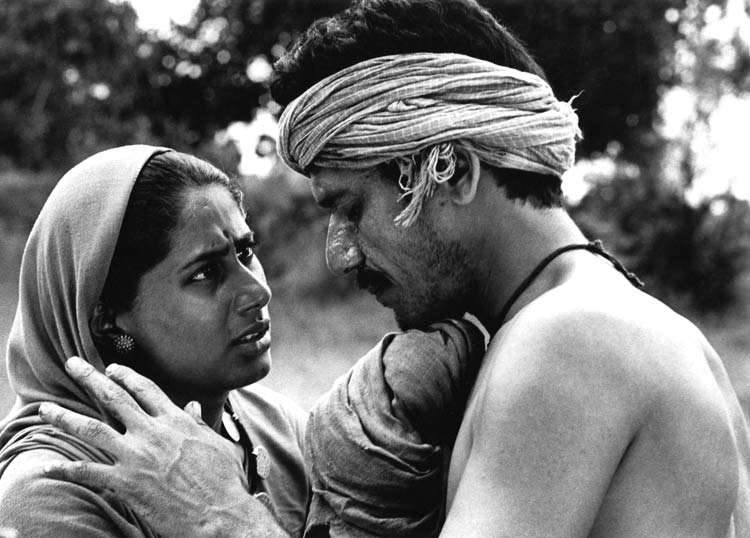
Satyajit Ray
Satyajit Ray (2 May 1921 – 23 April 1992) stands as the pre-eminent figure in the history of Indian cinema and one of the supreme auteurs of world film. A Bengali filmmaker of extraordinary range and humane vision, Ray transformed the possibilities of Indian cinema with his debut feature, Pather Panchali (1955), and over the next four decades directed twenty-nine feature films, five documentaries, and two short films that together constitute one of the most significant bodies of work in the medium. Working almost exclusively in Bengali — though his one Hindi-language film, Shatranj Ke Khiladi (1977), demonstrated his command of the language and its literary tradition — Ray brought to the screen a distinctively Indian sensibility that was simultaneously rooted in the particularities of Bengali society and receptive to universal human concerns.
Ray’s films encompass an unusually wide range of subjects and formal strategies, from the lyrical ruralism of the Apu Trilogy (1955–1959) to the psychological intricacy of Charulata (1964), from the historical pageantry of Shatranj Ke Khiladi (1977) to the philosophical rumination of Agantuk (1991). Throughout his career he received a remarkable thirty-seven National Film Awards from the Government of India, making him the most decorated filmmaker in the history of those awards. He was conferred the Padma Bhushan in 1965, India’s highest civilian honour, the Bharat Ratna, shortly before his death in 1992, and the Dadasaheb Phalke Award — the nation’s highest cinematic honour — in 1985.
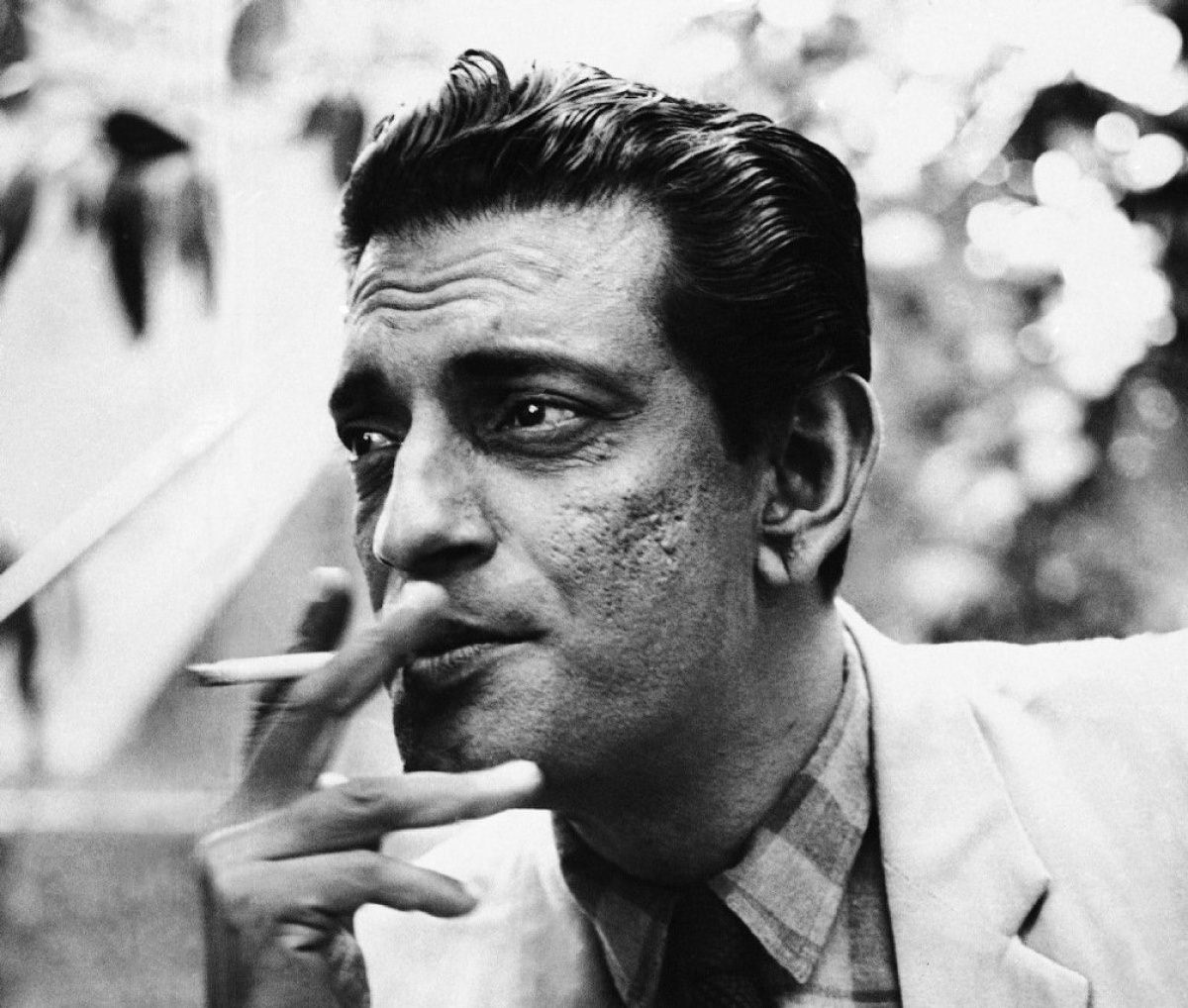
Ray’s international recognition was equally distinguished. The Apu Trilogy earned critical accolades at the Cannes, Venice, and London film festivals, while his film Aparajito (1956) won the Golden Lion at Venice. In 1982, he received the Honorary Golden Lion from Venice and a special tribute, the “Hommage à Satyajit Ray,” at the Cannes Film Festival, and in 1987 the French government honoured him with the Legion of Honour. Most movingly, twenty-four days before his death, he received the Honorary Academy Award from the Academy of Motion Picture Arts and Sciences — the first Indian filmmaker to be so recognised — and described it, from his hospital bed in Calcutta, as “the best achievement of my movie-making career.”
Ray was not only a filmmaker but a polymath: a graphic artist and illustrator, a typographer who designed the celebrated typefaces Ray Roman and Ray Bizarre, a composer who scored most of his own films, a prolific author of fiction and essays, and the editor of the Bengali children’s magazine Sandesh. His multifarious talents were unified by a rigorous aesthetic intelligence and a deep commitment to humanist values. As the initiator of India’s parallel cinema movement, he demonstrated that Indian film need not be confined to the melodramatic conventions of commercial Hindi cinema; through his example, he opened the way for subsequent generations of filmmakers across the subcontinent.
Life and Early Work
Satyajit Ray was born on 2 May 1921 in Calcutta (now Kolkata) into a family whose contributions to Bengali arts and letters spanned several generations. His paternal grandfather, Upendrakishore Ray Chowdhury, was a celebrated writer, illustrator, and pioneering printer who founded the children’s magazine Sandesh — a publication that Satyajit himself would later revive and edit. His father, Sukumar Ray, was one of the most beloved figures in Bengali literature, renowned for his nonsense verse and illustrated stories in the tradition of Edward Lear and Lewis Carroll. Sukumar Ray died of a tropical disease when Satyajit was only two years old, leaving the child and his mother, Suprabha Devi, in straitened circumstances. The family’s intimate connection with the world of arts, letters, and print culture nonetheless exerted a formative influence on the young Ray.
Ray attended Ballygunge Government High School in Calcutta and subsequently enrolled at Presidency College, where he studied economics and science, graduating in 1940. His mother strongly encouraged him to continue his education at Visva-Bharati University in Santiniketan, the institution founded by Rabindranath Tagore in the rural district of Birbhum as an experiment in open-air, humanistic education. Ray was initially reluctant to leave Calcutta, whose urban intellectual and cinematic life he had come to relish. However, his years at Santiniketan, from 1940 to 1942, proved transformative. Under the guidance of the eminent painters Nandalal Bose and Binodebehari Mukherjee — both students of Tagore and masters of the modern Indian art — Ray developed a rigorous grounding in visual composition, Indian classical aesthetics, and the principles of rasa that would profoundly shape his later filmmaking. Santiniketan also deepened his appreciation of Eastern artistic traditions and enabled him to synthesise these with the Western influences he had absorbed in Calcutta.
Returning to Calcutta in 1942, Ray sought employment consistent with his talents in visual design. In April 1943 he joined D.J. Keymer, a British-run advertising agency, as a junior visualiser. He remained with the agency for thirteen years, rising to become a senior art director and producing innovative advertising campaigns that displayed his characteristic attention to typography and graphic composition. His work at Keymer also brought him into contact with a British director who encouraged him to design covers and illustrations for books — a commission that, in 1944, led him to illustrate an abridged version of Bibhutibhushan Bandyopadhyay’s novel Pather Panchali for a Calcutta publisher. The encounter with this text, which depicted rural Bengali life with unsentimental compassion, planted the seed of his first film.
Ray was simultaneously deepening his engagement with cinema through the Calcutta Film Society, which he co-founded in 1947 with the journalist Chidananda Das Gupta and others. The Society screened international films — including the works of Jean Renoir, Vittorio De Sica, Sergei Eisenstein, and the Japanese directors — that were otherwise inaccessible to Bengali audiences, and Ray wrote reviews and essays that demonstrated his growing sophistication as a film theorist. A decisive encounter occurred in 1949, when Jean Renoir came to Calcutta to shoot The River; Ray assisted him in scouting locations in the Bengal countryside, and their conversations about cinema proved deeply illuminating. A year later, in 1950, Ray was sent by D.J. Keymer to work at its London headquarters. During six months in the British capital he saw approximately a hundred films, but it was Vittorio De Sica’s Bicycle Thieves (1948) that proved revelatory. Emerging from the screening, Ray later recalled, he was determined to become a filmmaker.
Ray married the actress Bijoya Das in 1949; she would serve as a close collaborator and trusted reader throughout his career. Their son, Sandip Ray, later became a filmmaker in his own right.
Filmmaking
Ray decided to use Bibhutibhushan Bandopadhyay’s novel Pather Panchali as the subject of his first film. The semi-autobiographical novel narrated the life of Apu, a small boy from a village in Bengal who later moved to Calcutta.
He gathered a motley group of inexperienced artists and technicians and started working on the project in late 1952. Funds were hard to come by and at one-point, Bijoya had to pawn her jewellery so that the shooting could continue. Finally, with a loan from the West Bengal Government, Pather Panchali was completed in 1955 and hit the theatres. The film was a great success, both critical and popular. The first-timers had created history and many of them would grow into their careers as the stalwarts of their trade.
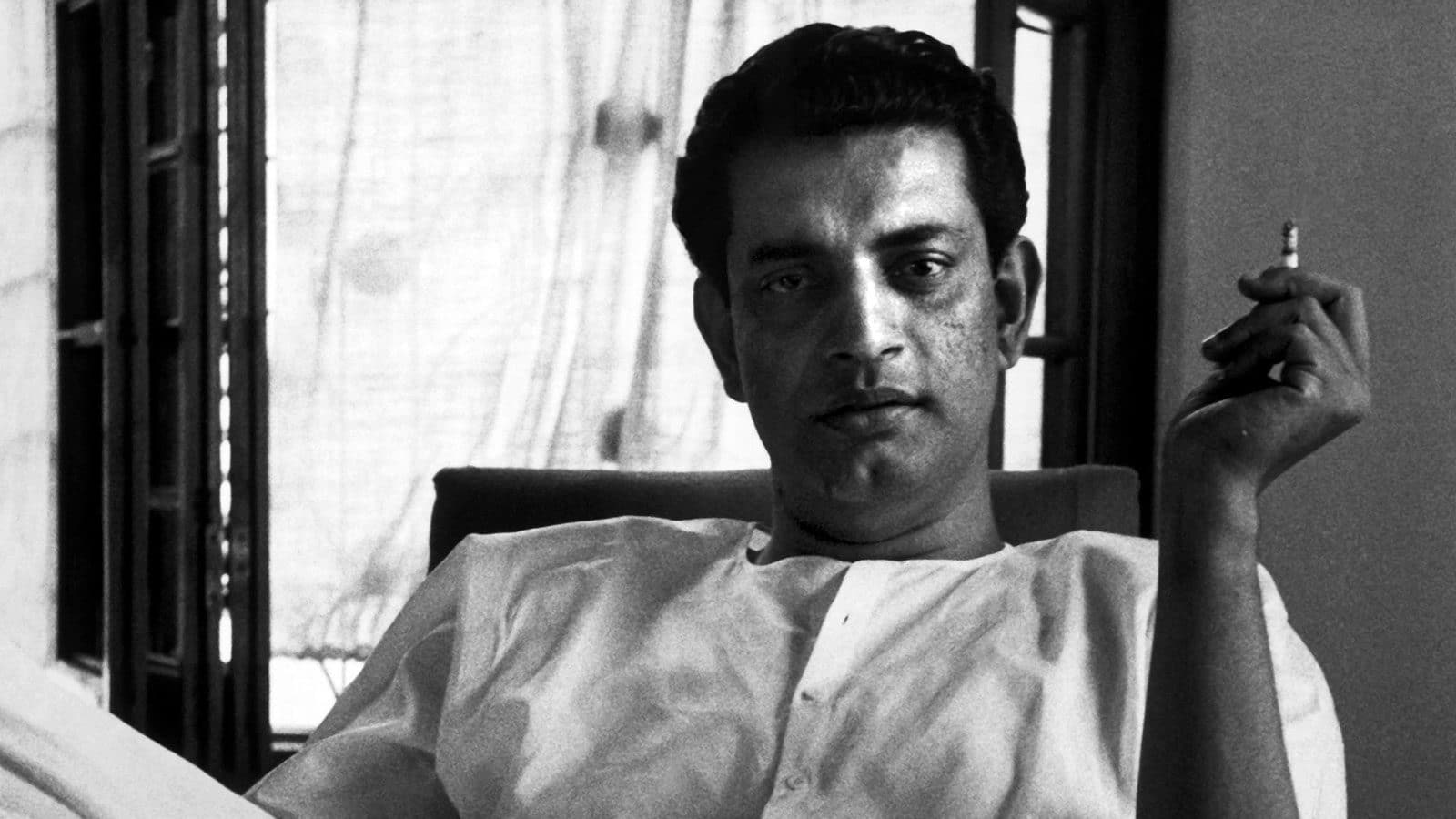
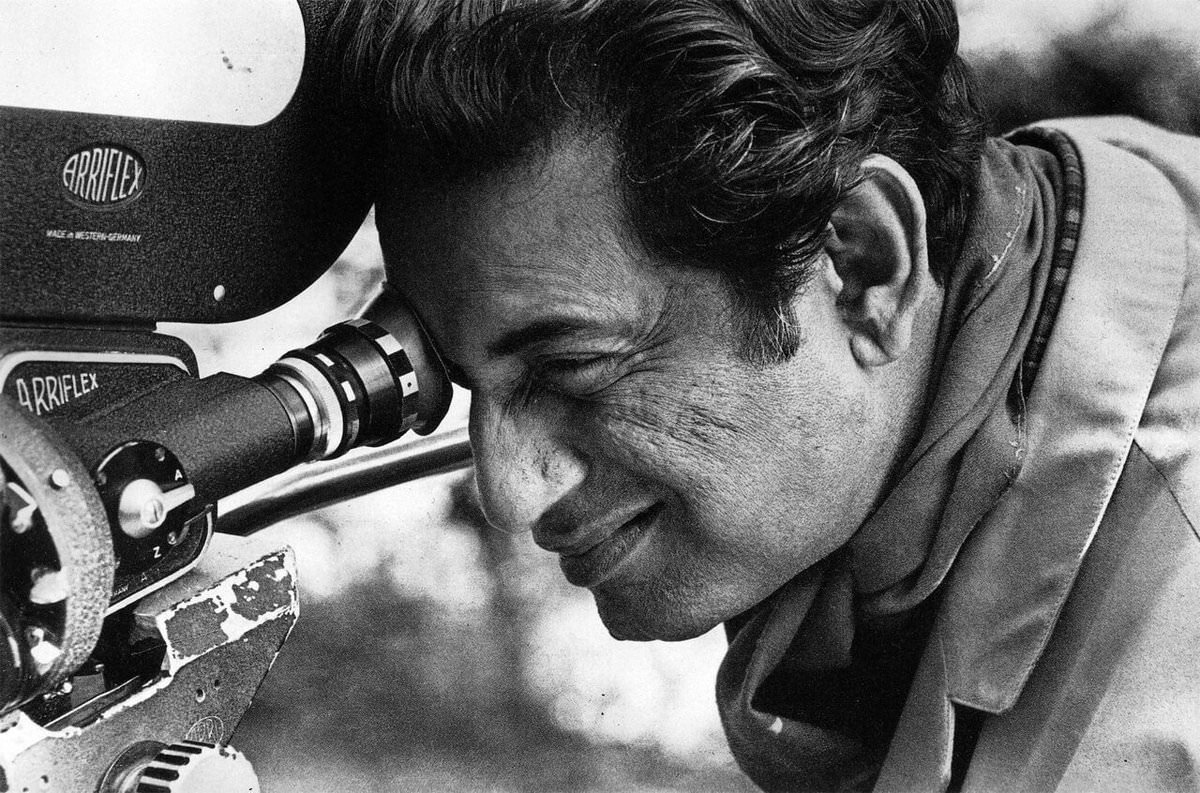
The sequel, Aparajito (1956), which follows Apu’s adolescence and his difficult negotiation between filial obligation and personal ambition, won the Golden Lion at Venice, confirming Ray’s standing in world cinema. The trilogy was completed with Apur Sansar (The World of Apu, 1959), which traces Apu’s young adulthood, marriage, bereavement, and eventual reconciliation with life. Collectively, the Apu Trilogy is regarded as one of the supreme achievements of world cinema: a work that traces a life from childhood to mature selfhood with incomparable sensitivity, and that renders the social and physical landscape of Bengal — its villages, rivers, railways, and cities — with the precision and affection of a great novelist.
Even as he completed the trilogy, Ray was extending his range in striking directions. Jalsaghar (The Music Room, 1958) marked a departure from realism toward a more stylised, formally rigorous study of a feudal zamindar — a landlord of decaying fortune — who sacrifices his family and estate to sustain his obsessive patronage of classical music. The film is a meditation on the collision of tradition and modernity, rendered through extraordinarily composed images and the evocative use of music by Vilayat Khan, Bismillah Khan, and Roshan Kumari. With Devi (The Goddess, 1960), Ray turned to the dangers of religious superstition, telling the story of a young woman whose father-in-law becomes convinced she is an incarnation of the goddess Kali, with catastrophic consequences. The film remains one of Ray’s most searching examinations of the intersection of patriarchy, faith, and female subjection.
The early 1960s saw Ray produce a series of films of remarkable diversity. Teen Kanya (Three Daughters, 1961) was an anthology of three stories adapted from Tagore. Kanchenjungha (1962), his first film in colour, unfolds in real time during a single afternoon at the hill station of Darjeeling, dissecting the tensions within a bourgeois Bengali family. Abhijan (The Expedition, 1962) explored class conflict and ambition through the figure of a proud taxi driver. Mahanagar (The Big City, 1963) offered a nuanced portrait of a middle-class Calcutta woman who enters the workforce for the first time, navigating the contradictions of a society in transition.
Ray’s masterpiece of the 1960s is widely regarded as Charulata (The Lonely Wife, 1964), adapted from Tagore’s novella Nastanirh. Set in nineteenth-century Calcutta, it portrays the intellectual and emotional awakening of a neglected but gifted woman who develops an ambiguous attachment to her husband’s cousin, a writer who encourages her literary ambitions. The film is celebrated for its visual elegance — Subrata Mitra’s cinematography creates an interior world of extraordinary intricacy — and for Madhabi Mukherjee’s performance as Charulata, perhaps the finest in Ray’s filmography. Ray himself considered it his most technically accomplished film.
The later 1960s and early 1970s brought further experimentation. Nayak (The Hero, 1966) employed a single train journey as the setting for a psychological study of a matinee idol confronting the emptiness of his success. Goopy Gyne Bagha Byne (1969), Ray’s first film intended primarily for children, was an exuberant fantasy-musical that became enormously popular in Bengal and was followed by two sequels. Aranyer Din Ratri (Days and Nights in the Forest, 1970), adapted from a novel by Sunil Gangopadhyay, offered a wry examination of urban Bengali men confronting their own inadequacies during a forest holiday.
In 1977, Ray ventured into Hindi-language cinema for the only time with Shatranj Ke Khiladi (The Chess Players), his most expensive and elaborately mounted production, adapted from a story by Munshi Premchand. Set in Lucknow in 1856, on the eve of the annexation of Awadh by the East India Company, the film counterpoints the frivolous obsession of two aristocratic chess players with the political catastrophe unfolding around them. It is a devastating study of colonial power and the complicity of a ruling class in its own subjugation, executed with formal grandeur and mordant humour.
Ray’s later career, conducted under increasing strain from heart disease, demonstrated undiminished ambition. The Feluda detective series — Sonar Kella (The Golden Fortress, 1974) and Joi Baba Felunath (1978) — delighted Bengali audiences across generations. Sadgati (1981) was a short television film about caste violence, adapted from Premchand, stark and uncompromising in its indictment of Hindu social hierarchy. Ghare Baire (The Home and the World, 1984), adapted from Tagore, returned to the themes of nationalism, female emancipation, and political violence. His final film, Agantuk (The Stranger, 1991), released the year before his death, is a reflective philosophical comedy in which a mysterious uncle’s return to his niece’s home occasions a meditation on civilisation, belonging, and the nature of humanity.
Ray wrote all his own screenplays, composed his own film scores from the 1960s onwards, designed his own credit sequences and publicity materials, and supervised every aspect of production. This control over the total work was central to the coherence and distinctiveness of his artistic vision.

The Cinema of Satyajit Ray
Ray was deeply influenced by the work of great French filmmaker Jean Renoir and his work remained neorealist for most of his creative career. His narrative structure is similar to musical forms where songs are an inherent part of the story and are widely followed in Indian cinema even today. What set him apart was the complete control he showed on every aspect of his films. Being the multifaceted person that he was, he was closely involved in various departments of the film such as script, music, editing, art direction and even created the posters for promotion. He was aware of the real concerns of real people and did not shy away from putting those on-screen, albeit devoid of extreme elements of violence and sex. Although he kept experimenting through his career, he never remained true to his style of providing the finest of cinema with strong themes that have a sort of permanence in them. As a result, the Cinema of Satyajit Ray seems as relevant today as it was decades ago.
Ray’s cinema occupies a singular position in the history of world film: it is simultaneously a product of the Bengali literary tradition, an engagement with European realism and humanism, and a contribution to the global art cinema of the post-war decades. His films resist easy categorisation. They are not aligned with any single school or movement, though they share certain abiding qualities: a commitment to observed human behaviour over melodramatic convention, a visual language informed by both Indian classical aesthetics and European painterly tradition, and a sustained moral seriousness that never lapses into didacticism. As the critic Chidananda Das Gupta observed, Ray’s films offer “a fictional ethnography of a nation in transition,” tracing the movement of Indian society from rural feudalism through colonial modernity to the dilemmas of post-independence urbanisation.
Ray’s aesthetic was shaped by the encounter between two traditions. From the Indian side, his training under Nandalal Bose and Binodebehari Mukherjee at Santiniketan provided him with a grounding in classical aesthetics, in the principles of rasa — the theory of emotional essences in classical Indian art — and in the visual vocabularies of Mughal miniature painting, Kalighat pat, and the Bengal School. From the European side, his immersion in Italian Neorealism, French Poetic Realism, and the psychological cinema of Renoir gave him a model for location shooting, the use of non-professional actors, and the subordination of plot to character observation. The synthesis of these traditions produced a cinematic style that was immediately recognisable as both distinctively Indian and universally legible.
Central to Ray’s method was his acute observation of behavioural nuance. He rehearsed his actors exhaustively, developing a notation system for facial expressions and working to elicit performances of extraordinary subtlety. His collaborations with actors such as Chhabi Biswas, Sharmila Tagore, Soumitra Chatterjee, Madhabi Mukherjee, Utpal Dutt, and Waheeda Rehman produced some of the most precisely calibrated performances in Indian cinema. His visual style, realised most brilliantly in the earlier films through the cinematography of Subrata Mitra — who pioneered the technique of “bounce lighting” to create a luminous, natural indoor illumination — achieves a balance between documentary directness and painterly composition that is wholly characteristic.

A scene from Mahanagar
Key Themes
Humanism and the dignity of the ordinary: Ray’s films consistently assert the moral worth and inner complexity of ordinary people — the rural poor, the urban middle class, the marginalised woman — against the dehumanising forces of poverty, convention, and power. His characters are never mere social types but fully realised individuals whose small choices carry genuine weight.
Tradition and modernity: A central tension in Ray’s cinema is the conflict between inherited social structures — feudalism, caste, patriarchy, religious custom — and the pressures of modern life. His films neither celebrate tradition uncritically nor embrace modernity as straightforwardly liberating; they inhabit the difficult, often painful space between the two.
The position of women: Ray was one of the earliest and most searching analysts of female experience in Indian cinema. Films such as Devi, Charulata, Mahanagar, Ghare Baire, and Samapti examine the constraints imposed upon women by Bengali society and the various forms — intellectual, emotional, social — in which women seek expression and autonomy.
Colonialism and its aftermath: Several of Ray’s films engage directly with the history of British colonialism and its consequences for Indian society. Shatranj Ke Khiladi is his most sustained examination of colonial power, but the theme recurs in Jalsaghar, Charulata, and Ghare Baire, all of which situate their characters within the social transformations wrought by colonial rule.
Music as cultural memory: Music — whether the Indian classical tradition of Jalsaghar, the folk idioms of the Apu Trilogy, or the compositions Ray himself created from the 1960s onwards — functions in his films not merely as accompaniment but as a bearer of cultural memory and emotional truth. The relationship between a character and a musical tradition often encodes their relationship to Bengali heritage itself.
The ethical intelligence: Ray’s cinema is pervaded by a quiet but insistent moral seriousness. His films do not moralize, but they consistently place their characters in situations that test their capacity for self-knowledge, empathy, and ethical choice. The measure of a character’s humanity, in Ray’s world, is frequently their willingness to see and respond to another person’s suffering.

Selected Filmography
Pather Panchali (1955)
Ray’s debut feature, adapted from Bibhutibhushan Bandyopadhyay’s novel, follows the childhood of Apu in a poor Bengali village. Shot over three years with a largely non-professional cast and crew, the film introduced a new register of lyrical realism to Indian cinema. It won the Prix du document humain at the 1956 Cannes Film Festival and launched Ray’s international reputation.
Aparajito (1956)
The second film of the Apu Trilogy, following Apu’s move to the holy city of Varanasi and subsequently to Calcutta as he pursues his education. The film’s central drama is the painful rupture between Apu’s aspirations and his mother’s need for his presence and devotion. Winner of the Golden Lion at the Venice Film Festival, it confirmed Ray’s standing as a director of world importance.
Jalsaghar (1958)
Adapted from a story by Tarashankar Bandyopadhyay, the film portrays a decaying zamindar whose obsession with classical music leads him to ruin. A formally austere work in which the music of Vilayat Khan, Bismillah Khan, and Roshan Kumari serves as both dramatic counterpoint and cultural elegy, Jalsaghar is widely regarded as one of Ray’s most formally accomplished films.
Apur Sansar (1959)
The concluding film of the Apu Trilogy, charting Apu’s marriage to the spirited Aparna, her death in childbirth, and his eventual reconciliation with his estranged son. The film’s emotional climax — Apu’s reunion with the child he has abandoned — is among the most affecting sequences in Ray’s work.
Devi (1960)
A psychologically penetrating examination of patriarchal religious superstition, in which a young woman is proclaimed a goddess by her father-in-law, with tragic consequences. The film remains one of the most powerful critiques of the intersection of faith and female subjection in Indian cinema.
Charulata (1964)
Adapted from Tagore’s Nastanirh, this film is widely considered Ray’s masterpiece. Set in nineteenth-century Calcutta, it traces the intellectual and emotional awakening of a gifted but neglected woman whose attachment to her husband’s cousin brings her creativity and selfhood into painful conflict with social propriety. Madhabi Mukherjee’s performance as Charulata is a touchstone of Indian screen acting.
Nayak (1966)
A single train journey becomes the setting for a psychological study of a celebrated film star whose encounter with a journalist forces him to confront the emptiness behind his public success. The film employs an innovative structure of dream sequences and waking dialogue to explore the anxieties of celebrity and masculine inadequacy.
Shatranj Ke Khiladi (1977)
Ray’s only Hindi-language film, adapted from Premchand’s story, is set in Lucknow in 1856, as the British prepare to annex Awadh. Two aristocratic nawabs, obsessed with chess, remain oblivious to the political catastrophe unfolding around them. A work of historical panorama and biting political intelligence, the film features performances by Sanjeev Kumar, Saeed Jaffrey, Richard Attenborough, and Amjad Khan.
Agantuk (1991)
Ray’s final film, made when he was gravely ill, is a philosophical comedy in which the arrival of a mysterious uncle at his niece’s home precipitates a meditation on the nature of civilisation and human belonging. The film’s reflective, autumnal quality gives it the character of a valediction — a summation of Ray’s humanist vision.

Legacy
Satyajit Ray’s legacy in Indian cinema is without parallel. His achievement in inaugurating the Indian parallel cinema movement — establishing that Indian film could aspire to artistic seriousness and international recognition without abandoning its cultural roots — opened the way for subsequent generations of filmmakers across all of India’s regional cinemas. Mrinal Sen, Ritwik Ghatak, and Tapan Sinha in Bengal, Shyam Benegal and Govind Nihalani in Hindi cinema, Adoor Gopalakrishnan and Girish Kasaravalli in the south: all were in different ways enabled by Ray’s demonstration that a distinctively Indian art cinema was possible. The international validation his films received at Cannes, Venice, Berlin, and London gave these filmmakers — and their producers, distributors, and audiences — a framework within which to understand and advocate for their work.
Ray’s influence extended beyond India. Directors as varied as Martin Scorsese, François Truffaut, Akira Kurosawa, and Abbas Kiarostami acknowledged his significance. Kurosawa famously declared that “not to have seen the cinema of Ray means existing in the world without seeing the sun or the moon.” This assessment, while hyperbolic, captures the sense in which Ray’s films seemed to many international filmmakers to establish a new standard for what cinema, as a humanist art, might achieve.
Ray’s legacy is also literary and graphic. His illustrated fiction for children and adults — particularly the Feluda detective stories and the Professor Shonku science-fiction series — remain among the most beloved works in Bengali literature. His essays on cinema, collected in volumes such as Our Films, Their Films (1976), constitute a sophisticated body of film theory and criticism that remains essential reading for students of Indian cinema. His designs for typefaces, book covers, and film publicity materials established a standard of graphic elegance that influenced subsequent generations of Bengali designers.
The institutions that bear his name — the Satyajit Ray Film and Television Institute in Calcutta, the Satyajit Ray Award presented at the BFI London Film Festival — attest to the breadth of his cultural authority. His birth centenary in 2021 was marked by retrospectives and celebrations across India and internationally, confirming that his films remain vital, deeply watched, and actively debated more than three decades after his death. In the assessment of both scholars and practitioners, Satyajit Ray occupies a place in the history of cinema that is not merely important but foundational: he demonstrated, in work of enduring beauty and moral intelligence, what the art of film could be when it was placed at the service of human understanding.
Satyajit Ray on Art House Cinema