
Jahnu Barua
Jahnu Barua (born 17 October 1952, Sivasagar, Assam) is one of India’s most distinguished filmmakers, whose body of work has been central to the articulation of Assamese regional cinema within the broader trajectory of Indian art cinema. Over a career spanning four decades, Barua has directed a significant corpus of films in Assamese and Hindi that interrogate socio-cultural realities with humanist rigor, earning him multiple National Film Awards and prestigious civilian honours including the Padma Shri (2003) and Padma Bhushan (2015).
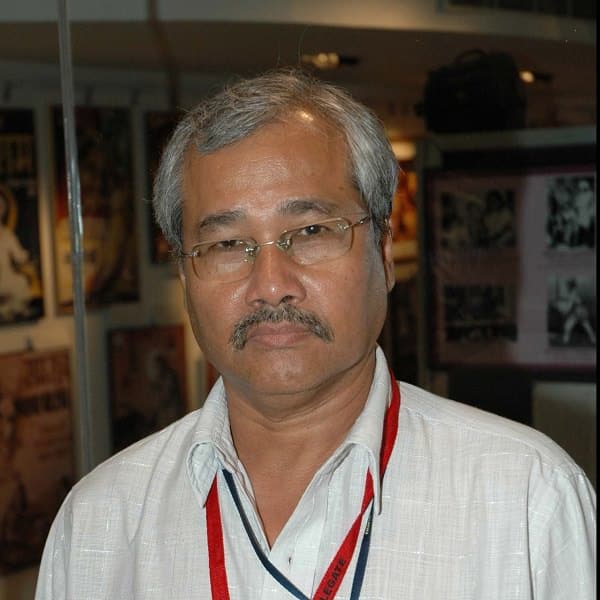
Life and Early Work
Barua was born into a family rooted in the agrarian and tea-garden milieu of upper Assam. He completed his early education in Guwahati, culminating in a Bachelor of Science degree followed by a postgraduate diploma in film direction from the Film and Television Institute of India (FTII), Pune.
Before emerging as a director of feature films, Barua gained foundational experience in cinematic craft and production practice through short films and documentary work. Early in his career he also worked as an assistant director in Mumbai and produced educational television programmes under the Satellite Instructional Television Experiment (SITE) for the Indian Space Research Organisation (ISRO), demonstrating an early commitment to socially engaged audiovisual communication.
Filmmaking
Barua made his feature film debut with Aparoopa (1982), a film that explored class and gender dialectics within Assam’s colonial past and signalled his capacity to blend narrative subtlety with social critique. However, it was his third feature, Halodhia Choraye Baodhan Khai (The Catastrophe, 1987), that established his reputation nationally and internationally: a poignant portrayal of rural exploitation that won the National Film Award for Best Feature Film and multiple honours at the Locarno International Film Festival.
Throughout the 1990s and early 2000s, Barua continued to refine his cinematic language, foregrounding narratives of socio-economic displacement, education, and community resilience. Films such as Firingoti (1992), which narrates a teacher’s struggle to rebuild education in an Assamese village, and Xagoroloi Bohudoor (It’s a Long Way to the Sea, 1995), which examines the impact of modernization on traditional livelihoods, reflect his sustained interest in rural lives and structural change.
Barua also ventured into Hindi cinema, most notably with Maine Gandhi Ko Nahin Mara (2005), a psychologically nuanced drama that engaged with themes of memory and national ethos, and solidified his reputation beyond regional language circuits.
The Cinema of Jahnu Barua
Barua’s cinema is marked by a consistent humanist philosophy: his films privilege the interiority of lived experience while embedding that experience within larger socio-political contexts. They often foreground marginalized voices — rural farmers, women, children — and mediate the tensions between tradition and transformation. This commitment has placed him alongside other indigenous auteurs in Indian art cinema who seek an ethical cinema distinct from commercial imperatives.
Stylistically, Barua favors restrained mise-en-scène, unobtrusive but evocative cinematography, and narratives that unfold through character and lived circumstance rather than melodrama. His films have been the subject of scholarly analysis for their “engaged and critical reading” of society and urbanity, and for articulating an Assamese aesthetic rooted in local idioms yet resonant with universal concerns.
Barua has also contributed to cinema as an institutional participant — serving on juries at national and international film festivals and participating in film education initiatives — thereby influencing successive generations of filmmakers from the North-East and beyond.
Selected Filmography
Aparoopa (1982) — Feature debut; Assamese drama.
Papori (1986) — Locally grounded narrative.
Halodhia Choraye Baodhan Khai (The Catastrophe) (1987) — National Best Feature Film; international recognition.
Bonani (1990) — Environmental concern.
Firingoti (1992) — Social education theme.
Xagoroloi Bohudoor (1995) — Rural livelihoods and change.
Kuhkhal (1998) / Pokhi (2000) — Youth and society.
Konikar Ramdhenu (2003) — Childhood and institutional structures.
Tora (2004) — Children’s narrative.
Maine Gandhi Ko Nahin Mara (2005) — Hindi psychological drama.
Baandhon (2012) — Elderly couple navigating loss.
Legacy
Jahnu Barua’s legacy in Indian cinema is anchored in his unwavering commitment to an ethical cinema that foregrounds the dignity of ordinary lives. His films have not only brought Assamese cultural narratives to a national and international stage but have also expanded the contours of regional cinema within the Indian film canon. With numerous National Film Awards and international honours to his name, Barua’s work continues to be a subject of academic study and cinephilic appreciation.
Moreover, his influence extends to both practitioners and scholars who examine cinema as a medium of social engagement, deepening critical understandings of narrative, region, and identity in contemporary film practice.