
Adoor Gopalakrishnan
Adoor Gopalakrishnan (born 3 July 1941) is one of India’s most influential auteurs, known for redefining Malayalam cinema through realism, formal rigour, and philosophical depth. Rejecting commercial spectacle, his films explore the inner lives of ordinary individuals shaped by social structures, power, memory, and moral choice.
Educated at the Film and Television Institute of India (FTII), Pune, Adoor emerged in the early 1970s as a central figure of the New Cinema movement. His debut Swayamvaram (1972) marked a decisive break from mainstream storytelling and set the tone for a body of work rooted in silence, restraint, and ethical inquiry.
His internationally acclaimed films—Kodiyettam, Elippathayam, Mathilukal, Vidheyan, and Anantaram—are celebrated for their contemplative pacing, precise compositions, and refusal to simplify human experience. Frequently screened at major global festivals, his cinema aligns more closely with world auteurs than national trends.
Beyond filmmaking, Adoor has played a crucial role in shaping film culture in Kerala through film societies, writing, and public discourse. A recipient of the Dadasaheb Phalke Award, Padma Vibhushan, and multiple National Film Awards, he remains a defining voice in Indian art cinema.
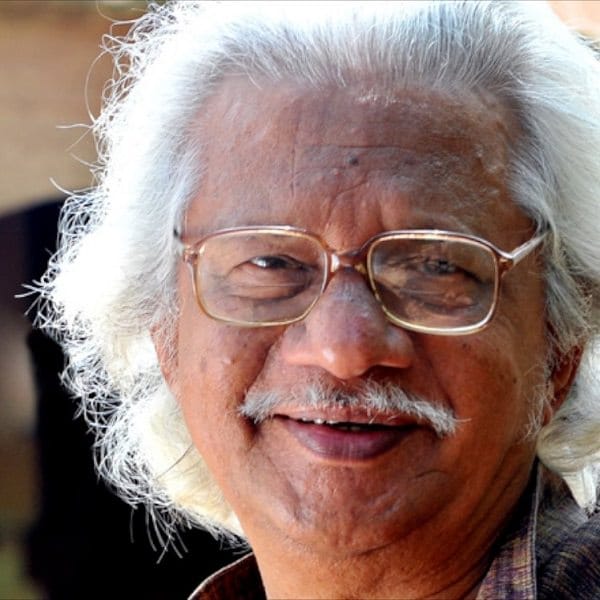
Life and Early Work
Adoor Gopalakrishnan was born into a family appreciative of the arts in Pallickal, Kerala. From an early age, he was drawn to the stage and storytelling, participating in theatre and developing a keen interest in cultural expression. After completing his graduation from the Gandhigram Rural Institute in 1960 in subjects including economics and political science, he worked briefly as a statistical investigator before pursuing his passion for cinema. In 1962, he enrolled at the Film and Television Institute of India in Pune, where he studied scriptwriting and direction, graduating in 1965.
Soon after his return, Adoor founded the Chitralekha Film Society and the Chitralekha Film Cooperative in Thiruvananthapuram—pioneering initiatives that played a vital role in developing film culture in Kerala by presenting classic and alternative films outside the mainstream commercial industry.
His earliest filmmaking included short fiction and documentary work, but it was his first full-length feature, Swayamvaram (1972), that marked his arrival as a major voice in Indian cinema. The film revolutionized Malayalam film language and is credited with effectively launching the New Cinema movement in the region.
Filmmaking
Adoor’s films are known for their understated yet rigorous narrative style—deeply observant, often contemplative, and rooted in the textures of everyday life. His debut Swayamvaram explored the challenges of urban existence and personal relationships against social realities, winning major national awards. Subsequent films such as Kodiyettam (1977) continued this exploration of individual transformation and social context.
In Elippathayam (1982, Rat-Trap), Adoor examined the decay of feudal structures and human inertia, winning the British Film Institute’s award for originality and imaginative filmmaking and cementing his reputation internationally.
Other significant works include Anantaram (1987), an innovative psychological drama that departed from linear storytelling; Mathilukal (1990), an adaptation of Vaikom Muhammad Basheer’s autobiographical novel set in prison; Vidheyan (1993); Kathapurushan (1995); and Nizhalkuthu (2002). Across these films, Adoor combined careful formal composition with a deep humanism, portraying individuals navigating ethical, social, and existential dilemmas.

Apart from his narrative cinema, he has made numerous documentaries and short films, and his work as a writer and cultural organizer has influenced generations of filmmakers and critics.
The Cinema of Adoor Gopalakrishnan
At a time when Malayalam films were largely driven by theatrical excess and commercial formula, Adoor introduced a cinematic language grounded in realism, restraint, and moral inquiry. His work demonstrated that films made in a regional language, with local settings and ordinary characters, could engage with universal human concerns and command international attention without compromise.
What distinguishes Adoor is his uncompromising belief in cinema as a serious art form. His films resist spectacle, emotional manipulation, and easy resolutions. Instead, they ask the viewer to observe, reflect, and participate. Silence, duration, and stillness are not stylistic flourishes in his work—they are ethical choices. By slowing cinema down, Adoor allows inner lives, social pressures, and moral tensions to emerge organically.
Adoor’s cinema consistently foregrounds the individual in conflict with larger systems—family, tradition, feudal power, bureaucracy, or the state. Whether it is the moral inertia of Elippathayam, the psychological fragmentation of Anantaram, or the brutal hierarchies of Vidheyan, his films examine how power operates quietly, often invisibly, within everyday life. These are not grand political statements but deeply human ones, revealing how structures shape consciousness itself.
Equally significant is his formal discipline. Each frame in an Adoor film is purposeful, composed with a literary and philosophical rigor rare in Indian cinema. He treats narrative not as a vehicle for plot, but as a space for thought. His refusal to over-explain, his trust in ambiguity, and his openness to multiple interpretations place him firmly within the lineage of world auteurs rather than national trends.
Beyond his films, Adoor’s role as a cultural architect is crucial. Through film societies, writing, and public engagement, he helped build a viewing culture in Kerala that valued cinema beyond entertainment. In doing so, he influenced generations of filmmakers, critics, and audiences to take cinema seriously—as a medium capable of intellectual depth and ethical engagement.
In an era increasingly dominated by speed, spectacle, and consumption, Adoor Gopalakrishnan’s cinema stands as a reminder of what film can achieve when it chooses patience over immediacy and reflection over distraction. His work continues to matter because it insists that cinema is not merely something we watch, but something we think with.
Key Themes
The Individual and Society
Adoor’s films consistently explore how ordinary individuals are shaped—and often constrained—by social structures, traditions, and power systems.
Time, Memory, and Subjectivity
Rather than linear storytelling, many of his films treat time as fluid, shaped by memory, perception, and inner reality (Anantaram being the clearest example).
Decay of Feudal and Moral Orders
Works like Elippathayam and Vidheyan reflect the slow collapse of feudal authority and the ethical emptiness left behind.
Silence and Stillness
Adoor uses silence not as absence, but as meaning—allowing pauses, gestures, and spaces to speak louder than dialogue.
Human Dignity and Moral Choice
Even in oppressive circumstances, his characters are defined by their ethical struggles, emphasizing moral responsibility over spectacle.
Cinema as Serious Art
Rejecting melodrama and formula, Adoor treats cinema as a disciplined, reflective medium—one that demands patience, attention, and introspection from its audience.
Selected Filmography
Swayamvaram (1972)
A landmark debut that ushered in the New Cinema movement in Malayalam film. Through the quiet struggles of a young couple, Adoor examines urban alienation, dignity, and the fragility of human relationships.
Kodiyettam (1977)
Often described as one of his most accessible works, the film traces the psychological growth of an ordinary man. With subtle humor and restraint, it captures social change through everyday life.
Elippathayam (1982)
A haunting allegory on feudal decay and moral paralysis. The film’s slow rhythm and claustrophobic spaces mirror its protagonist’s resistance to change, making it one of Adoor’s most internationally acclaimed works.
Anantaram (1987)
A bold, formally inventive film that blurs memory, fantasy, and reality. By questioning the reliability of storytelling itself, Adoor challenges conventional narrative structures in Indian cinema.
Mathilukal (1990)
Adapted from Vaikom Muhammad Basheer’s autobiographical novel, this tender prison romance unfolds almost entirely through voices and unseen presences, highlighting emotional intimacy over physical contact.
Vidheyan (1993)
A disturbing exploration of power, submission, and cruelty set in a feudal landscape. The film’s raw performances and moral complexity mark one of Adoor’s darkest works.
Kathapurushan (1995)
Spanning several decades, this epic follows one man’s life alongside Kerala’s socio-political transformation, blending personal history with collective memory.
Nizhalkuthu (2002)
A meditative reflection on justice and capital punishment, focusing on an executioner burdened by moral responsibility.
Legacy
Adoor Gopalakrishnan’s contribution to cinema extends far beyond his own films. As a central figure in the New Indian Cinema movement, he helped redefine Malayalam and Indian art cinema on both national and international stages. He has won more than a dozen National Film Awards and received India’s highest cinematic honor, the Dadasaheb Phalke Award (2004), as well as some of the country’s top civilian honors including the Padma Shri and Padma Vibhushan.
His films have been screened at major festivals worldwide, inspiring critical study and influencing filmmakers across cultures. Through his long career, he has maintained a stance that cinema should reflect real life and provoke thought, urging both practitioners and audiences to engage with film as a serious art form. Today, Adoor’s work continues to be celebrated for its artistic integrity, philosophical depth, and lasting impact on world cinema.