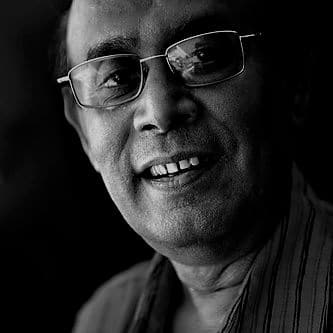
Bhuddhadeb Dasgupta
Buddhadeb Dasgupta (11 February 1944 – 10 June 2021) stands among the most significant auteurs in Indian cinema, especially within the context of Bengali parallel cinema. Known as a poet with a camera, Dasgupta’s films are marked by an exacting interplay of lyricism and social realism that challenges conventional narrative forms while probing the relationship between individuals and their socio-cultural environments. His work garnered sustained critical acclaim at home and abroad and earned him multiple National Film Awards and international recognition over a career spanning more than four decades.
Life and Early Work
Born in Purulia district in undivided Bengal in 1944, Dasgupta was raised amidst the red earth landscapes that later infused much of his cinematic imagination. Initially trained in economics, he earned his degree from Scottish Church College and embarked on a career as a lecturer at institutions including Burdwan and Calcutta universities. Yet his engagement with cinema preceded his academic career; as a young man he was deeply influenced by exposure to international filmmakers through the Calcutta Film Society, which introduced him to the films of Chaplin, Kurosawa, Bergman, and Antonioni—an education that profoundly shaped his aesthetic outlook.
Dasgupta’s venture into filmmaking emerged from this synthesis of intellectual rigor and poetic sensibility. His earliest cinematic work included short documentaries in the late 1960s, with his first feature Dooratwa (Distance, 1978) marking his formal entry into cinema. The film’s introspective study of political disillusionment and personal rupture signaled the emergence of a distinctive directorial voice predicated on the collision of inner and outer worlds.
Filmmaking
Dasgupta’s cinema is characterized by a sustained commitment to exploring socio-political realities through a visual idiom that privileges metaphor, rhythm, and symbolic resonance. Rather than adhering to realist transparency, his films often deploy a poetic register that complicates simple interpretations of narrative and character. Throughout the 1980s and early 1990s, works such as Neem Annapurna (date), Grihajuddha (date), and Andhi Gali (date) examined class tension, ideological disillusionment, and the lingering impact of the Naxalite movement on Bengali society.

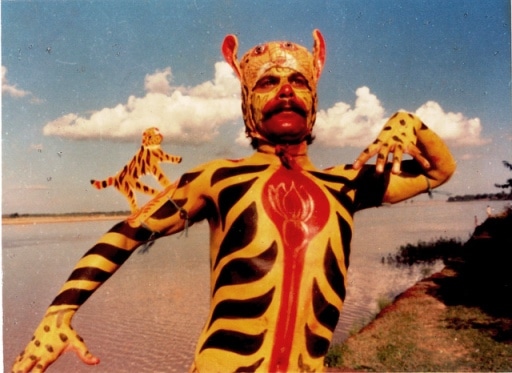
The late 1980s onward marked Dasgupta’s consolidation as a mature auteur. Bagh Bahadur (1989) juxtaposed folk performance with broader cultural marginalization, while Tahader Katha (1992) offered a layered meditation on post-colonial identity. Films such as Charachar (1993), Lal Darja (1997), and Mondo Meyer Upakhyan (2002) further extended his exploration of dispossession, dignity, and narrative ambiguity. His cinema resisted easy categorization, integrating elements of surrealism, folk traditions, and existential inquiry to articulate a vision of Indian society that is both particular and universal.
Dasgupta also worked across linguistic boundaries, directing Hindi films such as Andhi Gali and Anwar Ka Ajab Kissa, thereby situating his concerns within a broader Indian cinematic landscape.
The Cinema of Buddhadeb Dasgupta
What distinguishes Dasgupta’s cinema is its lyricism of form—a sensibility wherein time, space, and image are harnessed to evoke emotional and philosophical depth rather than mere plot progression. His films often operate through a contemplative pace, sustained observation of milieu, and attention to peripheral figures whose interior lives reveal larger cultural currents. In works such as Uttara (2000), which premiered at the Venice Film Festival and won the Special Director’s Award, Dasgupta juxtaposed the pastoral with the violent, interrogating the human impulse toward transcendence amidst decay.
Critics have observed that his films continually negotiate the tension between realism—a concern with historical and material conditions—and surreal poetic imagery, which invites the viewer into a reflective encounter with the unsaid and the unseen. This duality places his work in conversation not only with Indian parallel cinema but also with global modernist cinematic traditions.
Selected Filmography
Dooratwa (Distance, 1978) – Debut feature probing ideological crises.
Phera (The Return, 1988) – A meditation on memory and belonging.
Bagh Bahadur (1989) – National Award-winning drama on cultural displacement.
Tahader Katha (1992) – Post-colonial recovery and identity narrative.
Charachar (1993) – Exploration of intimacy and freedom.
Lal Darja (1997) – Social margins and symbolic transformation.
Uttara (2000) – Venice Special Director’s Award.
Swapner Din (2004) – National Award for Best Direction.
Mondo Meyer Upakhyan (2002) – National Award-winning feature.
Kaalpurush (2008) – National Award-winning chronicle of memory.
Tope (2016) – Psychological drama based on a short story.
Legacy
Buddhadeb Dasgupta’s legacy in Indian cinema is multifaceted. As a filmmaker, he expanded the expressive possibilities of narrative film, bridging poetry and visual storytelling in ways that enriched the discourse of world cinema. Domestically, he became one of the leading figures of Bengali parallel cinema, alongside contemporaries like Goutam Ghose and Aparna Sen, contributing profoundly to the articulation of a cinema that is reflective, socially engaged, and aesthetically daring.
His films continue to be studied for their formal innovation and thematic depth, and his influence resonates among filmmakers and scholars who seek to pursue cinema that melds ethical inquiry with artistic rigor. Dasgupta’s death in 2021 was widely mourned across the Indian cultural spectrum, with peers acknowledging the profound void his absence created in the landscape of serious cinema.
Buddhadeb Dasgupta on Art House Cinema