Kumar Shahani
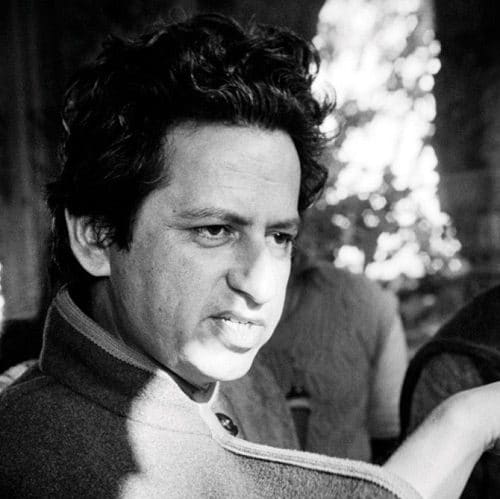
Kumar Shahani (7 December 1940 – 24 February 2024) was one of the most intellectually rigorous and formally uncompromising filmmakers in the history of Indian cinema. Born in Larkana, Sindh, and uprooted by the Partition of 1947, Shahani transformed the dislocations of post-independence India into a body of work of remarkable philosophical depth and aesthetic coherence. A defining figure of the Indian Parallel Cinema movement, he crafted a concentrated but landmark filmography — among which Maya Darpan (1972), Tarang (1984), Khayal Gatha (1989), Kasba (1990), and Char Adhyay (1997) stand as signal achievements — that earned him multiple National Film Awards, the Filmfare Critics Award on three occasions, and sustained international critical recognition. His work occupies a position in Indian cinema comparable to that of Andrei Tarkovsky or Pier Paolo Pasolini in world cinema: essential, challenging, and irreducibly singular.
Shahani’s cinema was defined by an unusual synthesis of aesthetic influences. Shaped as a student by Ritwik Ghatak at the Film and Television Institute of India in Pune, and subsequently by Robert Bresson and Roberto Rossellini during his studies at the Institut des hautes études cinématographiques (IDHEC) in Paris, he developed a formalist approach that was at once deeply Indian in its cultural reference and fully conversant with the European art cinema tradition. His films engaged India’s classical arts — Hindustani music, Odissi dance, epic literature — as active structural and thematic elements, not merely as decorative backdrop, constituting what critics have described as a cinema of the “respectful gaze.”
The conditions of his life informed his art in profound ways. Shahani often reflected that the experience of Partition had rendered him perpetually between cultures and languages, a condition that fostered in him a radical openness to multiple aesthetic and intellectual traditions. His films consequently refuse the comfort of a single narrative or formal register; they are works in which the social and the subjective, the mythological and the historical, the classical and the modern are held in sustained, generative tension. This quality — of productive irresolution rather than easy resolution — is perhaps the most characteristic feature of the Shahani aesthetic.
Beyond filmmaking, Shahani was a formidable theorist of cinema. His book of essays, Kumar Shahani: The Shock of Desire and Other Essays (Tulika Books, 2015), gathers forty years of critical writing and constitutes a significant contribution to film theory. As a teacher at FTII, he shaped generations of filmmakers. His death on 24 February 2024, at the age of eighty-three, marked the passing of one of the last great architects of Indian parallel cinema’s foundational generation.
Life and Early Work
Kumar Shahani was born on 7 December 1940 in Larkana, a district in Sindh, in the northwestern reaches of the Indian subcontinent, then under British rule. Larkana, the hometown of the Bhutto political dynasty and a city of considerable historical and cultural depth, was part of a Sindhi society whose intellectual and mercantile traditions were to be violently disrupted by the Partition of British India in 1947. When the subcontinent was divided along religious lines and the newly created state of Pakistan absorbed Sindh, Shahani’s family — like hundreds of thousands of Sindhi Hindus — was compelled to leave their ancestral home. They relocated to Bombay, where Kumar would grow up and receive his education.
The experience of displacement marked the young Shahani in ways he would later articulate with great clarity. In interviews, he recalled the peculiar double alienation of the Partition migrant: displaced from Sindh because the family was not Muslim, and then perceived as Pakistani — and therefore foreign — upon arrival in Bombay. The language spoken around him was not his own, and the cultural environment of Bombay’s cosmopolitan film world was initially strange and unfamiliar. He would later reflect that this condition of being simultaneously inside and outside multiple cultures led him to embrace all possible languages — linguistic and cinematic alike — as potentially his own. In this respect, he shared a profound spiritual kinship with Ritwik Ghatak, whose cinema of Partition-inflected mourning and cultural rupture would become one of Shahani’s deepest artistic touchstones.
Shahani completed his schooling in Bombay and subsequently enrolled at the University of Bombay, where he studied Political Science and History, graduating in 1962. This grounding in the political and historical dimensions of Indian society was not incidental to his later filmmaking; his films consistently engage with questions of power, class, gender, and the legacies of colonialism and feudalism within independent India. Following his undergraduate studies, he pursued formal training in filmmaking, enrolling at the Film and Television Institute of India in Pune.
At FTII, Shahani’s most significant formative relationship was with Ritwik Ghatak, the legendary Bengali filmmaker who taught there during the 1960s and whose influence on a generation of Indian directors — including Mani Kaul, John Abraham, and Shahani himself — can scarcely be overstated. Ghatak’s cinema, rooted in the traditions of Indian epic narrative, in Brecht’s theories of theatre, and in a politically charged lyricism born of the Partition experience, electrified Shahani. Under Ghatak’s tutelage, he developed an understanding of cinema as a practice continuous with India’s deep cultural traditions rather than derivative of Hollywood conventions. Shahani graduated from FTII in 1966 with a specialisation in Screenplay Writing and Film Direction.
Having secured a scholarship from the French government, Shahani subsequently travelled to Paris to study at the IDHEC, the most prestigious film school in France, which had trained a number of the key figures of European art cinema. In Paris, he not only received formal instruction in the technical and theoretical dimensions of filmmaking but also had the extraordinary opportunity to work as an assistant to Robert Bresson on the film Une Femme Douce (1969). The experience of working alongside Bresson, whose cinema is defined by its radical economy of means, its refusal of psychological explanation, and its rigorous attention to the material texture of sound and image, left a lasting imprint on Shahani’s own formal sensibility. Alongside Bresson, he identified Roberto Rossellini as the filmmaker from whom he learned the most — specifically Rossellini’s capacity to locate the historical and the transcendent within the ordinary and the immediate.
Filmmaking
Shahani returned to India in the early 1970s and directed his debut feature, Maya Darpan, in 1972. The title translates literally as “the illusory mirror,” and the film’s concern with illusion — social, psychological, aesthetic — is everywhere evident. Set in a provincial town in Northern India in the post-independence period, the film centres on the inner life of a young woman constrained by the structures of patriarchal and feudal order. The narrative is deliberately elliptical, the pacing contemplative, and the visual language marked by an extraordinary sensitivity to colour, composition, and the relationship between the human figure and architectural space. Maya Darpan was immediately recognised as a significant achievement: it won the National Film Award for Best Feature Film in Hindi in 1972 and the Filmfare Critics Award for Best Film, establishing Shahani as a filmmaker of serious ambition and original vision. Critics noted the film’s refusal to straddle the boundary between mainstream and art cinema, its commitment instead to a rigorous aesthetic sobriety that drew on the traditions of painting as much as of cinema.
Following the success of Maya Darpan, Shahani faced the conditions that circumscribed serious independent filmmaking in India: the difficulty of securing funding for work that refused commercial compromise. It would be twelve years before he was able to direct his next full-length feature film. During this period, he made several short films — among them Rails for the World, Fire in the Belly, and Our Universe — and continued to develop his theoretical and pedagogical work. The hiatus, though a product of structural conditions rather than creative choice, gave Shahani time to deepen his thinking about the relationship between epic form, classical Indian arts, and the possibilities of cinema.
In 1984, Shahani released Tarang, a film that marked both a maturation of his formal concerns and a direct engagement with contemporary political economy. The film, which starred Om Puri and Smita Patil — two of the most celebrated actors of the parallel cinema generation — depicts a complex web of industrial relations, class conflict, and moral ambiguity within a mill-owning family. Tarang is distinguished by its elaborately structured narrative, which draws on the traditions of Indian epic storytelling to examine the contradictions of capitalism, the complicity of the bourgeoisie, and the vulnerability of working-class communities to the imperatives of capital accumulation. The film was conferred the National Film Award for Special Jury Award at the 32nd National Film Awards, recognition that acknowledged its intellectual ambition even as mainstream audiences found it demanding.
Shahani’s subsequent major work, Khayal Gatha (1989), represented perhaps his most direct engagement with the tradition of classical Hindustani music. The title refers to the khayal, one of the principal forms of North Indian classical vocal music, which emerged in the eighteenth century as an elaboration and transformation of the older dhrupad tradition. In the film, Shahani uses the structural and aesthetic principles of the khayal — its interweaving of compositional structure and improvisatory freedom, its capacity to hold multiple temporal planes simultaneously — as a model for cinematic form. The film blends visual formalism with references to classical Indian arts including music, painting, and literature, and received the FIPRESCI Prize at the International Film Festival Rotterdam in 1990 as well as the Filmfare Critics Award for Best Film.
In 1990, Shahani directed Kasba, an adaptation of Anton Chekhov’s short story “In the Ravine,” transposed to a small Indian town. The film won the Filmfare Critics Award for Best Film in 1991, consolidating Shahani’s critical reputation as one of the most distinguished filmmakers of his generation. His documentary Bhavantarana (1991), a portrait of the great Odissi dance maestro Kelucharan Mohapatra, extended his cinematic exploration of classical Indian performance traditions. In the film, Shahani examines classical dance as a site of tension between codified, stylised labour and the improvisatory movements that exceed any system of classification. Bhavantarana won the National Film Award for Best Biographical Film, bringing Shahani’s tally of National Awards to three.
Shahani’s final major feature, Char Adhyay (1997), was an adaptation of the novel of the same name by Rabindranath Tagore, a work in which the Bengali literary master examines the relationship between female sexuality and nationalist politics in the revolutionary Bengal of the early twentieth century. Shahani’s film is faithful to the novel’s structural complexity — its non-linear temporality, its critique of how bourgeois and patriarchal ideologies can colonise even radical political movements — while deploying the full range of the director’s avant-garde formal strategies. Char Adhyay was screened at the International Film Festival Rotterdam in 1998 and has been the subject of sustained academic analysis for its innovative deployment of archive, gesture, and epic form.
The Cinema of Kumar Shahani
Kumar Shahani’s cinema constitutes one of the most coherent and philosophically sustained bodies of work in the history of Indian film. Where many of his contemporaries in the parallel cinema movement engaged with social realism as their primary mode, Shahani pursued a path that might best be described as dialectical formalism: a cinema in which the formal organisation of the image, sound, and time is itself the primary bearer of meaning, and in which aesthetic rigour and political thought are inseparable. His work invites comparison with the great formalist traditions of European art cinema — with Bresson, Pasolini, Tarkovsky, and Rivette — while remaining rooted in specifically Indian cultural and historical conditions.
Central to Shahani’s aesthetic is his engagement with India’s classical arts as formal models for cinematic practice. Unlike filmmakers who draw on classical traditions for their surface appeal or their capacity to signal cultural authenticity, Shahani was interested in classical Indian music, dance, and epic literature as structural principles: as ways of organising time, space, and the relationship between the individual and the collective that offered alternatives to the conventions of Western narrative cinema. The khayal’s interplay of structure and improvisation, the Odissi dance’s negotiation between codified form and living embodiment, the epic’s capacity to hold myth and history in simultaneous view — all of these become generative principles in his filmmaking.
Shahani was also a rigorous student of painting, and his films are notable for their extraordinary visual organisation. In Maya Darpan in particular, the relationship between colour, composition, and the positioning of the human figure within architectural and natural space draws on the traditions of Indian miniature painting and on the work of European painters whose work Shahani encountered during his years in France. The “respectful gaze” that critics have identified in his cinema — a quality of sustained, non-exploitative attention to the human subject, and particularly to women — is in part a product of this pictorial sensibility.
Key Themes
Displacement and Partition. Shahani’s personal experience of the Partition of 1947 — the loss of his birthplace in Sindh and the disorienting experience of cultural and linguistic displacement in Bombay — resonates throughout his work as a meditation on historical trauma, cultural memory, and the fragility of belonging. His cinema refuses the consolations of nationalist mythology and insists on attending to the human cost of political division.
Formalism and Classical Indian Aesthetics. Shahani’s sustained engagement with India’s classical arts — particularly Hindustani music, Odissi dance, and the epic traditions of Sanskrit literature — as structural models for cinematic form is the most distinctive feature of his aesthetic practice. He regarded these traditions not as repositories of a fixed and unchanging India but as dynamic systems whose formal principles — the management of time, rhythm, improvisation, and the relationship between the individual voice and the collective form — offered genuine alternatives to the conventions of Hollywood narrative cinema.
Gender, Patriarchy, and Feudal Order. From Maya Darpan’s examination of a young woman’s inner life within a provincial patriarchal household to Char Adhyay’s analysis of the entanglement of female sexuality with nationalist politics, Shahani’s films consistently engage with the structures of gender inequality and the forms of consciousness that sustain them. His cinema is remarkable for the empathy and formal intelligence with which it attends to the experience of women.
Capitalism, Labour, and Class. Tarang’s portrait of industrial relations and the moral corruption of the mill-owning class represents Shahani’s most direct engagement with the political economy of post-independence India. The film’s Marxist analytical framework is, however, never schematic; it is inflected by Shahani’s characteristic interest in the psychic dimensions of class conflict and in the ways in which capitalist ideology reproduces itself through desire as much as through coercion.
Epic Form and Historical Consciousness. Shahani consistently argued for the relevance of India’s epic traditions — the Mahabharata, the Ramayana, and the classical literary tradition more broadly — to the practice of contemporary filmmaking. The epic form, in his account, differs from Western dramatic form in its capacity to hold multiple time frames simultaneously, to interrupt linear narrative with digression and reflection, and to position individual stories within the longue durée of historical and mythological time. This epic sensibility is everywhere evident in the organisation of his films.
Classical Performance and the Living Body. Shahani’s films and documentaries return repeatedly to classical Indian performance — music in Khayal Gatha, dance in Bhavantarana — as sites where abstract formal structure and the irreducible particularity of the living body are held in dynamic tension. His cinema is deeply interested in what exceeds codification: the improvisatory gesture, the spontaneous ornament, the moment of performance that exceeds the score.
Selected Filmography
Maya Darpan (1972)
Maya Darpan (the Illusory Mirror) was Shahani’s debut feature film and one of the foundational works of the Indian Parallel Cinema movement. Set in a provincial North Indian town in the post-independence period, the film follows a young woman whose inner life of longing, restlessness, and suppressed desire is counterposed against the rigid structures of feudal-patriarchal order. Shahani employs a deliberately slow, contemplative visual rhythm and a painterly approach to colour and composition that draws as much on the traditions of Indian miniature painting as on the European art cinema. The film received the National Film Award for Best Feature Film in Hindi in 1972 and the Filmfare Critics Award for Best Film.
Tarang (1984)
Tarang (Wave or Turbulence) was Shahani’s first full-length feature film after a twelve-year hiatus, and it marked a decisive extension of his formal and political concerns into the terrain of contemporary industrial capitalism. Starring Om Puri and Smita Patil, the film examines a mill-owning family caught in the contradictions of capitalist expansion and class conflict. The narrative deploys the elaborately structured forms of Indian epic storytelling to anatomise the moral compromises of the bourgeoisie and the violence done to working-class communities in the name of industrial development. It received the National Film Award for Special Jury Award at the 32nd National Film Awards.
Khayal Gatha (1989)
Khayal Gatha is perhaps the most formally ambitious of Shahani’s films, a work that explicitly takes as its structural model the khayal, a form of classical North Indian vocal music. The film uses the khayal’s interplay of fixed compositional structure and improvisatory embellishment as an organising principle for its own temporal and spatial organisation, creating a cinematic experience that moves fluidly between the historical and the mythological, the personal and the collective. It received the FIPRESCI Prize at the International Film Festival Rotterdam in 1990 and the Filmfare Critics Award for Best Film.
Kasba (1990)
Kasba is an adaptation of Anton Chekhov’s short story “In the Ravine,” transposed to the context of a small Indian town. Shahani uses the Chekhovian source material to explore questions of moral compromise, social immobility, and the suppressed violence that underpins provincial life in post-independence India. The film is notable for its precise economy of means and for the quality of attention it brings to the spaces and social rituals of small-town India. It received the Filmfare Critics Award for Best Film in 1991.
Bhavantarana (1991)
Bhavantarana is a documentary portrait of Kelucharan Mohapatra, the legendary maestro of Odissi dance. The film is not a conventional biographical documentary but rather a meditation on the nature of classical performance itself: on the relationship between codified technique and the living, improvising body, between the inherited tradition and the individual artist’s transformation of that tradition. Shahani’s camera brings to dance the same quality of respectful, sustained attention that characterises his work with narrative subjects. The film won the National Film Award for Best Biographical Film.
Char Adhyay (1997)
Char Adhyay (Four Chapters) is an adaptation of Rabindranath Tagore’s 1934 novel of the same name, a work that examines the complex entanglement of female desire, nationalist politics, and revolutionary disillusionment in early twentieth-century Bengal. Shahani’s film deploys a non-linear narrative structure and a range of avant-garde formal strategies — Brechtian alienation effects, multiple temporal planes, a self-conscious deployment of archival materials — to engage with Tagore’s critique of how patriarchal and bourgeois ideologies can colonise even radical political movements. The film was screened at the International Film Festival Rotterdam in 1998.
Legacy
Kumar Shahani’s legacy is that of one of Indian cinema’s most uncompromising and original artists. In a filmmaking culture perennially under pressure to produce commercially viable work, he maintained throughout his career a commitment to formal experiment, political seriousness, and aesthetic rigour that brought him the respect of critics and fellow filmmakers even as it limited his reach with general audiences. His is a cinema that demands sustained and active engagement from its viewers, refusing the consolations of identification and resolution in favour of what he called the “respectful gaze”: an attention to human experience that neither sentimentalises nor simplifies.
As a teacher at the Film and Television Institute of India, Shahani shaped the thinking of several generations of Indian filmmakers, transmitting not only technical skills but also a way of understanding cinema’s relationship to the broader traditions of human culture. His insistence on the relevance of India’s classical arts to contemporary filmmaking practice, and his demonstration in his own work of how that relevance might be realised, constitutes a significant intellectual legacy for Indian cinema.
His theoretical writings, collected in Kumar Shahani: The Shock of Desire and Other Essays (Tulika Books, 2015), represent a forty-year engagement with questions of aesthetics, politics, and the specific capacities of cinema as an art form. These essays, written over the same period in which he was making his films, constitute one of the most sustained and original contributions to film theory produced in the Indian context, and they illuminate the intellectual framework within which his cinematic practice was developed.
In terms of formal honours, Shahani received three National Film Awards — for Maya Darpan (Best Feature Film in Hindi, 1972), Tarang (Special Jury Award, 32nd National Film Awards, 1985), and Bhavantarana (Best Biographical Film, 1992) — as well as the Filmfare Critics Award for Best Film in 1972, 1990, and 1991, the FIPRESCI Prize at the International Film Festival Rotterdam for Khayal Gatha in 1990, and the Prince Claus Award in 1998, the latter a Dutch prize that recognises cultural achievement in the developing world.
Internationally, Shahani’s work has been screened at major film festivals including Rotterdam and has been the subject of retrospectives and academic study. Critics and scholars of world cinema have placed him in the company of the great formalists — Bresson, Tarkovsky, Rivette, Pasolini — while also insisting on his distinctively Indian cultural and political grounding. He is, in the assessment of the Indian film scholar Ashish Rajadhyaksha and others, one of the few Indian filmmakers who successfully developed a cinematic language that was simultaneously avant-garde and rooted in the specific traditions and conditions of Indian life.
Kumar Shahani died on 24 February 2024, at the age of eighty-three, following a prolonged illness. His death was mourned by the Indian film community as the loss of a filmmaker whose rigour, intellectual generosity, and formal courage had set a standard for what Indian cinema might aspire to be. His small but extraordinary body of work remains an essential reference for anyone seeking to understand the full range of Indian cinema’s possibilities, and it continues to be discovered and reassessed by new generations of filmmakers, students, and critics.