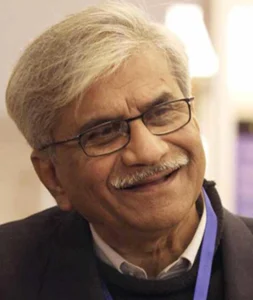
Nagraj Manjule
- Role
- Filmmaker
- Works in
- Hindi, Marathi
- Born
- 24 August 1978
- On Art House Cinema
- No films yet

Nagraj Popatrao Manjule, born on 24 August 1978, is a Marathi director, screenwriter, actor, producer and poet who has placed caste at the centre of popular Indian cinema. He came to film from a traditionally nomadic community on the outer edge of a Solapur village, and he has never worked to disguise the fact. Between 2011 and 2018 he won three National Film Awards. Each of the three was given for a film about a boy who is being taught where he may stand.
The short film Pistulya took the National Film Award for Best First Non-Feature Film of a Director at the 58th National Film Awards, announced in May 2011. The pattern was set there. His first feature, Fandry, won the Grand Jury Prize at the Mumbai Film Festival in October 2013 and then the Indira Gandhi Award for Best Debut Film of a Director at the 61st National Film Awards. At the 65th National Film Awards he received the Swarna Kamal for Best Direction in the non-feature category for Pavsacha Nibandh, a twenty-five-minute film about a schoolboy asked to write an essay in praise of the rains.
The film that carried his name beyond Maharashtra was Sairat. It was his second feature. Made for about four crore rupees and shot in his own village of Jeur, it premiered in the Generation 14plus section of the 66th Berlin International Film Festival in February 2016 and opened in India on 29 April that year. It earned roughly 110 crore rupees and remained the highest-grossing Marathi film until Raja Shivaji passed it in 2026. Five industries remade it: in Kannada as Manasu Mallige, in Punjabi as Channa Mereya, in Odia as Laila O Laila, in Bengali as Noor Jahaan and in Hindi as Dhadak. Rinku Rajguru, fifteen when she was cast, received a National Film Award Special Mention at the 63rd National Film Awards.
Manjule directed his first Hindi feature, Jhund, with Amitabh Bachchan in the lead, and released it on 4 March 2022 after three years of postponement and a litigation stay. In April 2026 he moved to long-form television with Matka King, an eight-episode series for Amazon Prime Video set in the gambling economy of 1960s Bombay. He also writes verse. His 2018 Marathi collection Unhachya Kataviruddha won the Bhairuratan Damani Sahitya Puraskar, and in Maharashtra his readers are not a small constituency.
Life and Early Work
Manjule grew up in Jeur, a village in Karmala taluka of Solapur district in Maharashtra. His family belongs to the Waddar community, a traditionally nomadic group associated with stone-breaking and quarry labour. Money was short. Baburao Manjule, a brother of his father Popatrao, adopted him during a period of financial hardship. He decided early that if he ever amounted to anything he would carry his biological father’s name into it, which is why every credit reads Nagraj Popatrao Manjule.
Education came late to the household and he pursued it hard. He took an M.A. in Marathi literature at the University of Pune, and followed it with a master’s in communication studies at the New Arts, Science and Commerce College in Ahmednagar. Poetry preceded film. The writing of B. R. Ambedkar shaped his politics from adolescence, and the mark of that reading shows in his work less through argument than through what hangs on a wall. The framed portrait of Ambedkar in a Nagpur room in Jhund, sharing its frame with Shivaji, Shahu Maharaj and Phule, drew comment in Maharashtra when the trailer appeared.
He married Sunita Manjule in 1997, while he was still in the twelfth standard. The marriage ended in divorce in November 2014. He married Gargi Kulkarni, who has since worked as a costume designer and producer on his films, in 2017.
Pistulya, made in 2009 on a budget of about 1.5 lakh rupees and shot in two days, was the first thing of his that anybody outside Ahmednagar saw. It runs eighteen minutes. It follows a boy from a nomadic community who wants to go to school, and whose family cannot see why he would want to. Suraj Pawar, who played him, won the National Film Award for Best Child Artist in the non-feature category at the same ceremony. Manjule has described the film as a reflection of his own felt experience, and the description is not a flourish. He had watched the same argument at home.
Filmmaking
Fandry was made for about 1.75 crore rupees and shot in Akolner, a village near Ahmednagar. The title is the Kaikadi word for pig. Jabya, played by the untrained Somnath Awghade, is a boy of the Kaikadi community who is in love with an upper-caste classmate, Shalu, played by Rajeshwari Kharat. He spends the film chasing a black sparrow, because burning one and scattering the ash is supposed to make whoever it touches fall in love. Kishor Kadam plays his father, Chhaya Kadam his mother, and Manjule himself plays Chankya, the alcoholic bicycle mechanic who is the only adult in the village who speaks to the boy as an equal. Vikram Amladi shot it, Chandan Arora cut it, Alokananda Dasgupta wrote the score and Ajay-Atul the songs.
The film premiered at the Mumbai Film Festival on 17 October 2013 and won the Grand Jury Prize there, after screenings at Abu Dhabi and London. Jay Weissberg, reviewing it in Variety, called Manjule’s understanding of nuanced storytelling sophisticated, and singled out the fairground sequence in which Chankya dances himself into a frenzy. The distributors released it on Valentine’s Day 2014 and it took about seven crore rupees. It also won the National Bank award for best first feature at the Indian Film Festival of Los Angeles. The last shot is a stone thrown by Jabya directly into the lens. The film cuts before it lands.
Manjule had begun writing Sairat in 2009 and abandoned it because he found it boring. While editing Fandry he noticed how many people had stayed away from a film with no songs, and went back to the discarded story with a different intention. He worked through some fifty drafts across two years and finished the script in December 2014. His brother Bharat wrote the dialogue. The shoot ran from February 2014 to May 2015 and took close to seventy days, long by Marathi standards, which Manjule attributed to the number of locations and the size of the crowd scenes.
He cast two students with no acting background. Rinku Rajguru was fifteen and came from Akluj, in the same district; she left school for the duration of the shoot and lost thirteen kilograms for the part. Akash Thosar, twenty and a bodybuilder, was found after he showed Bharat Manjule some photographs at a railway station. Both lived at Manjule’s house in Pune for two to three months before filming, rehearsing daily. Sudhakar Reddy Yakkanti shot the film and Kutub Inamdar cut it. Ajay-Atul recorded the score with a Western classical orchestra at the Sony Scoring Stage in Hollywood, a first for an Indian film.
Sairat runs 174 minutes and turns at the interval from village romance into something colder. Archi and Parshya elope to Hyderabad, are nearly killed at a railway station, are taken in by Suman Akka in a slum, work in a bottling plant and at a dosa stall, marry at a registrar’s office and have a son. Her family arrives with gifts. The last minutes carry no dialogue and no score. Manjule shot the ending that way because he wanted the violence to reach the audience without preparation, and because, as he put it, two people who are in love and happy can die suddenly.
The film opened on about 200 screens and expanded past 500. It took 3.60 crore rupees on its first day and about 25.50 crore in its first week, and a cinema in Rahimatpur in Satara district added shows at midnight and three in the morning. A censor-board copy leaked online two days before release, and Manjule filed a complaint with the Mumbai Police; a mobile-shop owner in Pune and a cable operator in Byculla were later arrested. Meenakshi Shedde wrote in Forbes India that it was one of the great triumphs of Indian cinema that year, and rare in addressing caste from first-hand experience rather than from sympathy at a distance. Ganesh Matkari of Pune Mirror thought it significant and too long. Uday Bhatia in Mint compared its handling of audience hope to Michael Haneke’s Funny Games.
Between the two features Manjule kept making short films and lending his name to other people’s. Pavsacha Nibandh won him the Swarna Kamal for Best Direction at the 65th National Film Awards, with Avinash Sonawane taking Best Audiography for the same film. In 2018 he produced Naal under his banner, Aatpat Production, and acted in it. Its director was Sudhakar Reddy Yakkanti, his cinematographer on Sairat, who won the National Film Award for Best Debut Film of a Director at the 66th National Film Awards. Manjule acts often. He appeared in Ghar Banduk Biryani in 2023 as a police officer, his first film with Sayaji Shinde.
Jhund is the film on which the consensus broke. Written and directed by Manjule and based on the work of Vijay Barse, the Nagpur sports teacher who founded Slum Soccer, it stars Amitabh Bachchan as Vijay Borade, with Ankush Gedam as the boy Ankush, and with Thosar, Rajguru and Awghade in supporting parts. Filming began in Nagpur in December 2018 and wrapped on 31 August 2019. The release was set for September 2019, moved to December, moved to May 2020, stopped by the pandemic, and then held up by a copyright suit on which the Supreme Court declined to lift the stay in November 2020. It reached cinemas on 4 March 2022 against a budget of about 22 crore rupees and did not recover it.
Saibal Chatterjee in NDTV wrote that it upends the Bollywood sports biopic template and uses football to make an incisive commentary on systemic oppression. Shubhra Gupta in The Indian Express gave it two stars. She complained that the film could not decide whether Borade was its hero or the slum children were its subject. Anna M. M. Vetticad in Firstpost also gave it two, and argued that Manjule, star-struck by Bachchan, had made poor Dalit characters cute for a Bollywood audience. The disagreement is worth recording, because it is the first time his method met sustained resistance from critics sympathetic to his politics.
Matka King, an eight-episode series for Amazon Prime Video, began streaming on 17 April 2026. Vijay Varma plays Brij Bhatti, a cotton trader in 1960s Bombay who builds a numbers-gambling empire, with Kritika Kamra as a journalist pursuing him. The form is new to him. So is the setting, which is urban throughout.
The Cinema of Nagraj Manjule
Manjule’s films are built on an argument about who is permitted to look. The Indian village film has usually watched the poor from a respectful distance and asked the audience to feel for them. He removes the distance. Fandry ends with Jabya, jeered at during the pig procession, dropping the animal and throwing a stone straight into the camera, and the film has spent 104 minutes earning the right to make the audience the target. Nothing in the film prepares for it except the accumulation of everything before it.
He casts non-professionals from the communities he is filming, and directs them by conversation rather than instruction. Rajguru and Thosar were asked what they themselves would say in a given situation, and their answers went into the film. Manjule has said that no glycerine was used on Sairat. The actors wept. The method carries a politics: the people on screen are not standing in for anybody.
His use of song is the most argued-over part of his practice. Ajay-Atul’s orchestral arrangements for Sairat belong to mainstream Hindi cinema, and the film deploys them exactly as a romance would, up to the point where it stops. The strategy is deliberate. Manjule described it as telling his own story in the audience’s preferred manner so that the audience would sit through it. Whether the pleasure of the first half undercuts the horror of the second or sets it up is the question his admirers and his detractors keep returning to.
The films are also attentive to bird sound and landscape as carriers of dread rather than atmosphere. Through Fandry runs the call of the red-wattled lapwing, which village belief holds to be unlucky, against the black sparrow that Jabya can never catch. The bird is the film’s only piece of fantasy, and it is animated. Parshya’s jump into a well in Sairat came out of Manjule’s own life, and he shot the film in Jeur because the geography was already in him.
Key Themes
Caste as a daily arrangement rather than an event. Manjule rarely stages atrocity as spectacle. In Fandry the offence is administrative: Jabya’s father is contracted to catch a pig because that is what the village has decided his family is for. The film accumulates small compliances until the last minute, when it stops complying.
Adolescent desire as a political act. Each of his features turns on somebody wanting a person they have been told is out of reach. Jabya wants Shalu. Chankya married an upper-caste woman and was beaten by her brother for it. Archi and Parshya are killed by her family. Desire is the mechanism by which his characters discover the shape of the cage.
Education as contested inheritance. Pistulya is about a boy who wants to enter a classroom. Pavsacha Nibandh is about a boy who has entered one and is set an essay praising rain that is coming through his roof. Jhund is about a teacher who works out that talent and access are different things. The Ambedkarite premise, that education is the route out, appears in these films chiefly through what it costs.
Women who act rather than wait. Manjule has said he was tired of the muscular hero and the damsel in distress, and wrote Archi to do what men in Marathi films do, including driving the tractor and pulling the gun. Harish Wankhede, writing in Tehelka, welcomed the reversal and noted its awkwardness. Archi’s confidence is also an expression of her family’s feudal power, while the Dalit characters around her remain dependent.
The withheld ending. Fandry, Sairat and Pavsacha Nibandh all stop at the point of maximum discomfort. None offers resolution. Manjule has been explicit in interviews that he does not write happy endings, and the refusal is structural rather than a matter of temperament.
Selected Filmography
Pistulya (2009)
An eighteen-minute short about a boy from a nomadic community who wants to attend school. It was shot in two days for roughly 1.5 lakh rupees. It won the National Film Award for Best First Non-Feature Film of a Director at the 58th National Film Awards, and Suraj Pawar won Best Child Artist in the non-feature category. Everything Manjule made afterwards grows out of it.
Fandry (2013)
His debut feature, set in Akolner, about a Kaikadi boy in love with an upper-caste classmate. It won the Grand Jury Prize at the Mumbai Film Festival, the Indira Gandhi Award for Best Debut Film of a Director at the 61st National Film Awards, and the National Bank best first feature award at the Indian Film Festival of Los Angeles. Vikram Amladi’s cinematography took a Filmfare Marathi award. Its final shot is among the most discussed in recent Indian cinema.
Sairat (2016)
A 174-minute inter-caste romance that ends in an honour killing. It premiered in Generation 14plus at the 66th Berlin International Film Festival, where the jury was composed of teenagers and the film received a standing ovation. It opened in India on 29 April 2016 and grossed about 110 crore rupees against a budget of four crore. It was remade in five languages and took eleven prizes at the 2017 Filmfare Marathi Awards, including Best Film, Best Director and Best Actress for Rajguru.
Pavsacha Nibandh (2017)
A twenty-five-minute short in which a boy must write a school essay in praise of the monsoon while his mother goes out into it to bring home a drunk husband. Manjule won the Swarna Kamal for Best Direction in the non-feature category at the 65th National Film Awards. Avinash Sonawane won Best Audiography. It is the most economical statement of his method.
Naal (2018)
Produced by Manjule under Aatpat Production and directed by Sudhakar Reddy Yakkanti, with Manjule acting alongside Shrinivas Pokale and Devika Daftardar. Yakkanti won the National Film Award for Best Debut Film of a Director at the 66th National Film Awards. The film matters in Manjule’s biography as evidence that he had started building a production base for other Marathi first-timers.
Jhund (2022)
His Hindi debut, based on Vijay Barse and Slum Soccer, with Amitabh Bachchan as a retiring sports teacher who builds a football team out of Nagpur slum children. It runs 176 minutes and cost about 22 crore rupees. Delayed for three years, it lost money on release. Reviews split sharply, from four and a half stars in NDTV to two in The Indian Express and Firstpost.
Matka King (2026)
An eight-episode Amazon Prime Video series set in 1960s Bombay, with Vijay Varma as a cotton trader turned gambling kingpin and Kritika Kamra as the journalist tracking him. It began streaming on 17 April 2026.
Legacy
The immediate consequence of Sairat was commercial. A Marathi film made for four crore rupees earned more than a hundred, and it did so with two unknown teenagers, no stars and a plot that ends in a double murder. Distributors who had treated Marathi as a regional afterthought released it in the United Arab Emirates and South Korea, both firsts for the language, and subtitled it for Gujarat, Madhya Pradesh, Karnataka, Delhi and Goa. The number changed how Marathi budgets are argued in Mumbai. Producers have been citing it ever since.
The cultural afterlife has been stranger. Archi and Parshya became reference points across Maharashtra well beyond the people who had seen the film, and by September 2016 Manjule was telling an audience in Nashik not to idolise film characters. The songs are still played at weddings in a state where the film’s subject is inter-caste marriage and its ending is a killing. That gap between what Sairat says and how it is consumed is the most uncomfortable part of his legacy. He has not resolved it, and it is not clear that a film can.
Within Indian film criticism his work has become the standard case in the argument over anti-caste aesthetics, and specifically over whether a Bahujan director working inside mainstream form can do something a sympathetic upper-caste director cannot. Shedde made that claim for Sairat in Forbes India in 2016. Vetticad, six years later, argued in Firstpost that Jhund had lost the thread and softened its own subjects. Both positions treat Manjule as the test case, which is itself a measure of where he sits.
He has also built something beyond his own films. Aatpat Production has backed first features by his collaborators, and the performers he found have gone on working: Rajguru, Thosar, Awghade and Gedam were all cast out of schools and streets rather than from a roster. Rajguru’s Special Mention at the 63rd National Film Awards went to a fifteen-year-old from Akluj who had never acted.
What he has not yet done is make a film his critics agree stands with his first two. Jhund divided them and Matka King moved him to a form and a city he had not worked in before, which makes the next decade of his career genuinely open. Three National Film Awards, one of the largest grossing regional films India has produced, and a body of poetry in Marathi amount to a substantial career by any measure. His own films keep insisting that this outcome is the exception. The boy in Akolner is still holding the stone.