Uttam Kumar
- Role
- Actor
- Acted in
- Bengali, Hindi
- Born
- 3 September 1926Calcutta
- On Art House Cinema
- No films yet
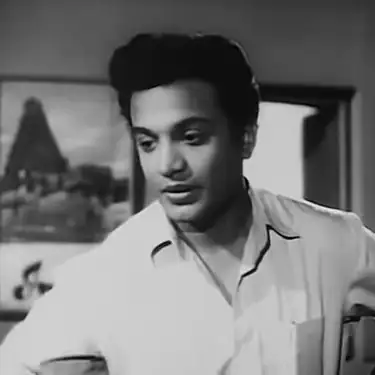
Uttam Kumar was born on 3 September 1926 in Calcutta and died on 24 July 1980 in the same city. Born Arun Kumar Chatterjee, he was the leading man of Bengali cinema for more than twenty-five years and acted in over 200 films. He started as a clerk in the Calcutta port office. His first films failed so often that he was nicknamed "Flop Master General".
His luck turned with Basu Paribar (1952) and Sharey Chuattor (1953), the first of nearly 30 films with Suchitra Sen. Satyajit Ray wrote Nayak (1966) with him in mind and then cast him as the detective Byomkesh Bakshi in Chiriyakhana (1967). For that film and Antony Firingee (1967) he won the first Best Actor award of the National Film Awards. He also produced films and directed three. He made a few in Hindi, among them Amanush (1975) and Gulzar's Kitaab (1977).
Life and Early Work
He was born at his mother's family home on Ahiritola Street in north Calcutta. His father, Satkari Chattopadhyay, was a projectionist at the Metro Cinema, which showed only English films. The family ran an amateur theatre troupe, the Suhrid Samaj, and the boy grew up around its rehearsals and acted in its production of Brajer Kanai. With friends he also started a group of his own, the Lunar Club.
After South Suburban School he studied commerce at the Government Commercial College. To help at home he became a clerk in the cash department of the Port Commissioners, at 275 rupees a month, and in his spare hours he went round the studios of south Calcutta. He married Gauri Ganguly in 1948.
His first film, the Hindi Mayador (1947), was never released. He first appeared on screen in Nitin Bose's Drishtidan (1948), as the younger self of the hero played by Asit Baran, credited under his own name. Kamona (1949) gave him a lead. Sahajatri (1951) was the first film to bill him as Uttam Kumar, and in it he mouthed songs sung by Hemanta Mukherjee for the first time.
On Stage and Screen
The early films failed one after another. The director Nirmal Dey changed that. He gave Uttam his first hit, Basu Paribar (1952), and then paired him with Suchitra Sen in Sharey Chuattor, after which Uttam left the port office. On 15 October 1953 he opened at the Star Theatre in Shyamali, from Nirupama Devi's novel, opposite Sabitri Chatterjee. Accounts of its run differ, but it played for hundreds of nights, and Ajoy Kar filmed it in 1956 with Uttam as the male lead.
Agradoot's Agni Pariksha opened on his birthday, 3 September 1954, ran 126 days and was the year's biggest Bengali hit. The romances with Sen followed, among them Shap Mochan (1955), Sagarika (1956) and Harano Sur (1957). In 1957 he formed Alo Chhaya Productions with Ajoy Kar, and its Harano Sur won a Certificate of Merit at the National Film Awards. That November the Metro broke its English-only rule to show the Bengali film Chandranath. His father, its chief projectionist, watched his son on the screen.
In 1961 came Saptapadi and Tapan Sinha's Jhinder Bondi, which set him against Soumitra Chatterjee for the first time. Ray's Nayak premiered at Indira Cinema in Calcutta on 6 May 1966 and won a Special Jury Award and the critics' prize at that year's Berlin festival. The same year Uttam directed his first film, Shudhu Ekti Bachhar. He also wrote the music for Kal Tumi Aleya.
The year 1967 brought Chiriyakhana and Sunil Banerjee's Antony Firingee, which opened at Durga Puja and ran more than 100 days. The awards were presented at Vigyan Bhavan in New Delhi on 25 November 1968, and the catalogue for that evening lists him as Best Actor of the Year for both films. His prize was a figurine. Ray won the direction award for Chiriyakhana the same night.
Hindi cinema went less well. He produced Chhoti Si Mulaqat (1967), a remake of Agni Pariksha with Vyjayanthimala, and it failed. Shakti Samanta shot Amanush in Bengali and Hindi at once, and the Hindi version, released in March 1975, earned him a Filmfare Special Award. In Jadubangsho (1974) he played Ganada, a tired older man.
On 23 July 1980 he was shooting Ogo Bodhu Sundori, an adaptation of Shaw's Pygmalion, and did seven takes of a scene on a staircase. That night, after a party, he felt the pain of a heart attack and drove himself to the Belle Vue Clinic. He died there the next day. The film was finished with a body double.
The Art of Uttam Kumar
Signature Roles
Saptapadi (1961). Krishnendu is a Hindu medical student in Calcutta who loves Rina Brown, an Anglo-Indian classmate played by Suchitra Sen. His father forbids the marriage, and years later he finds her drunk and unconscious in a military hospital. In the college production of Othello, Uttam plays the Moor on screen while Utpal Dutt's voice speaks the lines. The role won him the Bengal Film Journalists' Association award for Best Actor.
Jhinder Bondi (1961). Tapan Sinha took the story from Saradindu Bandyopadhyay's novel, itself drawn from The Prisoner of Zenda. Uttam plays three men: Gaurishankar Rai, a Calcutta sportsman, Shankar Singh, the heir to the throne of Jhind whom he resembles, and Kalishankar Rai, the ancestor of both. Soumitra Chatterjee played the villain Mayurbahan. A 2013 review in The Times of India thought the villain sometimes took the film from him.
Nayak (1966). Arindam Mukherjee is a film star on the overnight train to Delhi to collect an award, with a flop and a reported brawl behind him. Over a day and a night he tells Aditi, a magazine editor played by Sharmila Tagore, about his dead theatre mentor, the older star he snubbed and the friend he let down. Sayandeb Chowdhury points out that the journey echoes Uttam's own trip to Delhi in 1957 for the Harano Sur award. Playing a star so close to himself took nerve.
Chiriyakhana (1967). He was the first actor to play Saradindu Bandyopadhyay's detective Byomkesh Bakshi. A retired judge hires Byomkesh to find a missing actress who may be hiding at his nursery colony, and two murders follow. Uttam plays him as a patient questioner who works through the residents one by one.
Antony Firingee (1967). Hensman Anthony was a poet of Portuguese descent who composed and sang in Bengali. The film follows his contests with rivals such as Bhola Moira, played by Asit Baran. Manna Dey sang all of Uttam's songs. Sunil Banerjee shot much of it on location in Midnapore district.
Craft
Learning on the set. He had no formal training as an actor. In his rare remarks on acting, Sayandeb Chowdhury found, Uttam credited his early directors, among them Nirmal Dey and Tapan Sinha, with teaching him the work. Chowdhury calls him a natural actor rather than a Stanislavskian one, rehearsed "but never choreographed". Ray noticed his discipline. "I never saw him fooling around on the sets," he said.
Voice and song. Much of his stardom was sung by others. From Sahajatri onwards he mouthed Hemanta Mukherjee's songs, and when Hemanta scored Shap Mochan he sang four of them for Uttam. Uttam could change his own voice too. Atanu Ghosh, writing in The Telegraph's t2 in 2026, notes how his deep voice turns soft and weary as Ganada in Jadubangsho.
Theatre roots. He grew up in his father's amateur troupe and went back to the stage in Shyamali just as his films began to succeed. Chowdhury argues that he replaced the loud, declaiming manner of earlier Bengali screen actors with a plain, everyday one. The Othello scene in Saptapadi shows that he knew the difference.
Selected Filmography
Agni Pariksha (1954)
As Kiriti Mukherjee. Tapasi, a singer, falls in love with him and then learns that she was married as a child.
Harano Sur (1957)
As Alok Mukherjee. A businessman loses his memory in a train accident, and a second accident gives his past back but takes away his life with a doctor, Roma. He produced it.
Saptapadi (1961)
As Krishnendu. A medical student loves an Anglo-Indian woman his father will not accept. It won a National Film Award Certificate of Merit.
Jhinder Bondi (1961)
As Gaurishankar Rai. Tapan Sinha's adventure gives him three parts and ran for 57 weeks.
Nayak (1966)
As Arindam Mukherjee. A film star talks his way through a train journey to Delhi. Ray shot the train scenes on sets at New Theatres in Calcutta.
Chiriyakhana (1967)
As Byomkesh Bakshi. The detective story won Ray the National Film Award for direction.
Antony Firingee (1967)
As Hensman Anthony. A poet of Portuguese descent makes his name singing in Bengali. It was the highest-grossing Bengali film of the year.
Amanush (1974)
As Madhu Roy Chowdhury. A landowner's son is framed, drinks himself down in a Sundarbans fishing village, and saves it from a flood.
Legacy
Fans called him "Guru". The magazine Ultorath gave him the title Mahanayak, which stuck. In 2009 Tollygunge metro station in Kolkata was renamed Mahanayak Uttam Kumar, and India Post issued a stamp on his birthday. In 2012 the West Bengal government began the Mahanayak Samman, a film award in his name.
Colleagues judged him differently. Tapan Sinha said he freed Bengali cinema from the grip of the theatre. Soumitra Chatterjee felt that Uttam the star sometimes muzzled Uttam the actor. Ray wrote after his death that there would not be another hero like him.
His birth centenary fell on 3 September 2026. A restored Nayak had returned to cinemas the year before.