Adil Hussain
- Role
- Actor
- Acted in
- Assamese, English, Hindi
- Born
- 5 October 1963Goalpara
- On Art House Cinema
- No films yet
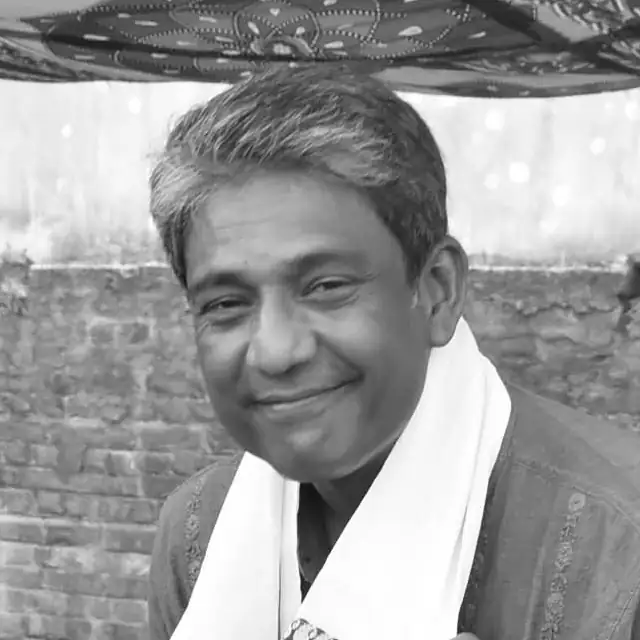
Adil Hussain was born on 5 October 1963 in Goalpara, a town in Assam close to the border with West Bengal. In his twenties he toured Assam as a stage comic. After training at the National School of Drama in Delhi and at Drama Studio London, he was a stage actor for many years before films found him. He came to wide notice in Hindi cinema at 46, as the gang lord in Abhishek Chaubey's Ishqiya (2010).
His work since then runs from Ang Lee's Life of Pi (2012) and Gauri Shinde's English Vinglish (2012) to small independent films. For Shubhashish Bhutiani's Mukti Bhawan and the Assamese film Maj Rati Keteki he received a Special Mention at the 64th National Film Awards, announced in April 2017. In August 2018 he won Norway's Amanda Award for Best Actor for Iram Haq's What Will People Say. He dedicated it to Goalpara.
Life and Early Work
He was the youngest of seven children in an Assamese Muslim family. His father taught school and later became a Muslim marriage registrar with no fixed salary. "We had land but very little cash," Hussain told The Better India in 2020. Cycle rickshaws were the main transport in Goalpara, and a rickshaw puller from Bihar rented the hut next door.
He acted in his first play at nine. During Bihu he watched a pair of travelling comedians who mimicked Hindi film stars, and he copied them for the neighbourhood children until, by the seventh class, he was performing as a mimic on stage.
In 1982 he went to B. Borooah College in Guwahati to study philosophy, with 250 rupees from his retired father. He joined the Bhaya Mama Group, a satirical troupe in which two stock characters, Gogoi and Bhaya Mama, interviewed other figures on stage. The act "wasn't slapstick comedy," he has said, and he toured Assam with its political satire for about five years.
He heard about the National School of Drama from an acquaintance, and its lack of fees made it possible. His father laughed, having never heard of a school for acting. Hussain left for Delhi in May 1990 and studied there until 1993, under teachers including Khalid Tyabji and Dilip Shankar. A Charles Wallace India Trust scholarship then took him to Drama Studio London for a year. He came home in 1994.
On Stage and Screen
His stage reputation came first. In 1999 he played Othello in Roysten Abel's Othello: A Play in Black and White, which won a Fringe First at the Edinburgh Festival Fringe that year, with Kristen Jain as Desdemona. At one performance he could not bring himself to kill her and held her instead, and Abel told him to "find a way to end the play." The two actors married in 2007, and Abel later turned the production into the film In Othello (2003), with Hussain in the lead.
Television brought him money before cinema did. He played the detective in Jasoos Vijay, an HIV awareness serial made by the BBC World Service Trust for Doordarshan, which he says paid him three lakh rupees a month in 2001. It drained him, and he stopped acting for three and a half years. From 2004 to 2007 he was artistic director of the Society for Artists and Performers in Hampi.
He had acted in a few Assamese films, and had a small part as a flight purser in Vishal Bhardwaj's Kaminey (2009). He did not want a film career, because "most of the films didn't inspire me," as he told DT Next. Chaubey flew from Bombay to Delhi to persuade him to do Ishqiya. Hussain agreed on conditions: he would not move to Bombay, his co-actors would be present for his scenes, and he would not dub.
Three larger films came in 2012. He was Satish Godbole in English Vinglish, Pi's father in Life of Pi and a part in Mira Nair's The Reluctant Fundamentalist. In 2013 he was the police inspector K. N. Singh in Vikramaditya Motwane's Lootera. Police and intelligence roles kept coming, which he put down in 2017 to being "not bankable".
Independent films took the rest of his time, beginning with a small part in Leena Yadav's Parched, shown at Toronto in September 2015. Mukti Bhawan premiered at the Venice Film Festival on 2 September 2016 and was released in India in April 2017. Santwana Bardoloi's Maj Rati Keteki won the National Film Award for Best Assamese Film. What Will People Say opened at Toronto in September 2017 and was Norway's entry for the Academy Awards.
Commercial films such as Commando 2 (2017) and Shankar's 2.0 (2018) paid for the small ones. Then came 2020. He played Buchi Paswan, a rickshaw puller in Ranchi, in Prakash Jha's Pareeksha, and Lieutenant Aditya Sahil in the third season of Star Trek: Discovery, shot in Toronto.
The Art of Adil Hussain
Signature Roles
Ishqiya (2010). Vidyadhar Verma is a gang lord in Gorakhpur whom everyone believes dead. His wife Krishna, played by Vidya Balan, shelters two small-time crooks and turns them to her own ends, and in time she learns he may be alive. The part is short. Verma walks in late, and his return turns the plot before he dies in a gas explosion.
English Vinglish (2012). Satish Godbole is a corporate man who takes his wife Shashi for granted and laughs at her English. Hussain plays no villain. Satish simply does not notice the harm he does. Of Sridevi, who played Shashi, he later said a good actor is "genuinely feeling that emotion at that particular time."
Life of Pi (2012). Santosh Patel runs the family zoo in Pondicherry and is a rationalist who tries to steer his son away from religion. When Pi gets too close to the tiger Richard Parker, his father makes him watch it kill a goat. Tabu played his wife.
Mukti Bhawan (2016). Rajiv, a middle-aged working man, takes his 77-year-old father Daya, played by Lalit Behl, to a lodge in Varanasi where the old go to die. Hussain called Rajiv "a culmination of all the sons in this world." He and Behl talked about death throughout the shoot in Varanasi. At Venice it received a standing ovation of some ten minutes.
What Will People Say (2017). Mirza is a Pakistani immigrant in Oslo who takes his 16-year-old daughter Nisha to Pakistan after he finds her with a Norwegian boy. Haq drew the story from her own life. In the last scene Nisha climbs out of a window to run away, and Mirza watches her go without stopping her.
Craft
The body first. "The body is my instrument," Hussain told Film Companion. He has described breath as tied to emotion and says that understanding this link is at the centre of acting. He has also said that "one tiny shift in the body posture can change the entire expression."
Leaving the method. His training in Delhi and London drew on Stanislavski and Grotowski, and he has added the teachings of Sri Aurobindo and Ramakrishna. He later decided that chasing a character as a method actor had been "terrible" for him. He does not reshape a character to suit his own personality, and for Buchi Paswan he drew on the rickshaw puller from Bihar who lived next door in Goalpara.
The stage as practice. Theatre is where an actor hones the craft, he says, since stage actors rehearse every day, but films now leave him little time for it. For years he has planned a solo piece with Dilip Shankar, a dialogue between Krishna and Arjuna in which he plays both. He wants two or three years to prepare it.
Selected Filmography
Ishqiya (2010)
As Vidyadhar Verma. Chaubey's first feature is a black comedy set in Uttar Pradesh, with Naseeruddin Shah and Arshad Warsi as the two crooks.
English Vinglish (2012)
As Satish Godbole. Shinde's film premiered at Toronto on 14 September 2012 and opened in India in October.
Life of Pi (2012)
As Santosh Patel. Lee's 3D film follows Pi from Pondicherry to a lifeboat shared with a Bengal tiger.
Lootera (2013)
As Inspector K. N. Singh. Motwane drew the second half of his film from O. Henry's 1907 story "The Last Leaf".
Parched (2015)
As the mystic lover. Yadav's film follows four women in a desert village in Rajasthan, and it opened in Indian cinemas in September 2016.
Mukti Bhawan (2016)
As Rajiv. Bhutiani was 25 when he made this debut feature, which won the UNESCO Gandhi Medal at Venice.
Maj Rati Keteki (2017)
As Priyendu Hazarika. A writer goes back after years to the small town where he began to write and faces his past.
What Will People Say (2017)
As Mirza. The film won Hussain the Amanda Award for Best Actor, presented in Haugesund in August 2018.
Legacy
Hussain came to Hindi cinema in middle age, by way of satire in Assam and years of theatre. He has never moved to Bombay. He has kept working in Assamese and abroad, and commercial fees have kept him in small films that pay little.
His prizes have come from those small films. The 2017 Special Mention was for two of them, a Hindi film by a 25-year-old debutant and an Assamese film. The Amanda came from Norway, and announcing it he wrote: "This award is for Goalpara, Assam, India."
He has taught actors at the National School of Drama and at Hampi, and says he learns more than he teaches. "My job is to create empathy through my work," he told the Khaleej Times.