
John Abraham
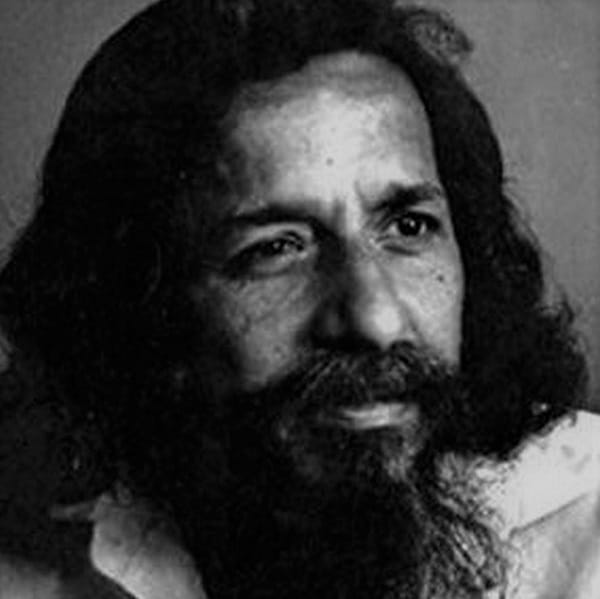
John Abraham (1937–1987) was an Indian filmmaker, screenwriter, and short-story writer who, in a career compressed into barely two decades and four completed feature films, became one of the most uncompromising and influential figures in the history of Indian parallel cinema. Working principally in Malayalam, with a single celebrated excursion into Tamil, he fashioned a body of work that fused political radicalism, Christian and Marxist iconography, and a restless formal experimentation rarely matched in the cinema of his generation. Though he directed only four films, each became a landmark, and his final film, Amma Ariyan (1986), remains the only South Indian feature to be included in the British Film Institute’s list of the ten greatest Indian films.
A graduate of the Film and Television Institute of India, where he studied under Ritwik Ghatak and worked alongside Mani Kaul, Abraham emerged from the crucible of the Indian New Wave with an aesthetic and political sensibility entirely his own. He was at once a product of the parallel-cinema movement and a rebel against its institutional dependence on state patronage and conventional distribution. His Tamil satire Agraharathil Kazhuthai (1977) won the National Film Award for Best Feature Film in Tamil, and Amma Ariyan received the National Film Award’s Special Jury Award in 1986. Yet awards capture only a fraction of his significance, for Abraham’s most enduring contribution was an idea: that cinema could be wrested from the marketplace and returned to the people who watched it.
To finance and circulate his last film, Abraham founded the Odessa Collective in 1984, a grassroots movement that raised production funds by going from village to village and house to house, performing street plays, beating drums, and screening Charlie Chaplin’s The Kid to gather contributions. Amma Ariyan was thus made by the public and exhibited across Kerala on a non-commercial basis, a genuine experiment in a “people’s cinema” unmediated by market forces. This audacity, together with his itinerant, self-destructive personal life, earned him the epithet Ottayan, the Lone Tusker—the solitary bull elephant that breaks from the herd.
Abraham died in 1987 at the age of forty-nine, following a fall, his life and art alike marked by intensity, contradiction, and a refusal of compromise. In the decades since, his reputation has steadily grown, and he is now widely regarded as one of the founding figures of independent cinema in Malayalam. The actor and comedian Adoor Bhasi, who appeared in two of his films, called him simply “a wonder in world cinema.”
Life and Early Work
John Abraham was born on 11 August 1937 in Chennamkary, a village in the Kuttanad region of Alleppey (Alappuzha) district in what was then the princely state of Travancore. Kuttanad, a low-lying expanse of paddy fields, backwaters, and canals—much of it lying below sea level—was among the most distinctive agrarian landscapes in Kerala, and its waterlogged terrain, its feudal landholding patterns, and its devout Syrian Christian communities would later furnish the imagery and moral concerns of Abraham’s cinema. He belonged to the Vazhakkat branch of the Pattamukkil family, a Christian household of the region.
Abraham completed his intermediate studies at CMS College, Kottayam, where he lived with his grandfather, who is said to have encouraged the boy’s early intellectual and artistic inclinations. He went on to take a degree in history and politics at Mar Thoma College, Tiruvalla. This grounding in history and political thought, combined with the deep familiarity with both Christian theology and Marxist ideas that he absorbed in the politically charged atmosphere of mid-century Kerala, would mark him for life; few Indian filmmakers moved as fluently between the symbolic vocabularies of the Gospel and of class struggle.
After graduating, Abraham worked briefly as a private college teacher before taking a position as an office assistant with the Life Insurance Corporation of India in Udupi, in coastal Karnataka. The settled routine of clerical employment was profoundly unsuited to his temperament, and the decisive turn in his life came when he secured admission to the Film and Television Institute of India in Pune, the institution that was then incubating much of the talent of the Indian New Wave. At the FTII he came under the influence of the Bengali master Ritwik Ghatak, whose passionate, politically engaged, and formally daring cinema left a permanent imprint on him, and he formed associations with contemporaries such as Mani Kaul. Abraham excelled as a student, graduating with gold medals in both screenwriting and film direction.
His apprenticeship in the industry began as an assistant director to Mani Kaul on the seminal Hindi film Uski Roti (1969), one of the foundational works of Indian parallel cinema. During this period Abraham made a number of short and documentary films, including Priya, his diploma film at the FTII, and worked on several Hindi projects shot in Kerala that were never released. Alongside cinema he pursued literature, writing short stories in Malayalam; a collection of his fiction was later published under the title Nerchakkozhi, and a further posthumous collection, John Abrahaminte Kathakal, appeared in 1993. Throughout his life the boundaries between his writing, his political convictions, and his filmmaking remained porous, each feeding the others.

Agraharathil Kazhuthai (1977)
Filmmaking
Abraham’s directorial career as a maker of feature films was brief and intermittent, yielding only four completed works across fourteen years. His feature debut was Vidyarthikale Ithile Ithile (This Way, Students, 1972), a Malayalam film scripted by M. Azad and featuring established stars of the Malayalam screen including Madhu, Adoor Bhasi, Jayabharathi, and the Telugu actor S. V. Ranga Rao, with cinematography by Ramachandra Babu and music by M. B. Sreenivasan. Satirical in tone and concerned with the condition of students and the failures of the educational and social order, the film announced the irreverent, anti-establishment sensibility that would characterise all his work, even if it did not yet achieve the formal radicalism of his later cinema.
Recognition came with his second feature, the Tamil film Agraharathil Kazhuthai (Donkey in a Brahmin Village, 1977), written with the critic Venkat Saminathan. A mordant social satire, it follows a university professor named Narayanaswami who adopts an orphaned donkey and brings it into a cloistered Brahmin agraharam, where the animal’s alien presence unleashes scorn, superstition, and finally violence, as the villagers come to blame it for their misfortunes and kill it. Through this deceptively simple fable Abraham mounted a withering critique of caste hypocrisy, ritual orthodoxy, untouchability, and mob irrationality. The film won the National Film Award for Best Feature Film in Tamil and would later be ranked among the hundred greatest Indian films of all time in a 2013 poll. Its unsparing treatment of religious and caste sensibilities also made it controversial, and the film had a difficult passage to audiences.
For his third feature Abraham returned to Malayalam and to the landscape of his birth with Cheriyachante Kroorakrithyangal (The Cruelties of Cheriyachan, 1979), starring Adoor Bhasi in a rare dramatic role alongside Kaviyoor Ponnamma, Poornima Jayaram, and Nedumudi Venu, with cinematography by Madhu Ambat and music by Johnson. Set against the feudal world of Kuttanad and saturated with Christian and feudal symbolism, the film follows Cheriyachan, a landlord who feels his world threatened by industrialisation and the rising tide of leftist activism. When he witnesses the brutality of the police against poor peasants, an overwhelming sense of guilt engulfs him, and he comes to feel responsible for the sins of his entire class; in the film’s haunting final image he is seen clinging to the top of a coconut palm, fleeing the police and, it seems, himself. The film won Abraham a Special Jury Award at the Kerala State Film Awards and confirmed his mastery of allegory and his capacity to weld personal anguish to historical critique.
Abraham’s final and greatest film, Amma Ariyan (Report to Mother, 1986), was also the most radical in both its mode of production and its form. The narrative begins when a young man, Purushan, setting out on the road to Delhi, encounters the corpse of a youth—Hari, a tabla player and former Naxalite—who has died, apparently by suicide. Unable to identify the dead man to his mother, Purushan and a growing company of fellow travellers undertake a long journey across Kerala to find her and to report the death, gathering along the way those who knew the dead man. Structured as a series of letters or a visual report addressed by Purushan to his own mother, the film weaves together fiction and documentary, flashback and digression, personal memory and the collective history of revolutionary politics, police brutality, and political disillusionment in Kerala. Its iconoclastic, essayistic structure—punctuated by ellipses, inserts, and reflexive commentary—made it one of the most formally adventurous films in Indian cinema.
Equally significant was how Amma Ariyan came into being. In 1984 Abraham had founded the Odessa Collective, launching it with a street drama in Fort Kochi titled Nayykali (The Game of Dogs). Conceived as a movement to free film production and distribution from the grip of commerce, Odessa raised the money for Amma Ariyan through public subscription, its members travelling from village to village collecting small contributions and screening Chaplin’s The Kid to draw audiences. The finished film was then carried across Kerala and shown on a non-commercial basis in halls, schools, and open spaces. The film received the National Film Award’s Special Jury Award. At the time of his death Abraham had begun, but never completed, a documentary on the life of the Communist leader and former Kerala chief minister E. M. S. Namboodiripad, and he left behind numerous finished and unfinished scripts.
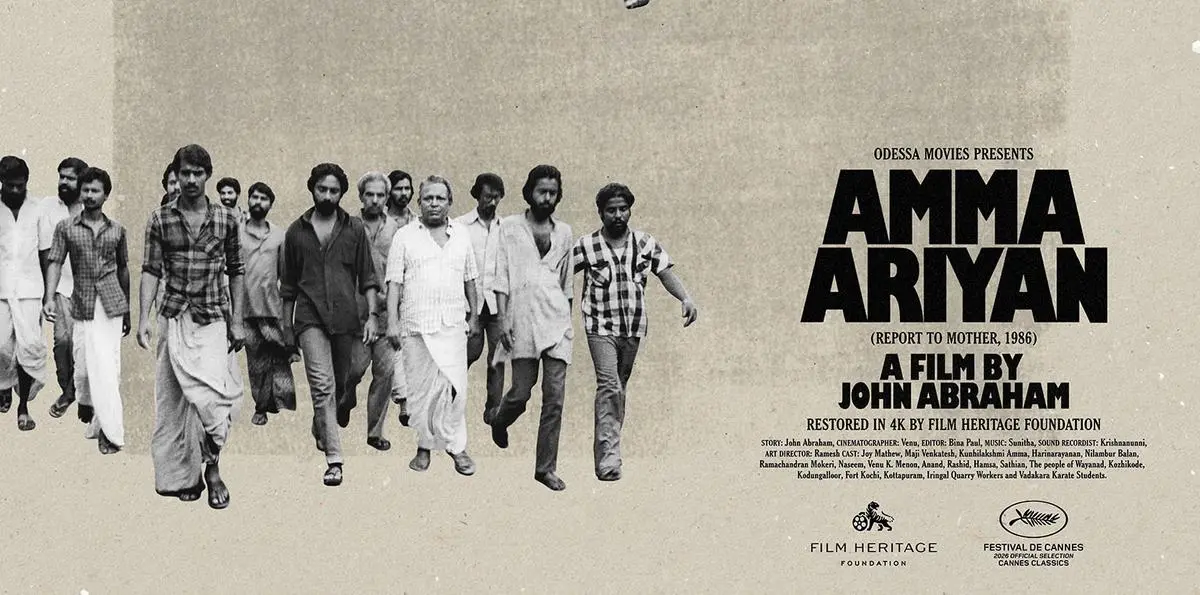
Amma Arian (1986). Poster. Source Film Heritage Foundation. Festival De Cannes.
The Cinema of John Abraham
The cinema of John Abraham is inseparable from the convictions that governed his life: that art must serve a moral and political purpose, that the artist must stand with the dispossessed, and that the conditions under which films are made and seen are themselves political questions. Trained in the rigorous, modernist idiom of the FTII and shaped above all by Ritwik Ghatak, Abraham nonetheless resisted the cool formalism that characterised much of the parallel-cinema movement. His films are passionate, allusive, and frequently unruly, animated by an anger at injustice that never entirely hardens into doctrine. He drew with equal facility on the imagery of Christianity—sacrifice, guilt, redemption—and on the analysis of Marxism, producing a body of work in which theology and class struggle illuminate one another.
Formally, Abraham was among the great experimenters of Indian cinema. He distrusted seamless storytelling and conventional dramatic structure, preferring fable, allegory, and the essayistic accumulation of fragments. His landscapes—above all the waterlogged feudal world of Kuttanad—are never mere backdrops but active moral presences, and his use of sound, music, and the long, observational take reflects a desire to make the spectator think rather than simply feel. Above all, his founding of the Odessa Collective expressed a conviction that runs through all his work: that genuinely free cinema requires freedom not only in the frame but in the economy of its making, and that the audience must be a participant in, not merely a consumer of, the work.
Key Themes
Caste, class, and social hypocrisy: Abraham’s films repeatedly expose the cruelties concealed beneath the surface of respectable society—the orthodoxy and superstition of the Brahmin agraharam, the violence of the feudal order, and the moral evasions of the propertied classes. His satire is unsparing but never merely cynical; beneath the mockery lies a genuine moral seriousness.
Guilt, sacrifice, and Christian symbolism: Drawing on his Syrian Christian background and the landscape of Kuttanad, Abraham infused his work with images of guilt, atonement, and sacrifice. The landlord Cheriyachan’s crushing sense of collective guilt, and the sacrificial logic that pervades his fables, give his political critiques a distinctly theological resonance.
Revolutionary politics and disillusionment: The history of the Left in Kerala—its hopes, its martyrs, and its failures—runs through his cinema, most powerfully in the meditation on the Naxalite movement, police brutality, and political disillusionment that animates his final film. Abraham was sympathetic to revolutionary aspiration while remaining clear-eyed about its costs and contradictions.
Cinema as a people’s movement: Perhaps his most original theme was reflexive: the question of who makes cinema, who pays for it, and who watches it. The Odessa Collective embodied his belief that film could be liberated from the marketplace and made collectively, by and for ordinary people, an idea that informs both the production and the form of his work.
The outsider and the nomad: Abraham was drawn to figures of estrangement—the donkey that does not belong, the guilt-stricken landlord fleeing his class, the wandering company carrying news of a death. These reflect his own itinerant, self-exiled life and his sense of the artist as one who breaks from the herd.
Selected Filmography
Vidyarthikale Ithile Ithile (1972). Abraham’s Malayalam feature debut, a satirical work concerning students and the social order, featuring leading Malayalam actors of the day. Though more conventional than his later cinema, it established the irreverent, anti-establishment voice that would define his career.
Agraharathil Kazhuthai (1977). A Tamil-language social satire in which a professor brings an orphaned donkey into an orthodox Brahmin village, with catastrophic results. A scathing allegory of caste hypocrisy, superstition, and mob violence, it won the National Film Award for Best Feature Film in Tamil and is widely regarded as one of the finest Indian films ever made.
Cheriyachante Kroorakrithyangal (1979). Set in the feudal landscape of Kuttanad and steeped in Christian and feudal symbolism, this Malayalam film traces a landlord’s descent into guilt as he confronts the violence of his own class against the peasantry. A profound meditation on conscience and class, it earned a Special Jury Award at the Kerala State Film Awards.
Amma Ariyan (1986). Abraham’s masterpiece and final film, an epistolary road movie in which a company of travellers journeys across Kerala to inform a mother of her son’s death, in the process reconstructing the history of the region’s revolutionary politics. Produced collectively through the Odessa Collective and exhibited non-commercially, it received the National Film Award’s Special Jury Award and is the only South Indian feature in the British Film Institute’s list of the ten greatest Indian films.
Legacy
John Abraham died on 31 May 1987 in Kozhikode, the day after a fall from a rooftop following a party. The circumstances of his death were grievous: admitted to the Kozhikode Medical College hospital unidentified, he was reportedly not recognised by the staff and did not receive timely attention; years later a surgeon who had been present, B. Ekbal, publicly lamented that the director might have been saved had his identity and his internal injuries been recognised in time. The squalor and neglect of his final hours stood in painful contrast to the moral grandeur of his art, and they have come to seem emblematic of the precarious place that uncompromising artists occupy in society.
In the years since his death Abraham’s stature has only grown. He is now regarded as one of the founding figures of independent cinema in Malayalam, and his influence extends across a generation of filmmakers who have sought, in his example, the courage to think and create beyond the conventional. Amma Ariyan and Agraharathil Kazhuthai continue to be studied, restored, and screened at film festivals and archives around the world, and the Odessa Collective remains a touchstone for movements seeking to democratise film production and exhibition.
His memory has been institutionalised in Kerala’s film culture. The Federation of Film Societies of India (Kerala) instituted the John Abraham Award for Best Malayalam Film in 1998, and since 2005 the John Abraham National Awards have honoured the best documentary and short films screened at the SIGNS festival, ensuring that his name is associated in perpetuity with the kind of independent, socially engaged cinema he championed. His short fiction, too, has kept his literary reputation alive.
Abraham occupies a singular place in the history of Indian cinema. He completed only four feature films, yet each is a landmark, and together they constitute one of the most coherent and uncompromising visions in the country’s parallel-cinema tradition. The “Lone Tusker” who broke from every herd—commercial, institutional, and even artistic—he insisted that cinema be at once politically serious, formally daring, and answerable to the people. In an industry shaped overwhelmingly by the market, John Abraham remains the conscience of an alternative: the artist who dreamed, and briefly realised, a cinema made by and for the people.