Films with Kanu Banerjee on Art House Cinema


Kanu Banerjee was born on 20 June 1905 in Jodhpur, in present-day Rajasthan, and died on 27 January 1983. A 2012 article in The Telegraph gives his dates as 1905 to 1985, but IMDb and other reference works give 1983. Born Kanailal Bandyopadhyay, he is also credited as Kanu Bandyopadhyay and Kanu Banerji. He acted on the Bengali stage and screen for over fifty years.
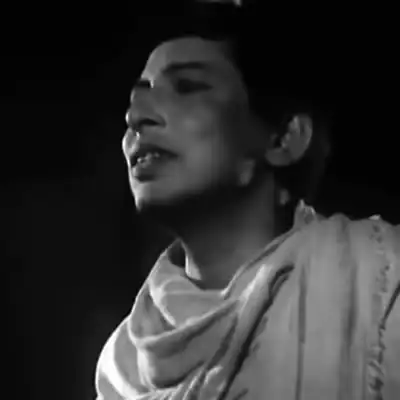
Audiences outside Bengal know him as Harihar Ray, Apu's father, in Satyajit Ray's Pather Panchali (1955) and Aparajito (1956). By then he had been in films for twenty years, and Soumitra Chatterjee counted 86 of them before Ray called on him. He was one of three professionals in that cast. The others were Chunibala Devi and Tulsi Chakraborty.
He learnt his trade from Sisir Kumar Bhaduri. Bhaduri was the actor-manager who brought a quieter, more natural style to the Calcutta stage. That training shows in Harihar, a poor priest who writes verse and is sure that things will come right.
Life and Early Work
He was born in a village near Jodhpur, where his father, Srikrishna Bandyopadhyay, worked for the Salt Revenue department in northern India. His mother was Shyamasundari Devi. A transfer brought the family to Calcutta, and they settled in the north of the city. At ten or eleven he recited Sanskrit verse at a neighbour's house, and the playwright Amritlal Basu, who was listening, was pleased with him.
He passed his matriculation from the Maharaja Cossimbazar Polytechnic School in Baghbazar and enrolled at City College, but almost at once he took a job with the East Indian Railway. A year later he moved to the post office, where he stayed until 1947.
His evenings went to the theatre. He joined an amateur group, Sandhya Samiti, directed by Bhubanesh Mustafi, son of the actor Ardhendu Shekhar Mustafi, and played women's parts there, including one in Pratapaditya. When no part could be found for him at the Rangmahal theatre, the actor and playwright Jogesh Choudhury told him he would learn nothing there. He sent him to Sisir Bhaduri with a letter.
Bhaduri tried to put him off, warning that the stage was a poor line of work and that his own family would shun him for it. The young clerk persisted. In 1932 Bhaduri gave him the part of Bikram Solanki in Alamgir.
On Stage and Screen
That first part began sixteen years with Bhaduri, which ran without a break until Dukhir Iman in 1948. He toured with the company as far as Delhi and Lucknow and acted in nearly every play Bhaduri staged. In Bijoya he began in a small role and, over time, stood in for almost every male part, including Bhaduri's own role of Rasbihari. On a single day in Alamgir he played both the comic Eradat Khan and the serious Bhim Singh. Afterwards Bhaduri told him, "Kanai, I owe you an appreciation."
The stage also brought him his proudest night. Tagore had adapted his novel Jogajog for Bhaduri, and when it was staged at the Star Theatre, Kanu Banerjee played Nabinkrishna. After the show Tagore asked for him, but the actor was so nervous that he fled the green room. The next day Bhaduri took him to Jorasanko, where Tagore told him he had been moved by his acting.
Films ran alongside the plays. His first appearance was a small part in P. N. Ganguly's silent Durgeshnandini, probably in 1924. His first sound film was Shubha Trihasparsha (1934), directed by the playwright Manmatha Ray. In 1947 he left the post office to act full time. When the playwright Debnarayan Gupta tried to talk him out of it, he said that stage parts kept running through his head while he sat with his pen. Through the 1940s and early 1950s he played character parts in films such as Chanakya (1939), which Bhaduri directed, and Chitta Bose's Bindur Chhele (1952).
Ray approached him during an invited show of Mess No. 49 and offered him Harihar, saying he had watched a lot of his work. On the first day of shooting, as Marie Seton's biography of Ray records, Banerjee arrived with a fresh haircut that Ray thought wrong for a village priest. Ray stopped the shoot. He accepted the loss and waited for the hair to grow back. The actor went round telling people that he had found a real director at last.
Pather Panchali won the President's Gold Medal for the best feature film, and at Cannes in 1956 it received the prize for the Best Human Document. Aparajito won the Golden Lion at Venice in 1957. Banerjee went back to the steady work of a character actor. Soumitra Chatterjee counted at least 112 films between 1934 and 1981.
The Art of Kanu Banerjee
Signature Roles
Champadangar Bou (1954). Nirmal Dey's film of a story by Tarasankar Bandyopadhyay cast him as Setap, the village headman and moneylender, a man who values money above everything. When he hears that his wife Kadambini and his younger brother Mahatap are close, he flies into a rage. Setap is a hard man of property. He is the opposite of the penniless Harihar, whom Banerjee played a year later.
Pather Panchali (1955). Harihar Ray is a priest and would-be playwright who leaves the village for months to look for work while his wife Sarbajaya keeps the household going. He comes home cheerful, calling for his children and carrying presents from the town, among them a sari for his daughter Durga. He does not know yet. Sarbajaya breaks down at his feet, and he learns that Durga has died of a fever.
Bhagaban Sri Sri Ramakrishna (1955). Prafulla Chakraborty's film cast him as the nineteenth-century saint, with Chhabi Biswas as Mathur. When the producers asked his fee, he was about to name a good sum until he remembered that Ramakrishna taught that money is clay. He asked for nothing and took the four or five thousand rupees they offered. For the length of the shoot he refused other films, bathed in the Ganges every morning and spent hours at worship.
Aparajito (1956). Harihar has moved the family to Benares, where he earns a living as a priest on the ghats, and there he catches a fever. Before dawn Sarbajaya sends Apu to fetch Ganges water for his father's lips. Harihar dies soon after. His head drops back on the pillow, and Ray cuts to a flock of pigeons rising into the sky.
Craft
Observation. Bhaduri taught him to keep watching people. For Nitai Ganguli in the stage play Biraj Bou, he borrowed a habit from a neighbour, Giren Babu, who would raise a hand above his head, snap his fingers and say "Narayan, Narayan." He also played a strict, priggish headmaster in Uro Chithi, and a spectator named Abbasuddin told him afterwards that he had met that very man. "You have to keep your eyes and ears open," Banerjee said.
Sisir's school. Bhaduri insisted on action and reaction between actors, and he spoke blank verse close to prose where older actors had sung their lines. Banerjee wrote that his teacher first explained a character in full and then told the cast, "Don't do what I do, do what I say." He could be harsh too. When a scene went wrong he would shout, "Where's Kanai? You acted like a buffoon."
The camera's eye. Banerjee said Ray was the first to see that a film is watched through the camera's eye, and that this is the difference between theatre and cinema. Working on the two Apu films, he said, had given him real pleasure.
Selected Filmography
Bindur Chhele (1952)
As Priyababu. Chitta Bose directed this film of Sarat Chandra Chattopadhyay's novel about a childless woman who raises her brother-in-law's son.
Champadangar Bou (1954)
As Setap. Nirmal Dey wrote, produced, shot and directed this film of Tarasankar Bandyopadhyay's story.
Pather Panchali (1955)
As Harihar Ray. Satyajit Ray's first film, from Bibhutibhushan Bandyopadhyay's novel, with Karuna Banerjee as Sarbajaya.
Bhagaban Sri Sri Ramakrishna (1955)
As Sri Ramakrishna. A life of the saint of Dakshineswar, written and directed by Prafulla Chakraborty.
Aparajito (1956)
As Harihar Ray. The second film of the Apu Trilogy, and the winner of the Golden Lion at Venice in 1957.
Legacy
Bengali theatre gives its leading actors honorific titles, and he never received one. Writing about Pather Panchali, Sambhu Mitra asked whether Kanu Banerjee's wonderful acting in it would be valued. By 1971 Banerjee was bitter. "Nobody calls me any more," he said in a memoir piece that year, calling himself a broken winnowing basket whose evenings felt empty without a part to play.
He taught others. Soumitra Chatterjee named him as one of the teachers of Sabitri Chatterjee, Bhanu Bandyopadhyay, Uttam Kumar and Satya Bandyopadhyay. In a tribute for Banerjee's hundredth birthday, Chatterjee wrote that the two never acted together. Before his own debut in Apur Sansar, though, he had formed his idea of film acting by watching Pather Panchali, Aparajito, Parash Pathar and Jalsaghar, and he named Banerjee as one of the actors who carried that quiet style.
In 2012 the publisher Sutradhar brought out Hariharer Panchali, built from a long interview for the 1979 puja issue of the magazine Baro Maas and some shorter ones. In it Banerjee praises Pramathesh Barua as warmly as Ray, and he tells how a hefty actress playing his wife once hugged him so hard on stage that he nearly fainted. In June a bust went up at Tala. He had lived in that north Kolkata neighbourhood.