Shriram Lagoo
- Role
- Actor
- Acted in
- Hindi, Marathi
- Born
- 16 November 1927Satara district
- On Art House Cinema
- No films yet
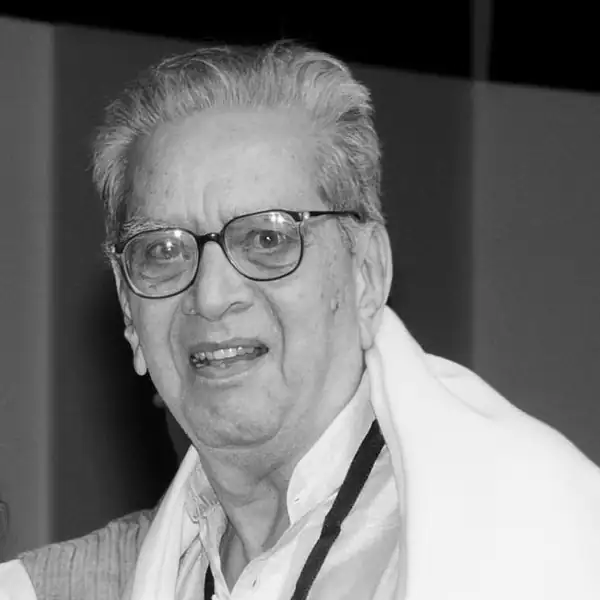
Shriram Lagoo was born on 16 November 1927 in Satara district, in present-day Maharashtra, and died on 17 December 2019 in Pune, aged 92. He was an ear, nose and throat surgeon who gave up medicine at 42 to act full time, and on the Marathi stage he is remembered above all as Appa Belwalkar, the ageing tragedian of Kusumagraj's Natsamrat. In films he worked in Marathi and Hindi for more than four decades.
His film career began with V. Shantaram's Pinjra (1972). Jabbar Patel then cast him in Samna (1974) and Sinhasan (1979), two political films written by Vijay Tendulkar. In Hindi he won the Filmfare Award for Best Supporting Actor for Bhimsain's Gharaonda (1977). He received the Padma Shri in 1974, and the Sangeet Natak Akademi gave him its award for acting in 1970 and its Fellowship, its highest honour, for 2009.
Life and Early Work
Lagoo was the eldest of four children of Balakrishna Chintaman Lagoo and Satyabhama Lagoo. He went to Bhave High School and Fergusson College in Pune, and then to B. J. Medical College, where he took his MBBS and MS. He was acting in college plays while he trained, and with his senior friend Bhalba Kelkar he founded the Progressive Dramatic Association in Pune, an amateur company that revived older Marathi plays by Vasant Kanetkar and P. K. Atre, usually with Lagoo in the lead.
He trained as an ENT specialist at Sassoon Hospital in Pune and took an ENT qualification from the University of Bombay in the early 1950s. He practised in Pune for six years and trained further in Canada and England, and in the 1960s he also worked as a surgeon in Tabora, Tanzania. Through all of it he kept acting as an amateur. That double life lasted from 1952 to 1969.
Then he chose. In 1969 he made his professional debut in Kanetkar's Ithe Oshalala Mrityu, a historical play about Sambhaji. He was 42, and he did not go back to surgery.
On Stage and Screen
Natsamrat opened in 1970, with Shanta Jog opposite him. Kusumagraj, the pen name of V. V. Shirwadkar, built the play loosely on King Lear. Appa Belwalkar is a famous Shakespearean actor who retires, gives everything he owns to his son and daughter and then has to leave both their homes. Lagoo played him for years, and the part made him a household name in Maharashtra. Two years later he played a reformer modelled on Dhondo Keshav Karve in Kanetkar's Himalayachi Savali, again with Jog.
His stage work moved between the popular theatre and the experimental one. With Vijaya Mehta's group Rangayan he acted in Tendulkar's Mi Jinkalo Mi Harlo and Madi. He directed and starred in Tendulkar's Gidhade, a play that caused a scandal. In 1974 he directed the first run of G. P. Deshpande's Uddhwasta Dharmashala and played its Marxist professor, Shridhar Vishwanath Kulkarni. He also translated and directed Ugo Betti's The Queen and the Rebels and Anouilh's Antigone.
For years he turned down films, because his practice and the theatre left no room for them. Shantaram changed that. Pinjra, made in Marathi and Hindi with the same cast, cast Lagoo as a village schoolteacher ruined by his love for a tamasha dancer, played by Sandhya. It cost about five lakh rupees and ran for 134 weeks in Pune. Jabbar Patel came next, with Samna, Sinhasan and, much later, Mukta (1994). In the Marathi film Devki Nandan Gopala (1977) he played the reformer Gadge Maharaj.
Hindi films used him more often and less well. He played shipping magnates, lawyers, judges and fathers. In Insaaf Ka Tarazu (1980) he was a lawyer, Mr Chandra, and in Muqaddar Ka Sikandar (1978) he was Ramnath. Richard Attenborough cast him as Gopal Krishna Gokhale in Gandhi (1982). Mrinal Sen gave him a different kind of part in Ek Din Achanak (1989), as a professor who walks out of his home and never returns. The theatre critic Arun Naik wrote that Lagoo later saw many of his small Hindi roles as a mistake and stepped back from them. He kept returning to substantial parts on stage, even in old age.
The Art of Shriram Lagoo
Signature Roles
Pinjra (1972). Shridhar Pant, called Guruji, is the moral centre of his village. He tries to stop a tamasha troupe from performing and then falls for its dancer, Chandrakala. Shantaram's film draws on Heinrich Mann's novel Professor Unrat, the source of The Blue Angel. Lagoo plays the teacher's fall with a flustered, divided stillness. In the final shot the gilded cage of the title covers his face.
Samna (1974). The man the sugar baron Hindurao Dhonde Patil calls Master has no name. He arrives in a village in a khadi dhoti and Gandhi cap, a bottle in his cloth bag, and keeps asking what happened to Maruti Kamble, a Dalit man who has disappeared. Tendulkar wrote him as a moral force more than a person. Lagoo answers Nilu Phule's expansive Dhonde Patil with a small voice and a closed body, and wins.
Gharaonda (1977). Mr Modi is a rich, ailing widower who proposes to Chhaya, a young woman in his office, played by Zarina Wahab. Her lover, played by Amol Palekar, urges her to accept and wait for Modi to die. Modi gets better instead. Modi falls ill again and Chhaya nurses him. At the end he offers her a divorce.
Sinhasan (1979). Vishwasrao Dabhade is the state's finance minister, quietly collecting the support of MLAs against his own chief minister, Jivajirao Shinde, played by Arun Sarnaik. Patel's film came from two novels by the journalist Arun Sadhu, Sinhasan and Mumbai Dinank, with a screenplay by Tendulkar. When the chief minister falls ill, Dabhade is one of the ministers who gather round and advise him to take it easy. Nobody believes the advice.
Ek Din Achanak (1989). Professor Shashank Ray goes out for a walk on a rainy evening and never comes back. Mrinal Sen's film, from Ramapada Chowdhury's novel Beej, follows his wife and children as they try to understand him. Shabana Azmi plays his elder daughter, Neeta. Uttara Baokar, as his wife, won the National Film Award for Best Supporting Actress.
Craft
Words first. Lagoo was frank about where his attention went. "I am not committed to stage directions. I am committed to dialogues," he once said, as quoted by Arun Naik. Appa Belwalkar is a part made of long speeches. In Samna the words are few. Asked where he comes from, the Master says he has come from the time before Independence and is going to the end of his own.
The body. He treated fitness as part of the job. "The body is the actor's equipment. It should be maintained," he said. He spoke of Stanislavski, Grotowski, Artaud and Strasberg, and he translated and directed foreign plays largely so that he could play their leads. He was also willing to admit failure, and he named his Macbeth and his Cyrano as two parts he had not managed.
Stage and camera. Naseeruddin Shah wrote that the ease of Lagoo's delivery, and of Paul Scofield's, convinced him there was no difference between good acting on stage and in film. Shah made the point after watching him on stage. It holds on film too.
Selected Filmography
Pinjra (1972)
As Shridhar Pant. V. Shantaram's tamasha drama won the National Film Award for Best Feature Film in Marathi.
Samna (1974)
As the Master. Jabbar Patel's first feature competed at the Berlin Film Festival in 1975 and won the National Film Award for Best Marathi Feature Film.
Gharaonda (1977)
As Mr Modi. Bhimsain's film about the Bombay housing crisis won Lagoo the Filmfare Award for Best Supporting Actor.
Devki Nandan Gopala (1977)
As Gadge Maharaj. Rajdutt directed the film, which brought Lagoo the Maharashtra State Film Award for Best Actor.
Sinhasan (1979)
As Vishwasrao Dabhade. Jabbar Patel's study of a power struggle inside a state cabinet won the National Film Award for Best Marathi Feature Film.
Gandhi (1982)
As Gopal Krishna Gokhale. Gokhale was the Congress moderate whom Gandhi called his political guru, and Lagoo plays him in the scenes after Gandhi's return to India.
Ek Din Achanak (1989)
As Professor Shashank Ray. Mrinal Sen's Hindi film won an OCIC honourable mention at the Venice Film Festival.
Mukta (1994)
As Aabasaheb Kanase-Patil. In Jabbar Patel's film he plays a veteran of Maharashtra's co-operative movement and the grandfather of the title character, played by Sonali Kulkarni.
Legacy
Lagoo was an atheist and a rationalist, and he said so in public. His essay "Time to Retire God" started a wide public argument. He was a friend of the anti-superstition campaigner Narendra Dabholkar and gave lectures for the organisation Dabholkar led in Maharashtra. He also defended plays the authorities had banned, including Pradeep Dalvi's Me Nathuram Godse Boltoy, whose politics he did not share.
His son Tanvir died after being hit by a stone thrown at a train. Lagoo founded the Tanvir award for theatre in his memory, and its first recipient was Ebrahim Alkazi. Later winners included Satyadev Dubey, Vijay Tendulkar, Vijaya Mehta and Naseeruddin Shah. His wife, Deepa Lagoo, also acted in theatre, television and film.
His autobiography is called Lamaan, a Marathi word for a carrier of goods. In his last years he had Parkinson's disease. The Maharashtra Cultural Centre in Pune now has a space named after him, the Shreeram Lagoo Rang-avkash.