Films with Mohan Agashe on Art House Cinema
All 8 films →


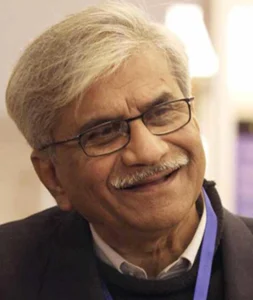
Mohan Agashe was born on 23 July 1947 in Bhor, in present-day Maharashtra. He is a psychiatrist who has acted in Marathi and Hindi theatre and film for more than fifty years, and he never gave up medicine to do it. On stage he is remembered as Nana Phadnavis in Vijay Tendulkar's Ghashiram Kotwal, a part he played from 1972 to 1992.
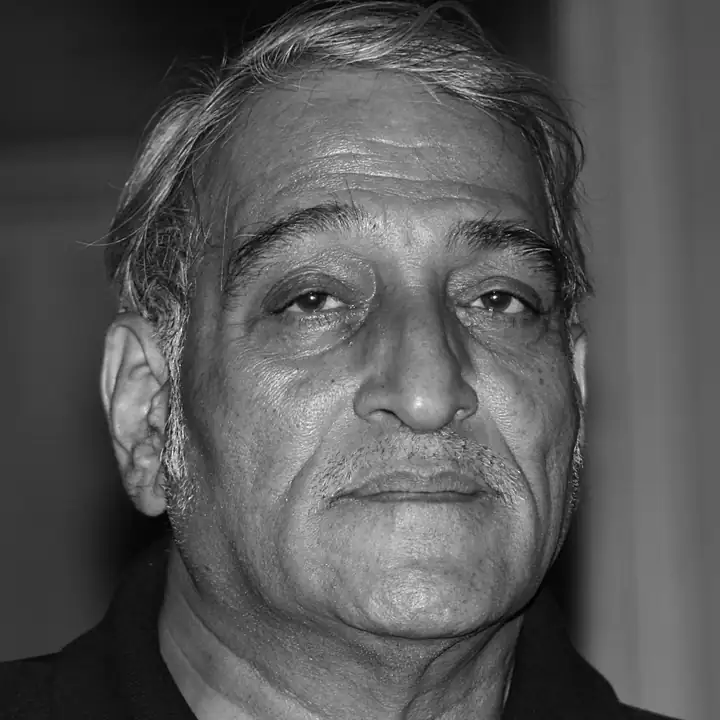
That performance brought him to cinema. Shyam Benegal saw it and cast him in Nishant (1975), Jabbar Patel made him the tribal drummer Nagya in Jait Re Jait (1977), and Satyajit Ray chose him to play the village priest in Sadgati (1981). Late in his career he acted in and produced films by Sumitra Bhave and Sunil Sukthankar about mental illness.
He received the Padma Shri in 1990 and the Sangeet Natak Akademi Award for acting in Marathi theatre in 1996. Germany gave him the Goethe Medal in 2004.
Life and Early Work
Agashe grew up in Pune in a family of modest means, where acting was one of the few pastimes the household could afford. He turned out to be good at it. As a boy he performed with Sai Paranjpye's children's theatre group, and in his tenth-standard year the director Purushottam Vaze cast him as the sick boy in Tagore's Dakghar.
His marks pointed him towards medicine, and he took his MBBS and then an MD in psychiatry at B. J. Medical College in Pune. There he met Jabbar Patel and Satish Alekar and followed Patel into the Progressive Dramatic Association. Psychiatry was the one branch of medicine he truly loved, he later said, because it was about people. Theatre, he told Outlook in 2024, "became as serious an activity for me as my medical studies."
He kept both careers going. From 1981 to 1991 he was professor of psychiatry at B. J. Medical College and Sassoon Hospital. In 1991 he set up the Maharashtra Institute of Mental Health in Pune and led it until 2005. After the Latur earthquake of 1993 he headed a five-year study of the survivors' trauma for the Indian Council of Medical Research. From April 1997 to April 2002 he was also Director General of the Film and Television Institute of India.
On Stage and Screen
Ghashiram Kotwal opened on 16 December 1972 at Bharat Natya Mandir in Pune, directed by Jabbar Patel. In Tendulkar's Pune of the Peshwas, Nana Phadnavis makes an outsider named Ghashiram the city's police chief and uses him against its Brahmins. The portrait of Nana gave offence and the play was banned for a time. When the Progressive Dramatic Association withdrew it, the younger members broke away, formed the Theatre Academy and put it back on.
It ran for twenty years. The company took it to Western Europe in 1980, and in all it was invited to more than twenty international festivals and went to twelve of them, with Agashe travelling as actor-manager.
Patel also gave him his first film, Samna (1974), in which he played Maruti Kamble, the missing man at the centre of the story. Benegal came next, and in a 2021 interview with Scroll, Agashe recalled arriving with his press cuttings and being told he did not need them, because he would play one of the brothers in Nishant. A part in Benegal's Manthan (1976) followed.
In 1976 the Yukt Film Cooperative, a group of mostly Film and Television Institute graduates, filmed Ghashiram Kotwal on a budget of Rs 1,50,000, with K. Hariharan, Mani Kaul, Saeed Akhtar Mirza and Kamal Swaroop sharing the direction. Agashe played Nana again, opposite Om Puri in his first film role. Then came Jait Re Jait, Patel's Sinhasan and Govind Nihalani's first feature, Aakrosh (1980).
He had just come back from a tour of Ghashiram Kotwal with a spine problem when a typed letter from Ray arrived, offering him Sadgati. He accepted at once. The film was shot near a village in the Raipur area, and during the shoot he shared a hotel room with Om Puri.
Hindi cinema gave him smaller parts over the next three decades. He was Hari Singh in Goutam Ghose's Paar (1984) and Kanti Napkin in Mira Nair's Mississippi Masala (1991). As the gangster Kooka Singh in Trimurti (1995) he was nominated for the Filmfare Award for Best Villain, and he played the defence minister in Rang De Basanti (2006).
On a visit to Germany in the mid-1980s he met Volker Ludwig of the Grips Theater, a children's company in Berlin. Agashe brought its approach home, producing plays with Grips and running workshops across India.
His last important partnership was with Bhave and Sukthankar. He played a psychiatrist in their Devrai (2004), a film about schizophrenia, then acted in and produced Astu (2013). He also produced Kaasav (2017), in which he plays Dattabhau, a man who works to protect olive ridley turtles. It won the Golden Lotus for Best Feature Film at the 64th National Film Awards, and Agashe collected it for the producers.
The Art of Mohan Agashe
Signature Roles
Ghashiram Kotwal (1976). Agashe had played Nana Phadnavis on stage for four years when the film was made. Nana is the Diwan of Pune, a man who rules through others: he takes Ghashiram into his service, hands him the city and sets him to spy on its Brahmins. Its final shot runs for more than ten minutes.
Nishant (1975). Prasad is one of the younger brothers of the Jagirdar, played by Amrish Puri. With his brother Anjaiya, played by Anant Nag, he takes the schoolmaster's wife Sushila from her home by force. At the end the villagers rise and kill the brothers. It was Agashe's first Hindi film, and it competed for the Palme d'Or at Cannes in 1976.
Jait Re Jait (1977). Nagya is a drummer of the Thakar tribe who grows up wanting to see the queen bee. When bees attack him in the forest he stops drumming, and he sets out with his wife Chindi, played by Smita Patil, to destroy the hives. She dies, and he beats the drum in a frenzy. Hridaynath Mangeshkar's songs became popular in Maharashtra, though the film failed at the box office.
Sadgati (1981). Pandit Ghasiram is the Brahmin to whom Dukhi, a Dalit labourer played by Om Puri, comes to fix the date of his daughter's wedding. Ghasiram sets him to chop wood in the sun. Dukhi collapses and dies, and the priest has the body dragged away with a rope so that he need not touch it. Agashe has said that in Ray's film "it is the culture that is the villain, not the humans."
Astu (2013). Dr Chakrapani Shastri, called Appa, is a retired Sanskrit scholar with Alzheimer's disease. On a drive with his daughter Ira he follows an elephant through the city and ends up at the mahout's home, where Channamma looks after him. When a co-producer pulled out, Agashe put his own savings into finishing the film. It premiered in Stuttgart in 2013 but reached most cinemas only in 2016, and it won him the Filmfare Critics Award for Best Actor (Marathi).
Craft
The doctor's eye. "To me, both professions are one and the same as both essentially deal with human emotions," he told the Mumbai Theatre Guide, adding that psychiatry had taught him about acting and medicine had shaped how he read a play.
Teaching by pleasure. He describes his theatre and his late films in the same terms. "I smuggle in education in the garb of issue-based entertainment," he said in 2021. Grips, he once said, was "like a surgery of education under the anaesthesia of entertainment."
One part, twenty years. "Ghashiram was like a school for me," he told Outlook. Two decades as Nana, twelve foreign festivals among them, trained him. It also typecast him, and he has said so plainly.
Selected Filmography
Samna (1974)
As Maruti Kamble. Jabbar Patel's first feature was also Agashe's first film, with Nilu Phule and Shriram Lagoo in the leads.
Nishant (1975)
As Prasad. Shyam Benegal's film won the National Film Award for Best Feature Film in Hindi.
Ghashiram Kotwal (1976)
As Nana Phadnavis. The Yukt Film Cooperative's film was shown at the Berlin Film Festival in 1978 and again in its Forum section in 2014.
Jait Re Jait (1977)
As Nagya. Jabbar Patel's musical, from a book by G. N. Dandekar, won the National Film Award for Best Feature Film in Marathi.
Aakrosh (1980)
As Bhonsle. In Govind Nihalani's first film, written by Vijay Tendulkar, he is chairman of the zilla parishad.
Sadgati (1981)
As Pandit Ghasiram. Satyajit Ray made the 52-minute film from a Premchand story for Doordarshan.
Devrai (2004)
As the psychiatrist. He treats Atul Kulkarni's Shesh in a film made to explain schizophrenia.
Astu (2013)
As Dr Chakrapani Shastri. Two National Film Awards went to the film, for Bhave's dialogue and Amruta Subhash's supporting role.
Legacy
Agashe taught psychiatry and ran both a state institute and the national film school, and he went on acting through all of it. His films with Bhave and Sukthankar brought the two careers together. "There is no health without mental health," he told Scroll in 2021, while promoting Dithee, Bhave's last film.
His Nana Phadnavis belongs to the history of modern Marathi theatre. Later honours came from that world too: the Thespo Lifetime Achievement Award in 2017 and the Vishnudas Bhave Puraskar in 2018.
In films he was rarely the lead. Ray made him a priest and Nihalani the head of a district council, two more men with power over others.