EK HOTA VIDUSHAK (Once There Was A Clown)
Jabbar Patel
India. 1992. 168 min
Cast : Laxmikant Berde, Varsha Usgaonkar, Madhu Kambikar, Nilu Phule, Mohan Agashe
Introduction
There is a particular cruelty in the figure of the clown, for the laughter he provokes is purchased at the expense of the man who wears the mask. Jabbar Patel's Ek Hota Vidushak (Once There Was A Clown, 1992) takes this ancient paradox of the comic performer and grounds it in the dust and torchlight of the Maharashtrian tamasha, the folk theatre of song, satire and lavani that has long served as the popular conscience of the Deccan countryside. The film follows Aburao, a songadya or comic foil, from his beginnings as the illegitimate son of a tamasha dancer to his elevation as a film star and, finally, a politician, charting at every stage the slow corrosion of a gift by the appetites it awakens. It is at once an elegy for a vanishing performance tradition and a moral fable about the seductions of fame, and it remains one of the very few Indian films to take the inner life of the folk artiste as its central subject rather than its decorative backdrop.
The film merits sustained attention on several counts. It represents the return to screenwriting, after a silence of thirty-nine years, of Purushottam Laxman Deshpande, the most beloved humorist and man of letters in modern Marathi culture, whose script invests the material with a literary density rare in popular cinema. It offered Laxmikant Berde, an actor then almost wholly defined by broad farce, the role of his career, and in doing so quietly argued that the comedian and the tragedian are kin rather than opposites. And it stands as a mature work by a director who, having already reshaped Marathi theatre with Ghashiram Kotwal and Marathi cinema with Sinhasan and Umbartha, here turned his political intelligence inward, towards the question of what is lost when an art rooted in community is consumed by the machinery of celebrity. To watch Ek Hota Vidushak is to encounter a film acutely aware that the clown's smile and the clown's grief are, in the end, the same expression seen from different sides.
Cast
- Laxmikant Berde - Aburao
- Varsha Usgaonkar - Menaka
- Madhu Kambikar - Aburao's mother
- Himani Padhye - Jaai
- Nilu Phule - Nana
- Mohan Agashe - Himmatrao Inamdar
- Dilip Prabhavalkar - Gunwant
- Tushar Dalvi - Ravi
Crew
- Direction - Jabbar Patel
- Story - Jabbar Patel
- Screenplay - P.L. Deshpande
- Cinematography - Harish Joshi
- Editing - Vishwas - Anil
- Music - Anand Modak
- Production - NFDC

Background and Production
Ek Hota Vidushak was produced by the National Film Development Corporation of India under producers Ravi Gupta and Ravi Malik, the public body that across the 1970s and 1980s underwrote much of the country's most ambitious art cinema. The project grew from a short story written by Jabbar Patel himself, but its decisive creative act was the engagement of P. L. Deshpande, universally known as Pu La, to compose the screenplay and dialogues. Deshpande had not written for the cinema since Gulacha Ganapati in 1953, a film in which he had also starred; his return after nearly four decades was, in the Marathi cultural imagination, an event in itself. His participation lent the film an authority that exceeded its modest commercial ambitions, for Deshpande's command of Marathi idiom, his affection for the small dignities of ordinary lives, and his unsentimental feeling for the world of performers were precisely the qualities the subject demanded. The collaboration between Patel's structural intelligence and Deshpande's verbal richness gave the film a texture closer to literature than to the prevailing popular melodrama.
The production assembled an unusually accomplished body of collaborators drawn substantially from the Maharashtrian theatre and parallel-cinema milieu that Patel had helped to define. Cinematography was entrusted to Harish Joshi and the editing to the partnership credited as Vishwas-Anil, while the score was composed by Anand Modak, a musician deeply versed in folk forms, working with lyrics by the poet N. D. Mahanor, whose earlier verses for Patel's Jait Re Jait had already demonstrated his gift for rural Marathi song. Because the film is steeped in tamasha, music was not an ornament but a structural principle: the soundtrack runs to some twenty-two compositions, predominantly built on the lavani, and was given voice by playback singers of the first rank, including Asha Bhosle, Ravindra Sathe and Devaki Pandit. The choreography, by Laxmibai Kolhapurkar, sought to translate the bodily vocabulary of stage tamasha into cinematic terms. The film's running time of some one hundred and sixty-eight minutes reflects this commitment to the form's expansiveness, allowing the performance sequences to breathe rather than reducing them to montage.
Story
The film opens on a note of mordant irony. Aburao, by now a celebrated film star, performs the shraddha rites for his late mother in his home village of Begadewadi, but because his shaven head would break the continuity of a film still in production, he conducts the ceremony in a wig, while the media record the spectacle of his grief. From this image of mourning staged for the cameras the narrative folds back into memory. We learn that Aburao is the illegitimate son of Manjula, a tamasha dancer who left her troupe to become the mistress of the politician-landlord Himmatrao Inamdar; on Inamdar's sudden death, mother and son return to the precarious life of the travelling troupe, now under Manjula's sister Kausalya. There the boy is captivated by the old clown Nana, whose ability to convulse an audience with laughter becomes his vocation. Grown to manhood, Aburao perfects mimicry, song and a line in political satire that makes him the most beloved songadya of his region, until a chance encounter draws him towards the film industry and the actress Menaka, and a single intended film becomes the doorway through which he abandons his troupe and his pregnant companion Subhadra.

What gives the narrative its tragic structure is the steady substitution of performance for life. Aburao's marriage to Menaka collapses when he understands that she loved the clown in him rather than the man, prizing the laughter that distracted her from her own unhappiness; the artist is wanted only for his function. The motif crystallises in the figure of Jaai, his daughter by the dead Subhadra, a child who has never once smiled and who asks of her father not the public's jokes but the private, ordinary fairy tale that any father might tell. Drawn at last into electoral politics by his old schoolfellow Gunawant, now Chief Minister, Aburao begins to betray the very principles his satire once defended, until a heart attack, brought on by drugs administered to keep him performing at a rally, forces a reckoning. Catching sight of Jaai in the crowd, he abandons his political oration to tell her the simple tale she has always wanted, and her first laughter coincides with his discovery of what love and art were always for. Beneath its surface as a show-business saga, the film is a sustained meditation on authenticity and commodification, on the difference between the laughter a performer gives a community and the laughter extracted from him by industry and power.
The film is equally a study of the tamasha itself as a threatened cultural form. By rooting Aburao's gift in a living folk tradition with its own ethics, hierarchies and tutelary figures, embodied above all in Nana, the mentor who repeatedly recalls the protagonist to his obligations, Patel and Deshpande frame the lure of cinema and politics as a fall from a community of artists into a marketplace of images. The clown of the title is thus both an individual and an emblem: the vidushak of classical and folk Indian theatre, the licensed truth-teller whose foolery permits him to speak what others cannot, here drained of his function as he is absorbed by the very powers he once mocked. The recurring contrast between the warmth of the torch-lit tamasha stage and the cold artifice of film sets and political platforms carries the film's central argument without recourse to explicit statement, so that its social critique is felt as loss rather than delivered as thesis.

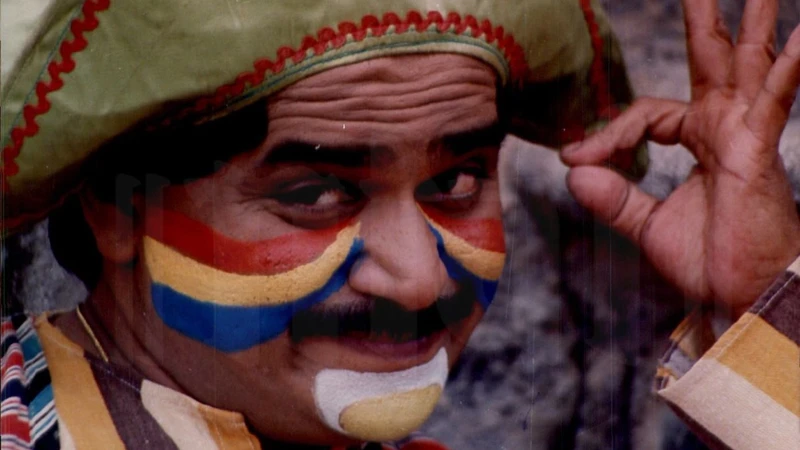
Laxmikant Berde, the Songadya of Ek Hota Vidushak, and Varsha Usgaonkar, Menaka, with Jabbar Patel
Direction and Craftsmanship
Patel's direction is distinguished by its confidence in the long performance sequence and its refusal to condescend to the folk form it depicts. The tamasha scenes are staged not as quaint interludes but as the film's living centre, their energy and rhythm permitted to unfold at length so that the spectator understands, viscerally, what Aburao surrenders when he leaves the troupe. Harish Joshi's cinematography draws a consistent contrast between the textured, warm-toned intimacy of the village stage, lit as if by lamp and torch, and the harder, more clinical light of the studio and the political dais, lending the film's moral geography a visual correlative. The flashback architecture, moving from the staged grief of the opening to the long retrospective of Aburao's rise, is handled with clarity, the editing by Vishwas-Anil allowing the parallel between past idealism and present compromise to accumulate force. Throughout, the camera attends closely to the face, the clown's instrument, registering the widening gap between the public mask and the private man.
The film's craftsmanship is inseparable from its music and movement, and here the contributions of Anand Modak, N. D. Mahanor and the choreographer Laxmibai Kolhapurkar are decisive. The lavani-based songs function as narrative and character rather than spectacle, and the choreography's success in carrying the bodily idiom of stage tamasha onto the screen was formally recognised at the national level. Yet it is the central performance that anchors the whole. Laxmikant Berde, an actor whose enormous popularity rested on broad comedy, here reveals a tragic register few had suspected, modulating from the irresistible vitality of the young songadya to the hollowed weariness of the compromised celebrity without ever forfeiting the character's essential sweetness. He is supported by a formidable ensemble: Nilu Phule lends the mentor Nana a grave moral weight, Madhu Kambikar gives Manjula a wounded dignity, Mohan Agashe and Dilip Prabhavalkar embody the worlds of feudal and electoral power, and Varsha Usgaonkar makes of Menaka a figure whose glamour conceals a real desolation. The acting throughout is calibrated to the film's larger purpose, in which the question of who is performing, and for whom, is never permitted to rest.
The Cinema of Jabbar Patel
Ek Hota Vidushak belongs to one of the most distinguished directorial careers in Marathi cinema. Jabbar Patel, born in Pandharpur in 1942, trained and practised as a paediatrician before devoting himself wholly to the stage and screen, and his sensibility was forged in the experimental theatre of Pune. His 1973 production of Vijay Tendulkar's Ghashiram Kotwal, mounted with the Theatre Academy he founded alongside Mohan Agashe and Satish Alekar, is regarded as a landmark of modern Indian theatre, fusing folk performance idioms with a sharply political dramaturgy. That theatrical inheritance, with its readiness to draw on popular forms in the service of social critique, runs directly into Ek Hota Vidushak, whose embrace of the tamasha is the work of a director who had long understood folk performance as a serious artistic and political instrument rather than a source of local colour.
Patel's cinema has been preoccupied, almost without exception, with the workings of power and conscience. His debut Samna (1974) and the montage-driven Sinhasan (1979) anatomised Maharashtrian politics with unusual candour; Jait Re Jait (1977) rendered the life of a forgotten tribal community through an extraordinary tapestry of song; and Umbartha (1982), with Smita Patil as the superintendent of a women's reform home, brought a feminist seriousness to the popular screen. Seen against this body of work, Ek Hota Vidushak emerges as a characteristic Patel film turned inward: the political subject is no longer the legislature or the institution but the individual artist, and the corrupting force is the alliance of the culture industry with electoral power. The film looks forward, too, to his later turn to the biographical mode in the monumental Dr. Babasaheb Ambedkar (2000), sharing with it a concern for the fate of integrity under public pressure. Recipient of the Padma Shri in 1982 and of numerous national honours, Patel occupies a position in Marathi cinema comparable to that of the major regional auteurs of the parallel movement, and Ek Hota Vidushak is among the most personal expressions of his enduring themes.
Reception and Legacy
The film was received as a significant achievement and gathered a substantial body of honours. At the 40th National Film Awards, for films of 1992, it was named Best Feature Film in Marathi, the citation praising its humane portrait of a simple tamasha clown drawn into the glittering world of show business and exploited by politicians. It also won the National Film Award for Best Choreography for Laxmibai Kolhapurkar, who in receiving it became the first choreographer, and the first woman, to be so honoured, the citation noting the successful adaptation of a popular folk theatre form to the screen. At the Maharashtra State Film Awards of 1993 the film was adjudged Best Marathi Film and took a further clutch of prizes, including Best Screenplay for P. L. Deshpande, Best Lyrics for N. D. Mahanor, Best Male Playback Singer for Ravindra Sathe, and a script award for Jabbar Patel. The film was additionally selected for the Indian Panorama at the International Film Festival of India in 1993, confirming its standing within the national art-cinema canon.
The most enduring strand of the film's legacy concerns Laxmikant Berde. An actor adored across Marathi and Hindi cinema for his comic energy, Berde was widely felt to have given here the performance of his life, demonstrating a dramatic range that his subsequent commercial roles only rarely allowed him to revisit; in retrospective assessments of his career his Aburao is frequently cited as the proof of what the industry's typecasting otherwise withheld. More broadly, the film has come to occupy an honoured place within the small lineage of Marathi works devoted to the tamasha and its artists, mentioned in the same breath as V. Shantaram's Pinjara (1972) before it and Ravi Jadhav's Natarang (2010) after it, films that together preserve on screen a performance culture under threat. As both a record of that tradition and a critique of the forces that erode it, Ek Hota Vidushak has retained the regard of cinephiles and historians of Indian cinema, even as its relative scarcity on contemporary platforms has kept it from the wider rediscovery it deserves.
For its humane portrait of simple tamash clown sucked in by the glittering world of show business and exploited by politicians. (Citation)

Commentary
What lingers, after the awards and the historical placement have been accounted for, is the film's clear-eyed sorrow about the cost of being loved for one's gift. Ek Hota Vidushak refuses the consolations available to it. It does not redeem Aburao through worldly triumph, nor does it allow his fame to stand as compensation for what he has betrayed; instead it locates redemption in the smallest possible gesture, a father telling his child a simple story with nothing to sell and no audience to win. That the clown's final, genuine performance should empty the political rally of its crowd is the film's quietest and sharpest irony: authenticity, it suggests, is precisely what the marketplace of images and votes cannot use. In an Indian context where the traffic between cinematic celebrity and political power has only intensified in the decades since, the film's central insight has acquired, if anything, a sharper contemporary edge.
There is, finally, a fitting symmetry in the film's making that deepens its meaning. A work about the dignity of a folk performer was written by the culture's most cherished humorist, returning to the screen after a generation's silence, and was carried by an actor whom the public had confined to laughter, here permitted at last to grieve. The film thus enacts, in its own production, the very reconciliation of the comic and the tragic that its narrative pursues. If it has not attained the international visibility of the canonical works of Indian parallel cinema, this owes more to questions of language, circulation and access than to any deficiency of ambition or achievement. Ek Hota Vidushak endures as a humane and unsparing fable about art and its betrayals, and as a reminder that the figure who makes a community laugh is also, very often, the one who has been given least cause to do so himself.
Awards & Recognition
- Maharashtra State Film Awards (1992)
- Best Marathi Film - NFDC
- Best Screenplay - P.L. Deshpande
- Best Lyrics - N.D. Manohar
- Best Choreography - Laxmibai Kolhapurkar
- Best Singer (male) - Ravindra Sathe
- Best Script - Jabbar Patel
- 40th National Film Awards (1992)
- Best Feature Film in Marathi - NFDC
- Best Choreography - Laxmibai Kolhapurkar