Films with Farooq Shaikh on Art House Cinema


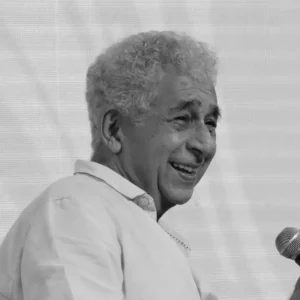
Farooq Shaikh was born on 25 March 1948 in Amroli, a village near Vadodara in Gujarat, and died on 28 December 2013 in Dubai. He came to film from college plays and political theatre in Bombay, and his first part, the younger son in M. S. Sathyu's Garm Hava (1973), paid him 750 rupees. Over the next ten years he worked for Satyajit Ray, Muzaffar Ali, Sai Paranjpye and Sagar Sarhadi, nearly always as a young man of modest means.

He made nine films with Deepti Naval, beginning with Chashme Buddoor (1981), and played opposite Shabana Azmi on stage for more than twenty years in Tumhari Amrita. Television made him a familiar face as a quiz host and later as an interviewer. His one National Film Award came late, for Lahore.
Life and Early Work
He was the eldest of five children of Mustafa Shaikh, a Bombay lawyer, and his wife Farida. Farooq went to St Mary's School and then to St Xavier's College, where he acted in college theatre and met his future wife, Roopa. They married after nine years and had two daughters, Shaista and Sanaa.
Law came next. He followed his father to Siddharth College of Law, but in a 2002 interview he said that cases seemed to be settled at police stations rather than in court, and that he could not accept it. Theatre pulled harder. He acted with the Indian People's Theatre Association (IPTA) and worked with the director Sagar Sarhadi, who would later cast him in Bazaar.
Bombay knew his voice first. He was a quiz master on radio and compered the Binny Double or Quits quiz on Vividh Bharati in the 1970s, and he anchored Yuvadarshan and Young World on Bombay Doordarshan.
On Stage and Screen
Sathyu approached him in 1973, in his final year of law school. Garm Hava follows a Muslim family of shoe makers in Agra after Partition, and most of its cast came from IPTA troupes in Delhi, Bombay and Agra. Shaikh became Sikandar Mirza, the younger son of Balraj Sahni's Salim. Sathyu could not afford recording equipment, so the film was shot silent in Agra and every voice was dubbed later. By Shaikh's own account, the fee reached him in instalments over several years.
Satyajit Ray cast him next, in Shatranj Ke Khilari (1977). Shaikh said later that Ray reached him while he was on holiday in Canada and agreed to wait a month for his return. Muzaffar Ali's first feature, Gaman (1978), gave him a lead. Noorie (1979), a romance produced by Yash Chopra, brought a flood of offers, and he said he turned down about forty of them because most were remakes of Noorie.
In 1981 came two very different parts. In Paranjpye's Chashme Buddoor he was Siddharth Parashar, a shy Delhi University student courting Deepti Naval's Neha. In Ali's Umrao Jaan he was Nawab Sultan, the young nobleman who loves Rekha's courtesan and then marries another woman to please his family. Sarhadi cast him in Bazaar (1982), and he paired with Naval again in Saath Saath (1982). For Paranjpye's Katha he played against type, as Bashu Bhatt, a smooth-talking rogue who arrives in a Bombay chawl as a house guest and charms everyone in it.
The pairing with Naval ran all the way to Listen... Amaya (2013). He also played opposite Azmi on film in Sarhadi's Lorie, Kalpana Lajmi's Ek Pal and Ali's Anjuman (1986). In the late 1980s he moved into television, with the title role in Shrikant, from Sarat Chandra Chattopadhyay's novel, on Doordarshan. Later he was the minister Surya Prakash Singh in Ji Mantriji (2001), an Indian version of Yes Minister on Star Plus.
Tumhari Amrita opened at Prithvi Theatre in Bombay on 27 February 1992. Javed Siddiqui wrote it from A. R. Gurney's Love Letters, and Feroz Abbas Khan directed. It is told through letters between Amrita Nigam and Zulfikar Haider over 35 years, with Shaikh as Zulfi, and it toured India, Europe, the Middle East, the United States and Pakistan. A sequel, Aapki Soniya, opened at Prithvi in 2004 with Sonali Bendre.
He played the kickboxing coach S. K. Rao in Lahore, released in March 2010, and won the National Film Award for it. He was a neurosurgeon mourning his only son in Club 60 (2013) and Ranbir Kapoor's father in Yeh Jawaani Hai Deewani (2013). Club 60 was his last release in his lifetime. He died of a heart attack in Dubai, where he was on holiday with his family.
The Art of Farooq Shaikh
Signature Roles
Garm Hava (1973). Sikandar Mirza is a student in Agra whose family comes apart after Partition: his uncle leaves for Pakistan, the family loses its house and his sister takes her own life. When his father at last decides to leave too, Sikandar argues that they should stay and fight for a better country. In the final scene his friends call to him from a march against unemployment. His father tells him to go, and then joins the march himself.
Gaman (1978). Ghulam Hasan leaves his wife Khairun, played by Smita Patil, and his ailing mother in Kotwara in Uttar Pradesh. His friend Lallulal, played by Jalal Agha, finds him work cleaning taxis in Bombay, and Ghulam learns to drive one. He needs about 500 rupees to go home and never saves it. The film ends with him still driving through the city.
Chashme Buddoor (1981). Siddharth Parashar is a studious student who wants to be an economist. His flatmates Omi and Jomo, played by Rakesh Bedi and Ravi Baswani, both chase their new neighbour Neha and fail, yet she falls for the one who barely speaks to women. Paranjpye shot the film in Delhi in October and November 1980. Shaikh did not smoke, so she cut his shots just as he raised a cigarette to his lips.
Umrao Jaan (1981). Nawab Sultan falls in love with Umrao, a Lucknow courtesan and poet played by Rekha, but tells her he must marry someone else to please his family. Years later Umrao finds that his wife is Ram Dai, the girl who was kidnapped with her in childhood. Shaikh plays the nawab as a gentle man who will not defy his elders.
Bazaar (1982). Sarju is a young man in Hyderabad who loves Shabnam, played by Supriya Pathak, and works to earn enough to marry her. Her poor parents give her instead to Shakir Khan, a middle-aged man who works in the Gulf. Sarju begs Shakir Khan to call off the wedding and is beaten for it. On the wedding night Shabnam poisons herself.
Craft
Ordinary men. Shaikh's best parts are students, a taxi driver, a jilted lover and a nawab without the nerve to defy his family, and he played them without heroics. The comedy of Chashme Buddoor rests on Siddharth's shyness, as when he is left alone at the door because his flatmates have hidden from a saleswoman.
Choosing less. He said he never accepted more than two films at a time and had never been commercially viable. "It requires insanity to make insane money," he said in the same 2002 interview. Refusing the Noorie remakes cost him money and left him free for directors such as Paranjpye and Sarhadi.
The voice. Radio trained his voice before the cameras did. He was a host on Vividh Bharati and Doordarshan before he was a film actor, and he went back to it on Zee TV, interviewing film stars in Jeena Isi Ka Naam Hai. In Tumhari Amrita the whole evening rests on two voices reading letters aloud.
Selected Filmography
Garm Hava (1973)
As Sikandar Mirza. Kaifi Azmi and Shama Zaidi wrote it from an unpublished story by Ismat Chughtai, and it competed for the Palme d'Or at Cannes.
Gaman (1978)
As Ghulam Hasan. Muzaffar Ali's first feature won Jaidev the National Film Award for Best Music Direction.
Chashme Buddoor (1981)
As Siddharth Parashar. Sai Paranjpye built it from her own Doordarshan teleplay, Dhuan Dhuan.
Umrao Jaan (1981)
As Nawab Sultan. Rekha won the National Film Award for Best Actress, and Khayyam composed the songs.
Bazaar (1982)
As Sarju. Sagar Sarhadi's film about the sale of young brides in Hyderabad to rich men from the Gulf also starred Smita Patil and Naseeruddin Shah.
Lahore (2010)
As S. K. Rao. Sanjay Puran Singh Chauhan won the Indira Gandhi Award for Best Debut Film of a Director for it.
Club 60 (2013)
As Dr Tariq Shaikh. A neurosurgeon and his wife, played by Sarika, try to rebuild their lives after their only son dies.
Legacy
Shaikh never became a top box-office star, and he said so himself. What he left is a run of parts for Sathyu, Ray, Ali, Paranjpye and Sarhadi between 1973 and 1983. Garm Hava was restored and re-released across 70 screens in eight Indian cities on 14 November 2014, less than a year after his death.
Some of his generosity came out only after his death. ThePrint reported that he had paid for the schooling of the two sons of a Taj hotel worker killed in the 26/11 attacks in Mumbai. He had read about the family in The Indian Express, and he insisted that his name be kept out of it. In 2019 he became the first artist to receive the Bimal Roy Lifetime Achievement Award after his death.
Deepti Naval worked with him again in Listen... Amaya, 26 years after their previous film together, and she recalled that he was still pulling her leg. He is buried near his mother's grave in Andheri West, Mumbai.