
Films with Utpal Dutt on Art House Cinema


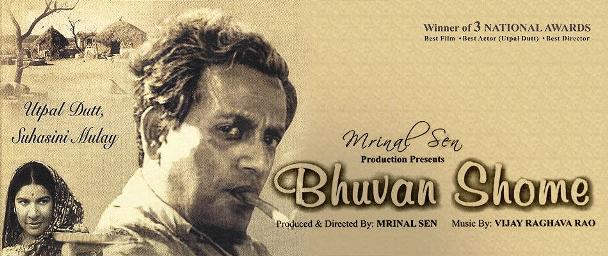
Utpal Dutt was born on 29 March 1929 in Barisal, in what is now Bangladesh. He died on 19 August 1993 in Calcutta, aged 64. He was first a man of the theatre, who wrote 22 full-length plays and directed more than 60 productions. In 1965 he spent several months in jail because the West Bengal government feared one of his plays.

On screen he worked in Bengali and Hindi for more than four decades. He won the National Film Award for Best Actor as the railway officer in Mrinal Sen's Bhuvan Shome (1969). Satyajit Ray gave him parts in Jana Aranya, Joi Baba Felunath, Hirak Rajar Deshe and finally Agantuk (1991). In Hindi he played Bhavani Shankar in Hrishikesh Mukherjee's Gol Maal (1979), one of three roles that won him the Filmfare award for Best Comedian.
Life and Early Work
His father was Girijaranjan Dutta. The boy went to St. Edmund's School in Barisal and later passed his matriculation from St. Xavier's Collegiate School in Calcutta in 1945. Four years later he took an honours degree in English literature at St. Xavier's College.
English plays came first. In 1947, while still a student, he founded a group called The Shakespeareans and opened with Richard III, playing the king himself. Geoffrey and Laura Kendal, whose Shakespeareana company toured India performing Shakespeare, saw the production and hired him. He spent two year-long tours with them across India and Pakistan, in 1947 to 1949 and 1953 to 1954. His Othello was praised.
The Kendals left India in 1949. He then renamed his group the Little Theatre Group, and over the next three years it staged Ibsen, Shaw, Tagore, Gorky and Konstantin Simonov in English. In 1948 he had also formed a Brecht Society in Calcutta, with Satyajit Ray as its president. He joined the Bengal unit of the Indian People's Theatre Association in 1950 and left it a year later.
In time the Little Theatre Group turned to Bengali, and in 1959 it took the lease of the Minerva Theatre in north Calcutta and opened with Angar, a play about coal miners. He also taught English at South Point School, and in 1960 he married the actress Shobha Sen. Their daughter, Bishnupriya Dutt, became a professor of theatre studies at Jawaharlal Nehru University.
On Stage and Screen
Film came to him through Othello, when the director Modhu Bose saw him in the part and cast him as the poet Michael Madhusudan Dutt in Michael Madhusudan (1950). It was his first screen role, and a lead.
The theatre still came first. Kallol, his play about the 1946 mutiny in the Royal Indian Navy, opened at the Minerva in 1965 and drew large crowds. The Congress government in West Bengal had him detained without trial in Presidency Jail that year, and he wrote Louha Manab while he was inside. He was released while busy shooting the title role in James Ivory's The Guru (1969).
Ivory had already used him in Shakespeare Wallah (1965), a story built on the Kendal family's touring company, and Dutt played the Maharaja who keeps the actors in comfort while he can. In 1969 he led the cast of K. A. Abbas's Saat Hindustani, the film in which Amitabh Bachchan made his debut.
The same year Mrinal Sen made Bhuvan Shome. Dutt played the title role of a widowed senior officer of the Indian Railways who goes on a duck-shooting holiday in Gujarat. Suhasini Mulay made her debut as Gauri, the village girl who guides him, while Bachchan spoke the narration. The film won Dutt the National Film Award for Best Actor.
After Bhuvan Shome he moved freely between Calcutta and Bombay. In Bengal he worked with Sen again on Ek Adhuri Kahani (1972) and Chorus (1974), and Ray gave him Bishuda, a cheerful fixer, in Jana Aranya (1976). After the Minerva lease ended, his company carried on as the People's Little Theatre. He also wrote and acted in jatra, the open-air folk theatre of rural Bengal.
In Bombay, Hrishikesh Mukherjee found the comedian in him. Guddi (1971) was the start, and Gol Maal (1979), Naram Garam (1981) and Rang Birangi (1983) followed, and each one won him the Filmfare award for Best Comedian. He also played villains opposite Bachchan, in The Great Gambler (1979) and again in Inquilaab (1984).
He directed films of his own, among them Megh (1961), Jhar (1979), Baisakhi Megh (1981) and Inquilab Ke Baad (1984). The Sangeet Natak Akademi gave him its fellowship in 1990 for his work in theatre. His last major roles were Manomohan Mitra in Ray's Agantuk and a part in Goutam Ghose's Padma Nadir Majhi (1993). He died of a heart attack at his home in Tollygunge, soon after returning from dialysis at S.S.K.M. Hospital.
The Art of Utpal Dutt
Signature Roles
Bhuvan Shome (1969). As Bhuvan Shome, he begins as the terror of the railway clerks, a man the ticket checkers discuss in whispers. Out in rural Gujarat he becomes a clumsy hunter who cannot shoot a bird. Dutt lets the officer's pomposity drain away in small stages, so the final reprieve he grants an erring railwayman feels earned. The performance won him the National Film Award.
Joi Baba Felunath (1979). Maganlal Meghraj, the Marwari businessman who crosses Feluda in Benares, is Ray's quietest villain. Dutt played him in Bengali bent by a non-Bengali accent, so that "refuse" came out as "refuz". He never raises his voice. When Feluda refuses his bribe, Maganlal answers with a knife-throwing show, and the timid writer Jatayu is made to stand as the target.
Gol Maal (1979). Bhavani Shankar, owner of Urmila Traders, hates modern clothes and sport and distrusts any man without a moustache. Dutt speaks stiff, formal Hindi and plays the man completely straight, so that his earnestness becomes the joke. Each lie Amol Palekar's clerk tells him lands harder because Dutt believes every word.
Hirak Rajar Deshe (1980). The King of Hirak hoards diamonds while his subjects starve. His critics are sent to a machine called the Jantarmantar to be washed of their opinions. Dutt played the tyrant as a vain and petty man whose ministers agree with everything he says.
Agantuk (1991). Manomohan Mitra writes to his niece after 35 years abroad and arrives at her Calcutta home, where her husband suspects he has come for an inheritance. Dutt plays the anthropologist as a teasing guest who answers suspicion with stories about the people he has lived among. He won the Bengal Film Journalists' Association award for Best Actor for the part.
Craft
The Kendal schooling. He learnt his trade on the Kendals' tours, playing Shakespeare in towns across India and Pakistan. He had played Richard III and Othello before he was twenty-five. In Ajoy Kar's Saptapadi (1961) it was Dutt's voice that spoke Othello's lines for Uttam Kumar in the college play.
Playing it straight. His comedy came from rigid men who never suspect they are funny. Bhavani Shankar and Inspector Dhurandhar Bhatawdekar of Rang Birangi both hold firm opinions about how other people should live. Dutt gave each of them total conviction and never once winked at the audience.
Theatre of argument. He wrote and staged political plays all his life, from Kallol to Laal Durgo (1990), and he wrote essays on Brecht and Stanislavsky. That habit of argument carries into Manomohan in Agantuk. When a lawyer friend of the family questions him, he answers each charge with an account of the lives he has studied.
Selected Filmography
Michael Madhusudan (1950)
As Michael Madhusudan Dutt. Modhu Bose cast him after seeing his Othello, and the role of the Bengali poet was his first on screen.
Shakespeare Wallah (1965)
As the Maharaja. James Ivory's film follows a touring English company in India, modelled on the Kendals he had once toured with.
Saat Hindustani (1969)
As Jogender Nath. K. A. Abbas's film about seven volunteers in the movement to free Goa was Amitabh Bachchan's first.
The Guru (1969)
As Ustad Zafar Khan. He played a sitar master who reluctantly takes on a young English pop star, played by Michael York.
Guddi (1971)
As Professor S. Gupta. He helps show a schoolgirl obsessed with Dharmendra the real working life behind the films.
Jana Aranya (1976)
As Bishuda. In Ray's Calcutta, he is the cheerful older man who talks the jobless Somnath into becoming a middleman.
Rang Birangi (1983)
As Dhurandhar Bhatawdekar. A police inspector who despises Hindi cinema, the role brought him his third Filmfare award for Best Comedian.
Legacy
India Post put him on a stamp in 2013. It was part of a series for the centenary of Indian cinema, and it shows him twice: in one image he wears a khaki shirt, and in the other a white kurta, spectacles and a thick moustache.
His plays have outlived him. In 2005 Kallol was revived as Gangabokshe Kallol, staged beside the Hooghly in Kolkata during a festival named after him. Rituparno Ghosh based The Last Lear (2007), with Amitabh Bachchan as an old Shakespearean actor, on his play Aajker Shahjahan. It won the National Film Award for Best Feature Film in English.
On screen he left two audiences who barely overlap. Bengali viewers remember Maganlal and the King of Hirak, while Hindi viewers quote Bhavani Shankar. Both are watching the same actor, trained on Shakespeare in the Kendals' company.


