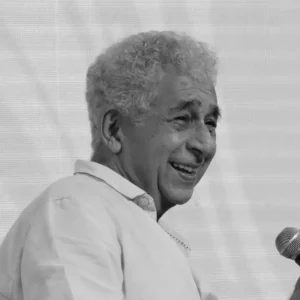
Om Puri was born in Ambala, then in East Punjab and now in Haryana, in 1950. He died on 6 January 2017 at his home in Mumbai. He trained at the National School of Drama in Delhi and at the Film and Television Institute of India in Pune, and his first lead was the title role in the Marathi film Ghashiram Kotwal (1976).

In the early 1980s he played the poor and the powerless for Govind Nihalani, Shyam Benegal and Satyajit Ray. He won the National Film Award for Best Actor twice. The films were Benegal's Arohan (1982) and Nihalani's Ardh Satya (1983), and the second also won him the Best Actor prize at Karlovy Vary. He worked mostly in Hindi, but also in Punjabi, Malayalam and English, and from the 1990s he was a regular in British films.
He received the Padma Shri in 1990. An honorary OBE followed in 2004.
Life and Early Work
Nobody wrote down the day he was born. His mother remembered only that it was two days after Dussehra. An uncle who enrolled him in school entered 9 March 1950, and years later, in Bombay, Puri looked up the calendar for 1950 and settled on 18 October as his birthday.
The family was Punjabi and Hindu. His father, Tek Chand Puri, had served in the army and then worked for the railways, and when he was jailed over the alleged theft of cement, the family lost its home. His elder brother, Ved Prakash, worked as a railway porter. Om worked at a tea stall, took odd jobs and picked coal off the railway tracks to help at home.
He studied at Khalsa College in Patiala, where the college records him in 1965, and he cycled more than 30 km a day to get there. Theatre started there. At a youth festival in early 1967, the director Harpal Tiwana saw him act and took him into his company, Punjab Kala Manch. With Tiwana and his wife Neena he played in The Father, Chamkaur Di Garhi and other plays, and his voice made him known in Patiala before he left.
In 1970 he auditioned for the National School of Drama. Naseeruddin Shah auditioned the same day and remembered his voice in a Punjabi piece as "steel wrapped in silk". Both got in, and Puri slept in a cramped room at Old Delhi railway station, where a friend's uncle worked. Shah recalls a quiet student who went over his scripts after rehearsals and was playing leads by the end of the three-year course. When Shah went on to the acting course at FTII in Pune, Puri followed him.
On Stage and Screen
His first screen part was in a children's film, Chor Chor Chhup Ja (1975). Next came Ghashiram Kotwal, made by the Yukt Film Cooperative, a collective of sixteen people, most of them FTII graduates. K. Hariharan, Mani Kaul, Saeed Akhtar Mirza and Kamal Swaroop directed it together from Vijay Tendulkar's play. Puri later said he had been paid "peanuts" for it.
In Bombay he kept to the stage. He started a theatre group, Majma, with Shah as a member. When Shah, Benjamin Gilani and Tom Alter opened Waiting for Godot at the new Prithvi Theatre on 29 July 1979, they did it under the Majma banner.
Film work came slowly at first, with a small part in Benegal's Bhumika (1977). Then Govind Nihalani cast him in his first feature, Aakrosh (1980), as Lahanya Bhiku, a labourer jailed for his wife's murder who says almost nothing for the whole film. It won him the Filmfare award for Best Supporting Actor. In the same year he played Tulsi in the Punjabi film Chann Pardesi.
The big parts then came quickly. Ray made Sadgati (1981) for Doordarshan from a Premchand story, with Puri as Dukhi, and for Benegal he was Hari Mondal in Arohan, a Bengal sharecropper who spends years in court for his rights. After a brief part in Richard Attenborough's Gandhi (1982) came Ardh Satya in 1983, and in the same year he played Ahuja, the crooked builder, in Kundan Shah's farce Jaane Bhi Do Yaaro.
In Ketan Mehta's Mirch Masala (1987) he was Abu Mian, the old gatekeeper of a spice factory where Smita Patil's Sonbai hides from a tax collector. In Nihalani's Tamas (1988), from Bhisham Sahni's novel of the Partition riots, he was Nathu, a tanner. In Malayalam he played Raman in Lenin Rajendran's Puravrutham (1988).
Then the work went abroad. He played Hazari Pal, a farmer who brings his family to Calcutta, in Roland Joffé's City of Joy (1992). In Hanif Kureishi's My Son the Fanatic (1997) he was Parvez, a Pakistani-born taxi driver in a northern English city, and the role won him Best Actor at the Brussels International Film Festival in 1998. Ayub Khan-Din's East Is East (1999) brought him a BAFTA nomination for Best Actor in a Leading Role.
At home he played Sanatan in Gulzar's Maachis (1996). He was also funny, in Hera Pheri (2000) and Malamaal Weekly (2006). In Hollywood he was General Zia-ul-Haq in Charlie Wilson's War (2007) and Papa Kadam in The Hundred-Foot Journey (2014). His last films included the Malayalam Aadupuliyattam (2016) and his first Pakistani film, Actor in Law (2016).
The Art of Om Puri
Signature Roles
Aakrosh (1980). Lahanya Bhiku is a tribal labourer whose wife is raped by a foreman, who then frames him for her death. Puri plays him almost entirely without words. His voice is heard only in a flashback and at the end. At his father's funeral, in chains, Lahanya sees the foreman watching his young sister, kills her with an axe and screams.
Sadgati (1981). Dukhi is a Dalit grass cutter who goes to the Brahmin priest Ghasiram, played by Mohan Agashe, to fix a date for his daughter's wedding. The priest sets him to work instead. Weak and unfed, Dukhi chops wood in the sun until he dies, and the priest drags his body away with a rope.
Ardh Satya (1983). Anant Velankar is an honest sub-inspector in Bombay who can't touch the gangster Rama Shetty, played by Sadashiv Amrapurkar, or the politicians who protect him. Suspended and drinking, he beats a petty thief to death, then strangles Shetty and gives himself up. Vijay Tendulkar wrote it from a story by S. D. Panvalkar, and the title comes from a poem by Dilip Chitre.
Tamas (1988). Nathu is a tanner whom a contractor, played by Pankaj Kapur, pays to kill a pig. When a pig's carcass is thrown at a mosque, Nathu believes it is the one he killed, and he blames himself for the riots that follow. Doordarshan first showed the film as a series. Puri plays a man undone by guilt.
East Is East (1999). George Khan is a Pakistani father who co-runs a fish and chip shop in Salford in 1971 with his English wife, Ella, played by Linda Bassett. Puri plays the comedy and the menace of the man in the same scenes. The film won the BAFTA for Best British Film.
Craft
The voice. In Patiala, before films, people remembered the voice. Shah heard it at the NSD audition in 1970. Yet Puri made his name in Aakrosh with almost no lines at all.
The working body. He had carried coal and served tea as a boy, and on screen he played men who live by their hands. Dukhi in Sadgati chops wood until he drops, Hari Mondal in Arohan works another man's land, and Nathu in Tamas is a tanner.
Two kinds of cinema. Shah describes a man who drew on his own pain and anger for the serious parts and on his own mischief for the comic ones. That is how one actor could play Velankar and Ahuja in the same year.
Selected Filmography
Ghashiram Kotwal (1976)
As Ghashiram. His first lead, in a Marathi film directed by four people from Vijay Tendulkar's play.
Aakrosh (1980)
As Lahanya Bhiku. Govind Nihalani's first film won the Golden Peacock at the International Film Festival of India.
Sadgati (1981)
As Dukhi. Satyajit Ray's 52-minute television film won a Special Jury Award at the National Film Awards.
Arohan (1982)
As Hari Mondal. Shyam Benegal's film about a sharecropper's fight for his land won Puri his first National Film Award for Best Actor.
Ardh Satya (1983)
As Anant Velankar. The film won the National Film Award for Best Feature Film in Hindi, and Puri won Best Actor again.
Mirch Masala (1987)
As Abu Mian. The gatekeeper of the spice factory in Ketan Mehta's film, opposite Smita Patil and Naseeruddin Shah.
Tamas (1988)
As Nathu. Govind Nihalani's film of Bhisham Sahni's novel won the Nargis Dutt Award for Best Feature Film on National Integration.
Legacy
The Filmfare Lifetime Achievement Award came in 2009. That year his wife, the journalist Nandita Puri, published a biography of him, Unlikely Hero: The Story of Om Puri, and he was angered by what it told of his earlier relationships. His first marriage, to Seema Kapoor in 1991, had lasted only months. He married Nandita in 1993, and they had a son before separating in 2013.
He died at 66, of a heart attack, during work on a Marathi film. Between Aakrosh and Tamas, his roles gave Hindi parallel cinema its labourers, its sharecroppers and its honest policeman.
The friendship with Shah lasted from the NSD audition in 1970 to the end. On what would have been Puri's 75th birthday, Shah published a tribute that recalls that audition and the voice he heard there.